Hawkish expectations from the Federal Reserve and safe-haven demand have boosted the dollar, leading to a continued rebound against the yen and a renewed test of the 160 level.
2026-05-18 10:02:39
On Monday during Asian trading hours, the USD/JPY pair continued its upward trend, strengthening for the sixth consecutive trading day, rising to around 158.90, a new high for the period. Market expectations of the Federal Reserve maintaining high interest rates continued to intensify, coupled with rising global risk aversion, driving continued capital inflows into the US dollar.
Recently, several Federal Reserve officials have consistently released hawkish signals, emphasizing that curbing inflation remains the core policy objective and stating that further interest rate hikes are possible if price pressures persist. This stance has significantly altered the market's previous optimistic expectations for rate cuts. According to data from the CME Group's FedWatch tool, the market now expects a 48% probability of a Fed rate hike in December, compared to only about 14% a week ago. Market bets on a prolonged period of high US interest rates have become a major reason for the continued strength of the US dollar index.
Market expectations for a Federal Reserve rate hike have risen rapidly, keeping the dollar index at its highest level since April. Meanwhile, continued tensions in the Middle East have further strengthened the dollar's safe-haven appeal. With the US and Iran still unable to reach an agreement on a ceasefire and the reopening of the Strait of Hormuz, global market concerns about energy supply risks continue to escalate.
US President Trump publicly warned Iran that it must move forward with negotiations as soon as possible, or it may face new consequences. Market concerns about a further escalation of the situation in the Middle East have led to increased shipping risks in the Strait of Hormuz. The Strait of Hormuz handles approximately 20% of global seaborne crude oil transport. Current restrictions on this shipping route have already driven up international crude oil prices and further intensified global inflation concerns.
For Japan, the impact of rising energy prices is particularly pronounced. As Japan is highly dependent on energy imports, rising international oil prices will directly increase import costs and exert sustained pressure on domestic inflation. Domestically, recent producer inflation data released by Japan has exceeded market expectations, leading the market to speculate that the Bank of Japan may gradually adjust its long-term ultra-loose monetary policy.
Bank of Japan policy board member Kazuyuki Masuda stated that interest rate hikes should be implemented as soon as possible to address the long-term inflation risks caused by the war. This statement initially provided support for the yen, but its overall impact was significantly weaker than the upward momentum of the dollar. Imported inflationary pressures in Japan are rising, but the dollar's interest rate advantage continues to significantly suppress the yen's performance.
ING analysts expect Japan's first-quarter GDP to grow by about 0.3% quarter-on-quarter, roughly flat compared to the previous quarter. While the energy shock from geopolitical conflicts has a limited impact on economic growth, its impact on inflation is more pronounced. ING projects Japan's April inflation rate to be around 1.8%. Overall inflation remains manageable for now, as government subsidies continue to limit some price increases, but energy-related cost pressures persist.
From a technical perspective, the USD/JPY pair has established a clear upward trend on the daily chart. After breaking through the 157 and 158 levels, bullish momentum has further strengthened. The area around 158.50 has now become a key short-term support zone; if it continues to hold above this level, the market may further test the 160 mark. Observing the 4-hour chart, the USD/JPY pair maintains a strong upward structure in the short term. The MACD indicator continues to run above the zero line, indicating that bullish funds still dominate, while the RSI indicator is near the high zone, suggesting some overbought risk in the short term. If the dollar continues to be supported by safe-haven flows, the exchange rate may further reach new highs; however, if the Bank of Japan releases a clearer signal of an interest rate hike, it could trigger a short-term pullback.
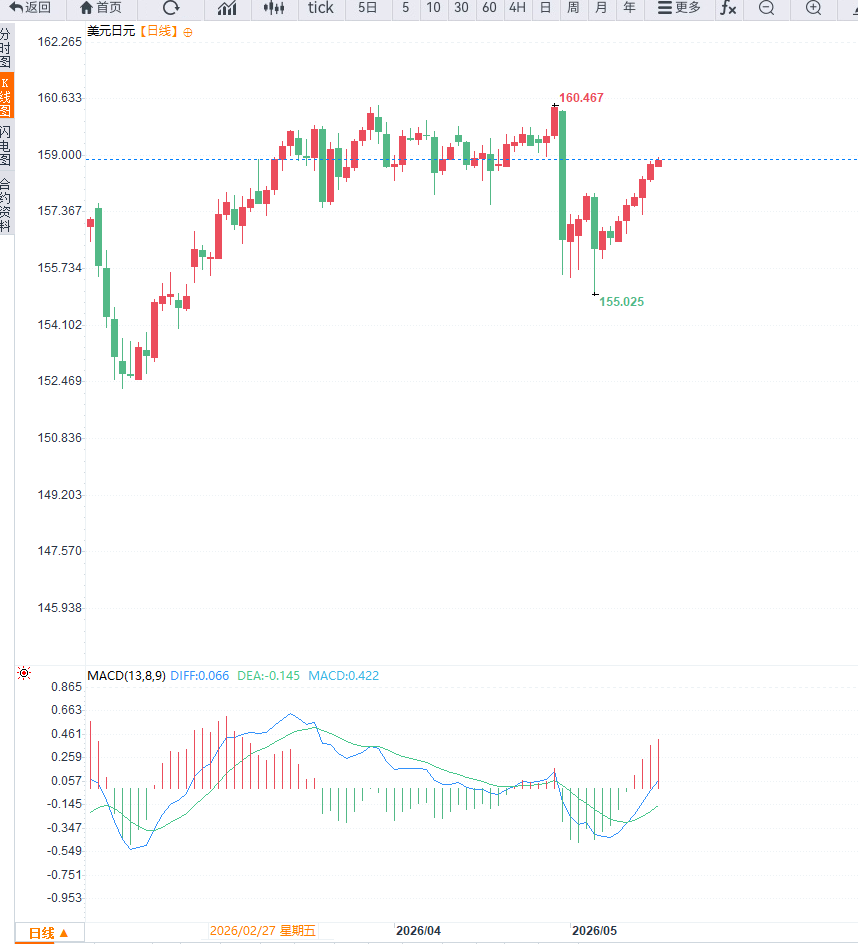
Furthermore, the market is also watching whether the Japanese government might intervene in the foreign exchange market again. Previously, when the USD/JPY exchange rate rapidly approached 160, the Japanese Ministry of Finance intervened to stabilize the exchange rate. Therefore, the 160 level has now become an important psychological and policy observation area for the market.
Editor's Summary:
The core logic behind the current rise in USD/JPY is mainly driven by expectations of high interest rates from the Federal Reserve, global safe-haven demand, and inflation concerns fueled by rising energy prices. Although domestic inflationary pressures are increasing in Japan, and the Bank of Japan has begun signaling policy adjustments, the overall interest rate differential remains significantly biased towards the US dollar. In the short term, USD/JPY is expected to maintain its strength, but as the exchange rate approaches the key 160 level, the risk of potential intervention by the Japanese government is increasing. Going forward, the market will focus on Federal Reserve policy, developments in the Middle East, and the Bank of Japan's subsequent interest rate hike path.
Recently, several Federal Reserve officials have consistently released hawkish signals, emphasizing that curbing inflation remains the core policy objective and stating that further interest rate hikes are possible if price pressures persist. This stance has significantly altered the market's previous optimistic expectations for rate cuts. According to data from the CME Group's FedWatch tool, the market now expects a 48% probability of a Fed rate hike in December, compared to only about 14% a week ago. Market bets on a prolonged period of high US interest rates have become a major reason for the continued strength of the US dollar index.
Market expectations for a Federal Reserve rate hike have risen rapidly, keeping the dollar index at its highest level since April. Meanwhile, continued tensions in the Middle East have further strengthened the dollar's safe-haven appeal. With the US and Iran still unable to reach an agreement on a ceasefire and the reopening of the Strait of Hormuz, global market concerns about energy supply risks continue to escalate.
US President Trump publicly warned Iran that it must move forward with negotiations as soon as possible, or it may face new consequences. Market concerns about a further escalation of the situation in the Middle East have led to increased shipping risks in the Strait of Hormuz. The Strait of Hormuz handles approximately 20% of global seaborne crude oil transport. Current restrictions on this shipping route have already driven up international crude oil prices and further intensified global inflation concerns.
For Japan, the impact of rising energy prices is particularly pronounced. As Japan is highly dependent on energy imports, rising international oil prices will directly increase import costs and exert sustained pressure on domestic inflation. Domestically, recent producer inflation data released by Japan has exceeded market expectations, leading the market to speculate that the Bank of Japan may gradually adjust its long-term ultra-loose monetary policy.
Bank of Japan policy board member Kazuyuki Masuda stated that interest rate hikes should be implemented as soon as possible to address the long-term inflation risks caused by the war. This statement initially provided support for the yen, but its overall impact was significantly weaker than the upward momentum of the dollar. Imported inflationary pressures in Japan are rising, but the dollar's interest rate advantage continues to significantly suppress the yen's performance.
ING analysts expect Japan's first-quarter GDP to grow by about 0.3% quarter-on-quarter, roughly flat compared to the previous quarter. While the energy shock from geopolitical conflicts has a limited impact on economic growth, its impact on inflation is more pronounced. ING projects Japan's April inflation rate to be around 1.8%. Overall inflation remains manageable for now, as government subsidies continue to limit some price increases, but energy-related cost pressures persist.
From a technical perspective, the USD/JPY pair has established a clear upward trend on the daily chart. After breaking through the 157 and 158 levels, bullish momentum has further strengthened. The area around 158.50 has now become a key short-term support zone; if it continues to hold above this level, the market may further test the 160 mark. Observing the 4-hour chart, the USD/JPY pair maintains a strong upward structure in the short term. The MACD indicator continues to run above the zero line, indicating that bullish funds still dominate, while the RSI indicator is near the high zone, suggesting some overbought risk in the short term. If the dollar continues to be supported by safe-haven flows, the exchange rate may further reach new highs; however, if the Bank of Japan releases a clearer signal of an interest rate hike, it could trigger a short-term pullback.
Furthermore, the market is also watching whether the Japanese government might intervene in the foreign exchange market again. Previously, when the USD/JPY exchange rate rapidly approached 160, the Japanese Ministry of Finance intervened to stabilize the exchange rate. Therefore, the 160 level has now become an important psychological and policy observation area for the market.
Editor's Summary:
The core logic behind the current rise in USD/JPY is mainly driven by expectations of high interest rates from the Federal Reserve, global safe-haven demand, and inflation concerns fueled by rising energy prices. Although domestic inflationary pressures are increasing in Japan, and the Bank of Japan has begun signaling policy adjustments, the overall interest rate differential remains significantly biased towards the US dollar. In the short term, USD/JPY is expected to maintain its strength, but as the exchange rate approaches the key 160 level, the risk of potential intervention by the Japanese government is increasing. Going forward, the market will focus on Federal Reserve policy, developments in the Middle East, and the Bank of Japan's subsequent interest rate hike path.
- Risk Warning and Disclaimer
- The market involves risk, and trading may not be suitable for all investors. This article is for reference only and does not constitute personal investment advice, nor does it take into account certain users’ specific investment objectives, financial situation, or other needs. Any investment decisions made based on this information are at your own risk.