Gold Trading Alert: Amid the looming threat of conflict in Iran, gold prices rebounded slightly, but the dollar's rescue efforts were insufficient to offset the simultaneous decline in oil and bond prices, leaving the market outlook uncertain.
2026-05-19 07:28:44
In May 2026, amidst continued global geopolitical turmoil, the gold market once again witnessed a tale of "hope and disappointment." Boosted by a weaker US dollar, spot gold rebounded from its lows on Monday (May 19th), closing up slightly by 0.6% at around $4566 per ounce. However, the dual pressures of rising oil prices and soaring US Treasury yields quickly limited the upside potential. The market was torn between the fragile glimmer of hope in Iranian peace talks and the risk of potential supply disruptions, resulting in highly sensitive investor sentiment. This not only reflects the complex positioning of gold as a safe-haven asset but also suggests that precious metals may face greater volatility in the short term.
On Tuesday (May 19) in early Asian trading, spot gold continued its rebound, rising as much as 0.5% to around $4,588 per ounce by 07:20.
The current gold price movement is deeply rooted in the latest developments in the Middle East conflict. US President Trump announced on Monday that he had suspended planned attacks on Iran in order to allow room for negotiations to end the US-Israel war, given Iran's new peace proposal submitted through Pakistan. This news itself carries a certain degree of conciliatory intent: Trump mentioned that the leaders of Qatar, Saudi Arabia, and the UAE had requested a halt to the action and hinted that an agreement could satisfy many parties.
However, Iran's response remained firm. Iran's Supreme Joint Military Command, the "Seal of the Prophet," explicitly warned the United States and its allies against making a "strategic mistake," and declared that its armed forces were ready to "pull the trigger." Iran's peace proposals focused on ending the war, reopening the Strait of Hormuz, lifting some sanctions, and unfreezing assets, but core differences—especially those related to its nuclear program—were postponed to later negotiations. Pakistani sources revealed that both sides were "constantly changing their objectives," making progress extremely difficult. The region currently maintains a fragile ceasefire, and drone attacks continue to occur, making it difficult to completely dispel market concerns about supply disruptions.
This uncertainty of "talking and fighting" has directly increased tension in the energy market and indirectly affected the safe-haven appeal of gold.
In stark contrast to gold's modest performance, the oil market saw a strong surge. On Monday, Brent crude rose approximately 2.6% to $112.10 per barrel, while U.S. WTI crude rose 3.1% to $108.66 per barrel, both hitting multi-week highs. Since the U.S.-Israel conflict with Iran began in late February, Brent crude has risen by approximately 55%, while spot gold has fallen by approximately 13.8% over the same period.
The core driving factor lies in the potential risk of a blockade of the Strait of Hormuz, a crucial oil shipping route. Global oil supply relies on this strait for approximately 20%, and the head of the International Energy Agency (IEA) has warned that commercial crude oil inventories are rapidly declining, and strategic reserves are "not inexhaustible." While there are reports that the US may grant waivers to Iranian oil sanctions during negotiations, the market is clearly more concerned about a prolonged disruption scenario. Capital Economics bluntly states that a continued blockade of the strait would lead to a downward revision of global GDP, a mild recession in Europe, and increased pressure on major central banks to raise interest rates, significantly increasing inflation risks.
This global inflation expectation directly diminishes the relative appeal of gold as a non-interest-bearing asset.
The dollar index fell 0.3% to 98.98 on Monday, providing a direct boost to gold. A weaker dollar makes dollar-denominated gold more attractive to holders of other currencies. Jim Wyckoff, market analyst at the U.S. Gold Exchange, explicitly stated that the dollar index's drop to its intraday low was a positive factor for the gold market.
However, this positive factor was offset by a sharp reaction in the bond market. Global government bonds continued their decline, with the benchmark 10-year US Treasury yield rising to its highest level since February 2025, and the 30-year yield also hitting a more than one-year high. In a high-yield environment, investors are more inclined to turn to bonds or other interest-bearing assets that provide real returns, leading to a relative increase in the cost of holding gold. Wyckoff also warned that the continued rise in bond yields could put further downward pressure on precious metal prices in the short term.
Expectations for Federal Reserve policy have also shifted accordingly. The market currently anticipates a 47%-51% probability of a Fed rate hike before December, with new Chairman Warsh facing the dual challenge of balancing inflation and growth. This expectation of monetary policy tightening further limits the upside potential for gold.
Due to the aforementioned multiple factors, some financial institutions have begun to adjust their optimistic forecasts for gold. JPMorgan Chase became one of the first major banks to lower its average gold price forecast for 2026, significantly reducing its expectation from $5,708 per ounce to $5,243. This adjustment reflects market concerns about weakening short-term safe-haven demand and changes in the long-term interest rate environment.
Spot gold closed at $4,566 an ounce on Monday, up 0.7%, after hitting a low of $4,480 in early trading, its lowest level since March 30, but the overall rebound was limited. U.S. June gold futures fell slightly by 0.1%. Low trading volume and volatility in the futures market exacerbated price uncertainty.
In summary, the gold market is currently in a delicate balance between expectations of geopolitical easing and macroeconomic tightening pressures. Trump's suspension of attacks has opened a window for negotiations. If the Strait of Hormuz reopens smoothly, oil prices fall, and inflation concerns ease, gold may face some risk of a pullback. However, as long as the situation in the Middle East remains fragile and uncertain, any breakdown in negotiations or signs of new conflict could reignite safe-haven buying.
For investors, the focus should be on the Federal Reserve's actual actions, oil price trends, and changes in the US Treasury yield curve. In an environment of high interest rates and high oil prices, gold's traditional safe-haven appeal has been partially weakened, but its value as a long-term inflation hedge has not disappeared. For the remainder of 2026, gold may exhibit a range-bound trading pattern, awaiting clearer macroeconomic or geopolitical signals to break the current equilibrium.
Overall, while the recent gold price rebound has been supported by the US dollar, it has struggled to escape the dual pressures of oil prices and the bond market. Every step forward in the Iran negotiations could become a key variable influencing gold's price movement. In this era of uncertainty, gold's "shining" moment may require more patience to await.
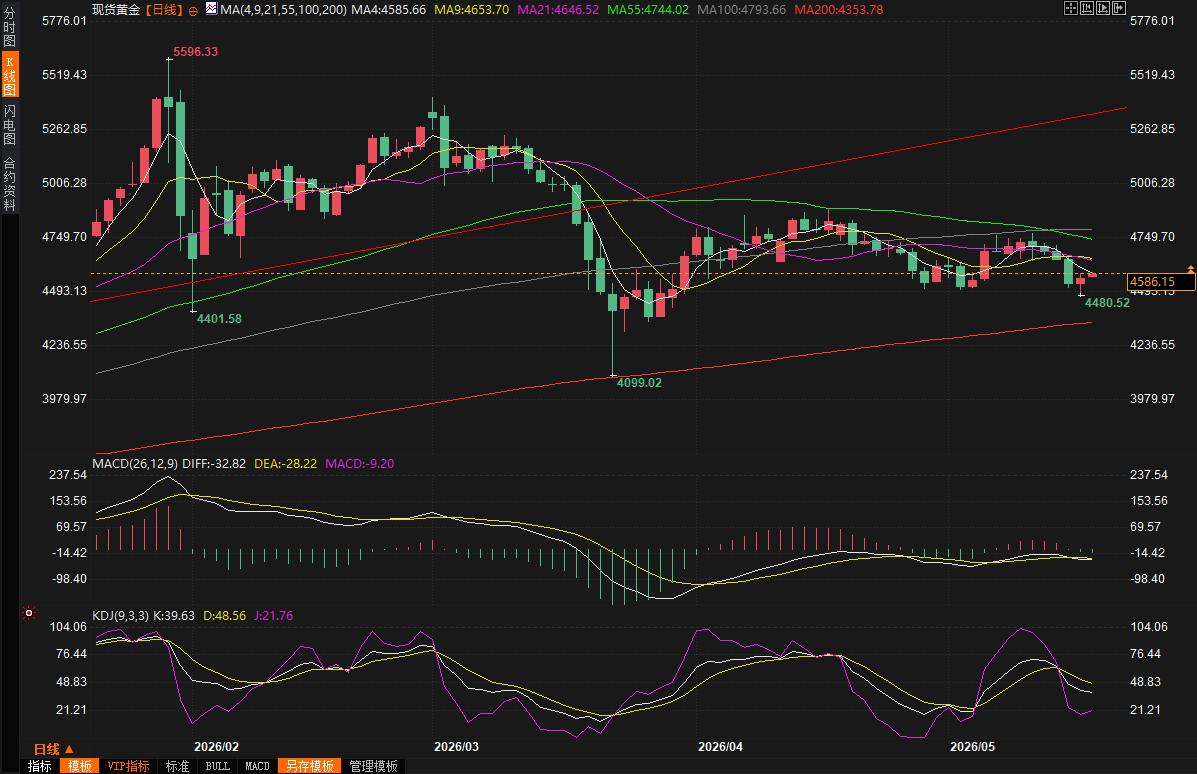
(Spot gold daily chart, source: FX678)
At 07:26 Beijing time, spot gold was trading at $4,586.56 per ounce.
On Tuesday (May 19) in early Asian trading, spot gold continued its rebound, rising as much as 0.5% to around $4,588 per ounce by 07:20.
Trump suspends attacks, Iran takes a hard line
The current gold price movement is deeply rooted in the latest developments in the Middle East conflict. US President Trump announced on Monday that he had suspended planned attacks on Iran in order to allow room for negotiations to end the US-Israel war, given Iran's new peace proposal submitted through Pakistan. This news itself carries a certain degree of conciliatory intent: Trump mentioned that the leaders of Qatar, Saudi Arabia, and the UAE had requested a halt to the action and hinted that an agreement could satisfy many parties.
However, Iran's response remained firm. Iran's Supreme Joint Military Command, the "Seal of the Prophet," explicitly warned the United States and its allies against making a "strategic mistake," and declared that its armed forces were ready to "pull the trigger." Iran's peace proposals focused on ending the war, reopening the Strait of Hormuz, lifting some sanctions, and unfreezing assets, but core differences—especially those related to its nuclear program—were postponed to later negotiations. Pakistani sources revealed that both sides were "constantly changing their objectives," making progress extremely difficult. The region currently maintains a fragile ceasefire, and drone attacks continue to occur, making it difficult to completely dispel market concerns about supply disruptions.
This uncertainty of "talking and fighting" has directly increased tension in the energy market and indirectly affected the safe-haven appeal of gold.
Oil prices rebounded strongly, while inflation concerns loomed globally.
In stark contrast to gold's modest performance, the oil market saw a strong surge. On Monday, Brent crude rose approximately 2.6% to $112.10 per barrel, while U.S. WTI crude rose 3.1% to $108.66 per barrel, both hitting multi-week highs. Since the U.S.-Israel conflict with Iran began in late February, Brent crude has risen by approximately 55%, while spot gold has fallen by approximately 13.8% over the same period.
The core driving factor lies in the potential risk of a blockade of the Strait of Hormuz, a crucial oil shipping route. Global oil supply relies on this strait for approximately 20%, and the head of the International Energy Agency (IEA) has warned that commercial crude oil inventories are rapidly declining, and strategic reserves are "not inexhaustible." While there are reports that the US may grant waivers to Iranian oil sanctions during negotiations, the market is clearly more concerned about a prolonged disruption scenario. Capital Economics bluntly states that a continued blockade of the strait would lead to a downward revision of global GDP, a mild recession in Europe, and increased pressure on major central banks to raise interest rates, significantly increasing inflation risks.
This global inflation expectation directly diminishes the relative appeal of gold as a non-interest-bearing asset.
A weaker dollar provided support, but bond yields were the biggest drag.
The dollar index fell 0.3% to 98.98 on Monday, providing a direct boost to gold. A weaker dollar makes dollar-denominated gold more attractive to holders of other currencies. Jim Wyckoff, market analyst at the U.S. Gold Exchange, explicitly stated that the dollar index's drop to its intraday low was a positive factor for the gold market.
However, this positive factor was offset by a sharp reaction in the bond market. Global government bonds continued their decline, with the benchmark 10-year US Treasury yield rising to its highest level since February 2025, and the 30-year yield also hitting a more than one-year high. In a high-yield environment, investors are more inclined to turn to bonds or other interest-bearing assets that provide real returns, leading to a relative increase in the cost of holding gold. Wyckoff also warned that the continued rise in bond yields could put further downward pressure on precious metal prices in the short term.
Expectations for Federal Reserve policy have also shifted accordingly. The market currently anticipates a 47%-51% probability of a Fed rate hike before December, with new Chairman Warsh facing the dual challenge of balancing inflation and growth. This expectation of monetary policy tightening further limits the upside potential for gold.
Banks lowered their forecasts, and investor demand showed signs of weakness.
Due to the aforementioned multiple factors, some financial institutions have begun to adjust their optimistic forecasts for gold. JPMorgan Chase became one of the first major banks to lower its average gold price forecast for 2026, significantly reducing its expectation from $5,708 per ounce to $5,243. This adjustment reflects market concerns about weakening short-term safe-haven demand and changes in the long-term interest rate environment.
Spot gold closed at $4,566 an ounce on Monday, up 0.7%, after hitting a low of $4,480 in early trading, its lowest level since March 30, but the overall rebound was limited. U.S. June gold futures fell slightly by 0.1%. Low trading volume and volatility in the futures market exacerbated price uncertainty.
Outlook: Short-term pressure, but structural opportunities remain in the medium to long term.
In summary, the gold market is currently in a delicate balance between expectations of geopolitical easing and macroeconomic tightening pressures. Trump's suspension of attacks has opened a window for negotiations. If the Strait of Hormuz reopens smoothly, oil prices fall, and inflation concerns ease, gold may face some risk of a pullback. However, as long as the situation in the Middle East remains fragile and uncertain, any breakdown in negotiations or signs of new conflict could reignite safe-haven buying.
For investors, the focus should be on the Federal Reserve's actual actions, oil price trends, and changes in the US Treasury yield curve. In an environment of high interest rates and high oil prices, gold's traditional safe-haven appeal has been partially weakened, but its value as a long-term inflation hedge has not disappeared. For the remainder of 2026, gold may exhibit a range-bound trading pattern, awaiting clearer macroeconomic or geopolitical signals to break the current equilibrium.
Overall, while the recent gold price rebound has been supported by the US dollar, it has struggled to escape the dual pressures of oil prices and the bond market. Every step forward in the Iran negotiations could become a key variable influencing gold's price movement. In this era of uncertainty, gold's "shining" moment may require more patience to await.
(Spot gold daily chart, source: FX678)
At 07:26 Beijing time, spot gold was trading at $4,586.56 per ounce.
- Risk Warning and Disclaimer
- The market involves risk, and trading may not be suitable for all investors. This article is for reference only and does not constitute personal investment advice, nor does it take into account certain users’ specific investment objectives, financial situation, or other needs. Any investment decisions made based on this information are at your own risk.