Better-than-expected Japanese Q1 GDP growth boosted market sentiment, leading to a continued rebound in the USD/JPY exchange rate.
2026-05-19 09:51:48
Preliminary data released by Japan's Cabinet Office on Tuesday showed that Japan's economic growth in the first quarter of 2026 exceeded market expectations, bringing some positive sentiment to global markets recently. The data showed that Japan's GDP grew at a quarterly rate of 0.5% in the first quarter, higher than the market expectation of 0.4%, and also significantly higher than the revised 0.3% growth rate in the fourth quarter of 2025. On an annualized basis, Japan's GDP growth reached 2.1%, exceeding the market's previous forecast of 1.7%, indicating that the momentum of Japan's economic recovery is gradually improving.

The better-than-expected GDP data mainly reflects signs of recovery in domestic consumption and business investment in Japan. Analysts believe that the fact that the Japanese economy has been able to maintain expansion for two consecutive quarters after a prolonged period of low growth has provided some support for market confidence. Japan's annualized GDP growth rate reached 2.1%, marking a relatively strong performance in recent quarters.
From an economic structure perspective, the recovery in consumer demand remains a key driver of Japan's economic growth. With gradually improving wage growth and stable corporate capital expenditure, domestic economic activity in Japan has shown signs of recovery. Meanwhile, the continued recovery in tourism spending has also provided some support to the service sector. However, external demand remains uncertain, particularly the global economic slowdown and escalating trade concerns, which could still impact Japan's export performance.
Despite strong GDP data, the foreign exchange market reacted relatively modestly. Following the data release, the USD/JPY pair remained around 158.83, rising only slightly by about 0.05% for the day. This indicates that while the market acknowledges the improvement in the Japanese economy, it remains cautious about the Bank of Japan's future policy normalization path.
The current interest rate differential between the US and Japan remains near historical highs, which continues to be a significant factor suppressing the yen's performance. While improved Japanese economic data helps raise market expectations for the Bank of Japan to further exit its ultra-loose monetary policy, US interest rates are still significantly higher than Japanese rates. Therefore, the yield advantage of dollar-denominated assets continues to attract substantial international capital flows to the US market.
Meanwhile, market opinions remain divided on the Bank of Japan's (BOJ) future interest rate hike pace. Some institutions believe that Japan's continued economic recovery and improved wage growth may prompt the BOJ to further adjust its monetary policy this year. However, others argue that while core inflation remains relatively stable, the overall economy still lacks sufficiently strong domestic demand, and the BOJ may maintain a relatively cautious stance.
Recent global market conditions have also impacted the yen. Due to tensions in the Middle East and persistently high international oil prices, Japan, as an energy importer, faces increasing risks of imported inflation. International crude oil prices remaining near $100 have increased energy cost pressures on Japanese businesses and residents. Analysts point out that if energy prices continue to rise, it could further weaken the recovery in Japanese consumption and potentially drag down economic growth.
From a capital market perspective, the Japanese stock market has remained relatively stable recently. Some overseas funds continue to flow into the Japanese market, mainly due to improved corporate profitability and ongoing corporate governance reforms. However, the continued weakness of the yen also means that overseas investors face exchange rate volatility risks, therefore the market is paying close attention to future policy signals from the Bank of Japan.
From a technical perspective, the USD/JPY pair maintains a clear upward trend on the daily chart. The exchange rate continues to trade above major moving averages, indicating that the US dollar remains dominant overall. On the daily chart, the 158 level has become a significant short-term support area, while the area around 160 constitutes a key psychological resistance. If US economic data continues to be strong and the Federal Reserve maintains its high interest rate policy, USD/JPY may further test the 160 level.
In terms of technical indicators, the daily MACD remains at a high level, but the red bars are starting to narrow, indicating that the upward momentum of the US dollar has slowed down compared to before. The RSI indicator is in a relatively high area, suggesting that the market faces some technical pullback pressure in the short term. However, there are currently no clear signs of a reversal in the overall trend.
From a 4-hour chart perspective, USD/JPY is maintaining a high-level consolidation structure in the short term. The 4-hour MACD shows a slight bearish divergence, indicating that short-term bullish momentum is weakening. Short-term support is forming around 158.20, while the 159.50-160 area is a significant resistance zone. If the Bank of Japan releases a more hawkish signal, the yen may experience a temporary rebound; however, if US yields continue to rise, USD/JPY is likely to remain strong.
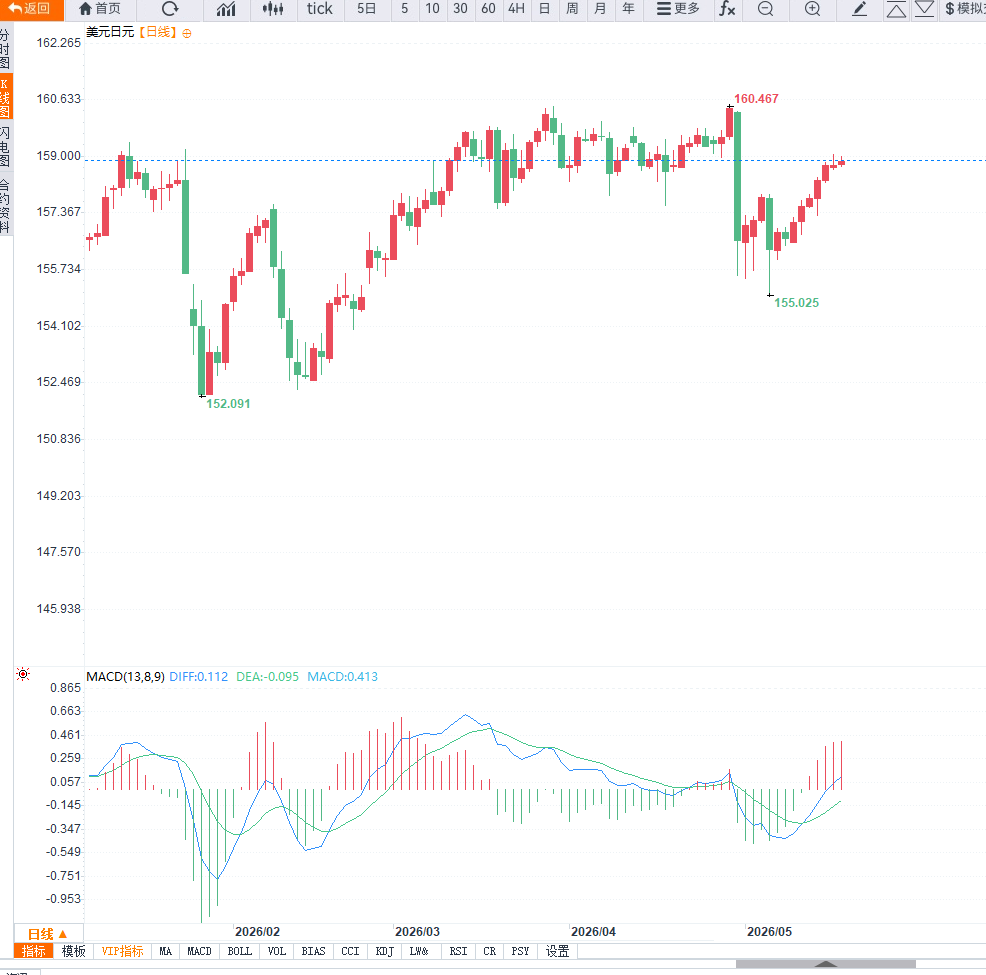
Overall, while the better-than-expected Japanese GDP data brought some positive sentiment to the market, the core logic of the foreign exchange market still revolves around the US-Japan interest rate differential. Given the US maintaining high interest rates, the yen is unlikely to escape its weak trend in the short term. However, if the Japanese economy continues to improve and prompts the Bank of Japan to further adjust its policy, the yen may gradually gain support in the future.
Editor's Summary : Japan's first-quarter GDP growth exceeded expectations, indicating that the Japanese economy is gradually emerging from its long-term low-growth predicament, which has a positive impact on market confidence. However, the yen's current exchange rate is still mainly influenced by the USD/JPY interest rate differential, with the high-interest-rate environment in the US continuing to suppress the yen's performance. In the medium to long term, if Japanese wage growth, consumption recovery, and corporate investment continue to improve, the Bank of Japan may further normalize monetary policy, which would help the yen gradually stabilize. However, in the short term, against the backdrop of global risk sentiment volatility and persistently high US yields, the USD/JPY exchange rate may continue to fluctuate at high levels. Investors should pay close attention to changes in the Bank of Japan's policy, US economic data, and global energy price trends.
The better-than-expected GDP data mainly reflects signs of recovery in domestic consumption and business investment in Japan. Analysts believe that the fact that the Japanese economy has been able to maintain expansion for two consecutive quarters after a prolonged period of low growth has provided some support for market confidence. Japan's annualized GDP growth rate reached 2.1%, marking a relatively strong performance in recent quarters.
From an economic structure perspective, the recovery in consumer demand remains a key driver of Japan's economic growth. With gradually improving wage growth and stable corporate capital expenditure, domestic economic activity in Japan has shown signs of recovery. Meanwhile, the continued recovery in tourism spending has also provided some support to the service sector. However, external demand remains uncertain, particularly the global economic slowdown and escalating trade concerns, which could still impact Japan's export performance.
Despite strong GDP data, the foreign exchange market reacted relatively modestly. Following the data release, the USD/JPY pair remained around 158.83, rising only slightly by about 0.05% for the day. This indicates that while the market acknowledges the improvement in the Japanese economy, it remains cautious about the Bank of Japan's future policy normalization path.
The current interest rate differential between the US and Japan remains near historical highs, which continues to be a significant factor suppressing the yen's performance. While improved Japanese economic data helps raise market expectations for the Bank of Japan to further exit its ultra-loose monetary policy, US interest rates are still significantly higher than Japanese rates. Therefore, the yield advantage of dollar-denominated assets continues to attract substantial international capital flows to the US market.
Meanwhile, market opinions remain divided on the Bank of Japan's (BOJ) future interest rate hike pace. Some institutions believe that Japan's continued economic recovery and improved wage growth may prompt the BOJ to further adjust its monetary policy this year. However, others argue that while core inflation remains relatively stable, the overall economy still lacks sufficiently strong domestic demand, and the BOJ may maintain a relatively cautious stance.
Recent global market conditions have also impacted the yen. Due to tensions in the Middle East and persistently high international oil prices, Japan, as an energy importer, faces increasing risks of imported inflation. International crude oil prices remaining near $100 have increased energy cost pressures on Japanese businesses and residents. Analysts point out that if energy prices continue to rise, it could further weaken the recovery in Japanese consumption and potentially drag down economic growth.
From a capital market perspective, the Japanese stock market has remained relatively stable recently. Some overseas funds continue to flow into the Japanese market, mainly due to improved corporate profitability and ongoing corporate governance reforms. However, the continued weakness of the yen also means that overseas investors face exchange rate volatility risks, therefore the market is paying close attention to future policy signals from the Bank of Japan.
From a technical perspective, the USD/JPY pair maintains a clear upward trend on the daily chart. The exchange rate continues to trade above major moving averages, indicating that the US dollar remains dominant overall. On the daily chart, the 158 level has become a significant short-term support area, while the area around 160 constitutes a key psychological resistance. If US economic data continues to be strong and the Federal Reserve maintains its high interest rate policy, USD/JPY may further test the 160 level.
In terms of technical indicators, the daily MACD remains at a high level, but the red bars are starting to narrow, indicating that the upward momentum of the US dollar has slowed down compared to before. The RSI indicator is in a relatively high area, suggesting that the market faces some technical pullback pressure in the short term. However, there are currently no clear signs of a reversal in the overall trend.
From a 4-hour chart perspective, USD/JPY is maintaining a high-level consolidation structure in the short term. The 4-hour MACD shows a slight bearish divergence, indicating that short-term bullish momentum is weakening. Short-term support is forming around 158.20, while the 159.50-160 area is a significant resistance zone. If the Bank of Japan releases a more hawkish signal, the yen may experience a temporary rebound; however, if US yields continue to rise, USD/JPY is likely to remain strong.
Overall, while the better-than-expected Japanese GDP data brought some positive sentiment to the market, the core logic of the foreign exchange market still revolves around the US-Japan interest rate differential. Given the US maintaining high interest rates, the yen is unlikely to escape its weak trend in the short term. However, if the Japanese economy continues to improve and prompts the Bank of Japan to further adjust its policy, the yen may gradually gain support in the future.
Editor's Summary : Japan's first-quarter GDP growth exceeded expectations, indicating that the Japanese economy is gradually emerging from its long-term low-growth predicament, which has a positive impact on market confidence. However, the yen's current exchange rate is still mainly influenced by the USD/JPY interest rate differential, with the high-interest-rate environment in the US continuing to suppress the yen's performance. In the medium to long term, if Japanese wage growth, consumption recovery, and corporate investment continue to improve, the Bank of Japan may further normalize monetary policy, which would help the yen gradually stabilize. However, in the short term, against the backdrop of global risk sentiment volatility and persistently high US yields, the USD/JPY exchange rate may continue to fluctuate at high levels. Investors should pay close attention to changes in the Bank of Japan's policy, US economic data, and global energy price trends.
- Risk Warning and Disclaimer
- The market involves risk, and trading may not be suitable for all investors. This article is for reference only and does not constitute personal investment advice, nor does it take into account certain users’ specific investment objectives, financial situation, or other needs. Any investment decisions made based on this information are at your own risk.