Hawkish expectations from the Federal Reserve are supporting the US dollar index; can its strength above the 99 level be sustained?
2026-05-19 13:42:42
The dollar index was supported as market expectations rose for a more hawkish stance from the Federal Reserve, remaining above the 99.00 level on Tuesday (May 19).
The dollar index regained its upward momentum after a slight decline in the previous trading session, trading around 99.10 in Asian trading on Tuesday. Despite a cooling of bullish sentiment towards the dollar, it has demonstrated resilience amid renewed expectations of a re-anchoring of Federal Reserve policy.
Traders pointed out that the dollar index's stabilization above the 99.00 level is technically considered a bullish signal, and if it can hold this position, it could open up further upside potential. The market is currently focused on this week's US inflation data and speeches by Federal Reserve officials for clearer clues about the interest rate path.
Overnight, the benchmark 10-year US Treasury yield surged to 4.63%, a new high since May 2025, before falling back to 4.58%, essentially flat for the day. This sharp intraday move reflects the extreme sensitivity and growing divergence among bond market investors. Behind the rapid rise in yields lies a deep-seated concern: high energy costs could transmit to consumer price inflation, ultimately prompting the Federal Reserve to further raise interest rates.
Specifically, recent oil prices have continued to rise due to geopolitical tensions, coupled with US sanctions against Iran and Russia, creating new disruptions to the energy supply chain. The market is concerned that these cost pressures will gradually be reflected in gasoline and broader goods and services prices in the coming months, thereby pushing up overall inflation. Against this backdrop, investors are beginning to repric the Federal Reserve's policy path, with some even discussing the possibility of another interest rate hike this year. Although the new Federal Reserve Chairman, Kevin Warsh, has not yet provided clear guidance, the sharp reaction in the bond market indicates that the market has entered a tense state of "reacting first, then verifying." Rising yields mean higher financing costs, which will have a ripple effect on the US fiscal deficit, corporate bond issuance, and mortgage rates, making a soft landing for the economy more difficult.
At this sensitive time following the Federal Reserve's leadership transition, the market is closely watching its internal developments, particularly its policy stance and decision-making independence.
DRW Trading strategist Lou Bryan points out that recent market volatility stems from investors testing how new Chairman Kevin Warsh will address rising inflationary pressures. The market is currently in a "wait-and-see" phase: high energy prices, geopolitical risks, and a resilient labor market are supporting inflation, while Warsh's previous criticism of the loose monetary policies following the financial crisis has led investors to speculate that he may favor earlier and more aggressive monetary tightening. However, since Warsh has not yet elaborated on his full assessment of inflation since taking office, the market can only piece together the policy picture through the bond yield curve, interest rate futures, and comments from other Fed officials.
Brian emphasized that Wall Street wants to see Warsh prioritize the Fed's traditional mission and act independently, rather than succumbing to political pressure from the White House. Previously, Powell faced repeated pressure from the government during his tenure, and the market has always been wary of the risk of political interference. Now, with inflation yet to fall back to the 2% target, Warsh's policy stance has become a core issue. Analysts believe that if market confidence in the Fed's independence wavers, long-term inflation expectations could spiral out of control, leading to a further surge in US Treasury yields, increased dollar volatility, and even a broader tightening of financial conditions. Therefore, any recent public appearances or policy communications by Warsh could be amplified and interpreted by the market, becoming a key variable determining asset price trends in the short term.
However, the overall improvement in market sentiment somewhat dampened demand for the US dollar as a safe haven. This shift occurred after US President Donald Trump announced a postponement of the planned military strike against Iran.
According to reports, Trump canceled a planned attack scheduled for Tuesday at the urging of Gulf allies who requested more time for diplomatic negotiations. While the US government has stated it remains prepared to strike if an acceptable agreement cannot be reached, no specific deadline has been set.
The US dollar index is currently mainly supported by expectations of hawkish policies from the Federal Reserve, coupled with rising US Treasury yields, which together keep the dollar strong.
However, market probing into the policy stance of the new Federal Reserve chairman and improved risk sentiment resulting from the temporary easing of geopolitical tensions have both weakened safe-haven buying of the dollar to some extent.
In the short term, the upside potential of the US dollar may be constrained by a combination of factors, including inflation data, signals from the Federal Reserve, and the evolving situation in the Middle East.
From the daily chart, the US dollar index is currently trading around 99.10, located in an area where several key moving averages converge. Specifically, the 20-day moving average (MA20) is at 98.52, the 50-day moving average (MA50) is at 99.01, the 100-day moving average (MA100) is at 98.50, and the 200-day moving average (MA200) is at 98.54. The current price (99.10) has stabilized above all major moving averages, which constitutes a bullish signal in terms of technical structure. Of particular note is the successful breakout of the long-term moving average MA50 (99.01), a significant psychological and technical level. If this level can be maintained, the MA50 is expected to transform from a resistance level into a support level, laying the foundation for further upward movement of the index. The initial resistance is located near the psychological level of 100; a break above this area would target 100.39.
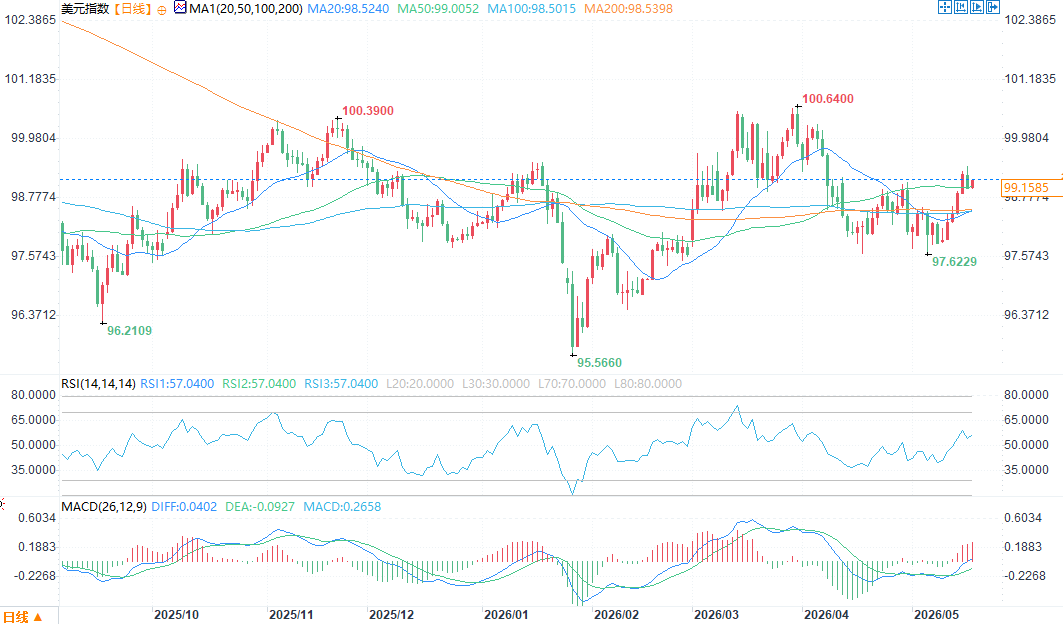
(US Dollar Index Daily Chart, Source: FX678)
At 13:42 Beijing time on May 19, the US dollar index was at 99.13.
US Dollar Index and US Treasury Yield Trends
The dollar index regained its upward momentum after a slight decline in the previous trading session, trading around 99.10 in Asian trading on Tuesday. Despite a cooling of bullish sentiment towards the dollar, it has demonstrated resilience amid renewed expectations of a re-anchoring of Federal Reserve policy.
Traders pointed out that the dollar index's stabilization above the 99.00 level is technically considered a bullish signal, and if it can hold this position, it could open up further upside potential. The market is currently focused on this week's US inflation data and speeches by Federal Reserve officials for clearer clues about the interest rate path.
Overnight, the benchmark 10-year US Treasury yield surged to 4.63%, a new high since May 2025, before falling back to 4.58%, essentially flat for the day. This sharp intraday move reflects the extreme sensitivity and growing divergence among bond market investors. Behind the rapid rise in yields lies a deep-seated concern: high energy costs could transmit to consumer price inflation, ultimately prompting the Federal Reserve to further raise interest rates.
Specifically, recent oil prices have continued to rise due to geopolitical tensions, coupled with US sanctions against Iran and Russia, creating new disruptions to the energy supply chain. The market is concerned that these cost pressures will gradually be reflected in gasoline and broader goods and services prices in the coming months, thereby pushing up overall inflation. Against this backdrop, investors are beginning to repric the Federal Reserve's policy path, with some even discussing the possibility of another interest rate hike this year. Although the new Federal Reserve Chairman, Kevin Warsh, has not yet provided clear guidance, the sharp reaction in the bond market indicates that the market has entered a tense state of "reacting first, then verifying." Rising yields mean higher financing costs, which will have a ripple effect on the US fiscal deficit, corporate bond issuance, and mortgage rates, making a soft landing for the economy more difficult.
The market is focused on the internal dynamics and independence of the Federal Reserve.
At this sensitive time following the Federal Reserve's leadership transition, the market is closely watching its internal developments, particularly its policy stance and decision-making independence.
DRW Trading strategist Lou Bryan points out that recent market volatility stems from investors testing how new Chairman Kevin Warsh will address rising inflationary pressures. The market is currently in a "wait-and-see" phase: high energy prices, geopolitical risks, and a resilient labor market are supporting inflation, while Warsh's previous criticism of the loose monetary policies following the financial crisis has led investors to speculate that he may favor earlier and more aggressive monetary tightening. However, since Warsh has not yet elaborated on his full assessment of inflation since taking office, the market can only piece together the policy picture through the bond yield curve, interest rate futures, and comments from other Fed officials.
Brian emphasized that Wall Street wants to see Warsh prioritize the Fed's traditional mission and act independently, rather than succumbing to political pressure from the White House. Previously, Powell faced repeated pressure from the government during his tenure, and the market has always been wary of the risk of political interference. Now, with inflation yet to fall back to the 2% target, Warsh's policy stance has become a core issue. Analysts believe that if market confidence in the Fed's independence wavers, long-term inflation expectations could spiral out of control, leading to a further surge in US Treasury yields, increased dollar volatility, and even a broader tightening of financial conditions. Therefore, any recent public appearances or policy communications by Warsh could be amplified and interpreted by the market, becoming a key variable determining asset price trends in the short term.
The easing of geopolitical risks has restrained the safe-haven support for the US dollar.
However, the overall improvement in market sentiment somewhat dampened demand for the US dollar as a safe haven. This shift occurred after US President Donald Trump announced a postponement of the planned military strike against Iran.
According to reports, Trump canceled a planned attack scheduled for Tuesday at the urging of Gulf allies who requested more time for diplomatic negotiations. While the US government has stated it remains prepared to strike if an acceptable agreement cannot be reached, no specific deadline has been set.
The US dollar is supported in the short term by hawkish expectations, but its upside potential is limited.
The US dollar index is currently mainly supported by expectations of hawkish policies from the Federal Reserve, coupled with rising US Treasury yields, which together keep the dollar strong.
However, market probing into the policy stance of the new Federal Reserve chairman and improved risk sentiment resulting from the temporary easing of geopolitical tensions have both weakened safe-haven buying of the dollar to some extent.
In the short term, the upside potential of the US dollar may be constrained by a combination of factors, including inflation data, signals from the Federal Reserve, and the evolving situation in the Middle East.
From the daily chart, the US dollar index is currently trading around 99.10, located in an area where several key moving averages converge. Specifically, the 20-day moving average (MA20) is at 98.52, the 50-day moving average (MA50) is at 99.01, the 100-day moving average (MA100) is at 98.50, and the 200-day moving average (MA200) is at 98.54. The current price (99.10) has stabilized above all major moving averages, which constitutes a bullish signal in terms of technical structure. Of particular note is the successful breakout of the long-term moving average MA50 (99.01), a significant psychological and technical level. If this level can be maintained, the MA50 is expected to transform from a resistance level into a support level, laying the foundation for further upward movement of the index. The initial resistance is located near the psychological level of 100; a break above this area would target 100.39.
(US Dollar Index Daily Chart, Source: FX678)
At 13:42 Beijing time on May 19, the US dollar index was at 99.13.
- Risk Warning and Disclaimer
- The market involves risk, and trading may not be suitable for all investors. This article is for reference only and does not constitute personal investment advice, nor does it take into account certain users’ specific investment objectives, financial situation, or other needs. Any investment decisions made based on this information are at your own risk.