The pound fell slightly against the dollar as the UK job market slowed and political uncertainty intensified.
2026-05-19 14:27:28
The British pound continued its weakness against the US dollar in European trading on Tuesday, trading around 1.3415. The latest UK employment data was generally weak, coupled with continued political turmoil in the UK, further fueling market concerns about the UK's economic and fiscal prospects, thus putting significant selling pressure on the pound. The latest data showed that UK wage growth in the first quarter was approximately 3.4% year-on-year, in line with market expectations, but continuing to slow compared to previous levels. The continued slowdown in wage growth indicates weakening demand in the UK labor market , which also means that domestic consumption momentum may face further slowdown risks. At the same time, the UK unemployment rate remains near 5%, and the number of unemployment benefit claims continues to rise, indicating that overall pressure on the job market has not yet eased.
The UK labor market is weak amid heightened political uncertainty. Following Prime Minister Keir Starmer's defeat in local elections, internal pressure on the government is mounting, and resignations of senior officials continue to fuel market concerns. The market believes that current UK fiscal policy may be influenced by political factors, thereby increasing the risk of future fiscal deficits and economic slowdown.
The UK government bond market has recently experienced significant volatility, driven by fiscal concerns. Yields on long-term UK government bonds touched a near 28-year high , reflecting escalating investor worries about UK debt risk and fiscal stability. While the International Monetary Fund recently raised its 2026 UK economic growth forecast to approximately 1.0%, it also warned that domestic uncertainty could drag down consumption and business investment.
Analysts at the International Monetary Fund say the current political instability in the UK could weaken business capital spending and consumer confidence, and increase downside risks to economic growth.
Regarding the US dollar, recent US inflation data remains strong, further reinforcing market expectations that the Federal Reserve will maintain its high interest rate policy. Currently, the market estimates a 35% probability of another 25 basis point rate hike by the Fed this year, and with US Treasury yields remaining high, the US dollar index continues to strengthen.
Amid rising global risk aversion, funds continue to flow into dollar assets. Market concerns that the high-interest-rate environment will continue to suppress global economic activity and reduce the attractiveness of risk assets are putting pressure on non-US currencies overall.
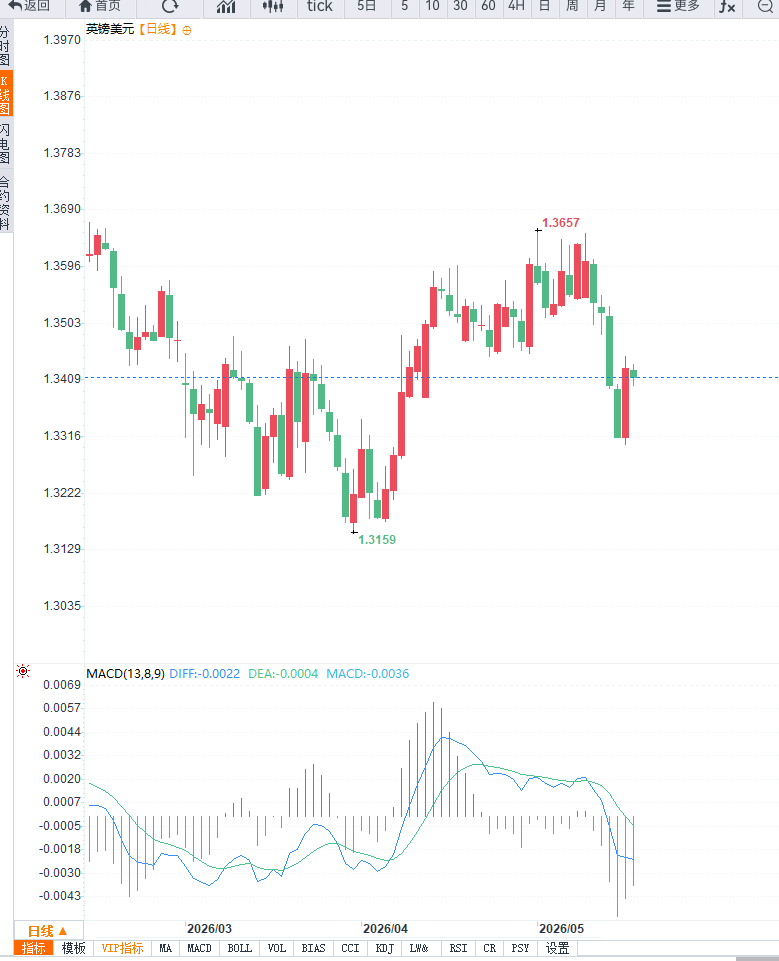
From a technical perspective, the GBP/USD pair has clearly broken below the support of the 20-day and 50-day moving averages on the daily chart, indicating a short-term bearish trend. However, the exchange rate is still temporarily above the 200-day exponential moving average, and the medium- to long-term structure has not been completely destroyed. The Relative Strength Index (RSI) is currently around 44, indicating that bearish momentum is increasing, but it has not yet entered extreme oversold territory. The MACD indicator's death cross continues to widen, suggesting that short-term selling pressure still dominates.
Current technical indicators suggest that initial support for GBP/USD is around 1.3380. A further break below this level could open up downside potential to 1.3320 or even 1.3250. Short-term resistance is around 1.3460; a successful retest of this area could alleviate current downward pressure and allow for a retest of resistance near 1.3520.
The 4-hour chart shows the exchange rate still trading within a descending channel, with short-term moving averages maintaining a bearish alignment. While the MACD bearish momentum bars have narrowed somewhat, the overall trend remains bearish. The RSI is hovering around 40, indicating continued market caution. However, as short-term technical indicators are gradually approaching oversold territory, a short-term pullback in the US dollar or improved UK economic data could lead to a potential technical rebound in the exchange rate.
Overall, the current exchange rate of the pound against the dollar is still mainly driven by three factors: political uncertainty in the UK, a cooling labor market, and a strong dollar. In the short term, market focus will continue to be on UK economic data, expectations for Federal Reserve policy, and volatility in the global bond market.
Editor's Summary : The slowdown in the UK job market is further eroding market confidence in the resilience of the UK economy, while political uncertainty amplifies concerns about fiscal risks, leading to a decline in the attractiveness of sterling assets. Meanwhile, persistently high US inflation reinforces the Federal Reserve's hawkish stance, thus continuing to support the US dollar. In the medium term, as long as US yields remain high, the pound/dollar exchange rate will continue to face significant downward pressure. However, if subsequent UK economic data improves and expectations for a Fed rate hike cool, the pound may still see a phase of recovery. Investors need to pay close attention to UK fiscal developments, changes in employment data, and adjustments in US inflation and interest rate expectations.
The UK labor market is weak amid heightened political uncertainty. Following Prime Minister Keir Starmer's defeat in local elections, internal pressure on the government is mounting, and resignations of senior officials continue to fuel market concerns. The market believes that current UK fiscal policy may be influenced by political factors, thereby increasing the risk of future fiscal deficits and economic slowdown.
The UK government bond market has recently experienced significant volatility, driven by fiscal concerns. Yields on long-term UK government bonds touched a near 28-year high , reflecting escalating investor worries about UK debt risk and fiscal stability. While the International Monetary Fund recently raised its 2026 UK economic growth forecast to approximately 1.0%, it also warned that domestic uncertainty could drag down consumption and business investment.
Analysts at the International Monetary Fund say the current political instability in the UK could weaken business capital spending and consumer confidence, and increase downside risks to economic growth.
Regarding the US dollar, recent US inflation data remains strong, further reinforcing market expectations that the Federal Reserve will maintain its high interest rate policy. Currently, the market estimates a 35% probability of another 25 basis point rate hike by the Fed this year, and with US Treasury yields remaining high, the US dollar index continues to strengthen.
Amid rising global risk aversion, funds continue to flow into dollar assets. Market concerns that the high-interest-rate environment will continue to suppress global economic activity and reduce the attractiveness of risk assets are putting pressure on non-US currencies overall.
From a technical perspective, the GBP/USD pair has clearly broken below the support of the 20-day and 50-day moving averages on the daily chart, indicating a short-term bearish trend. However, the exchange rate is still temporarily above the 200-day exponential moving average, and the medium- to long-term structure has not been completely destroyed. The Relative Strength Index (RSI) is currently around 44, indicating that bearish momentum is increasing, but it has not yet entered extreme oversold territory. The MACD indicator's death cross continues to widen, suggesting that short-term selling pressure still dominates.
Current technical indicators suggest that initial support for GBP/USD is around 1.3380. A further break below this level could open up downside potential to 1.3320 or even 1.3250. Short-term resistance is around 1.3460; a successful retest of this area could alleviate current downward pressure and allow for a retest of resistance near 1.3520.
The 4-hour chart shows the exchange rate still trading within a descending channel, with short-term moving averages maintaining a bearish alignment. While the MACD bearish momentum bars have narrowed somewhat, the overall trend remains bearish. The RSI is hovering around 40, indicating continued market caution. However, as short-term technical indicators are gradually approaching oversold territory, a short-term pullback in the US dollar or improved UK economic data could lead to a potential technical rebound in the exchange rate.
Overall, the current exchange rate of the pound against the dollar is still mainly driven by three factors: political uncertainty in the UK, a cooling labor market, and a strong dollar. In the short term, market focus will continue to be on UK economic data, expectations for Federal Reserve policy, and volatility in the global bond market.
Editor's Summary : The slowdown in the UK job market is further eroding market confidence in the resilience of the UK economy, while political uncertainty amplifies concerns about fiscal risks, leading to a decline in the attractiveness of sterling assets. Meanwhile, persistently high US inflation reinforces the Federal Reserve's hawkish stance, thus continuing to support the US dollar. In the medium term, as long as US yields remain high, the pound/dollar exchange rate will continue to face significant downward pressure. However, if subsequent UK economic data improves and expectations for a Fed rate hike cool, the pound may still see a phase of recovery. Investors need to pay close attention to UK fiscal developments, changes in employment data, and adjustments in US inflation and interest rate expectations.
- Risk Warning and Disclaimer
- The market involves risk, and trading may not be suitable for all investors. This article is for reference only and does not constitute personal investment advice, nor does it take into account certain users’ specific investment objectives, financial situation, or other needs. Any investment decisions made based on this information are at your own risk.