Escalating tensions in Iran could lead to a fragmentation of the global energy market, with the crude oil pricing system facing the risk of becoming multipolar.
2026-05-19 15:23:33
As tensions continue in the Middle East, the global energy market is undergoing increasingly pronounced structural changes. Rabobank analysts Michael Avery and Joe DeLaura recently pointed out that regardless of the final outcome of the conflict between the US and Iran, the global energy supply chain has already begun a profound adjustment, and one of the biggest potential risks for the future is the possible fragmentation of the international crude oil market.
The term "fragmentation" refers to the global crude oil market no longer following a single international pricing system, but instead forming multiple regional energy markets based on geopolitical alliances, payment currencies, security cooperation, and sanctions. International crude oil may no longer be a completely freely flowing global commodity, but will gradually evolve into a strategic geopolitical resource .
Analysts point out that the current market has long accepted the logic of "one global crude oil price," but historically, this situation has not always existed. Throughout the 20th century, the global energy market was significantly influenced by geopolitics, resulting in vastly different energy supply and settlement systems between different countries and regions.
For example, during the Cold War, there was a clear disconnect between energy transactions between Western countries and the Soviet bloc; and in recent years, some energy-exporting countries affected by sanctions have gradually established settlement mechanisms that bypass the dollar system.
Rabobank believes the global energy system may be entering a similar phase again. Especially against the backdrop of escalating tensions in the Middle East, global energy flows are already shifting. Some countries are reassessing their energy import sources, security systems, and payment channels.
The Strait of Hormuz handles approximately 20% of global seaborne crude oil transport , and any escalation of the situation there could rapidly impact the stability of the global energy supply chain. Therefore, a growing number of economies are considering establishing more regionalized and secure energy procurement systems to mitigate the risk of future supply disruptions.
Meanwhile, US financial sanctions against some energy-exporting countries are also driving changes in the global energy payment system. Market observations suggest that some countries are experimenting with using local currencies, bilateral currency swap agreements, and regional payment systems for energy transactions to reduce their dependence on the dollar system.
Market analysts say that future energy trade may be determined more by geopolitical alliances, security agreements, and monetary systems than by market prices.
While current international oil prices still primarily reference the WTI and Brent crude oil systems, regional premium differences are beginning to widen. The pace of energy price fluctuations is gradually diverging across Asia, Europe, and the Middle East, and transportation costs, insurance risks, and sanctions are also altering the global energy pricing logic.
Furthermore, the trend of "strategizing" energy is also strengthening. Some countries are beginning to link energy exports with diplomacy, security cooperation, and even the financial system, transforming energy from a traditional commodity into a geostrategic tool.
From the perspective of global capital markets, this change may mean that future oil price fluctuations will be more complex. Traditional pricing models based on supply and demand may gradually incorporate more political, security, and financial variables.
For economies heavily reliant on energy imports, this shift signifies a significant increase in the importance of future energy security. Some countries may accelerate the establishment of strategic oil reserves, diversify their energy import sources, and even strengthen investment in new energy sources to mitigate the risks of external energy shocks.
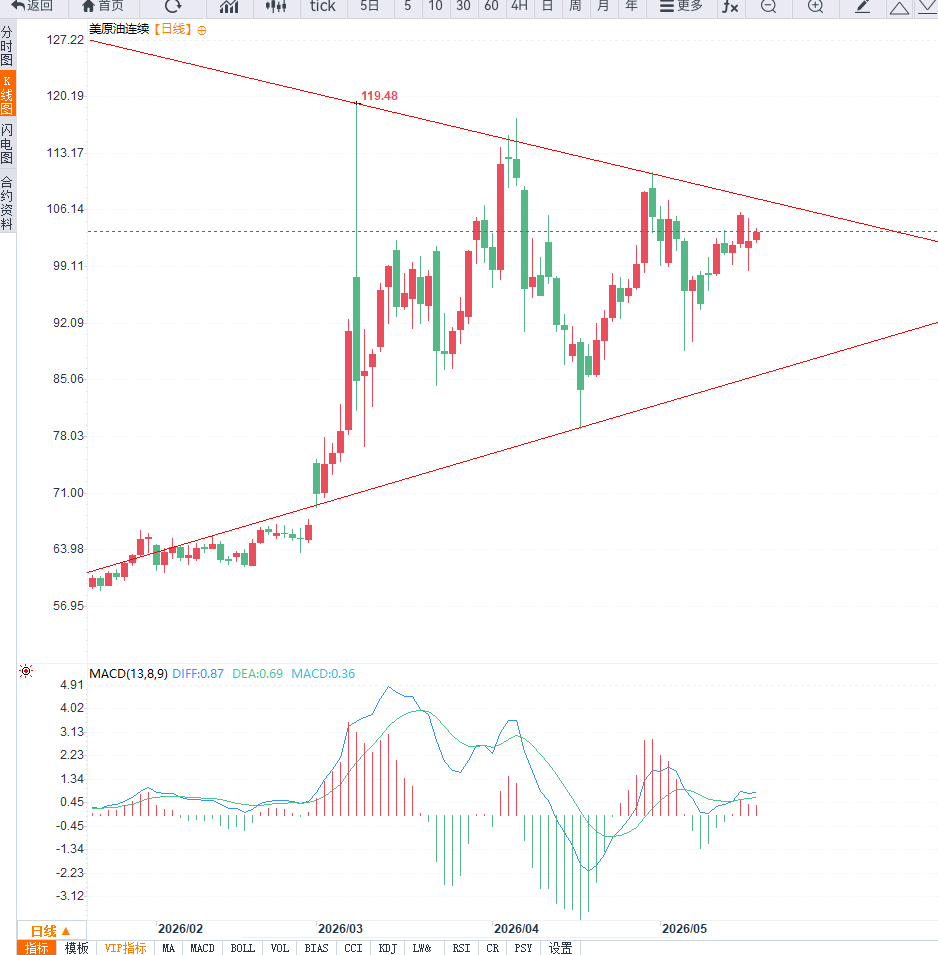
From a technical perspective, WTI crude oil has maintained its strong performance recently. The daily chart shows that oil prices continue to hold above the 20-day and 50-day exponential moving averages (EMAs), indicating a clear overall bullish structure. Although Trump's comments regarding the Iran negotiations have temporarily eased market tensions, supply risks continue to limit a significant decline in oil prices.
The Relative Strength Index (RSI) is currently hovering around 68, nearing overbought territory, indicating that bullish momentum remains strong, but short-term technical consolidation is possible. The MACD indicator continues its golden cross structure, suggesting that the medium-term uptrend has not yet ended.
Technical analysis shows that key resistance for WTI crude oil is located in the $104.80 to $105.50 area. A successful break above this level could lead to a further challenge of the $108 level. Initial support is at the $100 psychological level, with further significant support around $97. On the 4-hour chart, oil prices remain within a clear upward channel, with short-term moving averages maintaining a bullish alignment. While the MACD shows signs of slowing momentum in the short term, it remains above the zero line, indicating continued buying pressure. The RSI has fallen back to around 60, reflecting a period of consolidation at higher levels.
Overall, the situation in the Middle East, changes in the global energy supply chain, and the US dollar interest rate environment will remain the core drivers of future changes in international oil prices and the structure of the global energy market.
Editor's Summary : The global energy market is currently at a critical juncture. The unified global energy market system established over the past few decades is being impacted by geopolitics, financial sanctions, and the restructuring of security alliances. Future energy trade may become increasingly regionalized, politicized, and strategic, rather than solely determined by market supply and demand. For the global economy, this means more frequent energy price fluctuations and potentially longer-term inflation risks. For energy-importing economies, the importance of energy security, currency settlement systems, and supply chain stability is rising significantly, and global capital markets may be entering a new long-term adjustment cycle as a result.
The term "fragmentation" refers to the global crude oil market no longer following a single international pricing system, but instead forming multiple regional energy markets based on geopolitical alliances, payment currencies, security cooperation, and sanctions. International crude oil may no longer be a completely freely flowing global commodity, but will gradually evolve into a strategic geopolitical resource .
Analysts point out that the current market has long accepted the logic of "one global crude oil price," but historically, this situation has not always existed. Throughout the 20th century, the global energy market was significantly influenced by geopolitics, resulting in vastly different energy supply and settlement systems between different countries and regions.
For example, during the Cold War, there was a clear disconnect between energy transactions between Western countries and the Soviet bloc; and in recent years, some energy-exporting countries affected by sanctions have gradually established settlement mechanisms that bypass the dollar system.
Rabobank believes the global energy system may be entering a similar phase again. Especially against the backdrop of escalating tensions in the Middle East, global energy flows are already shifting. Some countries are reassessing their energy import sources, security systems, and payment channels.
The Strait of Hormuz handles approximately 20% of global seaborne crude oil transport , and any escalation of the situation there could rapidly impact the stability of the global energy supply chain. Therefore, a growing number of economies are considering establishing more regionalized and secure energy procurement systems to mitigate the risk of future supply disruptions.
Meanwhile, US financial sanctions against some energy-exporting countries are also driving changes in the global energy payment system. Market observations suggest that some countries are experimenting with using local currencies, bilateral currency swap agreements, and regional payment systems for energy transactions to reduce their dependence on the dollar system.
Market analysts say that future energy trade may be determined more by geopolitical alliances, security agreements, and monetary systems than by market prices.
While current international oil prices still primarily reference the WTI and Brent crude oil systems, regional premium differences are beginning to widen. The pace of energy price fluctuations is gradually diverging across Asia, Europe, and the Middle East, and transportation costs, insurance risks, and sanctions are also altering the global energy pricing logic.
Furthermore, the trend of "strategizing" energy is also strengthening. Some countries are beginning to link energy exports with diplomacy, security cooperation, and even the financial system, transforming energy from a traditional commodity into a geostrategic tool.
From the perspective of global capital markets, this change may mean that future oil price fluctuations will be more complex. Traditional pricing models based on supply and demand may gradually incorporate more political, security, and financial variables.
For economies heavily reliant on energy imports, this shift signifies a significant increase in the importance of future energy security. Some countries may accelerate the establishment of strategic oil reserves, diversify their energy import sources, and even strengthen investment in new energy sources to mitigate the risks of external energy shocks.
From a technical perspective, WTI crude oil has maintained its strong performance recently. The daily chart shows that oil prices continue to hold above the 20-day and 50-day exponential moving averages (EMAs), indicating a clear overall bullish structure. Although Trump's comments regarding the Iran negotiations have temporarily eased market tensions, supply risks continue to limit a significant decline in oil prices.
The Relative Strength Index (RSI) is currently hovering around 68, nearing overbought territory, indicating that bullish momentum remains strong, but short-term technical consolidation is possible. The MACD indicator continues its golden cross structure, suggesting that the medium-term uptrend has not yet ended.
Technical analysis shows that key resistance for WTI crude oil is located in the $104.80 to $105.50 area. A successful break above this level could lead to a further challenge of the $108 level. Initial support is at the $100 psychological level, with further significant support around $97. On the 4-hour chart, oil prices remain within a clear upward channel, with short-term moving averages maintaining a bullish alignment. While the MACD shows signs of slowing momentum in the short term, it remains above the zero line, indicating continued buying pressure. The RSI has fallen back to around 60, reflecting a period of consolidation at higher levels.
Overall, the situation in the Middle East, changes in the global energy supply chain, and the US dollar interest rate environment will remain the core drivers of future changes in international oil prices and the structure of the global energy market.
Editor's Summary : The global energy market is currently at a critical juncture. The unified global energy market system established over the past few decades is being impacted by geopolitics, financial sanctions, and the restructuring of security alliances. Future energy trade may become increasingly regionalized, politicized, and strategic, rather than solely determined by market supply and demand. For the global economy, this means more frequent energy price fluctuations and potentially longer-term inflation risks. For energy-importing economies, the importance of energy security, currency settlement systems, and supply chain stability is rising significantly, and global capital markets may be entering a new long-term adjustment cycle as a result.
- Risk Warning and Disclaimer
- The market involves risk, and trading may not be suitable for all investors. This article is for reference only and does not constitute personal investment advice, nor does it take into account certain users’ specific investment objectives, financial situation, or other needs. Any investment decisions made based on this information are at your own risk.