Is silver being unfairly punished due to the Iranian war and India's import restrictions?
2026-05-19 15:35:05
The silver market has always been highly volatile, and this latest round of price movements serves as a reminder of how quickly market sentiment can change.
After spot silver prices briefly approached $90 per ounce on May 13, the uncertainty surrounding the Iran war spread across global markets, leading to a sharp sell-off that pushed prices down to around $74 before stabilizing. The nearly 17% drop from around $90 to $74 in just a few days is enough to make any asset's heart race.
Spot silver is currently trading around $76, suggesting that the market may be forming a short-term bottom after a period of rapid correction. This price range has rebounded from its lowest point, but is still quite far from the previous high, with bulls and bears locked in a tug-of-war near a new equilibrium.
The price action alone—a sharp drop from around $89.34 last week followed by a slow climb to the current $76—might be unsettling, even discouraging investors unfamiliar with silver. However, in the silver market, volatility itself is part of the opportunity. Understanding this is a prerequisite for participating in silver trading.
The reason why silver fluctuates so drastically is that it is at the intersection of multiple demands and capital forces.
Firstly, there's investment demand: as a precious metal alongside gold, silver possesses safe-haven properties. When geopolitical risks escalate, inflation expectations rise, or the outlook for monetary policy becomes uncertain, investors will buy silver in much the same way they would buy gold.
Secondly, there is industrial demand: silver is an indispensable raw material for modern industries such as photovoltaic panels, 5G equipment, electric vehicles, and electronic products. The global energy transition process provides continuous demand support for silver.
Thirdly, there is speculative capital: Compared to gold, the silver market is smaller and has limited liquidity, so the same amount of capital entering or leaving can trigger more dramatic price reactions. When trend-following funds such as hedge funds collectively enter or leave, silver prices are prone to exaggerated fluctuations.
In addition, liquidity dynamics also play a key role: changes in open interest in COMEX silver futures, exchange inventory levels, and the supply and demand balance of physical silver all act as a magnifying glass for price fluctuations.
When uncertainty rises—whether it's an escalation of tensions in the Middle East, a shift in Federal Reserve policy, or a clouded global economic outlook—silver prices often react not mildly, but rather excessively, even seemingly irrationally. But it is precisely this "overreaction" that provides astute traders with opportunities to position themselves during panic and profit from buying when others are selling.
Silver's decline wasn't due to deteriorating fundamentals, but rather it was caught up in a broader wave of risk aversion. At the time, uncertainty surrounding the Iran-Iraq war spread across global markets, leading investors to adopt a defensive stance of "sell first, ask questions later," putting pressure on risky assets like stocks, crude oil, and copper. As a highly volatile asset, silver naturally couldn't remain unaffected. The key point is that this sell-off was driven by external sentiment, not by a collapse of internal logic.
The underlying demand logic remains intact. From an industrial demand perspective, the global energy transition has not stalled due to short-term geopolitical conflicts; silver consumption in fields such as photovoltaics, new energy vehicles, and electronics continues to grow steadily. From an investment demand perspective, even with the Federal Reserve maintaining high interest rates, market concerns about recurring inflation and worsening fiscal deficits have not dissipated, and silver's attractiveness as a safe-haven asset has not disappeared. From a supply and demand perspective, the silver market has been in a state of structural tight balance for many years, with slow growth in mine supply while industrial and investment demand continues to expand—this fundamental situation will not change due to a few days of selling.
In addition, the Indian government previously announced an immediate restriction on almost all forms of silver imports. As the world's largest consumer of silver, this move aims to control silver import volumes. According to the order, India has included 99.9% pure silver bars and all other semi-finished silver products in the restricted import category, effective immediately. As the world's largest consumer of silver, India's declining demand is putting downward pressure on international silver prices.
To some extent, this pullback has actually provided a more favorable technical position for traders hoping to position for a rebound. Around $90, chasing the price higher was risky, setting stop-loss orders was difficult, and the risk-reward ratio was not ideal. After a rapid drop to around $74 and stabilizing at $76, the price has absorbed a significant amount of panic, and technical indicators are gradually recovering from oversold territory. For traders, lower prices mean lower entry barriers, tighter stop-loss margins, and potentially larger rebounds.
In summary, silver prices retreated rapidly after reaching a high near $90, recently stabilizing around $76, indicating a short-term bottoming out. While the volatility is significant, this is not uncommon in the silver market and rather reflects its potential for growth. This sell-off was primarily driven by overall market risk aversion, rather than a deterioration in silver's fundamentals. The core logic of industrial demand, investment demand, and a tight supply-demand balance remains unshaken. As prices stabilize and the technical picture gradually improves, the market may be building momentum for a new rebound. If geopolitical tensions ease or inflation data continues to support the precious metals logic, silver's rebound potential could be unleashed by the combined effects of technical and fundamental factors. For prepared traders, this rapid correction is less of a crisis and more of an opportunity for recalibration and strategic positioning.
(Spot silver daily chart, source: EasyForex)
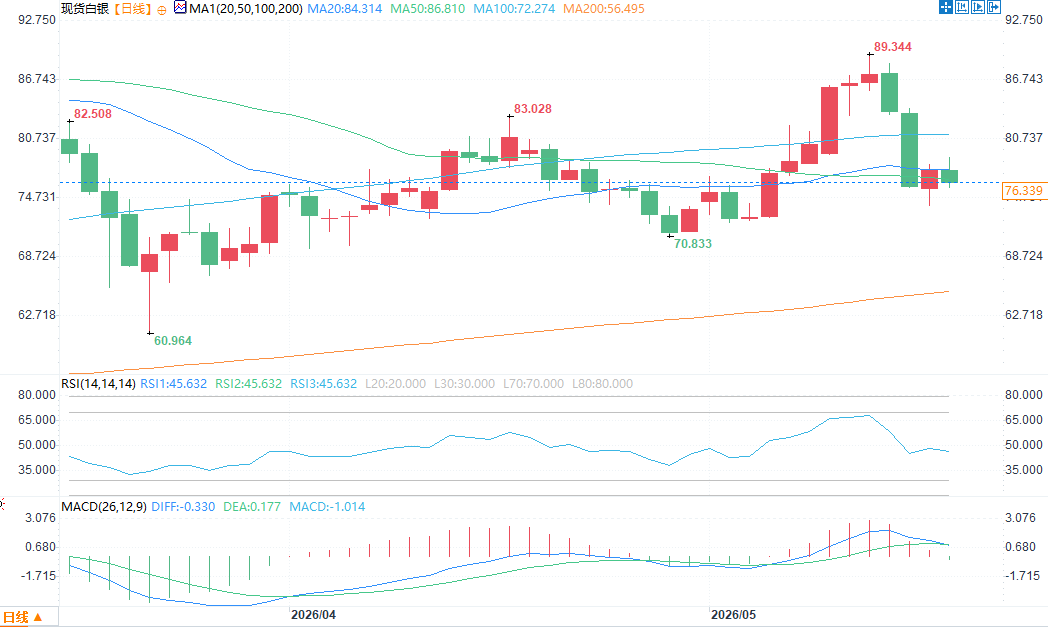
Based on the daily chart analysis of spot silver, the current silver price is trading around $76, a crucial position in the battle between bulls and bears. The moving average system is showing divergence: the short-term moving averages MA20 ($84.31) and MA50 ($86.81) remain above the current price, acting as resistance; while the long-term moving averages MA100 ($72.27) and MA200 ($56.50) are significantly lower than the current price, indicating that the long-term upward trend has not yet reversed, but short-term downward pressure is evident. It is worth noting that the silver price has broken below the MA20 and MA50, with short-term bearish sentiment dominating the market. The RSI indicator is at 45.63, below the 50 neutral line but not yet in the oversold zone (below 30), indicating that bearish momentum has been released but not exhausted, and further downward movement is still possible.
At 14:40 Beijing time, spot silver was trading at $76.43 per ounce.
After spot silver prices briefly approached $90 per ounce on May 13, the uncertainty surrounding the Iran war spread across global markets, leading to a sharp sell-off that pushed prices down to around $74 before stabilizing. The nearly 17% drop from around $90 to $74 in just a few days is enough to make any asset's heart race.
Spot silver is currently trading around $76, suggesting that the market may be forming a short-term bottom after a period of rapid correction. This price range has rebounded from its lowest point, but is still quite far from the previous high, with bulls and bears locked in a tug-of-war near a new equilibrium.
Volatility is the norm for silver, and it's also where opportunities lie.
The price action alone—a sharp drop from around $89.34 last week followed by a slow climb to the current $76—might be unsettling, even discouraging investors unfamiliar with silver. However, in the silver market, volatility itself is part of the opportunity. Understanding this is a prerequisite for participating in silver trading.
The reason why silver fluctuates so drastically is that it is at the intersection of multiple demands and capital forces.
Firstly, there's investment demand: as a precious metal alongside gold, silver possesses safe-haven properties. When geopolitical risks escalate, inflation expectations rise, or the outlook for monetary policy becomes uncertain, investors will buy silver in much the same way they would buy gold.
Secondly, there is industrial demand: silver is an indispensable raw material for modern industries such as photovoltaic panels, 5G equipment, electric vehicles, and electronic products. The global energy transition process provides continuous demand support for silver.
Thirdly, there is speculative capital: Compared to gold, the silver market is smaller and has limited liquidity, so the same amount of capital entering or leaving can trigger more dramatic price reactions. When trend-following funds such as hedge funds collectively enter or leave, silver prices are prone to exaggerated fluctuations.
In addition, liquidity dynamics also play a key role: changes in open interest in COMEX silver futures, exchange inventory levels, and the supply and demand balance of physical silver all act as a magnifying glass for price fluctuations.
When uncertainty rises—whether it's an escalation of tensions in the Middle East, a shift in Federal Reserve policy, or a clouded global economic outlook—silver prices often react not mildly, but rather excessively, even seemingly irrationally. But it is precisely this "overreaction" that provides astute traders with opportunities to position themselves during panic and profit from buying when others are selling.
Behind the sell-off: Risk aversion is the main driver, but the fundamentals remain unchanged.
Silver's decline wasn't due to deteriorating fundamentals, but rather it was caught up in a broader wave of risk aversion. At the time, uncertainty surrounding the Iran-Iraq war spread across global markets, leading investors to adopt a defensive stance of "sell first, ask questions later," putting pressure on risky assets like stocks, crude oil, and copper. As a highly volatile asset, silver naturally couldn't remain unaffected. The key point is that this sell-off was driven by external sentiment, not by a collapse of internal logic.
The underlying demand logic remains intact. From an industrial demand perspective, the global energy transition has not stalled due to short-term geopolitical conflicts; silver consumption in fields such as photovoltaics, new energy vehicles, and electronics continues to grow steadily. From an investment demand perspective, even with the Federal Reserve maintaining high interest rates, market concerns about recurring inflation and worsening fiscal deficits have not dissipated, and silver's attractiveness as a safe-haven asset has not disappeared. From a supply and demand perspective, the silver market has been in a state of structural tight balance for many years, with slow growth in mine supply while industrial and investment demand continues to expand—this fundamental situation will not change due to a few days of selling.
In addition, the Indian government previously announced an immediate restriction on almost all forms of silver imports. As the world's largest consumer of silver, this move aims to control silver import volumes. According to the order, India has included 99.9% pure silver bars and all other semi-finished silver products in the restricted import category, effective immediately. As the world's largest consumer of silver, India's declining demand is putting downward pressure on international silver prices.
To some extent, this pullback has actually provided a more favorable technical position for traders hoping to position for a rebound. Around $90, chasing the price higher was risky, setting stop-loss orders was difficult, and the risk-reward ratio was not ideal. After a rapid drop to around $74 and stabilizing at $76, the price has absorbed a significant amount of panic, and technical indicators are gradually recovering from oversold territory. For traders, lower prices mean lower entry barriers, tighter stop-loss margins, and potentially larger rebounds.
The pullback may have provided new entry opportunities.
In summary, silver prices retreated rapidly after reaching a high near $90, recently stabilizing around $76, indicating a short-term bottoming out. While the volatility is significant, this is not uncommon in the silver market and rather reflects its potential for growth. This sell-off was primarily driven by overall market risk aversion, rather than a deterioration in silver's fundamentals. The core logic of industrial demand, investment demand, and a tight supply-demand balance remains unshaken. As prices stabilize and the technical picture gradually improves, the market may be building momentum for a new rebound. If geopolitical tensions ease or inflation data continues to support the precious metals logic, silver's rebound potential could be unleashed by the combined effects of technical and fundamental factors. For prepared traders, this rapid correction is less of a crisis and more of an opportunity for recalibration and strategic positioning.
(Spot silver daily chart, source: EasyForex)
Based on the daily chart analysis of spot silver, the current silver price is trading around $76, a crucial position in the battle between bulls and bears. The moving average system is showing divergence: the short-term moving averages MA20 ($84.31) and MA50 ($86.81) remain above the current price, acting as resistance; while the long-term moving averages MA100 ($72.27) and MA200 ($56.50) are significantly lower than the current price, indicating that the long-term upward trend has not yet reversed, but short-term downward pressure is evident. It is worth noting that the silver price has broken below the MA20 and MA50, with short-term bearish sentiment dominating the market. The RSI indicator is at 45.63, below the 50 neutral line but not yet in the oversold zone (below 30), indicating that bearish momentum has been released but not exhausted, and further downward movement is still possible.
At 14:40 Beijing time, spot silver was trading at $76.43 per ounce.
- Risk Warning and Disclaimer
- The market involves risk, and trading may not be suitable for all investors. This article is for reference only and does not constitute personal investment advice, nor does it take into account certain users’ specific investment objectives, financial situation, or other needs. Any investment decisions made based on this information are at your own risk.