Is the pressure finally breaking? Unusual fluctuations in Japanese bond yields are forcing the central bank to release reassuring signals; the USD/JPY exchange rate is fluctuating at high levels and faces a directional decision.
2026-05-19 17:00:31
On Tuesday (May 19), the Japanese bond market experienced significant volatility, with market attention focused on news that the Bank of Japan might adjust the next phase of its bond-buying program. Against the backdrop of rapidly rising yields, the transmission effect of this potential policy adjustment on the yen exchange rate has become a key focus. The USD/JPY exchange rate is currently trading around 159, exhibiting short-term high-level fluctuations, requiring a comprehensive observation combining policy signals and technical levels.

According to mainstream market opinion, the Bank of Japan is assessing the specific pace of tapering its bond purchases ahead of its June policy meeting. Reports indicate that the bank does not rule out slowing down or suspending its bond-buying reduction plan for the next fiscal year in response to current bond market volatility. This approach differs from direct intervention; it primarily aims to stabilize the yield curve by maintaining liquidity, rather than immediately engaging in large-scale bond purchases.
From a fundamental perspective, the Bank of Japan's current bond holdings are significantly lower than their peak, and continuing quantitative tightening requires balancing fiscal pressures with the inflationary environment. If it decides to slow the quarterly reduction, for example, from 200 billion yen to 100 billion yen, or maintain the current purchase scale of approximately 2 trillion yen in the short term, it will send a reassuring signal to the market. Such an adjustment would likely provide short-term support for the yen, as it alleviates bond supply pressure, reduces the risk of yield overshooting, and thus mitigates the transmission of financing costs to the yen.
There are significant differences between direct and direct exchange rate intervention. Direct intervention affects supply and demand directly through foreign exchange market operations, typically on a large scale with strong signals, but its sustainability is constrained by reserve levels. Adjustments to the pace of bond purchases, on the other hand, fall under liquidity management within the monetary policy framework. Their impact on the yen is more indirect and relatively moderate, primarily transmitted to the exchange rate through yield curve stabilization. It may reduce pressure on the yen to attract capital outflows due to high yields, but it won't reverse short-term trends as quickly as direct intervention. A strategist from a well-known institution points out that such adjustments focus more on long-term policy continuity than on short-term exchange rate targets.
The current rise in Japanese government bond yields reflects investors' adjustments to their expectations regarding fiscal and monetary policy. The Bank of Japan believes that there is no need to immediately launch an emergency bond-buying facility during periods of normal market volatility. This stance is closely related to the outcome of the upcoming bond investor meeting this week, whose feedback will directly influence the formulation of the bond-buying plan for fiscal year 2027. If a moderate tapering path is ultimately chosen, the yen may receive some buffer, but global uncertainty remains a major variable.
From a technical perspective, the USD/JPY 4-hour chart shows the price trading between the upper and middle Bollinger Bands. The latest price is around 159.076, with the middle band at 158.607, the upper band at 159.371 forming short-term resistance, and the lower band at 157.843 serving as a reference support. The MACD indicator shows the DIFF slightly below the DEA, and the histogram slightly turning green, indicating a slight weakening of short-term bullish momentum, but it remains above the zero line overall, suggesting the medium-term trend has not completely reversed.
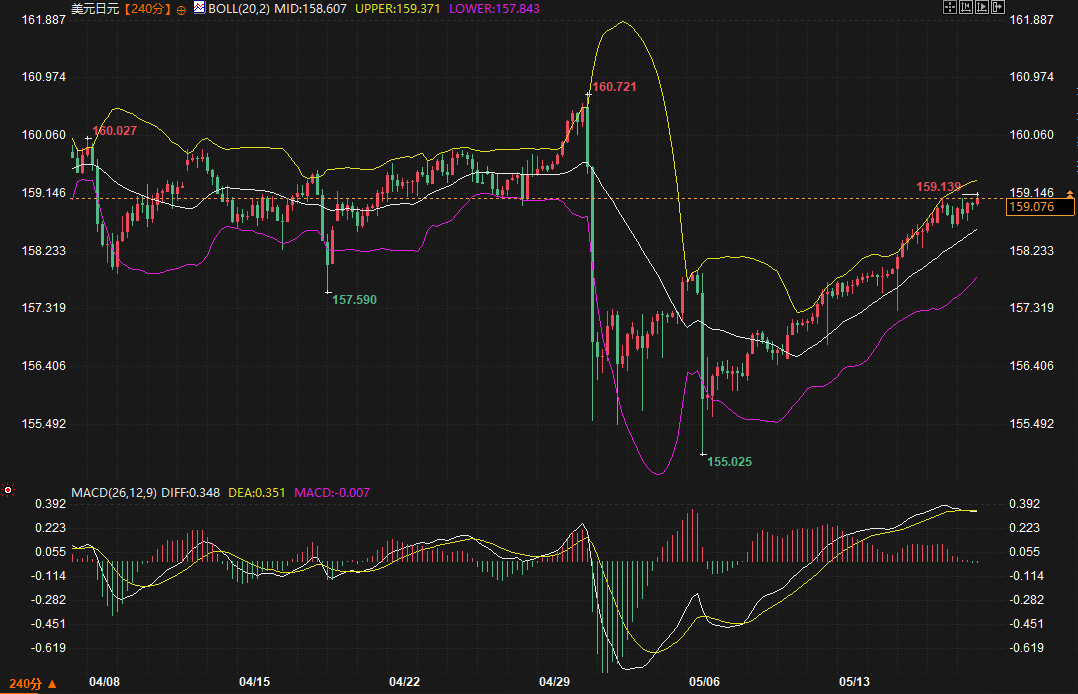
Historically, prices reached a high of 160.721 at the end of April, then quickly fell to a low of 155.025 in early May before rebounding. Currently, the price is near the lower edge of the previous consolidation range, facing resistance in the 159.139-159.371 area. A sustained move above 159.3 could open up further upside potential; conversely, the first support level to watch on a pullback is the Bollinger Band middle line around 158.6. During trading, close attention should be paid to the dynamics of Japanese government bond yields and related statements from the central bank. Clear signals of adjustments to bond purchases could potentially lead to a convergence in exchange rate volatility.
The predicted support and resistance range is based on the USD/JPY main contract: upper resistance at 159.139-159.371, and lower support at 158.607-157.843. This is based on the Bollinger Bands and previous high-volume trading areas. Key factors to watch include the Bank of Japan's bond market reaction ahead of the meeting and the synchronized movement of the US dollar index. If yields remain stable at current levels, the exchange rate may continue to consolidate within a range; however, if unexpected adjustments occur, volatility could increase.
In the short term, policy signals related to Japanese government bonds will be a key driver of the yen's exchange rate. A moderate adjustment in the pace of bond purchases may provide temporary support for the yen, but changes in the global interest rate environment and risk appetite remain the dominant variables. Given the current high-level technical consolidation, the exchange rate's movement will depend on whether fundamental factors can effectively translate into price action. Continued monitoring of the June policy meeting results and feedback from bond investor meetings is necessary to assess the actual impact of liquidity management on the exchange rate.
What is the direct impact of the Bank of Japan slowing down its bond-buying program on the yen exchange rate?
Slowing down bond purchases primarily supports the yen indirectly by stabilizing the Japanese government bond yield curve, reducing capital outflow pressure caused by tightening liquidity. Its impact is smaller than direct intervention, serving more as a medium- to long-term policy signal. Its effect on short-term exchange rates is relatively mild, depending on how well the market digests liquidity expectations.
What are the main differences in the impact mechanisms between adjusting the pace of bond purchases and direct exchange rate intervention?
Adjustments to bond purchases fall under liquidity management within the monetary policy toolbox, focusing on balancing supply and demand in the bond market; direct intervention, on the other hand, involves foreign exchange market operations, and the two have different transmission paths. The former has stronger sustainability but sends a gradual signal, while the latter has a greater short-term impact but may face reserve constraints and policy cost considerations.
How to determine the key technical support and resistance levels for USD/JPY?
Referring to the 4-hour Bollinger Band parameters, the upper band at 159.371 is the first resistance level, while the middle band around 158.607 is a significant support level. Combining previous highs and lows, the 159.139-159.371 area forms a short-term resistance zone, with the area around 157.843 serving as a potential downside target. If a MACD death cross is confirmed, the downward pressure may increase.
How much weight will this week's bond investor meeting carry in policy decisions?
The meeting will gather market opinions on the ideal pace of bond purchases, and the results will significantly influence the final policy plan formulated at the June policy meeting. It is an important basis for the central bank to assess the market's capacity to absorb the burden and is directly related to the choice of the quantitative tightening path in fiscal year 2027.
If the Bank of Japan maintains its current bond-buying tapering program, what are the main risks facing the yen?
Yield curve volatility may persist, increasing pressure on funding costs to be transmitted to the exchange rate. Against the backdrop of global uncertainty, without additional reassurance measures, the yen is susceptible to changes in external risk appetite; therefore, attention should be paid to the convergence of fundamental and technical factors.
Analysis of the Impact of Japanese Bond Price Fluctuations and Central Bank Bond Purchase Pace Adjustments
According to mainstream market opinion, the Bank of Japan is assessing the specific pace of tapering its bond purchases ahead of its June policy meeting. Reports indicate that the bank does not rule out slowing down or suspending its bond-buying reduction plan for the next fiscal year in response to current bond market volatility. This approach differs from direct intervention; it primarily aims to stabilize the yield curve by maintaining liquidity, rather than immediately engaging in large-scale bond purchases.
From a fundamental perspective, the Bank of Japan's current bond holdings are significantly lower than their peak, and continuing quantitative tightening requires balancing fiscal pressures with the inflationary environment. If it decides to slow the quarterly reduction, for example, from 200 billion yen to 100 billion yen, or maintain the current purchase scale of approximately 2 trillion yen in the short term, it will send a reassuring signal to the market. Such an adjustment would likely provide short-term support for the yen, as it alleviates bond supply pressure, reduces the risk of yield overshooting, and thus mitigates the transmission of financing costs to the yen.
There are significant differences between direct and direct exchange rate intervention. Direct intervention affects supply and demand directly through foreign exchange market operations, typically on a large scale with strong signals, but its sustainability is constrained by reserve levels. Adjustments to the pace of bond purchases, on the other hand, fall under liquidity management within the monetary policy framework. Their impact on the yen is more indirect and relatively moderate, primarily transmitted to the exchange rate through yield curve stabilization. It may reduce pressure on the yen to attract capital outflows due to high yields, but it won't reverse short-term trends as quickly as direct intervention. A strategist from a well-known institution points out that such adjustments focus more on long-term policy continuity than on short-term exchange rate targets.
The current rise in Japanese government bond yields reflects investors' adjustments to their expectations regarding fiscal and monetary policy. The Bank of Japan believes that there is no need to immediately launch an emergency bond-buying facility during periods of normal market volatility. This stance is closely related to the outcome of the upcoming bond investor meeting this week, whose feedback will directly influence the formulation of the bond-buying plan for fiscal year 2027. If a moderate tapering path is ultimately chosen, the yen may receive some buffer, but global uncertainty remains a major variable.
From a technical perspective, the USD/JPY 4-hour chart shows the price trading between the upper and middle Bollinger Bands. The latest price is around 159.076, with the middle band at 158.607, the upper band at 159.371 forming short-term resistance, and the lower band at 157.843 serving as a reference support. The MACD indicator shows the DIFF slightly below the DEA, and the histogram slightly turning green, indicating a slight weakening of short-term bullish momentum, but it remains above the zero line overall, suggesting the medium-term trend has not completely reversed.
Historically, prices reached a high of 160.721 at the end of April, then quickly fell to a low of 155.025 in early May before rebounding. Currently, the price is near the lower edge of the previous consolidation range, facing resistance in the 159.139-159.371 area. A sustained move above 159.3 could open up further upside potential; conversely, the first support level to watch on a pullback is the Bollinger Band middle line around 158.6. During trading, close attention should be paid to the dynamics of Japanese government bond yields and related statements from the central bank. Clear signals of adjustments to bond purchases could potentially lead to a convergence in exchange rate volatility.
The predicted support and resistance range is based on the USD/JPY main contract: upper resistance at 159.139-159.371, and lower support at 158.607-157.843. This is based on the Bollinger Bands and previous high-volume trading areas. Key factors to watch include the Bank of Japan's bond market reaction ahead of the meeting and the synchronized movement of the US dollar index. If yields remain stable at current levels, the exchange rate may continue to consolidate within a range; however, if unexpected adjustments occur, volatility could increase.
Future Trend Outlook
In the short term, policy signals related to Japanese government bonds will be a key driver of the yen's exchange rate. A moderate adjustment in the pace of bond purchases may provide temporary support for the yen, but changes in the global interest rate environment and risk appetite remain the dominant variables. Given the current high-level technical consolidation, the exchange rate's movement will depend on whether fundamental factors can effectively translate into price action. Continued monitoring of the June policy meeting results and feedback from bond investor meetings is necessary to assess the actual impact of liquidity management on the exchange rate.
Frequently Asked Questions
What is the direct impact of the Bank of Japan slowing down its bond-buying program on the yen exchange rate?
Slowing down bond purchases primarily supports the yen indirectly by stabilizing the Japanese government bond yield curve, reducing capital outflow pressure caused by tightening liquidity. Its impact is smaller than direct intervention, serving more as a medium- to long-term policy signal. Its effect on short-term exchange rates is relatively mild, depending on how well the market digests liquidity expectations.
What are the main differences in the impact mechanisms between adjusting the pace of bond purchases and direct exchange rate intervention?
Adjustments to bond purchases fall under liquidity management within the monetary policy toolbox, focusing on balancing supply and demand in the bond market; direct intervention, on the other hand, involves foreign exchange market operations, and the two have different transmission paths. The former has stronger sustainability but sends a gradual signal, while the latter has a greater short-term impact but may face reserve constraints and policy cost considerations.
How to determine the key technical support and resistance levels for USD/JPY?
Referring to the 4-hour Bollinger Band parameters, the upper band at 159.371 is the first resistance level, while the middle band around 158.607 is a significant support level. Combining previous highs and lows, the 159.139-159.371 area forms a short-term resistance zone, with the area around 157.843 serving as a potential downside target. If a MACD death cross is confirmed, the downward pressure may increase.
How much weight will this week's bond investor meeting carry in policy decisions?
The meeting will gather market opinions on the ideal pace of bond purchases, and the results will significantly influence the final policy plan formulated at the June policy meeting. It is an important basis for the central bank to assess the market's capacity to absorb the burden and is directly related to the choice of the quantitative tightening path in fiscal year 2027.
If the Bank of Japan maintains its current bond-buying tapering program, what are the main risks facing the yen?
Yield curve volatility may persist, increasing pressure on funding costs to be transmitted to the exchange rate. Against the backdrop of global uncertainty, without additional reassurance measures, the yen is susceptible to changes in external risk appetite; therefore, attention should be paid to the convergence of fundamental and technical factors.
- Risk Warning and Disclaimer
- The market involves risk, and trading may not be suitable for all investors. This article is for reference only and does not constitute personal investment advice, nor does it take into account certain users’ specific investment objectives, financial situation, or other needs. Any investment decisions made based on this information are at your own risk.