The new Fed chair's "first day": Will he offend the White House first, or the market first?
2026-05-19 17:01:18
Standard Chartered CEO Bill Winters said on Tuesday (May 19) that incoming Federal Reserve Chairman Kevin Warsh not only faces a challenging economic environment but also a “difficult boss.”
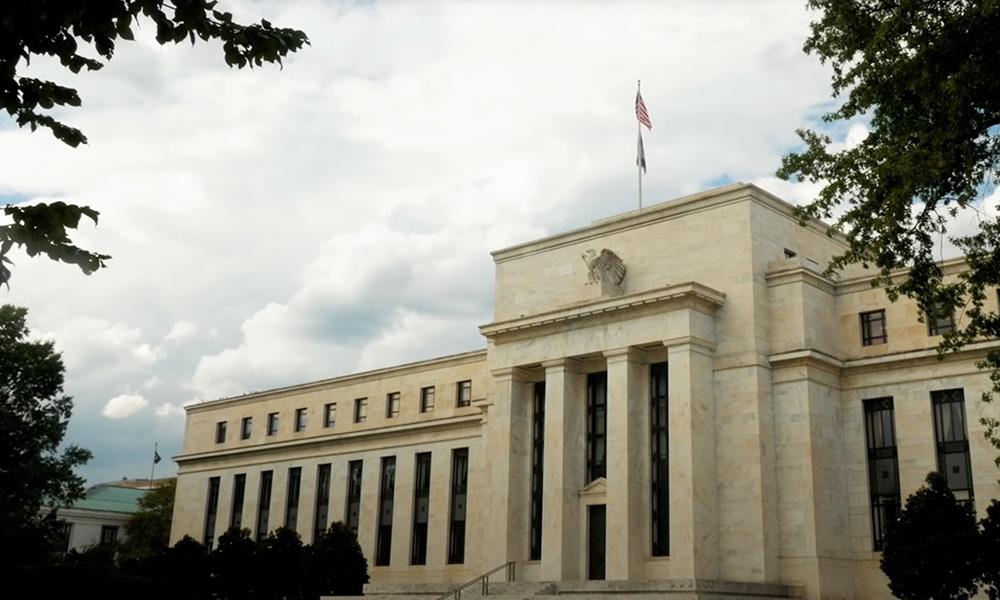
Winters points out that Warsh is facing political pressure to cut interest rates, while inflation remains high. This statement reveals the deep dilemma the Federal Reserve faces during the leadership transition: monetary policy decisions are caught between stubborn economic data and the White House's political expectations. For Warsh, technical interest rate judgments no longer solely depend on employment and inflation indicators; they also require careful balancing between the president's public pressure and the market's sensitive expectations.
Winters said, "Inflation remains high and is unlikely to fall in the short term. However, his political environment means he will face criticism if he doesn't cut rates." He added, "He has a difficult boss, but you know, Walsh is a serious man."
Warsh will be officially sworn in as Federal Reserve Chairman on Friday by President Donald Trump. Trump chose Warsh to head the U.S. central bank after Jerome Powell's term ended. Powell faced numerous public criticisms from Trump during his tenure, and Trump even discussed the possibility of removing Powell from office. Now, the same pressure from Trump's political camp has been transferred to Warsh. However, unlike Powell, Warsh was personally nominated by Trump, and it is widely believed that he may lack sufficient independent bargaining power in front of the White House.
Winters's description of a "difficult boss" is both a direct depiction of Trump's pressure tactics and an indication of the potential systemic dilemma Warsh might face: while the Federal Reserve Chair is nominated by the president, he should be accountable to Congress and the overall economy, not to any particular political agenda. If the market believes Warsh will hastily cut interest rates to appease the White House, the Fed's long-established credibility in combating inflation could be eroded.
Data shows that in the year ending in April, the US CPI rose 3.8%, the largest annual increase in three years, reflecting the impact of rising energy prices following the wars between the US and Israel and Iran. Rising energy costs are spreading from gasoline to a wider range of consumer goods, and inflation in the services sector has shown greater resilience than expected. Despite the Federal Reserve keeping interest rates at a restrained level over the past year, the process of inflation returning to the 2% target appears to have stalled.
Against this backdrop, some Federal Reserve policymakers are already concerned about high inflation and hope to signal a possible rate hike rather than a rate cut through the Fed's policy statement. A subtle rift is forming within the Fed: there is an increasingly apparent tension between the political demands for rate cuts that new Chairman Warsh may face and the technical stance of some senior members advocating for rate hikes. If inflation continues to rebound in the coming months, the Fed may be forced to tighten policy again, which would be completely contrary to the direction of Trump's public pronouncements.
Trump has repeatedly called on the Federal Reserve to cut interest rates significantly. In a recent interview, he stated bluntly that high interest rates are harming the competitiveness of American manufacturing and exports, and that the Fed should quickly shift to an easing stance given the decline in energy prices. However, current market pricing indicates a roughly 60% probability of a Fed rate hike before the end of the year. This means that traders in the bond and interest rate futures markets generally believe that inflationary pressures will remain the core variable driving Fed policy, rather than the White House's pronouncements.
This discrepancy between market expectations and those of the White House is precisely the first contradiction Warsh will face upon taking office: if he lowers interest rates according to Trump's wishes, the market may perceive it as the Federal Reserve yielding to political interference, thereby pushing up long-term inflation expectations and term premiums; if he chooses to hold rates steady or even raise them, he may directly anger the president who nominated him. Whichever path he chooses, Warsh will have to pay a considerable political or market price.
In conclusion, incoming Federal Reserve Chairman Warsh is in an extremely awkward position: on the one hand, inflation has risen to a three-year high, and some Fed officials are already considering raising interest rates; on the other hand, President Trump continues to pressure for rate cuts, and Warsh himself was nominated by Trump. Winters summarizes this contradiction as a double whammy of a "difficult boss" and a "daunting task." The market currently leans towards betting on rate hikes, which contrasts sharply with Trump's public statements. How Warsh balances political pressure and economic data after taking office will be a key variable determining the Fed's future interest rate path and will remain a focus of global financial markets in the coming months. For investors, the boundaries of the Fed's independence are being retested, and the outcome of this test is likely to directly affect the dollar's trajectory, the shape of the US Treasury yield curve, and the pricing logic of global risk assets.
It is worth noting that the current 10-year US Treasury yield has broken through 4.6%, and the 30-year US Treasury yield has firmly established itself above 5.12%, both reaching new highs since May 2025. Even more alarming is that the 30-year US Treasury yield has broken through the psychological threshold of 5%—the first time since the eve of the 2007 financial crisis—which the market sees as a key signal that long-term interest rates have lost their "ceiling" constraint.
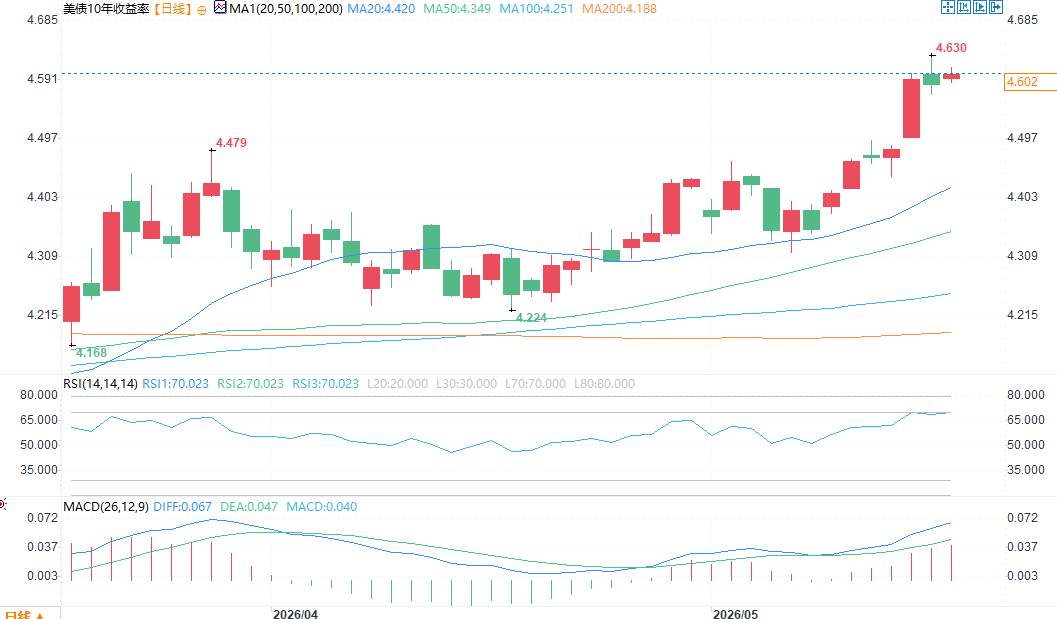
(Daily chart of 10-year US Treasury yield, source: EasyTrade)
Societe Generale's head of Americas research, Rajapa, bluntly stated: "Bond yields have shown abnormal trends, and controlling inflation expectations will become Warsh's core task." For Warsh, who has just taken office, this is not an environment where he can "take it slow"—before he even chaired his first policy meeting, the bond market had already used the yield curve to define his policy boundaries.
Winters points out that Warsh is facing political pressure to cut interest rates, while inflation remains high. This statement reveals the deep dilemma the Federal Reserve faces during the leadership transition: monetary policy decisions are caught between stubborn economic data and the White House's political expectations. For Warsh, technical interest rate judgments no longer solely depend on employment and inflation indicators; they also require careful balancing between the president's public pressure and the market's sensitive expectations.
Inflation remains stubbornly persistent, while political pressure demands interest rate cuts.
Winters said, "Inflation remains high and is unlikely to fall in the short term. However, his political environment means he will face criticism if he doesn't cut rates." He added, "He has a difficult boss, but you know, Walsh is a serious man."
Warsh will be officially sworn in as Federal Reserve Chairman on Friday by President Donald Trump. Trump chose Warsh to head the U.S. central bank after Jerome Powell's term ended. Powell faced numerous public criticisms from Trump during his tenure, and Trump even discussed the possibility of removing Powell from office. Now, the same pressure from Trump's political camp has been transferred to Warsh. However, unlike Powell, Warsh was personally nominated by Trump, and it is widely believed that he may lack sufficient independent bargaining power in front of the White House.
Winters's description of a "difficult boss" is both a direct depiction of Trump's pressure tactics and an indication of the potential systemic dilemma Warsh might face: while the Federal Reserve Chair is nominated by the president, he should be accountable to Congress and the overall economy, not to any particular political agenda. If the market believes Warsh will hastily cut interest rates to appease the White House, the Fed's long-established credibility in combating inflation could be eroded.
Inflation data continues to rise, and some Federal Reserve officials are inclined to raise interest rates.
Data shows that in the year ending in April, the US CPI rose 3.8%, the largest annual increase in three years, reflecting the impact of rising energy prices following the wars between the US and Israel and Iran. Rising energy costs are spreading from gasoline to a wider range of consumer goods, and inflation in the services sector has shown greater resilience than expected. Despite the Federal Reserve keeping interest rates at a restrained level over the past year, the process of inflation returning to the 2% target appears to have stalled.
Against this backdrop, some Federal Reserve policymakers are already concerned about high inflation and hope to signal a possible rate hike rather than a rate cut through the Fed's policy statement. A subtle rift is forming within the Fed: there is an increasingly apparent tension between the political demands for rate cuts that new Chairman Warsh may face and the technical stance of some senior members advocating for rate hikes. If inflation continues to rebound in the coming months, the Fed may be forced to tighten policy again, which would be completely contrary to the direction of Trump's public pronouncements.
Trump has repeatedly pressured for significant interest rate cuts, but the market is pricing in rate hikes.
Trump has repeatedly called on the Federal Reserve to cut interest rates significantly. In a recent interview, he stated bluntly that high interest rates are harming the competitiveness of American manufacturing and exports, and that the Fed should quickly shift to an easing stance given the decline in energy prices. However, current market pricing indicates a roughly 60% probability of a Fed rate hike before the end of the year. This means that traders in the bond and interest rate futures markets generally believe that inflationary pressures will remain the core variable driving Fed policy, rather than the White House's pronouncements.
This discrepancy between market expectations and those of the White House is precisely the first contradiction Warsh will face upon taking office: if he lowers interest rates according to Trump's wishes, the market may perceive it as the Federal Reserve yielding to political interference, thereby pushing up long-term inflation expectations and term premiums; if he chooses to hold rates steady or even raise them, he may directly anger the president who nominated him. Whichever path he chooses, Warsh will have to pay a considerable political or market price.
Walsh is caught in a dilemma: high inflation vs. political pressure.
In conclusion, incoming Federal Reserve Chairman Warsh is in an extremely awkward position: on the one hand, inflation has risen to a three-year high, and some Fed officials are already considering raising interest rates; on the other hand, President Trump continues to pressure for rate cuts, and Warsh himself was nominated by Trump. Winters summarizes this contradiction as a double whammy of a "difficult boss" and a "daunting task." The market currently leans towards betting on rate hikes, which contrasts sharply with Trump's public statements. How Warsh balances political pressure and economic data after taking office will be a key variable determining the Fed's future interest rate path and will remain a focus of global financial markets in the coming months. For investors, the boundaries of the Fed's independence are being retested, and the outcome of this test is likely to directly affect the dollar's trajectory, the shape of the US Treasury yield curve, and the pricing logic of global risk assets.
It is worth noting that the current 10-year US Treasury yield has broken through 4.6%, and the 30-year US Treasury yield has firmly established itself above 5.12%, both reaching new highs since May 2025. Even more alarming is that the 30-year US Treasury yield has broken through the psychological threshold of 5%—the first time since the eve of the 2007 financial crisis—which the market sees as a key signal that long-term interest rates have lost their "ceiling" constraint.
(Daily chart of 10-year US Treasury yield, source: EasyTrade)
Societe Generale's head of Americas research, Rajapa, bluntly stated: "Bond yields have shown abnormal trends, and controlling inflation expectations will become Warsh's core task." For Warsh, who has just taken office, this is not an environment where he can "take it slow"—before he even chaired his first policy meeting, the bond market had already used the yield curve to define his policy boundaries.
- Risk Warning and Disclaimer
- The market involves risk, and trading may not be suitable for all investors. This article is for reference only and does not constitute personal investment advice, nor does it take into account certain users’ specific investment objectives, financial situation, or other needs. Any investment decisions made based on this information are at your own risk.