Gold Trading Alert: Gold Prices Plunge 1.8% to Seven-Week Low as Middle East Conflict and Inflationary Bombardment Bring Bull Market to an Abrupt End?
2026-05-20 07:26:17
On Tuesday (May 19), spot gold fell sharply by 1.8%, hitting a low of $4,464.85 per ounce, its lowest level since March 30, before closing at $4,481.83. U.S. June gold futures also fell 1%, to $4,511.20 per ounce. This decline not only erased some of the recent gains but also highlighted the vulnerability of gold in a high-interest-rate environment coupled with geopolitical risks.
Although gold has historically been considered an inflation hedge, it faces unprecedented "opportunity cost" pressures in the current unique macroeconomic and geopolitical context. A stronger dollar, soaring US Treasury yields, and high energy prices driven by Middle East conflicts are collectively creating a perfect storm for a gold price decline.
On Wednesday (May 20) in early Asian trading, spot gold traded in a narrow range, currently at $4487.90 per ounce.
Tuesday's sharp drop in gold prices was not an isolated event, but a direct result of a confluence of multiple macroeconomic factors. Marex analyst Edward Meir stated bluntly that the general rise in global real interest rates is the main source of pressure on gold, and the strengthening of the US dollar further exacerbates this unfavorable situation.
The yield on the 10-year U.S. Treasury note surged to 4.687%, a new high since January 2025, before closing at 4.667%, a single-day increase of 8.7 basis points. The yield on the 30-year Treasury note rose even further, reaching 5.197%, a 19-year high. This significant upward shift at the long end of the yield curve directly increases the opportunity cost of holding gold, a non-interest-bearing asset. When investors can obtain higher real returns from Treasury bonds, the attractiveness of gold naturally diminishes.
Meanwhile, the dollar index rose 0.34% to 99.30, a six-week high. Dollar-denominated gold became more expensive for holders of non-dollar currencies, further dampening physical demand and investment buying. Analysis shows that this combination of a strong dollar and high yields is the core driver behind several gold price corrections in recent years.
The core driver behind rising yields and a stronger dollar is market concern about inflation spiraling out of control again. This concern stems from the energy market amid geopolitical conflicts in the Middle East.
Brent crude oil prices remained above $110 a barrel, having reached a high of $111. The conflict between Iran and the US and Israel has lasted for nearly three months, with Iran virtually blocking the Strait of Hormuz—a vital waterway for one-fifth of the world's oil shipments—leading to continued supply concerns. Even with the ceasefire agreement barely maintained, drone attacks on Gulf state facilities continue unabated, with the attack on the Barakah nuclear power plant in the UAE last weekend highlighting the possibility of escalation.
High fuel costs are rapidly spreading to the global supply chain, pushing up core inflationary pressures. Central banks are thus forced to maintain high interest rates, and may even face further tightening of policies later. This has dealt a double blow to gold: on the one hand, high interest rates have suppressed the premium of gold as a safe-haven asset; on the other hand, its inflation-hedging properties are temporarily overshadowed by the reality that "high interest rates must first suppress inflation."
Geopolitical uncertainty acted as a catalyst for the recent gold price correction. US President Trump publicly stated on Tuesday that he was just an hour away from ordering a new round of strikes against Iran, and claimed that Iranian leaders were "begging" for a deal. While Vice President JD Vance indicated progress in negotiations, he also acknowledged the difficulties of dealing with a divided Iranian leadership.
The mediators revealed that Iran's position remains largely unchanged, still demanding an end to hostilities, compensation, the lifting of sanctions, and a role in the Strait of Hormuz, while the United States insists that Iran abandon its nuclear program. Both sides are "constantly shifting the goalposts," making the prospects for peace highly uncertain. The market generally believes that even if an agreement is reached in the short term, energy prices are unlikely to fall quickly, and long-term inflation risks will continue to support a high-interest-rate environment.
This state of "unresolved conflict and protracted negotiations" has created both safe-haven demand (theoretically beneficial for gold) and stronger downward pressure by pushing up oil prices and yields. Currently, the latter appears to be in the lead.
Investors are closely awaiting the release of the minutes from the Federal Reserve's April policy meeting on Wednesday. Current market pricing indicates a 94.2% probability that the Fed will keep interest rates unchanged in June, while the probability of a rate hike in December is approximately 55%. New Fed Chairman Kevin Warsh faces a particularly tough test, with the bond market demanding he demonstrate a commitment to combating inflation.
Economists have generally postponed their expectations for interest rate cuts until 2027, believing that the current energy-driven inflation may only be temporary. However, the word "temporary" is enough to make gold bulls feel uneasy. With expectations of high interest rates remaining for a longer period, the willingness to hold gold as a non-interest-bearing asset has significantly decreased.
In summary, the current decline in gold prices is the result of a confluence of three factors: expectations of macroeconomic tightening, the transmission of inflation from geopolitical conflicts, and a strong US dollar. In the short term, as long as oil prices remain high and US Treasury yields continue to fluctuate at high levels, gold prices will face sustained downward pressure. The area around $4480 has become a significant psychological level; a breach of this level could lead to further testing of lower support levels.
However, from a medium- to long-term perspective, gold has not lost its bullish foundation. Geopolitical risks have not been eliminated, global debt levels remain high, and central banks' gold-buying trend continues. If the Middle East conflict escalates, causing oil prices to break through $120, or if the Federal Reserve's policy shows any dovish shift, gold will have a strong rebound opportunity. The current pullback is more like a healthy correction within a bull market than a trend reversal.
For investors, it is crucial to closely monitor the Federal Reserve meeting minutes, the latest developments in Middle East negotiations, and oil price trends. In 2026, a year shrouded in both inflation and geopolitical uncertainties, gold will remain an indispensable part of diversified portfolios; however, patience is needed to wait for a better entry point.
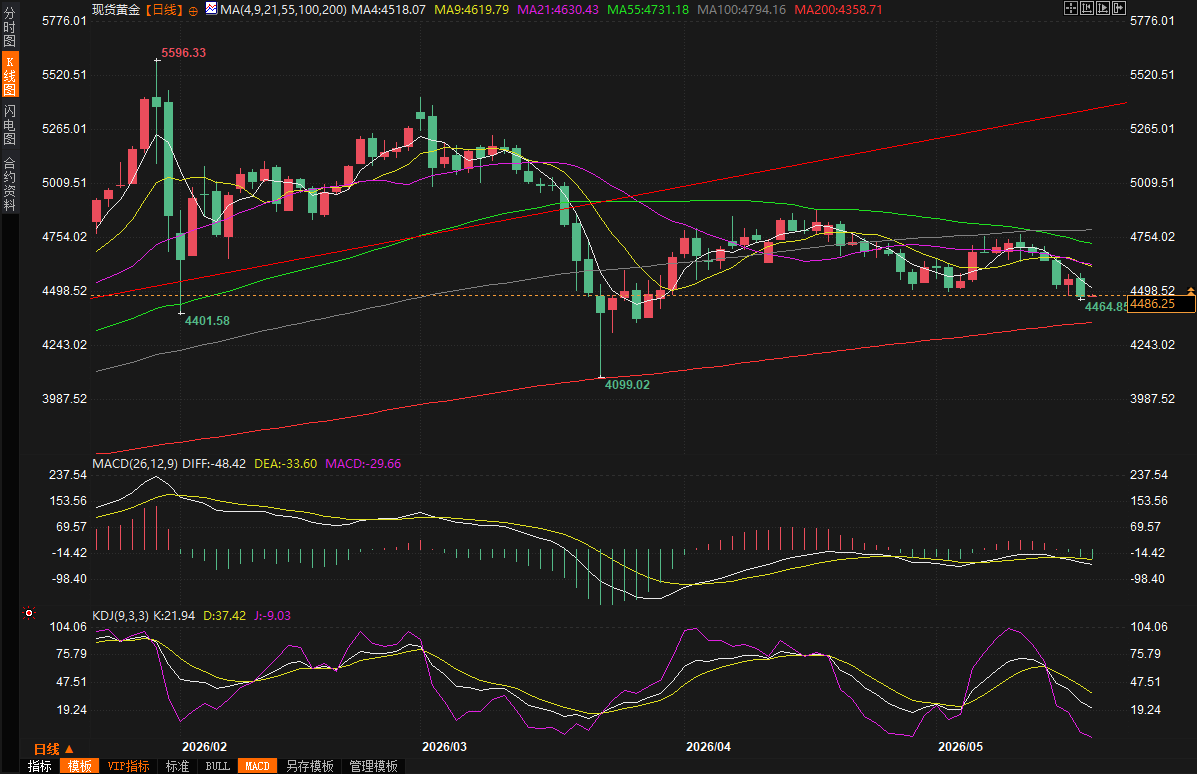
(Spot gold daily chart, source: FX678)
At 07:24 Beijing time, spot gold was trading at $4486.81 per ounce.
Although gold has historically been considered an inflation hedge, it faces unprecedented "opportunity cost" pressures in the current unique macroeconomic and geopolitical context. A stronger dollar, soaring US Treasury yields, and high energy prices driven by Middle East conflicts are collectively creating a perfect storm for a gold price decline.
On Wednesday (May 20) in early Asian trading, spot gold traded in a narrow range, currently at $4487.90 per ounce.
Gold spot prices are under pressure: Rising real interest rates are the biggest killer.
Tuesday's sharp drop in gold prices was not an isolated event, but a direct result of a confluence of multiple macroeconomic factors. Marex analyst Edward Meir stated bluntly that the general rise in global real interest rates is the main source of pressure on gold, and the strengthening of the US dollar further exacerbates this unfavorable situation.
The yield on the 10-year U.S. Treasury note surged to 4.687%, a new high since January 2025, before closing at 4.667%, a single-day increase of 8.7 basis points. The yield on the 30-year Treasury note rose even further, reaching 5.197%, a 19-year high. This significant upward shift at the long end of the yield curve directly increases the opportunity cost of holding gold, a non-interest-bearing asset. When investors can obtain higher real returns from Treasury bonds, the attractiveness of gold naturally diminishes.
Meanwhile, the dollar index rose 0.34% to 99.30, a six-week high. Dollar-denominated gold became more expensive for holders of non-dollar currencies, further dampening physical demand and investment buying. Analysis shows that this combination of a strong dollar and high yields is the core driver behind several gold price corrections in recent years.
Inflation concerns reignite: Brent crude oil's price above $110 is the main culprit.
The core driver behind rising yields and a stronger dollar is market concern about inflation spiraling out of control again. This concern stems from the energy market amid geopolitical conflicts in the Middle East.
Brent crude oil prices remained above $110 a barrel, having reached a high of $111. The conflict between Iran and the US and Israel has lasted for nearly three months, with Iran virtually blocking the Strait of Hormuz—a vital waterway for one-fifth of the world's oil shipments—leading to continued supply concerns. Even with the ceasefire agreement barely maintained, drone attacks on Gulf state facilities continue unabated, with the attack on the Barakah nuclear power plant in the UAE last weekend highlighting the possibility of escalation.
High fuel costs are rapidly spreading to the global supply chain, pushing up core inflationary pressures. Central banks are thus forced to maintain high interest rates, and may even face further tightening of policies later. This has dealt a double blow to gold: on the one hand, high interest rates have suppressed the premium of gold as a safe-haven asset; on the other hand, its inflation-hedging properties are temporarily overshadowed by the reality that "high interest rates must first suppress inflation."
US-Iran negotiations remain unresolved: The shadow of Trump's "further blow" looms over the market.
Geopolitical uncertainty acted as a catalyst for the recent gold price correction. US President Trump publicly stated on Tuesday that he was just an hour away from ordering a new round of strikes against Iran, and claimed that Iranian leaders were "begging" for a deal. While Vice President JD Vance indicated progress in negotiations, he also acknowledged the difficulties of dealing with a divided Iranian leadership.
The mediators revealed that Iran's position remains largely unchanged, still demanding an end to hostilities, compensation, the lifting of sanctions, and a role in the Strait of Hormuz, while the United States insists that Iran abandon its nuclear program. Both sides are "constantly shifting the goalposts," making the prospects for peace highly uncertain. The market generally believes that even if an agreement is reached in the short term, energy prices are unlikely to fall quickly, and long-term inflation risks will continue to support a high-interest-rate environment.
This state of "unresolved conflict and protracted negotiations" has created both safe-haven demand (theoretically beneficial for gold) and stronger downward pressure by pushing up oil prices and yields. Currently, the latter appears to be in the lead.
Federal Reserve policy expectations shift: hopes for rate cuts are slim, probability of rate hikes rises to 55%.
Investors are closely awaiting the release of the minutes from the Federal Reserve's April policy meeting on Wednesday. Current market pricing indicates a 94.2% probability that the Fed will keep interest rates unchanged in June, while the probability of a rate hike in December is approximately 55%. New Fed Chairman Kevin Warsh faces a particularly tough test, with the bond market demanding he demonstrate a commitment to combating inflation.
Economists have generally postponed their expectations for interest rate cuts until 2027, believing that the current energy-driven inflation may only be temporary. However, the word "temporary" is enough to make gold bulls feel uneasy. With expectations of high interest rates remaining for a longer period, the willingness to hold gold as a non-interest-bearing asset has significantly decreased.
Outlook: Short-term pressure, but structural opportunities remain in the medium to long term.
In summary, the current decline in gold prices is the result of a confluence of three factors: expectations of macroeconomic tightening, the transmission of inflation from geopolitical conflicts, and a strong US dollar. In the short term, as long as oil prices remain high and US Treasury yields continue to fluctuate at high levels, gold prices will face sustained downward pressure. The area around $4480 has become a significant psychological level; a breach of this level could lead to further testing of lower support levels.
However, from a medium- to long-term perspective, gold has not lost its bullish foundation. Geopolitical risks have not been eliminated, global debt levels remain high, and central banks' gold-buying trend continues. If the Middle East conflict escalates, causing oil prices to break through $120, or if the Federal Reserve's policy shows any dovish shift, gold will have a strong rebound opportunity. The current pullback is more like a healthy correction within a bull market than a trend reversal.
For investors, it is crucial to closely monitor the Federal Reserve meeting minutes, the latest developments in Middle East negotiations, and oil price trends. In 2026, a year shrouded in both inflation and geopolitical uncertainties, gold will remain an indispensable part of diversified portfolios; however, patience is needed to wait for a better entry point.
(Spot gold daily chart, source: FX678)
At 07:24 Beijing time, spot gold was trading at $4486.81 per ounce.
- Risk Warning and Disclaimer
- The market involves risk, and trading may not be suitable for all investors. This article is for reference only and does not constitute personal investment advice, nor does it take into account certain users’ specific investment objectives, financial situation, or other needs. Any investment decisions made based on this information are at your own risk.