Crude Oil Trading Alert: Geopolitical Concerns Coupled with a Sharp Drop in API Inventories Drive Oil Prices to Continue Rebound
2026-05-20 09:29:51
Tuesday saw a typical "sentiment reversal trading day" in the international crude oil market. WTI crude oil opened sharply lower in early Asian and European trading sessions due to market expectations of easing tensions in the Middle East, hitting a low near $101. However, as US President Trump subsequently reiterated a hardline stance in public speeches, the market quickly re-priced in geopolitical risk premiums, and WTI crude oil ultimately recovered all its losses, regaining its footing above the $103 mark. During Wednesday's Asian session, it traded around $104.10, returning to the upper boundary of the consolidation range; caution is advised against an upward breakout.

Previously, the market had believed that the US might postpone further military action against Iran, creating room for de-escalation in the Middle East. However, Trump subsequently stated that the US "has not left the Iran issue" and emphasized that "it may be necessary to strike Iran again," while revealing that Middle Eastern countries had requested "a few days" from the US to handle the situation. Trump also explicitly stated that the next two to three days would be a crucial decision-making window. This statement quickly changed the market's previous assessment of a de-escalation.
Iran responded with an even stronger stance. The Iranian Deputy Foreign Minister stated that Iran is "prepared to deal with any military aggression" and emphasized that Iran will either "win or die." The market generally believes this means the possibility of a comprehensive de-escalation agreement in the short term remains limited.
Meanwhile, the situation in the Strait of Hormuz remains the biggest focus of the global energy market. Market estimates suggest that the Strait of Hormuz handles approximately 20% of global seaborne crude oil transport , making it one of the world's most important energy transport routes. Currently, the number of oil tankers passing through the Strait of Hormuz is far below normal levels, with daily traffic only in the single digits, compared to over 120 vessels before the conflict. This means that the global crude oil supply chain still faces serious disruptions.
What worries the market even more is that NATO has signaled potential intervention. Market research indicates that NATO has stated it may consider joint deployment if the Strait of Hormuz cannot be reopened to normal traffic by July. This means that the situation, originally confined to the US, Israel, and Iran, could evolve into a broader international operation, further increasing market concerns about disruptions to global energy supplies.
The latest supply-side data further reinforced the upward trend in oil prices. Data from the American Petroleum Institute (API) showed that U.S. crude oil inventories unexpectedly fell by 9.1 million barrels last week, far exceeding market expectations of a 3.4 million barrel decline and significantly higher than the previous week's 2.188 million barrel drop. Such a large-scale inventory decline typically indicates strong demand from U.S. refineries, and also reflects a continued tightening of global supply liquidity.
This data echoes previous warnings from the International Energy Agency (IEA). The IEA recently pointed out that global crude oil and refined product inventories are declining rapidly. Although current global inventory levels have not yet reached emergency levels, the rate of decline has accelerated significantly. Furthermore, the obstruction of the Strait of Hormuz has affected global crude oil supply by approximately 10 to 12 million barrels per day , and some oil-producing countries will not be able to complete the adjustment of alternative transportation routes in the short term.
From a market sentiment perspective, the crude oil market has now entered a typical "risk premium-driven phase." Before there are clear signs of easing tensions in the Middle East, the market is more inclined to continue pricing in supply risks. Especially against the backdrop of rapidly declining US energy inventories, funds are beginning to flow back into the energy sector, further fueling bullish sentiment in crude oil.
From a technical perspective, WTI crude oil's daily chart structure remains clearly bullish. Currently, oil prices are firmly trading above the 50-day and 200-day exponential moving averages, with the 50-day EMA around $92, which has become a significant support area for the bullish trend since April. After rebounding from around $93 in early May, oil prices have now re-entered the $103-$104 range, indicating that the overall upward trend remains intact. The daily stochastic oscillator has turned upward from neutral territory, suggesting renewed bullish momentum and further upside potential. Short-term resistance is concentrated around $108, corresponding to the highs of April and May; if geopolitical tensions continue to deteriorate, the market may further test the year's high near $113.
From a 4-hour chart perspective, WTI crude oil's short-term trend remains bullish. Currently, oil prices are consolidating around $104, with short-term funds still inclined to buy on dips. Although the stochastic RSI indicator has shown some pullback, it has not yet entered extreme oversold territory, indicating that the current movement is more of a technical consolidation within an uptrend than a trend reversal. Key short-term support levels are first at the $103 psychological level, and then around $101.68. If oil prices can hold above these levels, the market still has a chance to further challenge the $108 resistance area. However, if there are signs of easing tensions, such as the resumption of some shipping in the Strait of Hormuz or the restart of negotiations between the US and Iran, the risk premium in the oil market may be quickly reversed, and oil prices may fall back to the 50-day moving average area around $90.
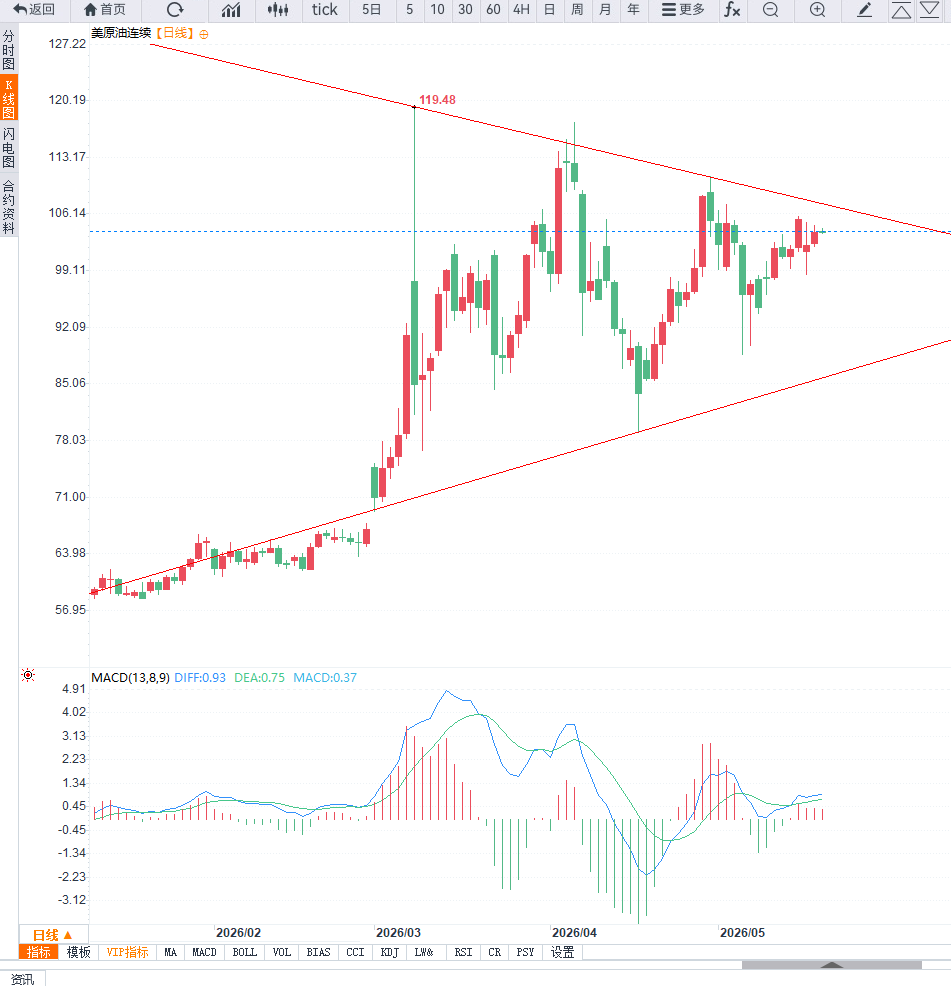
Overall, the core logic of the current crude oil market is very clear: as long as the issue of resuming shipping in the Strait of Hormuz remains unresolved, the market will continue to maintain a high risk premium. Meanwhile, the rapid decline in US inventories further amplifies expectations of tight supply. In the short term, geopolitical risks and inventory data will continue to be the two core variables determining the WTI oil price trend.
Editor's Summary : The international crude oil market has gradually shifted from the traditional supply and demand logic to a stage where "geopolitical risks drive pricing." The disruption of shipping in the Strait of Hormuz not only affects the stability of global energy supply but is also changing market assessments of future inventory safety margins. The Trump administration's increasingly assertive signals, Iran's continued strong responses, and expectations of potential NATO intervention all suggest that volatility in the global energy market may further increase in the coming weeks. Meanwhile, the unexpectedly large decline in US crude oil inventories indicates that the global supply buffer is shrinking. Against this backdrop, as long as the situation in the Middle East does not substantially ease, international oil prices still have room to rise further. However, the market also needs to be wary of the risk of a rapid correction due to a sudden resumption of diplomatic negotiations. For investors, the market has entered a high-volatility phase, making risk control significantly more important.
Previously, the market had believed that the US might postpone further military action against Iran, creating room for de-escalation in the Middle East. However, Trump subsequently stated that the US "has not left the Iran issue" and emphasized that "it may be necessary to strike Iran again," while revealing that Middle Eastern countries had requested "a few days" from the US to handle the situation. Trump also explicitly stated that the next two to three days would be a crucial decision-making window. This statement quickly changed the market's previous assessment of a de-escalation.
Iran responded with an even stronger stance. The Iranian Deputy Foreign Minister stated that Iran is "prepared to deal with any military aggression" and emphasized that Iran will either "win or die." The market generally believes this means the possibility of a comprehensive de-escalation agreement in the short term remains limited.
Meanwhile, the situation in the Strait of Hormuz remains the biggest focus of the global energy market. Market estimates suggest that the Strait of Hormuz handles approximately 20% of global seaborne crude oil transport , making it one of the world's most important energy transport routes. Currently, the number of oil tankers passing through the Strait of Hormuz is far below normal levels, with daily traffic only in the single digits, compared to over 120 vessels before the conflict. This means that the global crude oil supply chain still faces serious disruptions.
What worries the market even more is that NATO has signaled potential intervention. Market research indicates that NATO has stated it may consider joint deployment if the Strait of Hormuz cannot be reopened to normal traffic by July. This means that the situation, originally confined to the US, Israel, and Iran, could evolve into a broader international operation, further increasing market concerns about disruptions to global energy supplies.
The latest supply-side data further reinforced the upward trend in oil prices. Data from the American Petroleum Institute (API) showed that U.S. crude oil inventories unexpectedly fell by 9.1 million barrels last week, far exceeding market expectations of a 3.4 million barrel decline and significantly higher than the previous week's 2.188 million barrel drop. Such a large-scale inventory decline typically indicates strong demand from U.S. refineries, and also reflects a continued tightening of global supply liquidity.
This data echoes previous warnings from the International Energy Agency (IEA). The IEA recently pointed out that global crude oil and refined product inventories are declining rapidly. Although current global inventory levels have not yet reached emergency levels, the rate of decline has accelerated significantly. Furthermore, the obstruction of the Strait of Hormuz has affected global crude oil supply by approximately 10 to 12 million barrels per day , and some oil-producing countries will not be able to complete the adjustment of alternative transportation routes in the short term.
From a market sentiment perspective, the crude oil market has now entered a typical "risk premium-driven phase." Before there are clear signs of easing tensions in the Middle East, the market is more inclined to continue pricing in supply risks. Especially against the backdrop of rapidly declining US energy inventories, funds are beginning to flow back into the energy sector, further fueling bullish sentiment in crude oil.
From a technical perspective, WTI crude oil's daily chart structure remains clearly bullish. Currently, oil prices are firmly trading above the 50-day and 200-day exponential moving averages, with the 50-day EMA around $92, which has become a significant support area for the bullish trend since April. After rebounding from around $93 in early May, oil prices have now re-entered the $103-$104 range, indicating that the overall upward trend remains intact. The daily stochastic oscillator has turned upward from neutral territory, suggesting renewed bullish momentum and further upside potential. Short-term resistance is concentrated around $108, corresponding to the highs of April and May; if geopolitical tensions continue to deteriorate, the market may further test the year's high near $113.
From a 4-hour chart perspective, WTI crude oil's short-term trend remains bullish. Currently, oil prices are consolidating around $104, with short-term funds still inclined to buy on dips. Although the stochastic RSI indicator has shown some pullback, it has not yet entered extreme oversold territory, indicating that the current movement is more of a technical consolidation within an uptrend than a trend reversal. Key short-term support levels are first at the $103 psychological level, and then around $101.68. If oil prices can hold above these levels, the market still has a chance to further challenge the $108 resistance area. However, if there are signs of easing tensions, such as the resumption of some shipping in the Strait of Hormuz or the restart of negotiations between the US and Iran, the risk premium in the oil market may be quickly reversed, and oil prices may fall back to the 50-day moving average area around $90.
Overall, the core logic of the current crude oil market is very clear: as long as the issue of resuming shipping in the Strait of Hormuz remains unresolved, the market will continue to maintain a high risk premium. Meanwhile, the rapid decline in US inventories further amplifies expectations of tight supply. In the short term, geopolitical risks and inventory data will continue to be the two core variables determining the WTI oil price trend.
Editor's Summary : The international crude oil market has gradually shifted from the traditional supply and demand logic to a stage where "geopolitical risks drive pricing." The disruption of shipping in the Strait of Hormuz not only affects the stability of global energy supply but is also changing market assessments of future inventory safety margins. The Trump administration's increasingly assertive signals, Iran's continued strong responses, and expectations of potential NATO intervention all suggest that volatility in the global energy market may further increase in the coming weeks. Meanwhile, the unexpectedly large decline in US crude oil inventories indicates that the global supply buffer is shrinking. Against this backdrop, as long as the situation in the Middle East does not substantially ease, international oil prices still have room to rise further. However, the market also needs to be wary of the risk of a rapid correction due to a sudden resumption of diplomatic negotiations. For investors, the market has entered a high-volatility phase, making risk control significantly more important.
- Risk Warning and Disclaimer
- The market involves risk, and trading may not be suitable for all investors. This article is for reference only and does not constitute personal investment advice, nor does it take into account certain users’ specific investment objectives, financial situation, or other needs. Any investment decisions made based on this information are at your own risk.