Soaring US Treasury yields coupled with rising inflation concerns in the Middle East sent gold prices below $4,500, hitting a near two-month low.
2026-05-20 09:46:13
International gold prices continued their downward trend during Asian trading hours on Wednesday, with spot gold (XAU/USD) encountering significant selling pressure around $4480 and briefly hitting a near two-month low. The core trading logic in the market has gradually shifted from "safe-haven buying" to "high interest rates suppressing gold," with the continued rise in US Treasury yields being a key factor in the decline in gold prices.

U.S. long-term Treasury yields continued their rapid climb on Tuesday, with the 30-year Treasury yield rising as high as 5.20% , its highest level since the eve of the 2007 global financial crisis. Meanwhile, the 10-year Treasury yield also rose to around 4.69% , its highest level since early 2025. Although yields retreated slightly towards the end of the day, they remained high overall, reflecting a significant increase in market concerns about future U.S. inflation risks and the high-interest-rate environment.
Typically, as a non-interest-bearing asset, gold's price movement exhibits a clear negative correlation with US real interest rates. When US Treasury yields rise continuously, the opportunity cost of holding gold increases accordingly, and funds tend to flow more towards higher-yielding dollar assets, thus diminishing gold's attractiveness.
Furthermore, the recent strengthening of the US dollar index has further exacerbated the pressure on the gold market. As the market reassesses the Federal Reserve's future policy path, funds continue to flow back into dollar assets, driving the dollar's overall strength. Analysts point out that real interest rates are generally rising globally, and gold is one of the assets most affected.
Marex analyst Edward Meir stated that real interest rates are rising in many countries around the world, and a stronger dollar is also negatively impacting gold. The market is now beginning to worry that major central banks globally may need to maintain high interest rates for an extended period to address persistent inflation risks.
One of the key reasons driving renewed inflation expectations in the market remains the situation in the Middle East. The lack of substantial progress in resuming shipping through the Strait of Hormuz continues to pose a persistent risk to global energy supply. Since the Strait of Hormuz handles approximately 20% of global seaborne crude oil transport, market concerns that disruptions to oil supply could further push up international energy prices and transmit to the global inflation system.
US President Donald Trump on Tuesday again sent a tough signal towards Iran. This followed his earlier statement that military action against Iran was being cancelled, but he later threatened that the US might resume strikes against Iran in the coming days to push for a deal. This back-and-forth rhetoric has further exacerbated market concerns about an escalation of tensions in the Middle East.
The biggest concern in the market right now is not simply geopolitical risk itself, but rather the potential for rising energy prices to reignite global inflation. If international oil prices remain high, the Federal Reserve, the European Central Bank, and other major central banks may be forced to maintain tight monetary policies, thus putting long-term pressure on gold. Looking at capital flows, some safe-haven funds have recently begun flowing from the gold market to the US dollar and US Treasury markets. While the situation in the Middle East is theoretically favorable for safe-haven assets, the traditional safe-haven logic of gold is being challenged in the current context of a high-interest-rate environment.
From a technical perspective, the daily chart for gold has shown clear signs of weakening. The current gold price has broken through multiple short-term moving average supports and is gradually approaching the medium-term support zone. The daily stochastic oscillator continues to decline, indicating that bearish momentum remains dominant. The key short-term support level for gold is currently around $4450. A break below this area could lead to a further test of the $4400 psychological level. If bearish sentiment continues to spread, a further pullback to the $4300 area cannot be ruled out.
On the upside, $4,500 has become the first short-term resistance level, while more significant resistance lies in the $4,520 to $4,550 range. Only when gold regains a foothold in these areas can the market potentially resume its upward momentum.
From a 4-hour chart perspective, gold's short-term trend remains bearish. Prices continue to trade below short-term moving averages, and while the stochastic RSI indicator is near oversold territory, it hasn't yet formed a clear bullish divergence, suggesting the market is currently in a weak consolidation phase rather than a trend reversal. Furthermore, the 4-hour chart shows recent highs for gold continuing to decline, reflecting a still significant short-term bearish sentiment. If US Treasury yields remain high and the US dollar index rises further, gold may continue to face downward pressure in the short term.
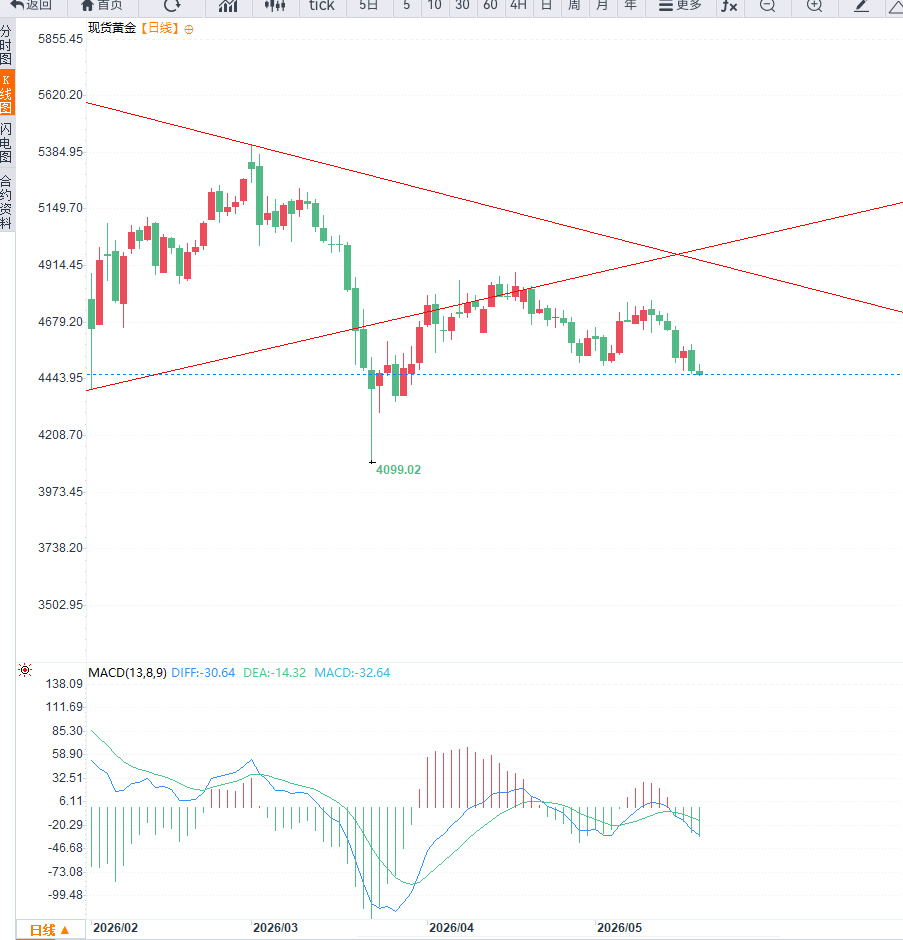
Overall, the gold market is currently in a phase of balancing between "high interest rate suppression" and "safe-haven demand support." While the situation in the Middle East continues to provide some safe-haven support, rising real interest rates and a strong dollar are gradually weakening the upward momentum for gold. Against the backdrop of renewed global inflation risks, future gold price movements will remain highly dependent on changes in US bond yields and adjustments to Federal Reserve policy expectations.
Editor's Summary : The gold market is currently undergoing a typical shift in macroeconomic logic. The geopolitical safe-haven sentiment that previously supported gold's rise is gradually being weakened by expectations of "long-term high interest rates." The US long-term Treasury yields hitting multi-year highs indicate that the market has begun to reassess future global inflation risks, while the situation in the Strait of Hormuz further amplifies inflationary pressures from rising energy prices. In the short term, as long as US yields remain high, gold will still face some downward pressure. However, the uncertainty surrounding the Middle East situation continues to limit the potential for a significant decline in gold prices. The market focus will shift to the Federal Reserve's policy path, US inflation data, and changes in global energy supply. Gold is likely to maintain high volatility going forward, and investors should pay close attention to changes in interest rates and the direction of the US dollar.
U.S. long-term Treasury yields continued their rapid climb on Tuesday, with the 30-year Treasury yield rising as high as 5.20% , its highest level since the eve of the 2007 global financial crisis. Meanwhile, the 10-year Treasury yield also rose to around 4.69% , its highest level since early 2025. Although yields retreated slightly towards the end of the day, they remained high overall, reflecting a significant increase in market concerns about future U.S. inflation risks and the high-interest-rate environment.
Typically, as a non-interest-bearing asset, gold's price movement exhibits a clear negative correlation with US real interest rates. When US Treasury yields rise continuously, the opportunity cost of holding gold increases accordingly, and funds tend to flow more towards higher-yielding dollar assets, thus diminishing gold's attractiveness.
Furthermore, the recent strengthening of the US dollar index has further exacerbated the pressure on the gold market. As the market reassesses the Federal Reserve's future policy path, funds continue to flow back into dollar assets, driving the dollar's overall strength. Analysts point out that real interest rates are generally rising globally, and gold is one of the assets most affected.
Marex analyst Edward Meir stated that real interest rates are rising in many countries around the world, and a stronger dollar is also negatively impacting gold. The market is now beginning to worry that major central banks globally may need to maintain high interest rates for an extended period to address persistent inflation risks.
One of the key reasons driving renewed inflation expectations in the market remains the situation in the Middle East. The lack of substantial progress in resuming shipping through the Strait of Hormuz continues to pose a persistent risk to global energy supply. Since the Strait of Hormuz handles approximately 20% of global seaborne crude oil transport, market concerns that disruptions to oil supply could further push up international energy prices and transmit to the global inflation system.
US President Donald Trump on Tuesday again sent a tough signal towards Iran. This followed his earlier statement that military action against Iran was being cancelled, but he later threatened that the US might resume strikes against Iran in the coming days to push for a deal. This back-and-forth rhetoric has further exacerbated market concerns about an escalation of tensions in the Middle East.
The biggest concern in the market right now is not simply geopolitical risk itself, but rather the potential for rising energy prices to reignite global inflation. If international oil prices remain high, the Federal Reserve, the European Central Bank, and other major central banks may be forced to maintain tight monetary policies, thus putting long-term pressure on gold. Looking at capital flows, some safe-haven funds have recently begun flowing from the gold market to the US dollar and US Treasury markets. While the situation in the Middle East is theoretically favorable for safe-haven assets, the traditional safe-haven logic of gold is being challenged in the current context of a high-interest-rate environment.
From a technical perspective, the daily chart for gold has shown clear signs of weakening. The current gold price has broken through multiple short-term moving average supports and is gradually approaching the medium-term support zone. The daily stochastic oscillator continues to decline, indicating that bearish momentum remains dominant. The key short-term support level for gold is currently around $4450. A break below this area could lead to a further test of the $4400 psychological level. If bearish sentiment continues to spread, a further pullback to the $4300 area cannot be ruled out.
On the upside, $4,500 has become the first short-term resistance level, while more significant resistance lies in the $4,520 to $4,550 range. Only when gold regains a foothold in these areas can the market potentially resume its upward momentum.
From a 4-hour chart perspective, gold's short-term trend remains bearish. Prices continue to trade below short-term moving averages, and while the stochastic RSI indicator is near oversold territory, it hasn't yet formed a clear bullish divergence, suggesting the market is currently in a weak consolidation phase rather than a trend reversal. Furthermore, the 4-hour chart shows recent highs for gold continuing to decline, reflecting a still significant short-term bearish sentiment. If US Treasury yields remain high and the US dollar index rises further, gold may continue to face downward pressure in the short term.
Overall, the gold market is currently in a phase of balancing between "high interest rate suppression" and "safe-haven demand support." While the situation in the Middle East continues to provide some safe-haven support, rising real interest rates and a strong dollar are gradually weakening the upward momentum for gold. Against the backdrop of renewed global inflation risks, future gold price movements will remain highly dependent on changes in US bond yields and adjustments to Federal Reserve policy expectations.
Editor's Summary : The gold market is currently undergoing a typical shift in macroeconomic logic. The geopolitical safe-haven sentiment that previously supported gold's rise is gradually being weakened by expectations of "long-term high interest rates." The US long-term Treasury yields hitting multi-year highs indicate that the market has begun to reassess future global inflation risks, while the situation in the Strait of Hormuz further amplifies inflationary pressures from rising energy prices. In the short term, as long as US yields remain high, gold will still face some downward pressure. However, the uncertainty surrounding the Middle East situation continues to limit the potential for a significant decline in gold prices. The market focus will shift to the Federal Reserve's policy path, US inflation data, and changes in global energy supply. Gold is likely to maintain high volatility going forward, and investors should pay close attention to changes in interest rates and the direction of the US dollar.
- Risk Warning and Disclaimer
- The market involves risk, and trading may not be suitable for all investors. This article is for reference only and does not constitute personal investment advice, nor does it take into account certain users’ specific investment objectives, financial situation, or other needs. Any investment decisions made based on this information are at your own risk.