Middle East risks and hawkish expectations from the Federal Reserve supported the US dollar, and the USD/CAD pair maintained a volatile rebound.
2026-05-20 10:51:20
The US dollar rebounded slightly against the Canadian dollar in Asian trading on Wednesday, after briefly retreating from near 1.3775, a new high since mid-April. However, with the US dollar index continuing to strengthen, the USD/CAD pair remains generally bullish. The core driver of the current market remains global risk aversion stemming from the escalating tensions in the Middle East. US President Trump previously stated that the US had temporarily postponed a new round of military action against Iran after receiving a request from Gulf leaders, but emphasized that the US might still "need to strike Iran again" in the future.

Meanwhile, negotiations between the United States and Iran have made little substantial progress, with significant differences remaining between the two sides on the nuclear issue and shipping in the Strait of Hormuz. Markets are widely concerned that a continued escalation of the situation in the Middle East would further impact the stability of global energy supplies. Since the Strait of Hormuz handles approximately 20% of global seaborne crude oil transport, any risk of disruption to this transport would quickly push up international oil prices and reignite global inflation concerns. This is also one of the key reasons why the US dollar remains strong.
The dollar index rose to its highest level since April 7 on Tuesday, indicating continued growth in market demand for safe-haven assets. Meanwhile, persistently high U.S. Treasury yields further enhanced the dollar's attractiveness.
From a monetary policy perspective, market expectations for the Federal Reserve to maintain high interest rates in the future are heating up again. According to the CME Group's FedWatch tool, traders are now betting on a greater than 55% probability that the Fed will raise interest rates by more than 25 basis points again in 2026. This shift in expectations means that the market believes that the risk of inflation in the United States may last longer than previously anticipated, and rising international oil prices have further reinforced this logic.
The continued high yields on long-term US Treasury bonds are driving continued inflows into dollar-denominated assets. Especially against the backdrop of rising global risk aversion, the dollar possesses both "high-yield" and "safe-haven" attributes. However, the market remains cautious about the Federal Reserve meeting minutes, with some dollar bulls temporarily slowing their pursuit of higher prices ahead of this important event.
For the Canadian dollar, rising international oil prices have alleviated some of the pressure on the local currency. As a major global energy exporter, Canada typically benefits from improved terms of trade during periods of rising oil prices, thus supporting the Canadian dollar's performance. Although previously released Canadian consumer inflation data was weaker than market expectations, the high level of WTI crude oil prices prevented the Canadian dollar from experiencing a significant one-sided decline.
The market currently believes that as long as international crude oil prices remain strong, the Canadian dollar will generally retain some defensive capabilities. However, given the current strength of the US dollar, the overall trend for USD/CAD remains upward. Furthermore, the Canadian economy is facing some pressure recently. With the rising risk of a global economic slowdown, Canadian export demand may be affected. At the same time, if the US maintains high interest rates for an extended period, it could further widen the interest rate differential between the US and Canada, thus continuing to support USD/CAD.
From a technical perspective, the USD/CAD daily chart structure has clearly strengthened. After successfully breaking through the key resistance level of 1.3650 recently, the bullish momentum has continued to increase, and the pair has regained its footing above the 50-day and 200-day exponential moving averages. Currently, the 50-day EMA is around 1.3560, while the 200-day EMA is in the 1.3480 area, indicating that the medium-to-long-term trend has gradually shifted towards a bullish structure. The daily chart shows that USD/CAD has formed a clear upward channel structure since rebounding from the May low of around 1.3420. Recent candlesticks have closed with consecutive positive candles, reflecting the continued dominance of bullish sentiment in the market. On the upside, the 1.3780 area has become the first key resistance level. If the US dollar continues to strengthen, USD/CAD has the opportunity to further test the 1.3850 area, and even retest the 1.3900 area. On the downside, 1.3700 has become an important short-term support area. If a technical pullback occurs, the area around 1.3650 will become a more crucial defensive position.
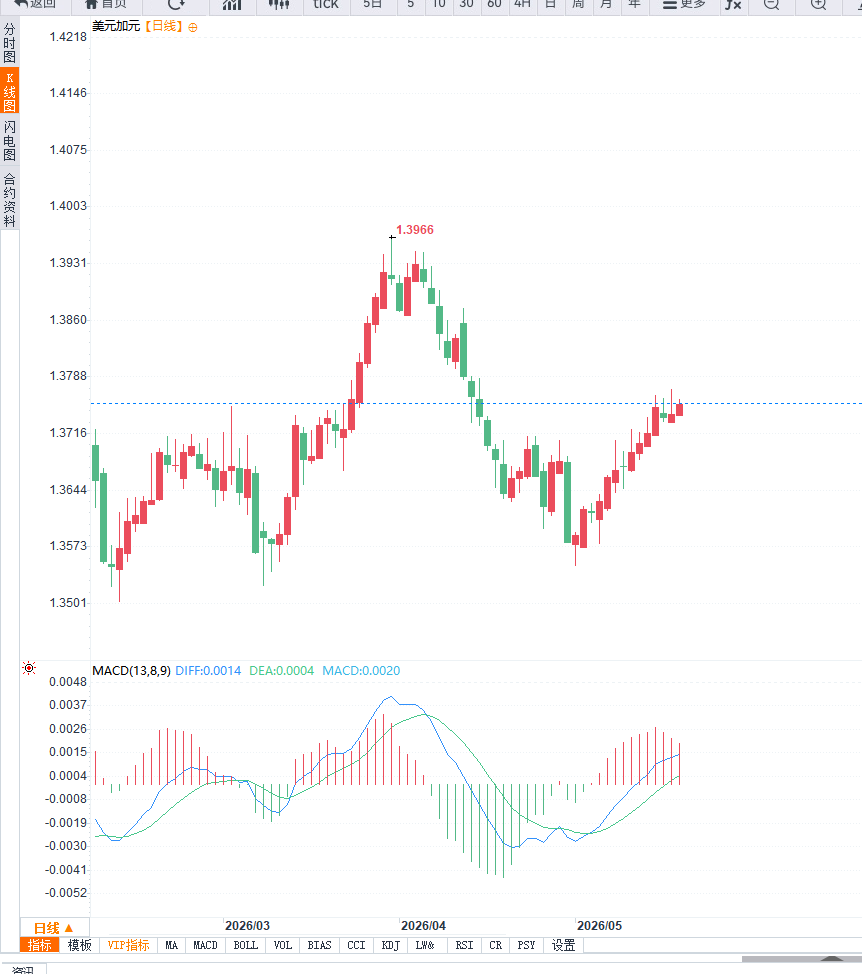
Overall, the current USD/CAD exchange rate is primarily influenced by both the strength of the US dollar as a safe haven and the support of oil prices for the Canadian dollar. In the short term, expectations regarding Federal Reserve policy, the situation in the Middle East, and changes in international crude oil prices will remain the core variables determining the direction of USD/CAD.
Editor's Summary : The USD/CAD market is currently in a clearly bullish phase. Continued tensions in the Middle East, high international oil prices, and hawkish expectations from the Federal Reserve are collectively driving the US dollar's strength. While rising oil prices provide some support for the Canadian dollar, the overall strength of the US dollar makes it difficult for the Canadian dollar to completely offset the upward pressure on USD/CAD in the short term. From a technical perspective, the short-to-medium-term trend for USD/CAD remains bullish, but it is gradually approaching a temporary high. The market focus will now be on the Federal Reserve meeting minutes, developments in the Middle East, and international oil price movements. If global risk aversion continues to rise, USD/CAD may have further upside potential.
Meanwhile, negotiations between the United States and Iran have made little substantial progress, with significant differences remaining between the two sides on the nuclear issue and shipping in the Strait of Hormuz. Markets are widely concerned that a continued escalation of the situation in the Middle East would further impact the stability of global energy supplies. Since the Strait of Hormuz handles approximately 20% of global seaborne crude oil transport, any risk of disruption to this transport would quickly push up international oil prices and reignite global inflation concerns. This is also one of the key reasons why the US dollar remains strong.
The dollar index rose to its highest level since April 7 on Tuesday, indicating continued growth in market demand for safe-haven assets. Meanwhile, persistently high U.S. Treasury yields further enhanced the dollar's attractiveness.
From a monetary policy perspective, market expectations for the Federal Reserve to maintain high interest rates in the future are heating up again. According to the CME Group's FedWatch tool, traders are now betting on a greater than 55% probability that the Fed will raise interest rates by more than 25 basis points again in 2026. This shift in expectations means that the market believes that the risk of inflation in the United States may last longer than previously anticipated, and rising international oil prices have further reinforced this logic.
The continued high yields on long-term US Treasury bonds are driving continued inflows into dollar-denominated assets. Especially against the backdrop of rising global risk aversion, the dollar possesses both "high-yield" and "safe-haven" attributes. However, the market remains cautious about the Federal Reserve meeting minutes, with some dollar bulls temporarily slowing their pursuit of higher prices ahead of this important event.
For the Canadian dollar, rising international oil prices have alleviated some of the pressure on the local currency. As a major global energy exporter, Canada typically benefits from improved terms of trade during periods of rising oil prices, thus supporting the Canadian dollar's performance. Although previously released Canadian consumer inflation data was weaker than market expectations, the high level of WTI crude oil prices prevented the Canadian dollar from experiencing a significant one-sided decline.
The market currently believes that as long as international crude oil prices remain strong, the Canadian dollar will generally retain some defensive capabilities. However, given the current strength of the US dollar, the overall trend for USD/CAD remains upward. Furthermore, the Canadian economy is facing some pressure recently. With the rising risk of a global economic slowdown, Canadian export demand may be affected. At the same time, if the US maintains high interest rates for an extended period, it could further widen the interest rate differential between the US and Canada, thus continuing to support USD/CAD.
From a technical perspective, the USD/CAD daily chart structure has clearly strengthened. After successfully breaking through the key resistance level of 1.3650 recently, the bullish momentum has continued to increase, and the pair has regained its footing above the 50-day and 200-day exponential moving averages. Currently, the 50-day EMA is around 1.3560, while the 200-day EMA is in the 1.3480 area, indicating that the medium-to-long-term trend has gradually shifted towards a bullish structure. The daily chart shows that USD/CAD has formed a clear upward channel structure since rebounding from the May low of around 1.3420. Recent candlesticks have closed with consecutive positive candles, reflecting the continued dominance of bullish sentiment in the market. On the upside, the 1.3780 area has become the first key resistance level. If the US dollar continues to strengthen, USD/CAD has the opportunity to further test the 1.3850 area, and even retest the 1.3900 area. On the downside, 1.3700 has become an important short-term support area. If a technical pullback occurs, the area around 1.3650 will become a more crucial defensive position.
Overall, the current USD/CAD exchange rate is primarily influenced by both the strength of the US dollar as a safe haven and the support of oil prices for the Canadian dollar. In the short term, expectations regarding Federal Reserve policy, the situation in the Middle East, and changes in international crude oil prices will remain the core variables determining the direction of USD/CAD.
Editor's Summary : The USD/CAD market is currently in a clearly bullish phase. Continued tensions in the Middle East, high international oil prices, and hawkish expectations from the Federal Reserve are collectively driving the US dollar's strength. While rising oil prices provide some support for the Canadian dollar, the overall strength of the US dollar makes it difficult for the Canadian dollar to completely offset the upward pressure on USD/CAD in the short term. From a technical perspective, the short-to-medium-term trend for USD/CAD remains bullish, but it is gradually approaching a temporary high. The market focus will now be on the Federal Reserve meeting minutes, developments in the Middle East, and international oil price movements. If global risk aversion continues to rise, USD/CAD may have further upside potential.
- Risk Warning and Disclaimer
- The market involves risk, and trading may not be suitable for all investors. This article is for reference only and does not constitute personal investment advice, nor does it take into account certain users’ specific investment objectives, financial situation, or other needs. Any investment decisions made based on this information are at your own risk.