The euro broke below short-term moving average support against the yen, and the descending wedge pattern suggests that the bearish momentum is gradually slowing.
2026-05-20 14:24:34
The euro continued its pullback against the yen in Asian trading on Wednesday, falling to around 184.30, marking its second consecutive day of weakness. The market is currently caught in a tug-of-war between rising global risk aversion, expectations of Japanese intervention, and hawkish expectations from the European Central Bank, causing EUR/JPY to consolidate at relatively high levels.

Recent tensions in the Middle East have led to a significant decline in global risk appetite. US President Trump's statement that the US might resume military action against Iran within the next two to three days has reignited market concerns about the risk of further escalation in the Middle East.
Meanwhile, Iran maintained its hardline stance, stating that any military strike would be met with a response. Against this backdrop, market risk aversion intensified significantly, with some funds flowing back into safe-haven currencies such as the Japanese yen.
However, unlike traditional safe-haven cycles, the current overall rebound of the yen remains relatively limited due to the persistently large interest rate differential between Japan and the US and Europe. Especially given the continued high yields on US Treasury bonds, carry trades continue to exert long-term pressure on the yen.
For the euro, the European Central Bank's recent hawkish shift has become a significant supporting factor. As rising international energy prices increase inflation risks in the Eurozone, market bets on further ECB rate hikes have rapidly intensified. Currently, most market participants expect the ECB to raise rates by another 25 basis points in June. Bundesbank President Nagel and ECB official Koch have both recently released hawkish signals, emphasizing that rising energy prices could reignite Eurozone inflation.
However, in the short term, EUR/JPY still faces some technical adjustment pressure. After approaching the historical high of 188, the bullish momentum gradually weakened, and the market entered a phase of profit-taking at higher levels.
From the daily chart, EUR/JPY currently maintains a generally bullish medium- to long-term structure, but has entered a clear correction phase in the short term. The exchange rate is currently trading within a gradually converging descending wedge pattern. This pattern typically consists of "continuously lower lows" and "continuously lower highs," but as the trading range gradually narrows, it usually indicates that the bearish momentum is gradually weakening.
The EUR/JPY pair has currently broken below both the 9-day exponential moving average (EMA) and the 50-day EMA, indicating a shift in short-term market sentiment from a strong upward trend to a bearish consolidation. The 9-day EMA is currently around 184.71, while the 50-day EMA is in the 184.84 area. These two levels have become the most critical short-term resistance zones. The daily stochastic oscillator (RSI) is currently hovering around 44, showing weak overall market momentum, but it has not yet entered extreme oversold territory. This means that while the market is still dominated by bears, the downward momentum has begun to slow.
From a candlestick chart perspective, EUR/JPY has recently formed a series of lower highs, while support levels are gradually approaching, indicating that the market is entering a phase of directional choice. If the exchange rate can subsequently break through the upper trendline of the descending wedge and hold above 184.80, the technical outlook may shift back to bullish, with a potential retest of the historical high area of 187.95. 187.95 is the historical high reached by EUR/JPY on April 17th and is currently the most important long-term resistance area. If the euro continues to receive support from expectations of ECB rate hikes, while the yen weakens again, EUR/JPY may still have the potential to retest this area.
On the downside, the 181.87 area is the first key support level, corresponding to the three-month low formed in mid-March. If market risk sentiment deteriorates further, or the Japanese government increases its intervention in the exchange rate, EUR/JPY may further test the 180.81 area, which corresponds to the February low and is also an important defensive area in the current medium-term structure.
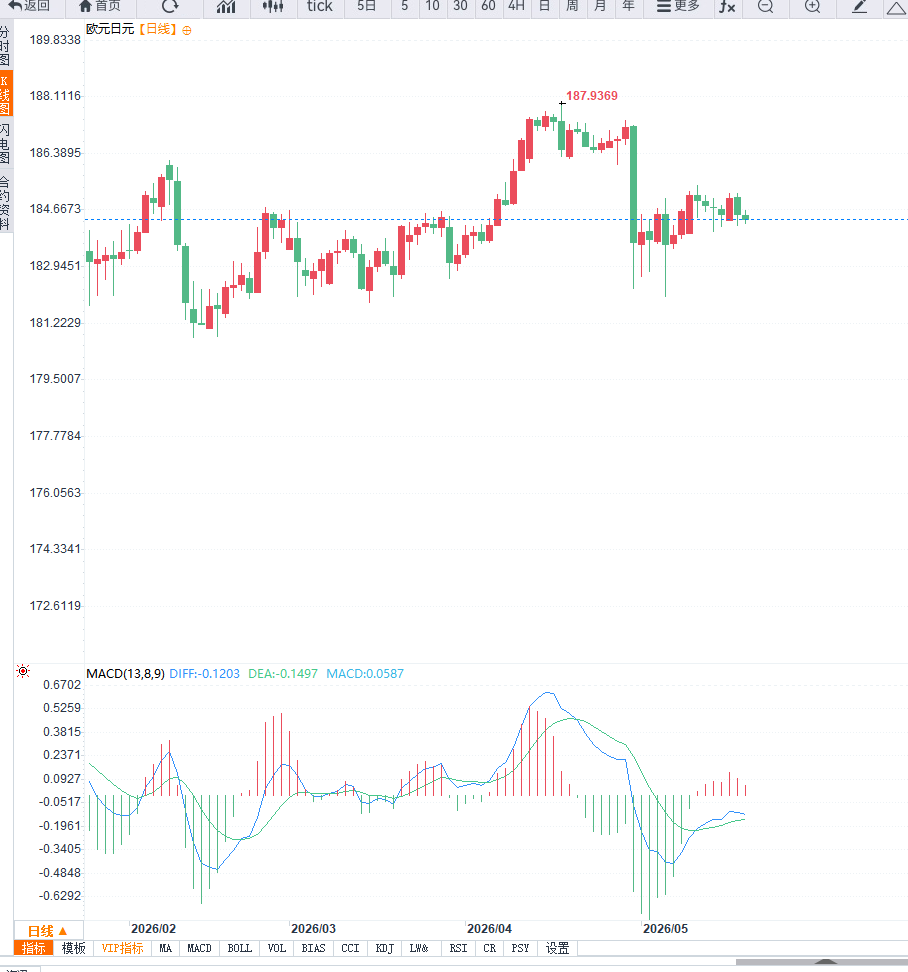
Overall, EUR/JPY is currently in a transitional phase between a short-term correction and a medium- to long-term bullish trend. The future direction of the exchange rate will largely depend on global risk sentiment, changes in the interest rate differential between the US and Europe and Japan, and whether expectations of Japanese government intervention further intensify.
Editor's Summary : The current EUR/JPY exchange rate has gradually entered a high-level correction phase after its previous one-sided rise. Although hawkish expectations from the European Central Bank continue to support the euro, rising global risk aversion and expectations of Japanese currency intervention are limiting further upside potential for EUR/JPY. From a technical perspective, the descending wedge pattern indicates that bearish momentum is gradually weakening, but the market has not yet completed a true breakout. In the short term, the resistance around 184.80 and the support area around 181.80 will be crucial watersheds determining the next direction of EUR/JPY. Going forward, the market will need to focus on developments in the Middle East, the European Central Bank's policy path, and the official Japanese exchange rate stance, as these factors will collectively determine whether EUR/JPY can resume its upward trend.
Recent tensions in the Middle East have led to a significant decline in global risk appetite. US President Trump's statement that the US might resume military action against Iran within the next two to three days has reignited market concerns about the risk of further escalation in the Middle East.
Meanwhile, Iran maintained its hardline stance, stating that any military strike would be met with a response. Against this backdrop, market risk aversion intensified significantly, with some funds flowing back into safe-haven currencies such as the Japanese yen.
However, unlike traditional safe-haven cycles, the current overall rebound of the yen remains relatively limited due to the persistently large interest rate differential between Japan and the US and Europe. Especially given the continued high yields on US Treasury bonds, carry trades continue to exert long-term pressure on the yen.
For the euro, the European Central Bank's recent hawkish shift has become a significant supporting factor. As rising international energy prices increase inflation risks in the Eurozone, market bets on further ECB rate hikes have rapidly intensified. Currently, most market participants expect the ECB to raise rates by another 25 basis points in June. Bundesbank President Nagel and ECB official Koch have both recently released hawkish signals, emphasizing that rising energy prices could reignite Eurozone inflation.
However, in the short term, EUR/JPY still faces some technical adjustment pressure. After approaching the historical high of 188, the bullish momentum gradually weakened, and the market entered a phase of profit-taking at higher levels.
From the daily chart, EUR/JPY currently maintains a generally bullish medium- to long-term structure, but has entered a clear correction phase in the short term. The exchange rate is currently trading within a gradually converging descending wedge pattern. This pattern typically consists of "continuously lower lows" and "continuously lower highs," but as the trading range gradually narrows, it usually indicates that the bearish momentum is gradually weakening.
The EUR/JPY pair has currently broken below both the 9-day exponential moving average (EMA) and the 50-day EMA, indicating a shift in short-term market sentiment from a strong upward trend to a bearish consolidation. The 9-day EMA is currently around 184.71, while the 50-day EMA is in the 184.84 area. These two levels have become the most critical short-term resistance zones. The daily stochastic oscillator (RSI) is currently hovering around 44, showing weak overall market momentum, but it has not yet entered extreme oversold territory. This means that while the market is still dominated by bears, the downward momentum has begun to slow.
From a candlestick chart perspective, EUR/JPY has recently formed a series of lower highs, while support levels are gradually approaching, indicating that the market is entering a phase of directional choice. If the exchange rate can subsequently break through the upper trendline of the descending wedge and hold above 184.80, the technical outlook may shift back to bullish, with a potential retest of the historical high area of 187.95. 187.95 is the historical high reached by EUR/JPY on April 17th and is currently the most important long-term resistance area. If the euro continues to receive support from expectations of ECB rate hikes, while the yen weakens again, EUR/JPY may still have the potential to retest this area.
On the downside, the 181.87 area is the first key support level, corresponding to the three-month low formed in mid-March. If market risk sentiment deteriorates further, or the Japanese government increases its intervention in the exchange rate, EUR/JPY may further test the 180.81 area, which corresponds to the February low and is also an important defensive area in the current medium-term structure.
Overall, EUR/JPY is currently in a transitional phase between a short-term correction and a medium- to long-term bullish trend. The future direction of the exchange rate will largely depend on global risk sentiment, changes in the interest rate differential between the US and Europe and Japan, and whether expectations of Japanese government intervention further intensify.
Editor's Summary : The current EUR/JPY exchange rate has gradually entered a high-level correction phase after its previous one-sided rise. Although hawkish expectations from the European Central Bank continue to support the euro, rising global risk aversion and expectations of Japanese currency intervention are limiting further upside potential for EUR/JPY. From a technical perspective, the descending wedge pattern indicates that bearish momentum is gradually weakening, but the market has not yet completed a true breakout. In the short term, the resistance around 184.80 and the support area around 181.80 will be crucial watersheds determining the next direction of EUR/JPY. Going forward, the market will need to focus on developments in the Middle East, the European Central Bank's policy path, and the official Japanese exchange rate stance, as these factors will collectively determine whether EUR/JPY can resume its upward trend.
- Risk Warning and Disclaimer
- The market involves risk, and trading may not be suitable for all investors. This article is for reference only and does not constitute personal investment advice, nor does it take into account certain users’ specific investment objectives, financial situation, or other needs. Any investment decisions made based on this information are at your own risk.