Silver Analysis: Could this "technical correction" turn into a "new round of sell-off" at any time?
2026-05-20 20:57:46
On Wednesday, May 20, spot silver was fluctuating around $75.5 per ounce, stabilizing somewhat from the previous trading day's closing price of $73.70. On the same day, spot gold was oscillating around $4,500 per ounce, the 10-year US Treasury yield was around 4.65%, and the US dollar index was around 99.35, still in the six-week high range.
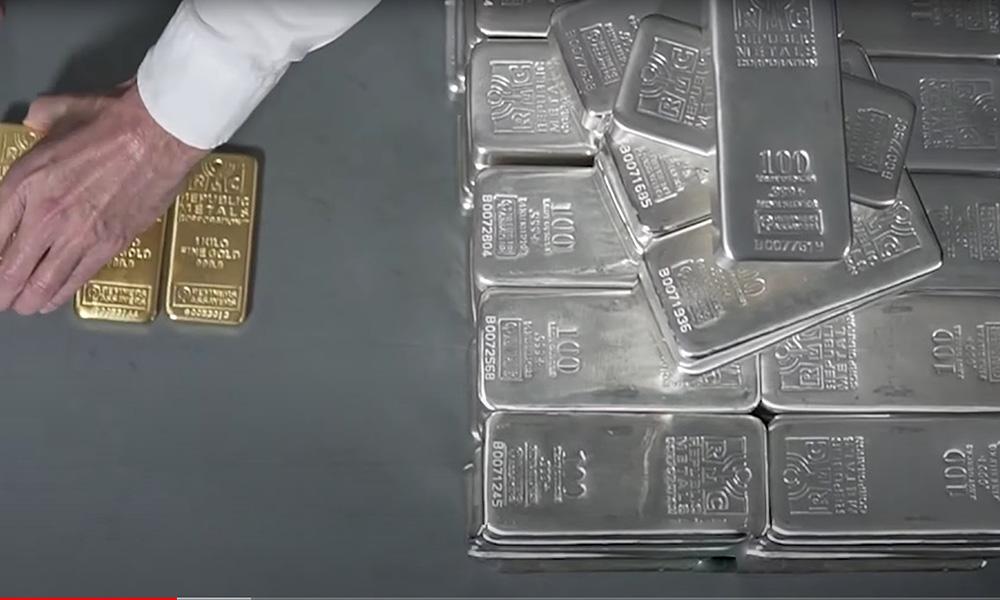
Spot silver stabilized and rose today, seemingly a recovery in precious metals following gold, but essentially reflecting a re-stratification of market expectations regarding energy shocks, inflation paths, and Federal Reserve policy. The oil price premium resulting from disturbances in the Strait of Hormuz has not fully subsided; even with a pullback, Brent and WTI crude remain above $100 per barrel, indicating that energy prices continue to exert a sticky influence on inflation expectations. Meanwhile, the US 30-year mortgage contract rate rose to 6.56%, a near two-month high, while mortgage applications fell by 2.3%, suggesting that high interest rates are once again suppressing interest rate-sensitive sectors.
For silver, this information is not entirely bullish. If easing geopolitical risks lead to a decline in oil prices, lower inflation expectations will reduce pressure on the Federal Reserve to raise interest rates, easing valuation pressures on precious metals. However, if oil prices remain high and push inflation stickiness upward, the market will be more inclined to revise the probability of a rate hike this year upward, and silver's financial attributes will be suppressed by rising real interest rates. Different interest rate futures metrics show that the probability of a rate hike at the end of the year has shifted from the earlier narrative of rate cuts to a rate hike pricing range of approximately 40% to 58%, indicating that funds are reducing expectations of further easing.
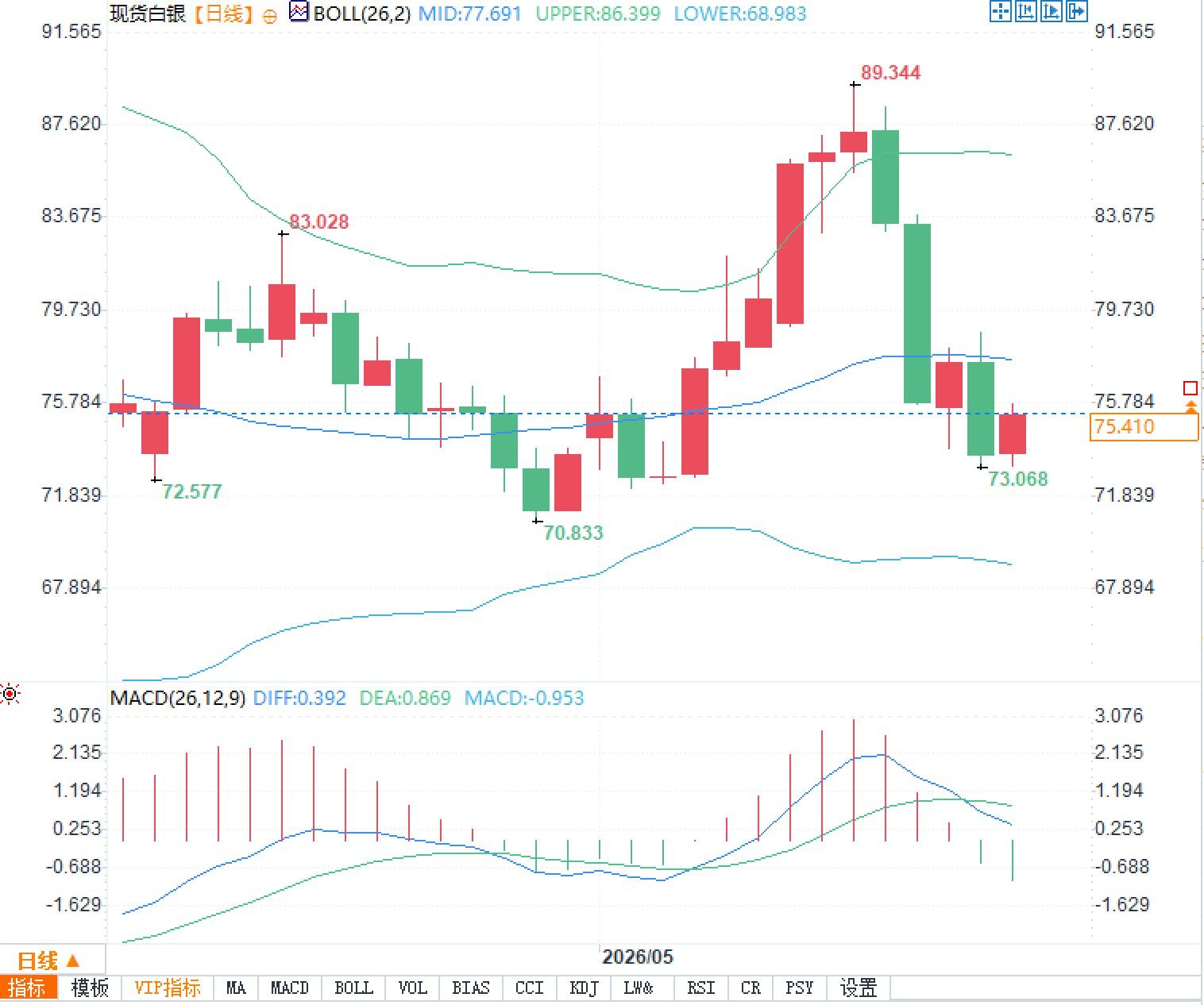
The daily chart shows that spot silver previously surged to $89.344 before quickly retreating, with the latest price around $75.50. It has broken below the Bollinger Band middle line at $77.691, and there is still room for it to fall to the lower line at $68.983. The upper Bollinger Band is flattening out around $86.399, indicating that the upward expansion phase has temporarily ended; the lower band is slowly rising, meaning that the medium-term price center has not completely collapsed, but the short-term trend has shifted from a strong upward move to a high-volatility consolidation.
On the MACD front, the DIFF is approximately 0.392 and the DEA is approximately 0.869, with the histogram showing a negative reading, indicating that the upward momentum is weakening and the market is still in a recovery phase. Traders should focus not on single-day price fluctuations, but rather on whether a significant volume band can re-form within the $75-$78 range. If silver fails to regain its position above the Bollinger Middle Band, the rebound is more likely to be interpreted as a technical correction following the sharp drop; only if the price continues to re-establish equilibrium around the Middle Band would it signify a renewed improvement in investor acceptance of high valuations.
Gold stabilized around $4,500/oz today, acting as a sentiment anchor for silver. The current contradiction in the precious metals market lies in the fact that safe-haven demand remains, but high yields and a strong dollar are simultaneously raising holding costs. The 10-year US Treasury yield is around 4.65%, while the 30-year yield once touched 5.198%, close to its highest level since 2007, indicating that concerns about fiscal policy, inflation, and term premiums in the bond market have not disappeared.
Compared to gold, silver is more susceptible to expectations of industrial demand. If the current price rebound stems solely from a synchronized recovery in precious metals, its sustainability depends on whether the US dollar and real interest rates decline. Only if there is simultaneous improvement in manufacturing demand, inventory contraction, or a strengthening of physical commodity premiums will silver's relative elasticity compared to gold be further realized. In other words, silver is not simply a safe-haven asset, but rather a cross-asset encompassing inflation trading, interest rate trading, and industrial cycle trading. This is a key reason why its volatility has consistently been higher than gold's.
The US dollar index remained around 99.35, near a six-week high, which will dampen the appeal of dollar-denominated silver to non-dollar buyers. Meanwhile, the Federal Reserve meeting minutes are a key window for the market to observe policy direction. The March meeting minutes showed that officials believed rising oil prices would push up inflation in the short term and delay the process of inflation falling back to the 2% target; if the April minutes continue to reinforce inflation concerns, the valuation upside for silver will face further compression.
Analysts believe that positive progress in US-Iran negotiations could ease inflation concerns and weaken the dollar; conversely, if the situation stalls or escalates, inflation concerns and bets on interest rate hikes will again weigh on precious metals. This assessment is highly correlated with silver's current price movement, as short-term silver pricing is not solely driven by risk appetite, but rather by whether risk events ultimately lead to lower inflation or higher interest rates.
Question 1: Does today's rebound in spot silver mean that the trend has strengthened again?
A: It's too early to draw a simple conclusion. The price rebounded from around $73 to above $75, indicating support at lower levels. However, the daily chart is still below the Bollinger Middle Band, and the MACD has not fully recovered. Currently, it's closer to a rebalancing after high volatility.
Question 2: Why might a drop in oil prices actually benefit silver?
A: Lower oil prices will ease inflationary pressures and reduce market bets on a Fed rate hike, thereby reducing valuation pressures on precious metals.
Question 3: What is the most critical variable going forward?
A: The key is whether the US dollar, US Treasury yields, and energy prices can cool down in tandem. If all three remain high, silver's rebound will be limited. Only if interest rate pressures ease will silver's elasticity be able to be released again.
The core of the silver rebound is not safe-haven demand, but rather the repricing of inflation and interest rate expectations.
Spot silver stabilized and rose today, seemingly a recovery in precious metals following gold, but essentially reflecting a re-stratification of market expectations regarding energy shocks, inflation paths, and Federal Reserve policy. The oil price premium resulting from disturbances in the Strait of Hormuz has not fully subsided; even with a pullback, Brent and WTI crude remain above $100 per barrel, indicating that energy prices continue to exert a sticky influence on inflation expectations. Meanwhile, the US 30-year mortgage contract rate rose to 6.56%, a near two-month high, while mortgage applications fell by 2.3%, suggesting that high interest rates are once again suppressing interest rate-sensitive sectors.
For silver, this information is not entirely bullish. If easing geopolitical risks lead to a decline in oil prices, lower inflation expectations will reduce pressure on the Federal Reserve to raise interest rates, easing valuation pressures on precious metals. However, if oil prices remain high and push inflation stickiness upward, the market will be more inclined to revise the probability of a rate hike this year upward, and silver's financial attributes will be suppressed by rising real interest rates. Different interest rate futures metrics show that the probability of a rate hike at the end of the year has shifted from the earlier narrative of rate cuts to a rate hike pricing range of approximately 40% to 58%, indicating that funds are reducing expectations of further easing.
The daily chart structure indicates that the mean reversion following the sharp rise from the high level has not yet ended.
The daily chart shows that spot silver previously surged to $89.344 before quickly retreating, with the latest price around $75.50. It has broken below the Bollinger Band middle line at $77.691, and there is still room for it to fall to the lower line at $68.983. The upper Bollinger Band is flattening out around $86.399, indicating that the upward expansion phase has temporarily ended; the lower band is slowly rising, meaning that the medium-term price center has not completely collapsed, but the short-term trend has shifted from a strong upward move to a high-volatility consolidation.
On the MACD front, the DIFF is approximately 0.392 and the DEA is approximately 0.869, with the histogram showing a negative reading, indicating that the upward momentum is weakening and the market is still in a recovery phase. Traders should focus not on single-day price fluctuations, but rather on whether a significant volume band can re-form within the $75-$78 range. If silver fails to regain its position above the Bollinger Middle Band, the rebound is more likely to be interpreted as a technical correction following the sharp drop; only if the price continues to re-establish equilibrium around the Middle Band would it signify a renewed improvement in investor acceptance of high valuations.
Gold provides a stable anchor, but silver's own elasticity depends more on industrial expectations.
Gold stabilized around $4,500/oz today, acting as a sentiment anchor for silver. The current contradiction in the precious metals market lies in the fact that safe-haven demand remains, but high yields and a strong dollar are simultaneously raising holding costs. The 10-year US Treasury yield is around 4.65%, while the 30-year yield once touched 5.198%, close to its highest level since 2007, indicating that concerns about fiscal policy, inflation, and term premiums in the bond market have not disappeared.
Compared to gold, silver is more susceptible to expectations of industrial demand. If the current price rebound stems solely from a synchronized recovery in precious metals, its sustainability depends on whether the US dollar and real interest rates decline. Only if there is simultaneous improvement in manufacturing demand, inventory contraction, or a strengthening of physical commodity premiums will silver's relative elasticity compared to gold be further realized. In other words, silver is not simply a safe-haven asset, but rather a cross-asset encompassing inflation trading, interest rate trading, and industrial cycle trading. This is a key reason why its volatility has consistently been higher than gold's.
The macroeconomic path will still be jointly determined by oil prices, the US dollar, and the Federal Reserve.
The US dollar index remained around 99.35, near a six-week high, which will dampen the appeal of dollar-denominated silver to non-dollar buyers. Meanwhile, the Federal Reserve meeting minutes are a key window for the market to observe policy direction. The March meeting minutes showed that officials believed rising oil prices would push up inflation in the short term and delay the process of inflation falling back to the 2% target; if the April minutes continue to reinforce inflation concerns, the valuation upside for silver will face further compression.
Analysts believe that positive progress in US-Iran negotiations could ease inflation concerns and weaken the dollar; conversely, if the situation stalls or escalates, inflation concerns and bets on interest rate hikes will again weigh on precious metals. This assessment is highly correlated with silver's current price movement, as short-term silver pricing is not solely driven by risk appetite, but rather by whether risk events ultimately lead to lower inflation or higher interest rates.
Frequently Asked Questions
Question 1: Does today's rebound in spot silver mean that the trend has strengthened again?
A: It's too early to draw a simple conclusion. The price rebounded from around $73 to above $75, indicating support at lower levels. However, the daily chart is still below the Bollinger Middle Band, and the MACD has not fully recovered. Currently, it's closer to a rebalancing after high volatility.
Question 2: Why might a drop in oil prices actually benefit silver?
A: Lower oil prices will ease inflationary pressures and reduce market bets on a Fed rate hike, thereby reducing valuation pressures on precious metals.
Question 3: What is the most critical variable going forward?
A: The key is whether the US dollar, US Treasury yields, and energy prices can cool down in tandem. If all three remain high, silver's rebound will be limited. Only if interest rate pressures ease will silver's elasticity be able to be released again.
- Risk Warning and Disclaimer
- The market involves risk, and trading may not be suitable for all investors. This article is for reference only and does not constitute personal investment advice, nor does it take into account certain users’ specific investment objectives, financial situation, or other needs. Any investment decisions made based on this information are at your own risk.