With the Strait of Hormuz gradually opening up, oil prices are undergoing a short-term adjustment.
2026-05-20 21:11:34
On Wednesday (Asia-Europe session), international oil prices fell throughout the day as geopolitical tensions between the US and Iran continued to escalate, with statements from both sides affecting the crude oil market. Currently, international oil prices are down by more than 2%.
US President Trump made it clear on Tuesday that if Iran refuses to sign a peace agreement, the US may launch a military strike within the next two to three days;
Vice President Vance also emphasized that the U.S. military action against Iraq remains "ready to launch" and can resume its offensive at any time.
However, as mentioned repeatedly in previous articles, the chances of the US and Iran resuming hostilities are very low, and oil prices have reflected this market expectation. The main factor affecting oil prices is the recovery of shipping capacity in the Taiwan Strait.
As the world's third-largest crude oil importer, India's shipping trends have become a market focus.
Several industry insiders revealed on Wednesday that India plans to send empty oil tankers into the Strait of Hormuz to complete crude oil purchases and shipments to Gulf oil-producing countries—this is India's first attempt to carry out oil and gas loading operations on the west side of this energy shipping hub since the outbreak of the geopolitical conflict with Iran.
Although the Strait of Hormuz has been blocked for nearly 80 days and shipping has almost come to a standstill, some Gulf crude oil freight routes have continued to operate, a move that is likely tacitly approved by both the US and Iran.
From a practical standpoint, the Indian fleet needs to overcome two hurdles: first, obtain permission from the US to pass through the blockaded area of the Gulf of Oman, and then obtain clearance from Iran before it can reach export ports along the Persian Gulf.
Previously, although India had broadened its oil and gas import channels outside the Hormuz route, there were shortcomings such as high costs and long logistics cycles. The resumption of direct flights is crucial to reducing import costs, but more importantly, it indicates that the new mechanism for passage through the Strait is now available.
The resumption of shipping services in multiple countries further confirms the recovery of shipping capacity in the Strait of Hormuz.
South Korea has confirmed that an oil tanker carrying 2 million barrels of crude oil has safely passed through the Strait of Hormuz after coordination with Iran. The South Korean Foreign Minister stated that the tanker is carefully completing the remaining navigation procedures.
Monitoring data from British shipping agencies provides a more direct reflection of the recovery trend: Lloyd's Daily Ship cited data on the 19th, stating that 54 ships transited the strait between May 11th and 17th, more than double the 25 ships of the previous week. Among them, a liquefied natural gas carrier belonging to Abu Dhabi National Oil Company of the UAE entered the Gulf with its Automatic Identification System (AIS) turned off. Statistics from Wenward Maritime Analysis show...
On May 18, a total of 19 vessels passed through the area, including cargo ships from India and Sri Lanka that entered the area, and 5 ships from Iran that left the area.
In addition, data from agencies shows that two supertankers carrying 6 million barrels of Middle Eastern crude oil sailed out of the Strait on Wednesday, and another is on its way out. These tankers have been waiting in the Persian Gulf for more than two months.
Iran has simultaneously tightened its control over waterways, forcing the implementation of new navigation rules.
Iran's Tasnim News Agency reported that Iran has released video footage of drones targeting oil tankers that were not being coordinated beforehand, and stated that illegal and concealed oil tankers at the entrance to the Strait of Hormuz have been identified and punished.
This control measure, combined with the practice of multinational consultation on air traffic, has formed a new air traffic model of "bilateral consultation + compliant passage".
Although the United States continues to impose a blockade on ships entering and leaving Iranian ports, shipping capacity in the Straits has improved significantly, and the pressure on the global crude oil supply chain has been marginally alleviated.
Better-than-expected inventory data provided fundamental support for oil prices.
Data from the American Petroleum Industry Association on Tuesday showed that U.S. crude oil inventories fell by a net 9.1 million barrels in the week ending May 15, significantly higher than the market expectation of 3.4 million barrels, and following a reduction of 2.18 million barrels the previous week.
The continuous sharp decline in inventories reflects a tight supply and demand situation for crude oil, and the market is awaiting further guidance from the official inventory data of the U.S. Energy Information Administration (EIA) on Wednesday evening.
The market is still focused on the passage conditions in the Strait of Hormuz, downplaying statements of hardline stances from both the US and Iran, while the decline in inventories is in line with market expectations.
As I have written in previous articles, the central price of oil is slowly rising. However, if the price increase is caused by geopolitical risks, such as aggressive statements from the US and Iran, it is likely to be just an emotional peak, because in the end, the story of crying wolf will play out, causing the market to panic.
From a technical perspective, Brent crude oil continues its upward trend, currently supported by the 5-day moving average and around 106.43, which is the 0.786 Fibonacci retracement level of this round of price increases.
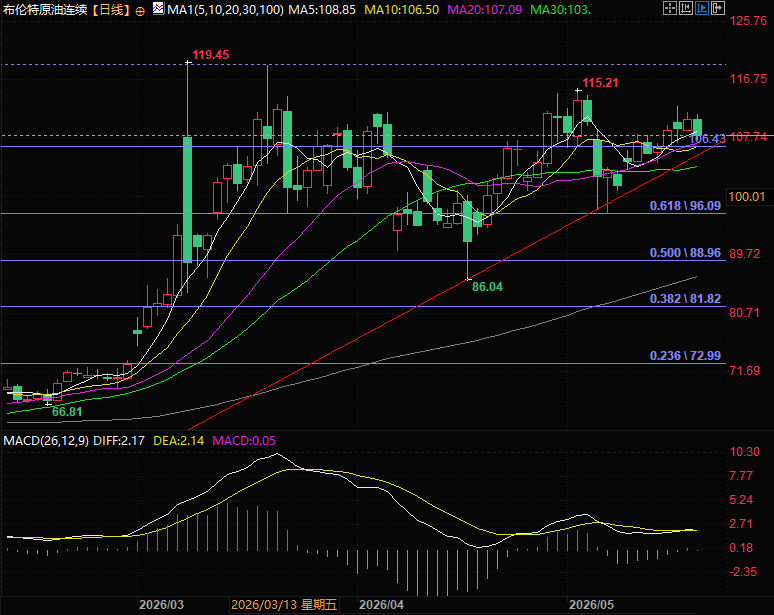
(Brent crude oil futures daily chart, source:)
At 21:10 Beijing time, Brent crude oil futures were trading at $108.22 per barrel.
US President Trump made it clear on Tuesday that if Iran refuses to sign a peace agreement, the US may launch a military strike within the next two to three days;
Vice President Vance also emphasized that the U.S. military action against Iraq remains "ready to launch" and can resume its offensive at any time.
However, as mentioned repeatedly in previous articles, the chances of the US and Iran resuming hostilities are very low, and oil prices have reflected this market expectation. The main factor affecting oil prices is the recovery of shipping capacity in the Taiwan Strait.
India plans to restart direct flights and bypass dual approval processes to advance crude oil purchases.
As the world's third-largest crude oil importer, India's shipping trends have become a market focus.
Several industry insiders revealed on Wednesday that India plans to send empty oil tankers into the Strait of Hormuz to complete crude oil purchases and shipments to Gulf oil-producing countries—this is India's first attempt to carry out oil and gas loading operations on the west side of this energy shipping hub since the outbreak of the geopolitical conflict with Iran.
Although the Strait of Hormuz has been blocked for nearly 80 days and shipping has almost come to a standstill, some Gulf crude oil freight routes have continued to operate, a move that is likely tacitly approved by both the US and Iran.
From a practical standpoint, the Indian fleet needs to overcome two hurdles: first, obtain permission from the US to pass through the blockaded area of the Gulf of Oman, and then obtain clearance from Iran before it can reach export ports along the Persian Gulf.
Previously, although India had broadened its oil and gas import channels outside the Hormuz route, there were shortcomings such as high costs and long logistics cycles. The resumption of direct flights is crucial to reducing import costs, but more importantly, it indicates that the new mechanism for passage through the Strait is now available.
Frequent changes in air traffic between multiple countries indicate a marginal improvement in cross-strait transport capacity.
The resumption of shipping services in multiple countries further confirms the recovery of shipping capacity in the Strait of Hormuz.
South Korea has confirmed that an oil tanker carrying 2 million barrels of crude oil has safely passed through the Strait of Hormuz after coordination with Iran. The South Korean Foreign Minister stated that the tanker is carefully completing the remaining navigation procedures.
Monitoring data from British shipping agencies provides a more direct reflection of the recovery trend: Lloyd's Daily Ship cited data on the 19th, stating that 54 ships transited the strait between May 11th and 17th, more than double the 25 ships of the previous week. Among them, a liquefied natural gas carrier belonging to Abu Dhabi National Oil Company of the UAE entered the Gulf with its Automatic Identification System (AIS) turned off. Statistics from Wenward Maritime Analysis show...
On May 18, a total of 19 vessels passed through the area, including cargo ships from India and Sri Lanka that entered the area, and 5 ships from Iran that left the area.
In addition, data from agencies shows that two supertankers carrying 6 million barrels of Middle Eastern crude oil sailed out of the Strait on Wednesday, and another is on its way out. These tankers have been waiting in the Persian Gulf for more than two months.
Iran strengthens waterway control, and a new "consultation + compliance" air traffic model takes shape.
Iran has simultaneously tightened its control over waterways, forcing the implementation of new navigation rules.
Iran's Tasnim News Agency reported that Iran has released video footage of drones targeting oil tankers that were not being coordinated beforehand, and stated that illegal and concealed oil tankers at the entrance to the Strait of Hormuz have been identified and punished.
This control measure, combined with the practice of multinational consultation on air traffic, has formed a new air traffic model of "bilateral consultation + compliant passage".
Although the United States continues to impose a blockade on ships entering and leaving Iranian ports, shipping capacity in the Straits has improved significantly, and the pressure on the global crude oil supply chain has been marginally alleviated.
Inventories continue to decline more than expected, providing strong support to fundamentals.
Better-than-expected inventory data provided fundamental support for oil prices.
Data from the American Petroleum Industry Association on Tuesday showed that U.S. crude oil inventories fell by a net 9.1 million barrels in the week ending May 15, significantly higher than the market expectation of 3.4 million barrels, and following a reduction of 2.18 million barrels the previous week.
The continuous sharp decline in inventories reflects a tight supply and demand situation for crude oil, and the market is awaiting further guidance from the official inventory data of the U.S. Energy Information Administration (EIA) on Wednesday evening.
Summary and Technical Analysis:
The market is still focused on the passage conditions in the Strait of Hormuz, downplaying statements of hardline stances from both the US and Iran, while the decline in inventories is in line with market expectations.
As I have written in previous articles, the central price of oil is slowly rising. However, if the price increase is caused by geopolitical risks, such as aggressive statements from the US and Iran, it is likely to be just an emotional peak, because in the end, the story of crying wolf will play out, causing the market to panic.
From a technical perspective, Brent crude oil continues its upward trend, currently supported by the 5-day moving average and around 106.43, which is the 0.786 Fibonacci retracement level of this round of price increases.
(Brent crude oil futures daily chart, source:)
At 21:10 Beijing time, Brent crude oil futures were trading at $108.22 per barrel.
- Risk Warning and Disclaimer
- The market involves risk, and trading may not be suitable for all investors. This article is for reference only and does not constitute personal investment advice, nor does it take into account certain users’ specific investment objectives, financial situation, or other needs. Any investment decisions made based on this information are at your own risk.