The tug-of-war between bulls and bears in silver: Indian demand contraction vs. global supply shortage.
2026-05-21 11:27:16
On Thursday (May 21), silver prices climbed above $76.90 before retreating and are currently trading around $75.50 per ounce, down nearly 0.3%. Behind this price surge and subsequent pullback, several key forces are at play.
In an effort to curb precious metal imports, alleviate pressure on foreign exchange reserves, and support the Indian rupee exchange rate, the Indian government has recently introduced a series of restrictions on silver imports.
On the tariff front, on May 13, the Indian government announced a significant increase in import tariffs on silver from 6% to 15% (including a 10% basic tariff and a 5% agricultural infrastructure and development tax), effective immediately. India is the world's second-largest consumer of precious metals, and importing gold and silver requires substantial amounts of US dollars. Against the backdrop of the US-Iran conflict driving up oil prices, pressure on India's foreign exchange reserves (which have decreased by nearly $38 billion since the outbreak of the conflict), and the rupee falling to a record low of 96.18 against the dollar, this move aims to quickly reduce the current account deficit and curb capital outflows.
At the non-tariff barrier level, the Indian government has further changed the import of silver bars from "free import" to "restricted import," stipulating that only goods with permits issued by the Directorate General of Foreign Trade (DGT) are allowed entry. The restricted categories cover silver bars and semi-finished silver with a purity of 99.9% or higher, accounting for over 90% of India's total silver imports. Furthermore, the issuance of subsequent import permits will be linked to companies' export performance.
If India's policy is to "tighten the tap" on the demand side, then the global silver supply side is experiencing a different picture – years of continuous supply shortages and depleted inventories.
According to the World Silver Institute's annual outlook report released in April 2026, the global silver market will experience a supply shortage for the sixth consecutive year, with the supply gap expected to widen by 15% to 46.3 million troy ounces in 2026. On the supply side, mined silver production will decline slightly, coupled with supply disruptions in major producing countries such as Peru, resulting in a projected 2% decrease in total supply. On the demand side, although industrial, jewelry, and silverware consumption has declined, investment demand for silver bars and coins has grown strongly by 18%, and demand for silver in fields such as photovoltaics, AI computing infrastructure, and new energy vehicles remains at historically strong levels.
The existence of supply gaps is no news, but what is more worrying is the “water level” of inventory – it is dropping at an alarming rate.
Regarding inventories, global visible silver inventories have fallen to critical levels. According to industry data, the total deliverable inventory across the three major exchanges—LBMA, COMEX, and Shanghai Futures Exchange—is less than 16,000 tons, enough to cover only about 1.2 months of global industrial consumption, far below the industry safety stock standard of 3-6 months. LBMA's available silver inventory has decreased by approximately 75% compared to its peak in 2019, making liquidity extremely fragile. Philip Newman, Managing Director of Metals Focus, warned that conditions for a new round of silver spot market squeeze do exist, and overall weakening liquidity will lead to greater volatility in leasing prices, potentially exceeding investors' previous expectations.
Inventories are already in dire need of replenishment, and supply disruptions in major silver-producing countries are tantamount to adding fuel to the fire in the already fragile supply chain.
On May 11, 2026, the Peruvian government officially issued an emergency decree on the energy crisis, declaring a state of energy crisis due to domestic power shortages and limited industrial natural gas quotas, effective until December 31, 2026. As the world's third-largest silver producer, Peru's silver mine supply reached 4,063 tons in 2025, accounting for approximately 15.4% of global production. Much of its silver is a byproduct of copper mining, and the entire mining, beneficiation, and smelting process is highly dependent on a stable supply of electricity and other energy resources. Under the dual constraints of electricity and natural gas, industrial electricity use in mines and other sectors faces strict restrictions, with the mining, beneficiation, and smelting stages, which account for a significant portion of energy costs, bearing the brunt.
According to multiple estimates, Peruvian silver mine capacity utilization may decline by 12%-15%, with an estimated annual supply gap of 490-610 tons, equivalent to approximately 3%-5% of its annual production, or 1.8%-2.2% of global annual production. Coupled with the simultaneous contraction of silver as a byproduct of copper, lead, and zinc smelting, the actual impact may be further amplified.
In summary, the current silver market is caught in a complex interplay of multiple forces: contracting Indian demand, global supply shortages, extremely low inventory levels, and supply disruptions in major producing countries. The pullback in silver prices above $76.90 reflects the differing interpretations and interplay between bulls and bears regarding these fundamental factors. In the short term, the contradiction between demand suppression stemming from Indian policies and tight global supply will remain the core driver of silver price fluctuations.
From the 60-minute chart, spot silver is currently trading around $75.50, at a critical juncture in the short-term battle between bulls and bears, with multiple technical indicators showing a neutral to consolidation signal.
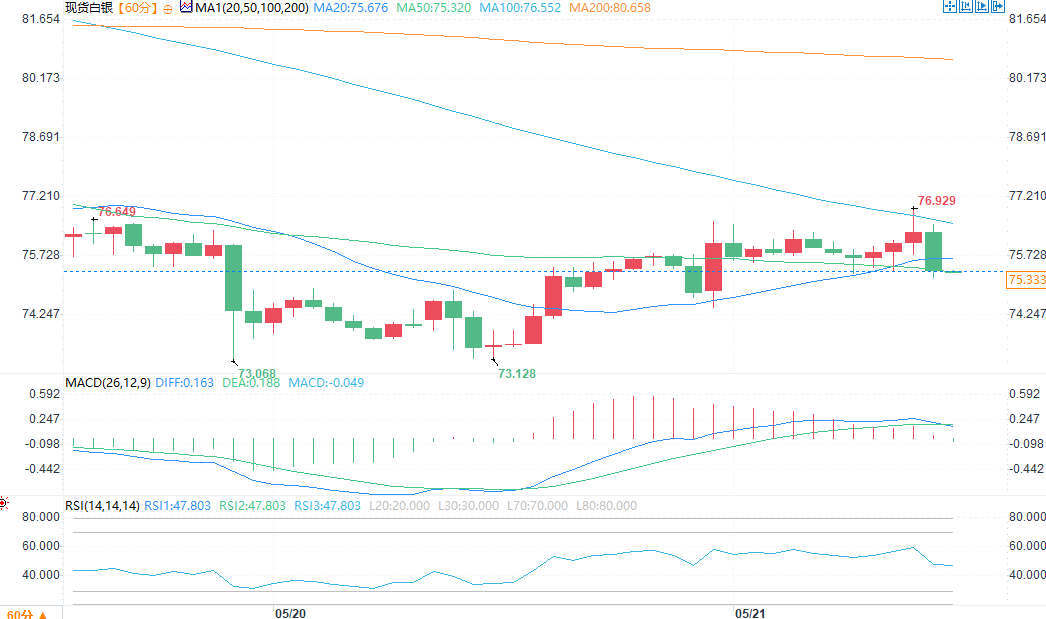
(Spot silver 60-minute chart, source: EasyForex)
Regarding the moving average system, the short-term moving average MA20 ($75.68) is above the current price, acting as short-term resistance; while MA100 ($76.55) and MA200 ($80.65) are significantly higher than the current price. The current price has fallen below MA20, indicating a weak short-term trend.
At 11:26 Beijing time, spot silver was trading at $75.47 per ounce.
India significantly tightens silver imports
In an effort to curb precious metal imports, alleviate pressure on foreign exchange reserves, and support the Indian rupee exchange rate, the Indian government has recently introduced a series of restrictions on silver imports.
On the tariff front, on May 13, the Indian government announced a significant increase in import tariffs on silver from 6% to 15% (including a 10% basic tariff and a 5% agricultural infrastructure and development tax), effective immediately. India is the world's second-largest consumer of precious metals, and importing gold and silver requires substantial amounts of US dollars. Against the backdrop of the US-Iran conflict driving up oil prices, pressure on India's foreign exchange reserves (which have decreased by nearly $38 billion since the outbreak of the conflict), and the rupee falling to a record low of 96.18 against the dollar, this move aims to quickly reduce the current account deficit and curb capital outflows.
At the non-tariff barrier level, the Indian government has further changed the import of silver bars from "free import" to "restricted import," stipulating that only goods with permits issued by the Directorate General of Foreign Trade (DGT) are allowed entry. The restricted categories cover silver bars and semi-finished silver with a purity of 99.9% or higher, accounting for over 90% of India's total silver imports. Furthermore, the issuance of subsequent import permits will be linked to companies' export performance.
The global silver shortage has lasted for six consecutive years, with the gap widening by 15%.
If India's policy is to "tighten the tap" on the demand side, then the global silver supply side is experiencing a different picture – years of continuous supply shortages and depleted inventories.
According to the World Silver Institute's annual outlook report released in April 2026, the global silver market will experience a supply shortage for the sixth consecutive year, with the supply gap expected to widen by 15% to 46.3 million troy ounces in 2026. On the supply side, mined silver production will decline slightly, coupled with supply disruptions in major producing countries such as Peru, resulting in a projected 2% decrease in total supply. On the demand side, although industrial, jewelry, and silverware consumption has declined, investment demand for silver bars and coins has grown strongly by 18%, and demand for silver in fields such as photovoltaics, AI computing infrastructure, and new energy vehicles remains at historically strong levels.
Inventory depletion: exacerbating liquidity vulnerability
The existence of supply gaps is no news, but what is more worrying is the “water level” of inventory – it is dropping at an alarming rate.
Regarding inventories, global visible silver inventories have fallen to critical levels. According to industry data, the total deliverable inventory across the three major exchanges—LBMA, COMEX, and Shanghai Futures Exchange—is less than 16,000 tons, enough to cover only about 1.2 months of global industrial consumption, far below the industry safety stock standard of 3-6 months. LBMA's available silver inventory has decreased by approximately 75% compared to its peak in 2019, making liquidity extremely fragile. Philip Newman, Managing Director of Metals Focus, warned that conditions for a new round of silver spot market squeeze do exist, and overall weakening liquidity will lead to greater volatility in leasing prices, potentially exceeding investors' previous expectations.
Peru's energy crisis impacts silver supply: production capacity may decline by 3%-10%, and the supply-demand gap continues to widen.
Inventories are already in dire need of replenishment, and supply disruptions in major silver-producing countries are tantamount to adding fuel to the fire in the already fragile supply chain.
On May 11, 2026, the Peruvian government officially issued an emergency decree on the energy crisis, declaring a state of energy crisis due to domestic power shortages and limited industrial natural gas quotas, effective until December 31, 2026. As the world's third-largest silver producer, Peru's silver mine supply reached 4,063 tons in 2025, accounting for approximately 15.4% of global production. Much of its silver is a byproduct of copper mining, and the entire mining, beneficiation, and smelting process is highly dependent on a stable supply of electricity and other energy resources. Under the dual constraints of electricity and natural gas, industrial electricity use in mines and other sectors faces strict restrictions, with the mining, beneficiation, and smelting stages, which account for a significant portion of energy costs, bearing the brunt.
According to multiple estimates, Peruvian silver mine capacity utilization may decline by 12%-15%, with an estimated annual supply gap of 490-610 tons, equivalent to approximately 3%-5% of its annual production, or 1.8%-2.2% of global annual production. Coupled with the simultaneous contraction of silver as a byproduct of copper, lead, and zinc smelting, the actual impact may be further amplified.
A battle between bulls and bears is underway, causing silver prices to fluctuate in the short term.
In summary, the current silver market is caught in a complex interplay of multiple forces: contracting Indian demand, global supply shortages, extremely low inventory levels, and supply disruptions in major producing countries. The pullback in silver prices above $76.90 reflects the differing interpretations and interplay between bulls and bears regarding these fundamental factors. In the short term, the contradiction between demand suppression stemming from Indian policies and tight global supply will remain the core driver of silver price fluctuations.
The price has fallen below the short-term moving average, indicating a weak trend.
From the 60-minute chart, spot silver is currently trading around $75.50, at a critical juncture in the short-term battle between bulls and bears, with multiple technical indicators showing a neutral to consolidation signal.
(Spot silver 60-minute chart, source: EasyForex)
Regarding the moving average system, the short-term moving average MA20 ($75.68) is above the current price, acting as short-term resistance; while MA100 ($76.55) and MA200 ($80.65) are significantly higher than the current price. The current price has fallen below MA20, indicating a weak short-term trend.
At 11:26 Beijing time, spot silver was trading at $75.47 per ounce.
- Risk Warning and Disclaimer
- The market involves risk, and trading may not be suitable for all investors. This article is for reference only and does not constitute personal investment advice, nor does it take into account certain users’ specific investment objectives, financial situation, or other needs. Any investment decisions made based on this information are at your own risk.