Falling oil prices coupled with strong intervention from the Reserve Bank of India caused the US dollar to retreat from its highs against the Indian rupee.
2026-05-21 14:12:08
The Indian rupee (INR) extended its recovery against the dollar on Thursday, ending nearly two weeks of weakness. The USD/INR pair retreated from a record high above 97.00 to around 96.30, as market focus shifted to the pullback in international oil prices and the impact of the Reserve Bank of India's (RBI) continued intervention in the currency market.
Previously, the Indian rupee had repeatedly hit record lows, triggering market concerns about capital outflows and imported inflation risks. Traders generally believe that the Reserve Bank of India (RBI) has been taking strong intervention measures recently to stabilize market sentiment and curb expectations of unilateral rupee depreciation. Market participants pointed out that since the outbreak of the Middle East war, the RBI has intervened multiple times through the offshore market and the non-deliverable forward (NDF) market to prevent excessive unilateral fluctuations in the USD/IRR exchange rate.
As one of the world's major crude oil importers, India is highly sensitive to fluctuations in international oil prices (highlighted in bold) . Because India's domestic energy demand is heavily reliant on imports, rising international oil prices typically exacerbate India's trade deficit and inflationary pressures, thus weakening the rupee's performance. Therefore, after a significant correction in international oil prices, the rupee quickly found temporary support. WTI crude oil prices had previously fallen sharply, briefly dropping to around $96, mainly due to a temporary easing of market concerns about Middle Eastern supply risks.
US President Trump stated that negotiations between the US and Iran have entered the "final stage." The market believes that if an agreement is ultimately reached, shipping risks in the Strait of Hormuz could decrease, thus alleviating concerns about global energy supplies. However, Trump also warned that the US might take further military action if negotiations fail. This means that market concerns about the Middle East situation have not completely subsided, and the overall oil market remains highly volatile.
Besides oil price fluctuations, continued foreign capital outflows from the Indian stock market are also keeping the market cautious. Data shows that foreign institutional investors (FIIs) net sold approximately 159.7 billion rupees worth of Indian equity assets on Wednesday, following a net outflow of approximately 245.7 billion rupees on Tuesday. The continued withdrawal of overseas funds is mainly related to the impact of high oil prices on the profit prospects of Indian companies. The market is concerned that rising energy import costs could squeeze corporate profit margins and increase government fiscal pressure.
Meanwhile, energy subsidies and high energy import expenditures could weaken the Indian government's spending capacity in infrastructure, employment, and public investment, thus impacting economic growth prospects. Furthermore, the decline in US Treasury yields has also put some downward pressure on the US dollar against the Indian rupee. Previously, due to market concerns that rising energy prices could reignite US inflation, the yield on the 10-year US Treasury bond had risen to around 4.69% , a high since the subprime mortgage crisis.
However, as international oil prices quickly corrected, the yield on the 10-year US Treasury bond subsequently fell back to around 4.59% , thus cooling the short-term rise in the US dollar. Nevertheless, overall hawkish expectations for the Federal Reserve remain high. US overall inflation rose to 3.8% year-on-year in April, a near three-year high, further reducing market expectations for a Fed rate cut.
According to the CME FedWatch tool, the market currently expects a 51% probability of the Federal Reserve raising interest rates at least once this year, while the remaining traders believe the Fed will maintain the current interest rate range of 3.50%-3.75%. On the economic data front, India's HSBC Composite PMI for May came in at 58.1 , slightly lower than the previous reading of 58.2. Although the manufacturing PMI fell from 54.7 to 54.3, the services PMI rose from 58.8 to 58.9, indicating that India's service sector remains resilient. Overall, while Indian economic activity has slowed slightly, service consumption and domestic demand continue to support the economy.
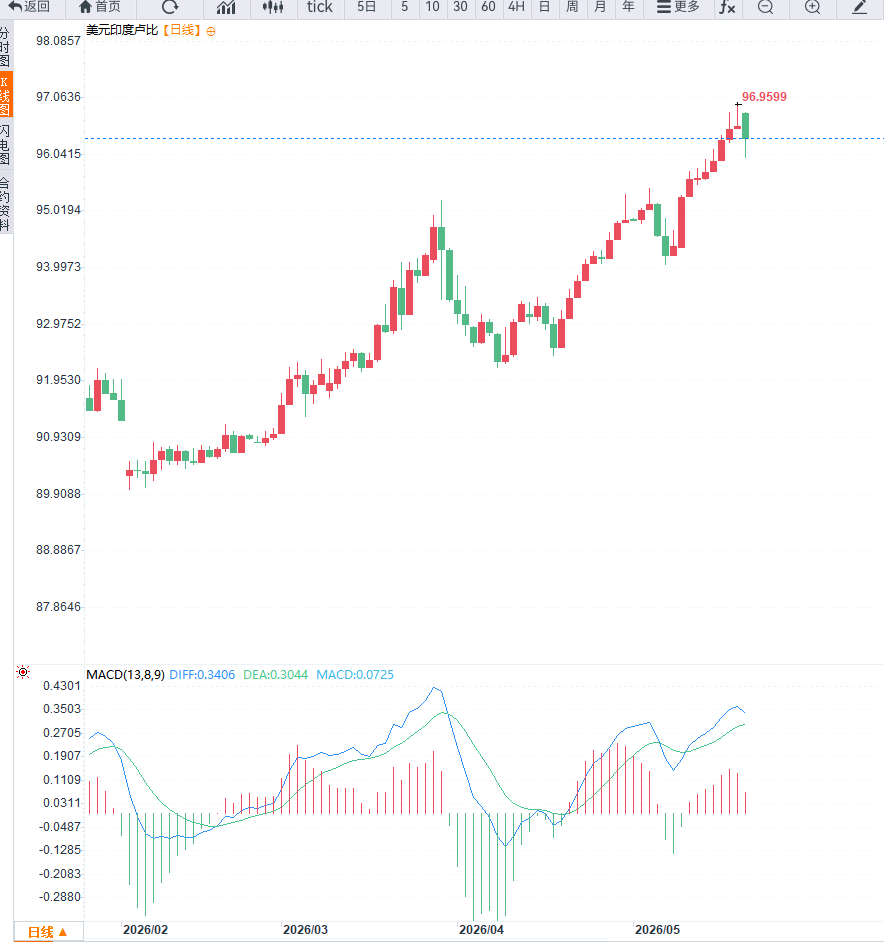
From a technical perspective, although the USD/INR pair has experienced a short-term pullback, the overall trend remains clearly bullish. The daily chart shows the exchange rate is still trading above the 20-day exponential moving average (EMA) at 95.36, indicating that the medium-term uptrend remains intact. The RSI indicator, after previously entering overbought territory, has now retreated to around 66, suggesting a cooling of market overheating, but the overall upward momentum has not yet completely ended. A break below the 20-day EMA area at 95.37 could open up further downside potential and test the psychological level of 95.00.
From the 4-hour chart, the USD/INR pair has entered a short-term consolidation phase at high levels. The MACD indicator has begun a bearish crossover at high levels, indicating a weakening of short-term bullish momentum, but the price is still generally trading above the major moving averages. If it subsequently reclaims the 97.00 level, the exchange rate may further challenge the 98.00 area; however, if international oil prices continue to decline, and the Reserve Bank of India continues to increase market intervention, the USD/INR pair still faces the risk of further technical correction in the short term.
Editor's Summary : The current rebound of the Indian rupee is mainly due to the rapid correction in international oil prices and the Reserve Bank of India's (RBI) active market intervention. As an energy-import-dependent economy, the Indian currency is highly sensitive to oil price fluctuations; therefore, oil price changes remain the core variable determining the rupee's trajectory. However, in the medium to long term, the overall strength of the US dollar, expectations of high interest rates from the Federal Reserve, and the continued outflow of foreign capital from the Indian market remain significant sources of pressure on the rupee. The market will need to focus on future developments in the Middle East, international oil price trends, and the extent of subsequent intervention by the RBI. Overall, although the USD/IRR exchange rate has experienced a short-term technical correction, it remains generally bullish given the strong global dollar.
Previously, the Indian rupee had repeatedly hit record lows, triggering market concerns about capital outflows and imported inflation risks. Traders generally believe that the Reserve Bank of India (RBI) has been taking strong intervention measures recently to stabilize market sentiment and curb expectations of unilateral rupee depreciation. Market participants pointed out that since the outbreak of the Middle East war, the RBI has intervened multiple times through the offshore market and the non-deliverable forward (NDF) market to prevent excessive unilateral fluctuations in the USD/IRR exchange rate.
As one of the world's major crude oil importers, India is highly sensitive to fluctuations in international oil prices (highlighted in bold) . Because India's domestic energy demand is heavily reliant on imports, rising international oil prices typically exacerbate India's trade deficit and inflationary pressures, thus weakening the rupee's performance. Therefore, after a significant correction in international oil prices, the rupee quickly found temporary support. WTI crude oil prices had previously fallen sharply, briefly dropping to around $96, mainly due to a temporary easing of market concerns about Middle Eastern supply risks.
US President Trump stated that negotiations between the US and Iran have entered the "final stage." The market believes that if an agreement is ultimately reached, shipping risks in the Strait of Hormuz could decrease, thus alleviating concerns about global energy supplies. However, Trump also warned that the US might take further military action if negotiations fail. This means that market concerns about the Middle East situation have not completely subsided, and the overall oil market remains highly volatile.
Besides oil price fluctuations, continued foreign capital outflows from the Indian stock market are also keeping the market cautious. Data shows that foreign institutional investors (FIIs) net sold approximately 159.7 billion rupees worth of Indian equity assets on Wednesday, following a net outflow of approximately 245.7 billion rupees on Tuesday. The continued withdrawal of overseas funds is mainly related to the impact of high oil prices on the profit prospects of Indian companies. The market is concerned that rising energy import costs could squeeze corporate profit margins and increase government fiscal pressure.
Meanwhile, energy subsidies and high energy import expenditures could weaken the Indian government's spending capacity in infrastructure, employment, and public investment, thus impacting economic growth prospects. Furthermore, the decline in US Treasury yields has also put some downward pressure on the US dollar against the Indian rupee. Previously, due to market concerns that rising energy prices could reignite US inflation, the yield on the 10-year US Treasury bond had risen to around 4.69% , a high since the subprime mortgage crisis.
However, as international oil prices quickly corrected, the yield on the 10-year US Treasury bond subsequently fell back to around 4.59% , thus cooling the short-term rise in the US dollar. Nevertheless, overall hawkish expectations for the Federal Reserve remain high. US overall inflation rose to 3.8% year-on-year in April, a near three-year high, further reducing market expectations for a Fed rate cut.
According to the CME FedWatch tool, the market currently expects a 51% probability of the Federal Reserve raising interest rates at least once this year, while the remaining traders believe the Fed will maintain the current interest rate range of 3.50%-3.75%. On the economic data front, India's HSBC Composite PMI for May came in at 58.1 , slightly lower than the previous reading of 58.2. Although the manufacturing PMI fell from 54.7 to 54.3, the services PMI rose from 58.8 to 58.9, indicating that India's service sector remains resilient. Overall, while Indian economic activity has slowed slightly, service consumption and domestic demand continue to support the economy.
From a technical perspective, although the USD/INR pair has experienced a short-term pullback, the overall trend remains clearly bullish. The daily chart shows the exchange rate is still trading above the 20-day exponential moving average (EMA) at 95.36, indicating that the medium-term uptrend remains intact. The RSI indicator, after previously entering overbought territory, has now retreated to around 66, suggesting a cooling of market overheating, but the overall upward momentum has not yet completely ended. A break below the 20-day EMA area at 95.37 could open up further downside potential and test the psychological level of 95.00.
From the 4-hour chart, the USD/INR pair has entered a short-term consolidation phase at high levels. The MACD indicator has begun a bearish crossover at high levels, indicating a weakening of short-term bullish momentum, but the price is still generally trading above the major moving averages. If it subsequently reclaims the 97.00 level, the exchange rate may further challenge the 98.00 area; however, if international oil prices continue to decline, and the Reserve Bank of India continues to increase market intervention, the USD/INR pair still faces the risk of further technical correction in the short term.
Editor's Summary : The current rebound of the Indian rupee is mainly due to the rapid correction in international oil prices and the Reserve Bank of India's (RBI) active market intervention. As an energy-import-dependent economy, the Indian currency is highly sensitive to oil price fluctuations; therefore, oil price changes remain the core variable determining the rupee's trajectory. However, in the medium to long term, the overall strength of the US dollar, expectations of high interest rates from the Federal Reserve, and the continued outflow of foreign capital from the Indian market remain significant sources of pressure on the rupee. The market will need to focus on future developments in the Middle East, international oil price trends, and the extent of subsequent intervention by the RBI. Overall, although the USD/IRR exchange rate has experienced a short-term technical correction, it remains generally bullish given the strong global dollar.
- Risk Warning and Disclaimer
- The market involves risk, and trading may not be suitable for all investors. This article is for reference only and does not constitute personal investment advice, nor does it take into account certain users’ specific investment objectives, financial situation, or other needs. Any investment decisions made based on this information are at your own risk.