Japan's PMI momentum slowed, but cost pressures continued to rise, and expectations of a June rate hike by the Bank of Japan supported the yen.
2026-05-21 16:28:40
Japan's economy has recently faced a complex situation with both slowing growth and rising inflationary pressures. The latest preliminary PMI figures for May show that while the manufacturing sector continues to expand, its growth rate has slowed significantly, while the service sector experienced its first stagnation in over a year. Data shows that Japanese companies are facing continued pressure from energy, transportation, and raw material costs. Particularly against the backdrop of tensions in the Middle East, increased risks to global supply chains and energy transportation have led Japanese companies to proactively increase inventory to prepare for potential supply disruptions.

However, increased inventory has also driven up operating costs for businesses. Danske Bank's research team points out that Japanese companies are currently facing significant profit margin squeezes. Although companies have raised selling prices, the rate of price increases is still lagging behind the rate of cost increases.
Japanese companies are currently facing the highest cost pressures since 2022 , which means that the risk of inflation in Japan is gradually spreading from imported costs to a wider range of areas.
In the services sector, Japan's services PMI ended its expansionary trend of more than a year, indicating that consumption and business activity are beginning to cool. Previously, Japan's economic recovery largely depended on the rebound in service consumption and the growth in tourism demand, but against the backdrop of a global economic slowdown and high energy costs, domestic demand in Japan is beginning to face pressure.
However, unlike Europe and the United States, Japan's most pressing issue is not overheated demand, but rather how to cope with persistently rising cost-based inflation against the backdrop of stabilizing economic growth. Junko Koeda, a board member of the Bank of Japan (BoJ), recently stated that if cost pressures remain high while economic growth remains stable, the BoJ may raise interest rates again as early as its meeting on June 15-16.
The Bank of Japan (BOJ) has begun a gradual shift from an era of ultra-loose monetary policy towards policy normalization . For a long time, the BOJ maintained ultra-low interest rates and yield curve control to stimulate inflation and economic growth. However, as Japanese inflation has gradually stabilized above the target level, the BOJ's policy direction has changed significantly. The market is currently paying particular attention to the upcoming nationwide CPI data for Japan.
Previous data from the Tokyo area showed that core inflation, excluding fresh food, declined in April, falling from 1.8% in March. This was partly due to the Japanese government alleviating pressure from rising oil prices on residents through energy subsidies. However, Danske Bank believes that decreased uncertainty in the energy market may actually increase the probability of an interest rate hike for the Bank of Japan.
The reason is that once the international energy market stabilizes, the Japanese government may gradually reduce energy subsidies, and businesses and residents will feel the real inflationary pressure more directly. At the same time, the Bank of Japan may also believe that the economic environment is more suitable for normalizing policy after energy price risks have decreased.
Unlike central banks in Europe and the US, the Bank of Japan is currently more concerned about the continued distortion of its economic structure caused by persistently low interest rates . The prolonged ultra-low interest rates have led to a persistently weak yen and have also driven up import costs. With changes in the global inflation environment, the Bank of Japan is gradually attempting to reduce its reliance on long-term easing policies. From the perspective of the currency market, the yen has recently received some support. Although high-yield currencies such as the US dollar and the British pound still maintain a relative advantage, market expectations for further interest rate hikes by the Bank of Japan are gradually limiting the yen's further depreciation potential.
Especially against the backdrop of rising global market volatility, some funds have increased their allocation to the safe-haven properties of the Japanese yen.
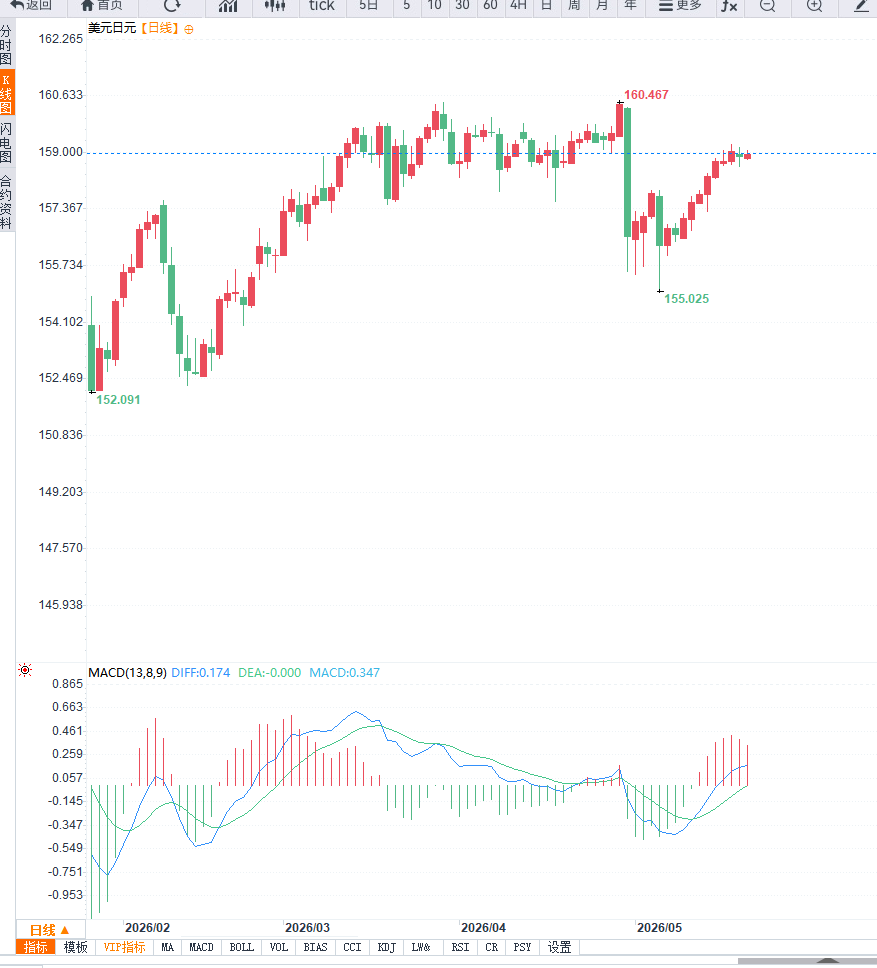
From a technical perspective, the USD/JPY pair has recently experienced significantly increased volatility at high levels. The daily chart shows that while the exchange rate remains high, the upward momentum is beginning to slow. The MACD indicator is converging at high levels, indicating a weakening of bullish strength; the RSI indicator is gradually falling back to near the neutral zone, suggesting that market sentiment is becoming more cautious.
From a key perspective, the resistance level to watch is the 158.00 to 159.00 area. Failure to break through this level could lead to a period of consolidation for USD/JPY. Key support levels are around 155.00 and 153.80. Looking at the 4-hour chart, the yen has shown some signs of stabilization in the short term. Short-term moving averages are gradually flattening, and the MACD indicator is approaching the zero line, indicating that the market is awaiting guidance from new policy and inflation data. However, given the Federal Reserve's hawkish stance and the still significant interest rate differential between USD and Japan, a medium- to long-term reversal in the yen's trajectory still requires further policy support.
Editor's Summary : The Japanese economy is currently at a critical turning point. On the one hand, economic growth momentum is slowing, and the expansion of the service sector has stagnated; on the other hand, corporate cost pressures and inflation risks continue to rise. Against this backdrop, the Bank of Japan's policy normalization process is likely to continue. Market expectations for another interest rate hike in June are gradually increasing, which is a significant reason for the recent support for the yen. However, given the relatively fragile fundamentals of the Japanese economy, the Bank of Japan is expected to remain cautious in its future interest rate hikes. The market will focus on Japanese inflation data, energy price changes, and the Bank of Japan's assessment of the balance between economic growth and inflation. Overall, while the long-term weakness of the yen has not been completely reversed, the market has begun to reassess the possibility of the Bank of Japan further exiting its ultra-loose policy.
However, increased inventory has also driven up operating costs for businesses. Danske Bank's research team points out that Japanese companies are currently facing significant profit margin squeezes. Although companies have raised selling prices, the rate of price increases is still lagging behind the rate of cost increases.
Japanese companies are currently facing the highest cost pressures since 2022 , which means that the risk of inflation in Japan is gradually spreading from imported costs to a wider range of areas.
In the services sector, Japan's services PMI ended its expansionary trend of more than a year, indicating that consumption and business activity are beginning to cool. Previously, Japan's economic recovery largely depended on the rebound in service consumption and the growth in tourism demand, but against the backdrop of a global economic slowdown and high energy costs, domestic demand in Japan is beginning to face pressure.
However, unlike Europe and the United States, Japan's most pressing issue is not overheated demand, but rather how to cope with persistently rising cost-based inflation against the backdrop of stabilizing economic growth. Junko Koeda, a board member of the Bank of Japan (BoJ), recently stated that if cost pressures remain high while economic growth remains stable, the BoJ may raise interest rates again as early as its meeting on June 15-16.
The Bank of Japan (BOJ) has begun a gradual shift from an era of ultra-loose monetary policy towards policy normalization . For a long time, the BOJ maintained ultra-low interest rates and yield curve control to stimulate inflation and economic growth. However, as Japanese inflation has gradually stabilized above the target level, the BOJ's policy direction has changed significantly. The market is currently paying particular attention to the upcoming nationwide CPI data for Japan.
Previous data from the Tokyo area showed that core inflation, excluding fresh food, declined in April, falling from 1.8% in March. This was partly due to the Japanese government alleviating pressure from rising oil prices on residents through energy subsidies. However, Danske Bank believes that decreased uncertainty in the energy market may actually increase the probability of an interest rate hike for the Bank of Japan.
The reason is that once the international energy market stabilizes, the Japanese government may gradually reduce energy subsidies, and businesses and residents will feel the real inflationary pressure more directly. At the same time, the Bank of Japan may also believe that the economic environment is more suitable for normalizing policy after energy price risks have decreased.
Unlike central banks in Europe and the US, the Bank of Japan is currently more concerned about the continued distortion of its economic structure caused by persistently low interest rates . The prolonged ultra-low interest rates have led to a persistently weak yen and have also driven up import costs. With changes in the global inflation environment, the Bank of Japan is gradually attempting to reduce its reliance on long-term easing policies. From the perspective of the currency market, the yen has recently received some support. Although high-yield currencies such as the US dollar and the British pound still maintain a relative advantage, market expectations for further interest rate hikes by the Bank of Japan are gradually limiting the yen's further depreciation potential.
Especially against the backdrop of rising global market volatility, some funds have increased their allocation to the safe-haven properties of the Japanese yen.
From a technical perspective, the USD/JPY pair has recently experienced significantly increased volatility at high levels. The daily chart shows that while the exchange rate remains high, the upward momentum is beginning to slow. The MACD indicator is converging at high levels, indicating a weakening of bullish strength; the RSI indicator is gradually falling back to near the neutral zone, suggesting that market sentiment is becoming more cautious.
From a key perspective, the resistance level to watch is the 158.00 to 159.00 area. Failure to break through this level could lead to a period of consolidation for USD/JPY. Key support levels are around 155.00 and 153.80. Looking at the 4-hour chart, the yen has shown some signs of stabilization in the short term. Short-term moving averages are gradually flattening, and the MACD indicator is approaching the zero line, indicating that the market is awaiting guidance from new policy and inflation data. However, given the Federal Reserve's hawkish stance and the still significant interest rate differential between USD and Japan, a medium- to long-term reversal in the yen's trajectory still requires further policy support.
Editor's Summary : The Japanese economy is currently at a critical turning point. On the one hand, economic growth momentum is slowing, and the expansion of the service sector has stagnated; on the other hand, corporate cost pressures and inflation risks continue to rise. Against this backdrop, the Bank of Japan's policy normalization process is likely to continue. Market expectations for another interest rate hike in June are gradually increasing, which is a significant reason for the recent support for the yen. However, given the relatively fragile fundamentals of the Japanese economy, the Bank of Japan is expected to remain cautious in its future interest rate hikes. The market will focus on Japanese inflation data, energy price changes, and the Bank of Japan's assessment of the balance between economic growth and inflation. Overall, while the long-term weakness of the yen has not been completely reversed, the market has begun to reassess the possibility of the Bank of Japan further exiting its ultra-loose policy.
- Risk Warning and Disclaimer
- The market involves risk, and trading may not be suitable for all investors. This article is for reference only and does not constitute personal investment advice, nor does it take into account certain users’ specific investment objectives, financial situation, or other needs. Any investment decisions made based on this information are at your own risk.