The PMI plunged below the 50-point threshold, signaling the end of the pound's "golden age," with the area above 1.36 becoming an insurmountable barrier.
2026-05-21 17:58:15
On Thursday, May 21, the British pound was trading around 1.344 against the US dollar, a significant pullback from the previous daily high of 1.3657. Technically, it has broken below the Bollinger Band's middle line, and any short-term rebound is still capped above 1.35. The latest UK May composite PMI preliminary reading fell to 48.5 from 52.6 in April, marking the first time it has fallen below the 50-point threshold since April 2025. Service sector activity fell to its lowest level since January 2021, and the support from inventory buildup in the manufacturing sector has begun to fade. Meanwhile, the UK's April CPI was 2.8% year-on-year, lower than March's 3.3%, but fluctuations in energy and fuel prices have complicated the subsequent inflation path again.
The core issue behind the current pressure on the pound is not simply exchange rate fluctuations, but rather the rapid downward revision of UK growth expectations. The rebound in the April PMI was interpreted by some as an economic recovery, but the latest data shows that the earlier expansion largely stemmed from companies placing orders in advance and replenishing inventories, rather than an improvement in end-user demand. Entering May, new orders, business confidence, and service sector activity all weakened simultaneously, indicating that businesses are shifting from "defensive stockpiling" to "cost reduction."
For traders, a composite PMI of 48.5 means the market is no longer just trading on spreads, but is repricing the actual pressure on the UK economy. The services sector, a major pillar of the UK economy, saw its activity index fall to multi-year lows, indicating that high energy costs, cautious consumption, and slowing external orders are simultaneously impacting cash flow and profit margins. S&P Global economist Chris Williamson stated that the data points to a possible 0.2% contraction in the UK economy this quarter, significantly weakening the pound's underlying macroeconomic support.
The UK's CPI fell to 2.8% year-on-year in April, with core CPI dropping to 2.5%, and services inflation declining to 3.2% from 4.5% in March. On the surface, this data eases pressure on the Bank of England to continue tightening, but the market cannot simply interpret it as a solution to the inflation problem. Official statistics show that housing and household services contributed significantly to the decline in inflation, while fuel prices continued to exert upward pressure, indicating that price pressures are shifting from household bills to transportation, production, and business costs.
This is precisely the most challenging aspect of the pound's current pricing. If the energy shock persists, nominal inflation may rebound in the coming months, but its source will be supply-side rather than excessive demand. The Bank of England kept the interest rate unchanged at 3.75% at its April meeting, with eight members supporting the hold and one member supporting a rate hike to 4%. The meeting minutes explicitly stated that the outlook for energy prices is highly uncertain, and monetary policy cannot directly influence energy prices, but it is necessary to prevent a second-round effect from wages and price setting.
Therefore, the pound sterling is not easily supported by "inflation above target." If the central bank is forced to send a more hawkish signal, growth concerns will suppress the exchange rate; if the central bank emphasizes economic weakness and postpones interest rate hikes, interest rate differential expectations will weaken the pound's attractiveness. This two-pronged squeeze is the key reason why the pound is currently struggling to return above 1.36.
The latest labor market data further exacerbates the Bank of England's dilemma. The UK unemployment rate was 5.0% from January to March, up 0.5 percentage points year-on-year; the preliminary figure for salaried employees in April showed a decrease of 100,000 from March, with job vacancies falling to 705,000, the lowest level since February-April 2021. During the same period, the annual growth rate of regular wages fell to 3.4%, while the growth rate of regular wages in the private sector was 3.0%, indicating that the labor market no longer possesses the strong wage transmission capacity it previously enjoyed.
This data has a fairly direct meaning for the pound: upside risks to inflation exist, but the second-round effect on wages has been weakened. For the central bank, in a phase of easing labor market and continuously weakening corporate hiring intentions, suppressing supply-side inflation through interest rate hikes may yield policy benefits that outweigh economic costs. Bank of England Governor Andrew Bailey recently also mentioned that rising market interest rates give the central bank more time to assess the impact of the conflict on the economy, while there are already signs of cooling in growth and the labor market.
This means that the expectation of a summer rate hike no longer has a basis for unilateral strengthening. For the pound to regain trend support, two types of data need to improve simultaneously: first, the PMI needs to return above 50 accompanied by improved new orders; second, inflationary pressures no longer rely on energy-driven growth. Currently, neither of these is sufficient.
From the daily chart, the GBP/USD pair formed a high near 1.3657 before quickly falling back, subsequently breaking below the Bollinger Middle Band near 1.3508, and reaching a low of 1.3302 before a slight recovery. The current price is around 1.344, still below the Middle Band, indicating that the rebound is more of a technical correction after an oversold condition than a trend reversal. The Lower Bollinger Band is around 1.3361, which still exerts influence on short-term fluctuations.
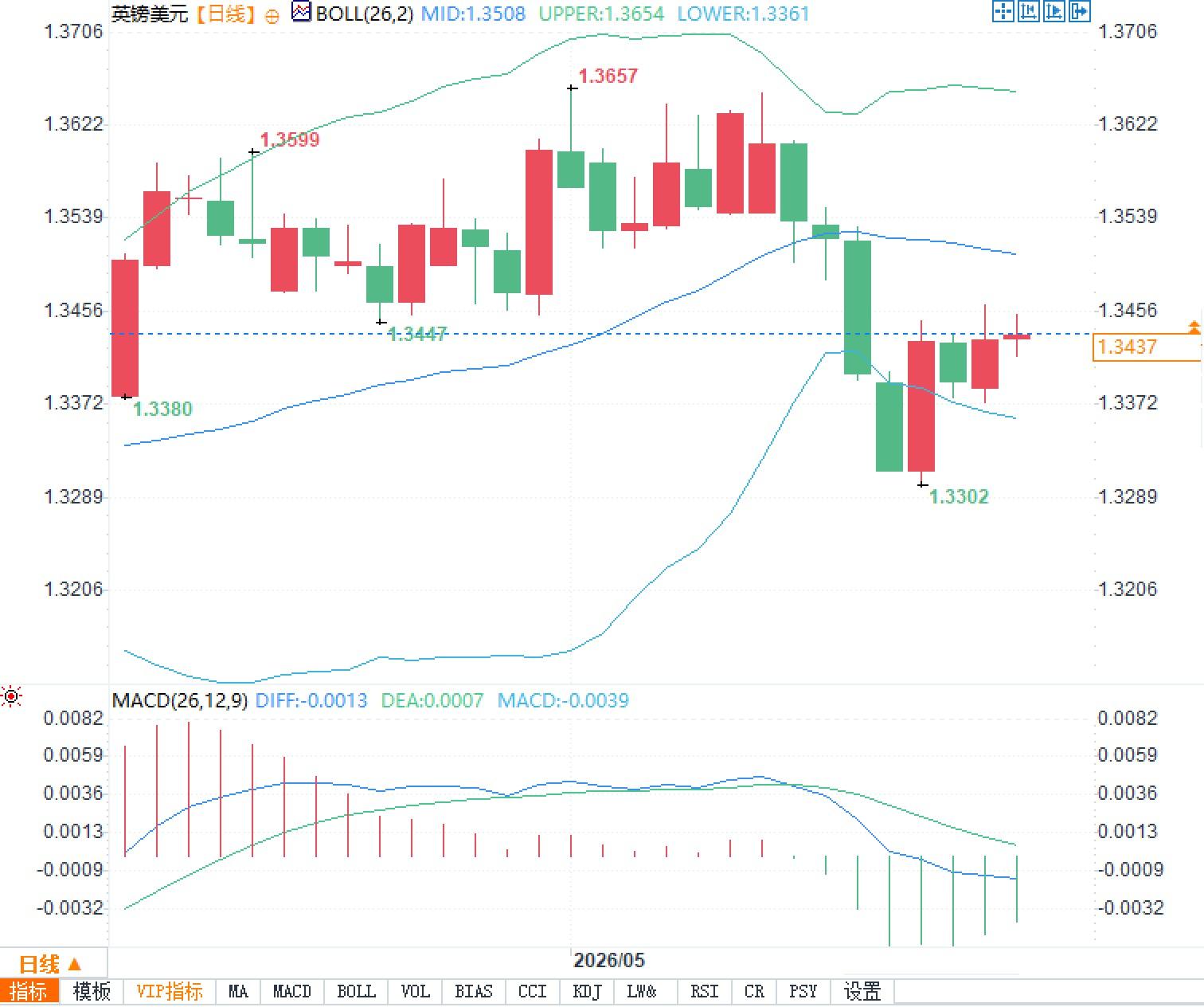
The MACD structure is also weak, with DIFF at -0.0013, DEA at 0.0007, and the histogram at -0.0039, indicating that the daily momentum has not yet been fully restored. If the price continues to be resisted around 1.35, it suggests that the market's downward revision of the UK's fundamentals is not yet over. If it returns above the Bollinger Middle Band, it will require improved macroeconomic data; otherwise, the reliability of a technical breakout is limited.
Question 1: Why is the pound still under pressure despite the UK CPI falling to 2.8%?
A: Because the decline in inflation mainly stemmed from some energy bills and base effects, the market is more focused on whether subsequent fuel, transportation, and business costs will push prices up again. At the same time, the PMI falling below 50 indicates weakening growth momentum, and the focus of exchange rate pricing has shifted from simply combating inflation to the dilemma between growth and policy.
Question 2: Why has the probability of the Bank of England raising interest rates this summer decreased?
A: The May PMI showed contraction in business activity, and employment data also showed a decline in job vacancies and a slowdown in wage growth. If inflationary pressures mainly stem from energy supply shocks, raising interest rates will not address the root cause of costs but may further depress demand. Therefore, policymakers are more inclined to wait for more data to confirm this.
Question 3: What is the most critical point to watch for in the current GBP/USD exchange rate?
A: From a macro perspective, we need to look at subsequent PMI, new orders, wages, and service inflation; from a technical perspective, we need to see if the 1.35 level can be effectively recovered. If the fundamentals remain weak, the rebound is likely to be seen as a correction. Only if growth data stabilizes and inflation does not surge again can the pound regain more stable valuation support.
A sharp drop in PMI changes the pricing focus of the pound.
The core issue behind the current pressure on the pound is not simply exchange rate fluctuations, but rather the rapid downward revision of UK growth expectations. The rebound in the April PMI was interpreted by some as an economic recovery, but the latest data shows that the earlier expansion largely stemmed from companies placing orders in advance and replenishing inventories, rather than an improvement in end-user demand. Entering May, new orders, business confidence, and service sector activity all weakened simultaneously, indicating that businesses are shifting from "defensive stockpiling" to "cost reduction."
For traders, a composite PMI of 48.5 means the market is no longer just trading on spreads, but is repricing the actual pressure on the UK economy. The services sector, a major pillar of the UK economy, saw its activity index fall to multi-year lows, indicating that high energy costs, cautious consumption, and slowing external orders are simultaneously impacting cash flow and profit margins. S&P Global economist Chris Williamson stated that the data points to a possible 0.2% contraction in the UK economy this quarter, significantly weakening the pound's underlying macroeconomic support.
Cooling inflation does not mean the relief of policy pressure.
The UK's CPI fell to 2.8% year-on-year in April, with core CPI dropping to 2.5%, and services inflation declining to 3.2% from 4.5% in March. On the surface, this data eases pressure on the Bank of England to continue tightening, but the market cannot simply interpret it as a solution to the inflation problem. Official statistics show that housing and household services contributed significantly to the decline in inflation, while fuel prices continued to exert upward pressure, indicating that price pressures are shifting from household bills to transportation, production, and business costs.
This is precisely the most challenging aspect of the pound's current pricing. If the energy shock persists, nominal inflation may rebound in the coming months, but its source will be supply-side rather than excessive demand. The Bank of England kept the interest rate unchanged at 3.75% at its April meeting, with eight members supporting the hold and one member supporting a rate hike to 4%. The meeting minutes explicitly stated that the outlook for energy prices is highly uncertain, and monetary policy cannot directly influence energy prices, but it is necessary to prevent a second-round effect from wages and price setting.
Therefore, the pound sterling is not easily supported by "inflation above target." If the central bank is forced to send a more hawkish signal, growth concerns will suppress the exchange rate; if the central bank emphasizes economic weakness and postpones interest rate hikes, interest rate differential expectations will weaken the pound's attractiveness. This two-pronged squeeze is the key reason why the pound is currently struggling to return above 1.36.
A weakening job market risks a wage spiral.
The latest labor market data further exacerbates the Bank of England's dilemma. The UK unemployment rate was 5.0% from January to March, up 0.5 percentage points year-on-year; the preliminary figure for salaried employees in April showed a decrease of 100,000 from March, with job vacancies falling to 705,000, the lowest level since February-April 2021. During the same period, the annual growth rate of regular wages fell to 3.4%, while the growth rate of regular wages in the private sector was 3.0%, indicating that the labor market no longer possesses the strong wage transmission capacity it previously enjoyed.
This data has a fairly direct meaning for the pound: upside risks to inflation exist, but the second-round effect on wages has been weakened. For the central bank, in a phase of easing labor market and continuously weakening corporate hiring intentions, suppressing supply-side inflation through interest rate hikes may yield policy benefits that outweigh economic costs. Bank of England Governor Andrew Bailey recently also mentioned that rising market interest rates give the central bank more time to assess the impact of the conflict on the economy, while there are already signs of cooling in growth and the labor market.
This means that the expectation of a summer rate hike no longer has a basis for unilateral strengthening. For the pound to regain trend support, two types of data need to improve simultaneously: first, the PMI needs to return above 50 accompanied by improved new orders; second, inflationary pressures no longer rely on energy-driven growth. Currently, neither of these is sufficient.
Technical analysis suggests the rebound is still in a corrective phase.
From the daily chart, the GBP/USD pair formed a high near 1.3657 before quickly falling back, subsequently breaking below the Bollinger Middle Band near 1.3508, and reaching a low of 1.3302 before a slight recovery. The current price is around 1.344, still below the Middle Band, indicating that the rebound is more of a technical correction after an oversold condition than a trend reversal. The Lower Bollinger Band is around 1.3361, which still exerts influence on short-term fluctuations.
The MACD structure is also weak, with DIFF at -0.0013, DEA at 0.0007, and the histogram at -0.0039, indicating that the daily momentum has not yet been fully restored. If the price continues to be resisted around 1.35, it suggests that the market's downward revision of the UK's fundamentals is not yet over. If it returns above the Bollinger Middle Band, it will require improved macroeconomic data; otherwise, the reliability of a technical breakout is limited.
Frequently Asked Questions
Question 1: Why is the pound still under pressure despite the UK CPI falling to 2.8%?
A: Because the decline in inflation mainly stemmed from some energy bills and base effects, the market is more focused on whether subsequent fuel, transportation, and business costs will push prices up again. At the same time, the PMI falling below 50 indicates weakening growth momentum, and the focus of exchange rate pricing has shifted from simply combating inflation to the dilemma between growth and policy.
Question 2: Why has the probability of the Bank of England raising interest rates this summer decreased?
A: The May PMI showed contraction in business activity, and employment data also showed a decline in job vacancies and a slowdown in wage growth. If inflationary pressures mainly stem from energy supply shocks, raising interest rates will not address the root cause of costs but may further depress demand. Therefore, policymakers are more inclined to wait for more data to confirm this.
Question 3: What is the most critical point to watch for in the current GBP/USD exchange rate?
A: From a macro perspective, we need to look at subsequent PMI, new orders, wages, and service inflation; from a technical perspective, we need to see if the 1.35 level can be effectively recovered. If the fundamentals remain weak, the rebound is likely to be seen as a correction. Only if growth data stabilizes and inflation does not surge again can the pound regain more stable valuation support.
- Risk Warning and Disclaimer
- The market involves risk, and trading may not be suitable for all investors. This article is for reference only and does not constitute personal investment advice, nor does it take into account certain users’ specific investment objectives, financial situation, or other needs. Any investment decisions made based on this information are at your own risk.