Has the Bank of Japan backed down first? A bond market survey reveals disagreements over balance sheet reduction, leaving the yen stuck at 159.
2026-05-21 18:53:42
On Thursday (May 21), the yen exchange rate fluctuated around the 159 level, with the latest USD/JPY quote at approximately 159.095. Amid some volatility in the Japanese government bond market, a Bank of Japan investor survey showed that some market participants were calling for a pause or slowdown in the pace of bond reduction, directly impacting the yen's performance. Long-term government bond yields declined, the yield curve flattened, and coupled with expectations of potential policy adjustments, market focus shifted to the normalization process of bond holdings and exchange rate stability.
Recent tensions in the Middle East have driven up energy prices, raising inflation concerns and causing volatility in global bond markets, including Japanese government bonds. The Bank of Japan will review its current bond-buying tapering program at its June meeting and outline its path beyond fiscal year 2027. Currently, monthly purchases are approximately 2.1 trillion yen. Some investors believe that maintaining this level will not significantly distort market function, while others suggest a continued gradual reduction to around 1.3 trillion yen.
On the fundamental front, Bank of Japan board member Koeda emphasized that prolonged unconventional monetary policies have led to an expansion of the balance sheet, necessitating a flexible and predictable approach to normalization. Meanwhile, investor surveys have revealed calls for emergency bond-buying operations in times of market instability, reflecting the current bond market's demand for policy buffers. While discussions regarding yield control have not become mainstream, volatility in long-term yields has prompted the market to assess the Bank of Japan's potential flexible responses.
The impact of these policy signals on the yen is clear: if the Bank of Japan slows its bond-buying program or maintains a high level of purchases, it will limit the upside potential of long-term yields, thereby easing pressure on yen funding costs. However, inflation expectations triggered by the energy shock may push up the overall yield curve, providing some support for the yen in the short term or amplifying volatility. The prevailing market view is that bond market stability is one of the potential triggers for exchange rate intervention, but the threshold for direct intervention has not yet been reached.
From a technical perspective, the USD/JPY 4-hour chart shows the price closely following the upper Bollinger Band, with the middle band at 158.955 and the lower band at 158.729. The upper band at 159.181 forms short-term resistance. The MACD indicator's DIF has crossed below the DEA, and the histogram has turned green, indicating a slight weakening of short-term bullish momentum. However, the overall trend remains above the zero line, and the medium-term bullish structure has not yet reversed.
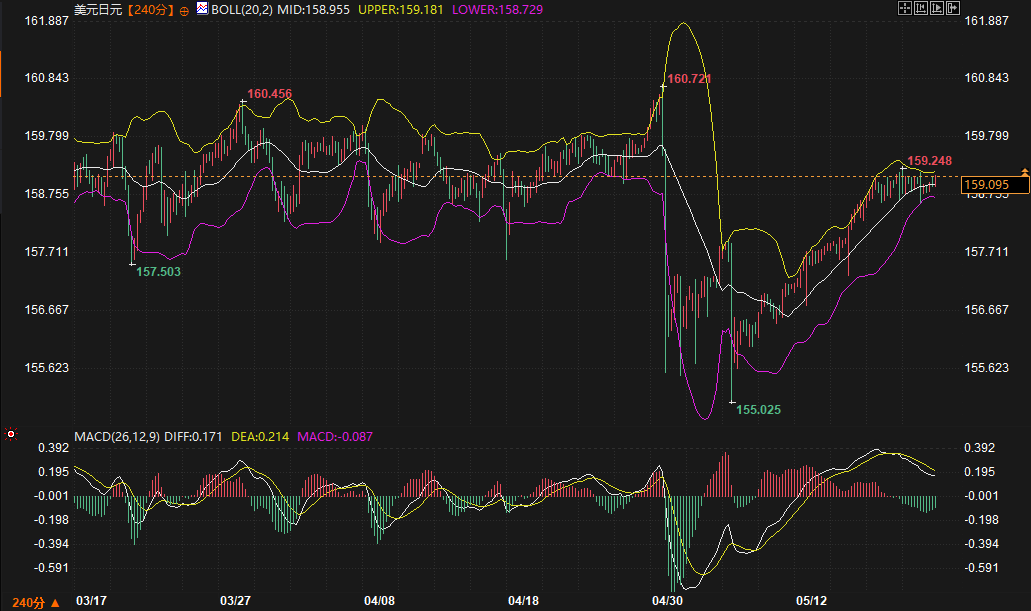
Historically, the price reached a high of 160.721 at the end of April, before quickly falling to a low of 155.025 in early May. Recently, it has rebounded from this low and is approaching the 159.2-159.5 range. The previous consolidation range was 157.50-160.45, and the price is currently in the later stages of a rebound, facing resistance from the previous high.
Support and resistance levels are predicted based on the USD/JPY main contract: Short-term support levels to watch are 158.955 (Bollinger Middle Band) and 158.729 (Bollinger Lower Band). A break below these levels could test the historical low near 157.50. Key resistance levels to watch are 159.181 (Bollinger Upper Band) and 159.248 (current high). A break above these levels could lead to a further test of the psychological level of 160.00. Key factors to watch during the session include the results of the Japanese government bond auction, statements from Bank of Japan officials, and the dynamics of the USD/JPY interest rate differential, all of which will directly impact exchange rate volatility.
Regarding long-term JGB yields, the 30-year yield fell back to around 4.03%, and the 10-year yield to around 2.77%. The yield curve has flattened for two consecutive days, with active buying at the ultra-long end. However, some traders remain cautious about the stable trend, and next week's 40-year auction will be a key observation window.
Looking ahead, the performance of Japanese government bonds and the Bank of Japan's policy flexibility will continue to dominate the yen's exchange rate fluctuation range. If the June meeting results reflect a cautious adjustment in bond purchases, it will provide short-term support for the yen; conversely, increased market volatility could trigger broader risk aversion. In terms of the exchange rate, the 159 level needs to be continuously monitored, and the shape of the bond yield curve should be considered to determine the medium-term direction. Overall, the balance between the policy normalization process and external inflationary pressures will determine the yen's resilience around its current level.
1. What direct impact will the calls for a halt to bond reductions in the Bank of Japan's investor survey have on the yen?
Some investors suggest maintaining the current monthly purchase level of 2.1 trillion yen, believing this will help stabilize market function. If the Bank of Japan adopts a similar view in its June review, it will limit the rapid rise in long-term yields, alleviate the yen's interest rate disadvantage, and support the yen's exchange rate within its current range in the short term. However, the final decision will still need to weigh the overall inflation path.
2. Does the current decline in Japanese government bond yields indicate a restart of yield control policies?
The decline in yields was mainly due to favorable auction results and genuine buying demand, rather than a formal adjustment to the yield control framework. The Bank of Japan's board members reiterated their emphasis on balancing normalization with economic impact, and the market has not yet anticipated a clear return to a control mechanism; however, policy flexibility may increase in a volatile environment.
3. How to interpret the Bollinger Band signals displayed in the USD/JPY technical analysis?
The price is trading within the upper Bollinger Band channel, indicating short-term strength, but the initial MACD death cross suggests a risk of pullback. The middle Bollinger Band at 158.955 acts as dynamic support, and its effectiveness needs to be monitored. If the price falls below the middle band, it may open up more room for correction; conversely, holding near the upper band would maintain the rebound structure.
4. How do energy price shocks transmit to the yen through the bond market?
Rising energy prices have exacerbated inflation expectations, putting downward pressure on overall bond yields, and Japan, as an energy importer, faces imported pressure. Bond market volatility may prompt the Bank of Japan to assess the necessity of intervention, indirectly affecting the yen's safe-haven status and exchange rate volatility.
5. What are the potential catalysts for the yen's exchange rate in the key events next week?
The 40-year government bond auction and continued monitoring of the bond market will be key focuses. A successful auction and a flattening yield curve would help stabilize the yen; meanwhile, any further statements from Bank of Japan officials regarding balance sheet normalization should be closely watched, as these will directly shape market expectations regarding the pace of policy.
Recent tensions in the Middle East have driven up energy prices, raising inflation concerns and causing volatility in global bond markets, including Japanese government bonds. The Bank of Japan will review its current bond-buying tapering program at its June meeting and outline its path beyond fiscal year 2027. Currently, monthly purchases are approximately 2.1 trillion yen. Some investors believe that maintaining this level will not significantly distort market function, while others suggest a continued gradual reduction to around 1.3 trillion yen.
Fundamental and technical analysis
On the fundamental front, Bank of Japan board member Koeda emphasized that prolonged unconventional monetary policies have led to an expansion of the balance sheet, necessitating a flexible and predictable approach to normalization. Meanwhile, investor surveys have revealed calls for emergency bond-buying operations in times of market instability, reflecting the current bond market's demand for policy buffers. While discussions regarding yield control have not become mainstream, volatility in long-term yields has prompted the market to assess the Bank of Japan's potential flexible responses.
The impact of these policy signals on the yen is clear: if the Bank of Japan slows its bond-buying program or maintains a high level of purchases, it will limit the upside potential of long-term yields, thereby easing pressure on yen funding costs. However, inflation expectations triggered by the energy shock may push up the overall yield curve, providing some support for the yen in the short term or amplifying volatility. The prevailing market view is that bond market stability is one of the potential triggers for exchange rate intervention, but the threshold for direct intervention has not yet been reached.
From a technical perspective, the USD/JPY 4-hour chart shows the price closely following the upper Bollinger Band, with the middle band at 158.955 and the lower band at 158.729. The upper band at 159.181 forms short-term resistance. The MACD indicator's DIF has crossed below the DEA, and the histogram has turned green, indicating a slight weakening of short-term bullish momentum. However, the overall trend remains above the zero line, and the medium-term bullish structure has not yet reversed.
Historically, the price reached a high of 160.721 at the end of April, before quickly falling to a low of 155.025 in early May. Recently, it has rebounded from this low and is approaching the 159.2-159.5 range. The previous consolidation range was 157.50-160.45, and the price is currently in the later stages of a rebound, facing resistance from the previous high.
Support and resistance levels are predicted based on the USD/JPY main contract: Short-term support levels to watch are 158.955 (Bollinger Middle Band) and 158.729 (Bollinger Lower Band). A break below these levels could test the historical low near 157.50. Key resistance levels to watch are 159.181 (Bollinger Upper Band) and 159.248 (current high). A break above these levels could lead to a further test of the psychological level of 160.00. Key factors to watch during the session include the results of the Japanese government bond auction, statements from Bank of Japan officials, and the dynamics of the USD/JPY interest rate differential, all of which will directly impact exchange rate volatility.
Regarding long-term JGB yields, the 30-year yield fell back to around 4.03%, and the 10-year yield to around 2.77%. The yield curve has flattened for two consecutive days, with active buying at the ultra-long end. However, some traders remain cautious about the stable trend, and next week's 40-year auction will be a key observation window.
Future Trend Outlook
Looking ahead, the performance of Japanese government bonds and the Bank of Japan's policy flexibility will continue to dominate the yen's exchange rate fluctuation range. If the June meeting results reflect a cautious adjustment in bond purchases, it will provide short-term support for the yen; conversely, increased market volatility could trigger broader risk aversion. In terms of the exchange rate, the 159 level needs to be continuously monitored, and the shape of the bond yield curve should be considered to determine the medium-term direction. Overall, the balance between the policy normalization process and external inflationary pressures will determine the yen's resilience around its current level.
Frequently Asked Questions
1. What direct impact will the calls for a halt to bond reductions in the Bank of Japan's investor survey have on the yen?
Some investors suggest maintaining the current monthly purchase level of 2.1 trillion yen, believing this will help stabilize market function. If the Bank of Japan adopts a similar view in its June review, it will limit the rapid rise in long-term yields, alleviate the yen's interest rate disadvantage, and support the yen's exchange rate within its current range in the short term. However, the final decision will still need to weigh the overall inflation path.
2. Does the current decline in Japanese government bond yields indicate a restart of yield control policies?
The decline in yields was mainly due to favorable auction results and genuine buying demand, rather than a formal adjustment to the yield control framework. The Bank of Japan's board members reiterated their emphasis on balancing normalization with economic impact, and the market has not yet anticipated a clear return to a control mechanism; however, policy flexibility may increase in a volatile environment.
3. How to interpret the Bollinger Band signals displayed in the USD/JPY technical analysis?
The price is trading within the upper Bollinger Band channel, indicating short-term strength, but the initial MACD death cross suggests a risk of pullback. The middle Bollinger Band at 158.955 acts as dynamic support, and its effectiveness needs to be monitored. If the price falls below the middle band, it may open up more room for correction; conversely, holding near the upper band would maintain the rebound structure.
4. How do energy price shocks transmit to the yen through the bond market?
Rising energy prices have exacerbated inflation expectations, putting downward pressure on overall bond yields, and Japan, as an energy importer, faces imported pressure. Bond market volatility may prompt the Bank of Japan to assess the necessity of intervention, indirectly affecting the yen's safe-haven status and exchange rate volatility.
5. What are the potential catalysts for the yen's exchange rate in the key events next week?
The 40-year government bond auction and continued monitoring of the bond market will be key focuses. A successful auction and a flattening yield curve would help stabilize the yen; meanwhile, any further statements from Bank of Japan officials regarding balance sheet normalization should be closely watched, as these will directly shape market expectations regarding the pace of policy.
- Risk Warning and Disclaimer
- The market involves risk, and trading may not be suitable for all investors. This article is for reference only and does not constitute personal investment advice, nor does it take into account certain users’ specific investment objectives, financial situation, or other needs. Any investment decisions made based on this information are at your own risk.