Iran's statement regarding the retention of highly enriched uranium in its territory had a limited impact on the crude oil market.
2026-05-22 01:53:04
On Thursday (May 21), a sudden geopolitical development in Iran disrupted global energy markets. According to Reuters, citing a core source within Iran's top leadership, Supreme Leader Mojtaba Khamenei issued an internal directive stipulating that Iran's near-weapon-grade highly enriched uranium stockpile must not be exported and must remain entirely within Iran. This statement directly touched a core red line for the United States and Israel, instantly triggering geopolitical risk panic in capital markets, and causing a sharp short-term jump in international crude oil prices: Brent crude surged by more than 3.5%, approaching $108.50 per barrel, while WTI crude also quickly rebounded to the $102 per barrel mark.
Initially, the market was generally concerned that this hardline stance could completely derail the US-Iran negotiations, leading to a breakdown in talks and a renewed escalation of tensions in the Middle East. However, this round of oil price surges did not develop into a sustained upward trend, with prices quickly experiencing a rollercoaster ride of "peak and fall." As Iranian official and semi-official media swiftly denied rumors and downplayed conflict expectations, the increase in crude oil prices narrowed rapidly, and the geopolitical risk premium quickly subsided.
The reason this event only caused a short-term, limited market shock, rather than triggering systemic fluctuations in the energy market, is primarily due to the combined effect of three factors: market desensitization, Iran's negotiating strategy, and the US's pragmatic approach to the game. The following analysis delves into the logic behind this market trend and the underlying context of the US-Iran game from four dimensions.
Market level: Repeated game-playing has led to a desensitization effect, and verbal statements are unlikely to sway actual market trends.
The US and Iran are currently locked in a protracted negotiation stalemate, with core issues such as navigation rules in the Strait of Hormuz, the handling of Iran's nuclear facilities, and the lifting of international sanctions remaining unresolved. Over the past few months, the US and Iran have frequently alternated between issuing tough statements and signals of peace talks. This persistent geopolitical noise has significantly reduced the oil market's sensitivity to single verbal events, creating a classic "crying wolf" desensitization effect.
For Wall Street institutions and global traders, market pricing has long since moved beyond "emotional herding" and formed a clear logic: mere verbal declarations of stance cannot change the fundamentals of oil supply and demand; only substantial physical risks such as the blockade of the Strait of Hormuz, military attacks on nuclear facilities, and disruptions to oil supply can provide the impetus for a sustained rise in oil prices. Therefore, Iran's recent strong statement only triggered short-term speculative trading and is unlikely to support a one-sided upward trend.
Meanwhile, the Trump administration's public statements further stabilized market expectations. Trump repeatedly released positive signals, stating that the US-Iran conflict would end quickly, that both sides were advancing substantive negotiations, and explicitly stating that "the United States will eventually achieve its established goals and acquire Iranian uranium resources." This series of pragmatic statements effectively suppressed market panic, limited the space for speculative buying, and led the market to unanimously characterize this tough statement as a bargaining chip rather than a prelude to war escalation.
Iran's strategy: Brinkmanship, making strong statements while quickly leaving room for negotiation.
This directive prohibiting the export of highly enriched uranium is not a declaration of war by Iran, but rather a typical brinkmanship negotiation tactic. Following the sharp market fluctuations triggered by the news, Iranian official and semi-official media quickly launched a propaganda campaign to downplay the confrontational nature of the issue and signal compromise, clarifying that retaining highly enriched uranium does not equate to a refusal to negotiate, and that Iran remains willing to dispose of its nuclear stockpile within the international framework.
According to high-ranking Iranian sources, the principle of "not leaving the country's uranium stockpile" is a consensus bottom line among hardliners within Iran, with the core objective of defending national nuclear sovereignty and responding to domestic public opinion and the demands of the Revolutionary Guard. However, in terms of external negotiations, Iran has not closed the door to consultations. Several senior advisors have stated that they are willing to accept full supervision from the International Atomic Energy Agency (IAEA) and to replace the physical export of uranium with on-site dilution and enrichment within Iran, in exchange for the lifting of key US sanctions against Iran, thus achieving a balance of interests between the two sides.
This operational model of "being tough on domestic issues and setting a bottom line, while softening external stances and leaving room for maneuver" is a mature game strategy employed by Iran: on the one hand, it uses red lines to build domestic political consensus and solidify its ruling base; on the other hand, it avoids the situation from spiraling out of control by quickly dispelling rumors and releasing compromise proposals, thus preserving sufficient dignity and room for maneuver for subsequent negotiations and fundamentally eliminating extreme risk aversion in the market.
The US Game: The White House's Red-Cop/Blue-Cop Strategy – Prioritizing Pragmatism and Strictly Controlling Conflict Risks
The Trump administration's approach to Iran exhibited a clear pragmatic orientation and strategic stratification, with its core objective being to achieve a diplomatic victory through diplomatic means, rather than restarting military conflict. Trump stated frankly that the US demand for Iranian uranium resources served more for domestic public relations and propaganda purposes than an absolute necessity; moreover, the US, relying on its comprehensive monitoring system and military deployments, had completely grasped the core risks of the Iranian nuclear situation, making the situation highly controllable.
The core motivation for avoiding conflict stems from domestic economic and political considerations: Inflationary pressures in the United States have not yet fully eased, and a full-scale escalation of the situation in the Middle East and a continued surge in oil prices would directly exacerbate imported inflation, impacting consumer spending and the pace of economic recovery, while also severely affecting the midterm elections. Therefore, the Trump administration resolutely avoids restarting large-scale military action against Iran, prioritizing a diplomatically concluded victory.
Based on this, the White House adopted a "red-cop/blue-cop" strategy, with the president stabilizing expectations and senior officials upholding bottom lines, precisely balancing market sentiment and strategic positions. Trump continued to release positive signals for peace talks, stabilizing oil prices and market expectations; while Secretary of State Rubio took a hard line, drawing red lines, acknowledging positive progress in negotiations while strongly rejecting Iran's proposed toll system for passage through the Strait of Hormuz, calling it illegal and highly provocative, which would directly lead to a complete standstill in diplomatic negotiations. This combination of soft and hard approaches stabilized market sentiment while safeguarding core US interests, making it clear to the market that the US-Iran conflict remained within a controllable framework.
Market Outlook: The high-level consolidation pattern will continue; only a substantial upgrade will break the equilibrium.
In summary, Iran's recent nuclear red line statement is essentially an escalation of its bargaining power amid the stalemate in US-Iran negotiations. Its core objective is to build domestic consensus and increase its negotiating leverage internationally, rather than signaling a full-blown escalation of the situation. Coupled with Iran's rapid de-escalation of public opinion and the US's pragmatic and restrained approach, the impact of this event on the oil market has been largely offset, making it unlikely to have a long-term trend-like effect.
The crude oil market is expected to maintain a high-level fluctuation pattern of $100-110 per barrel in the short term, and the balance of high-risk games will continue. The key observation windows for subsequent market movements will focus on two crucial signals: the progress of Pakistan's mediation efforts and the US's attitude towards Iran's "on-site uranium stockpile dilution" plan.
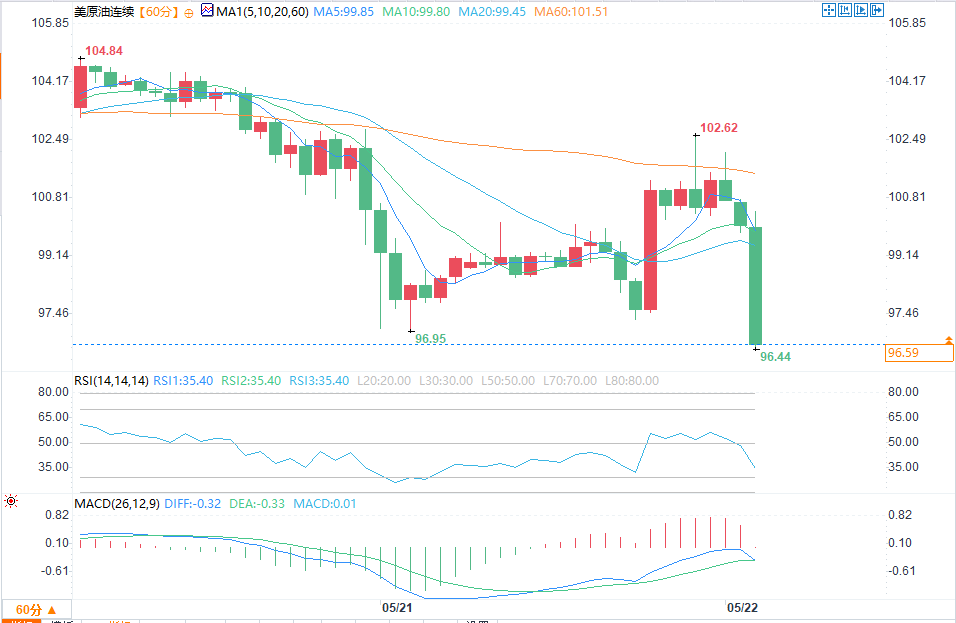
(WTI crude oil daily chart source: FX678)
Overall, the current US-Iran rivalry remains characterized by "negotiations and maneuvering, constant verbal sparring, and a manageable conflict," meaning the conditions for a unilateral surge in oil prices have not yet been met. Only substantial risks such as a clear escalation of military conflict, a complete blockade of the Strait of Hormuz, or a complete breakdown in negotiations will break the current volatile pattern in the oil market. The ultimate outcome depends on the Trump administration's negotiating flexibility and the room for compromise between the US and Iran on their core interests.
At 01:49 Beijing time, WTI crude oil was trading at $96.9 per barrel, down 1.38%.
Initially, the market was generally concerned that this hardline stance could completely derail the US-Iran negotiations, leading to a breakdown in talks and a renewed escalation of tensions in the Middle East. However, this round of oil price surges did not develop into a sustained upward trend, with prices quickly experiencing a rollercoaster ride of "peak and fall." As Iranian official and semi-official media swiftly denied rumors and downplayed conflict expectations, the increase in crude oil prices narrowed rapidly, and the geopolitical risk premium quickly subsided.
The reason this event only caused a short-term, limited market shock, rather than triggering systemic fluctuations in the energy market, is primarily due to the combined effect of three factors: market desensitization, Iran's negotiating strategy, and the US's pragmatic approach to the game. The following analysis delves into the logic behind this market trend and the underlying context of the US-Iran game from four dimensions.
Market level: Repeated game-playing has led to a desensitization effect, and verbal statements are unlikely to sway actual market trends.
The US and Iran are currently locked in a protracted negotiation stalemate, with core issues such as navigation rules in the Strait of Hormuz, the handling of Iran's nuclear facilities, and the lifting of international sanctions remaining unresolved. Over the past few months, the US and Iran have frequently alternated between issuing tough statements and signals of peace talks. This persistent geopolitical noise has significantly reduced the oil market's sensitivity to single verbal events, creating a classic "crying wolf" desensitization effect.
For Wall Street institutions and global traders, market pricing has long since moved beyond "emotional herding" and formed a clear logic: mere verbal declarations of stance cannot change the fundamentals of oil supply and demand; only substantial physical risks such as the blockade of the Strait of Hormuz, military attacks on nuclear facilities, and disruptions to oil supply can provide the impetus for a sustained rise in oil prices. Therefore, Iran's recent strong statement only triggered short-term speculative trading and is unlikely to support a one-sided upward trend.
Meanwhile, the Trump administration's public statements further stabilized market expectations. Trump repeatedly released positive signals, stating that the US-Iran conflict would end quickly, that both sides were advancing substantive negotiations, and explicitly stating that "the United States will eventually achieve its established goals and acquire Iranian uranium resources." This series of pragmatic statements effectively suppressed market panic, limited the space for speculative buying, and led the market to unanimously characterize this tough statement as a bargaining chip rather than a prelude to war escalation.
Iran's strategy: Brinkmanship, making strong statements while quickly leaving room for negotiation.
This directive prohibiting the export of highly enriched uranium is not a declaration of war by Iran, but rather a typical brinkmanship negotiation tactic. Following the sharp market fluctuations triggered by the news, Iranian official and semi-official media quickly launched a propaganda campaign to downplay the confrontational nature of the issue and signal compromise, clarifying that retaining highly enriched uranium does not equate to a refusal to negotiate, and that Iran remains willing to dispose of its nuclear stockpile within the international framework.
According to high-ranking Iranian sources, the principle of "not leaving the country's uranium stockpile" is a consensus bottom line among hardliners within Iran, with the core objective of defending national nuclear sovereignty and responding to domestic public opinion and the demands of the Revolutionary Guard. However, in terms of external negotiations, Iran has not closed the door to consultations. Several senior advisors have stated that they are willing to accept full supervision from the International Atomic Energy Agency (IAEA) and to replace the physical export of uranium with on-site dilution and enrichment within Iran, in exchange for the lifting of key US sanctions against Iran, thus achieving a balance of interests between the two sides.
This operational model of "being tough on domestic issues and setting a bottom line, while softening external stances and leaving room for maneuver" is a mature game strategy employed by Iran: on the one hand, it uses red lines to build domestic political consensus and solidify its ruling base; on the other hand, it avoids the situation from spiraling out of control by quickly dispelling rumors and releasing compromise proposals, thus preserving sufficient dignity and room for maneuver for subsequent negotiations and fundamentally eliminating extreme risk aversion in the market.
The US Game: The White House's Red-Cop/Blue-Cop Strategy – Prioritizing Pragmatism and Strictly Controlling Conflict Risks
The Trump administration's approach to Iran exhibited a clear pragmatic orientation and strategic stratification, with its core objective being to achieve a diplomatic victory through diplomatic means, rather than restarting military conflict. Trump stated frankly that the US demand for Iranian uranium resources served more for domestic public relations and propaganda purposes than an absolute necessity; moreover, the US, relying on its comprehensive monitoring system and military deployments, had completely grasped the core risks of the Iranian nuclear situation, making the situation highly controllable.
The core motivation for avoiding conflict stems from domestic economic and political considerations: Inflationary pressures in the United States have not yet fully eased, and a full-scale escalation of the situation in the Middle East and a continued surge in oil prices would directly exacerbate imported inflation, impacting consumer spending and the pace of economic recovery, while also severely affecting the midterm elections. Therefore, the Trump administration resolutely avoids restarting large-scale military action against Iran, prioritizing a diplomatically concluded victory.
Based on this, the White House adopted a "red-cop/blue-cop" strategy, with the president stabilizing expectations and senior officials upholding bottom lines, precisely balancing market sentiment and strategic positions. Trump continued to release positive signals for peace talks, stabilizing oil prices and market expectations; while Secretary of State Rubio took a hard line, drawing red lines, acknowledging positive progress in negotiations while strongly rejecting Iran's proposed toll system for passage through the Strait of Hormuz, calling it illegal and highly provocative, which would directly lead to a complete standstill in diplomatic negotiations. This combination of soft and hard approaches stabilized market sentiment while safeguarding core US interests, making it clear to the market that the US-Iran conflict remained within a controllable framework.
Market Outlook: The high-level consolidation pattern will continue; only a substantial upgrade will break the equilibrium.
In summary, Iran's recent nuclear red line statement is essentially an escalation of its bargaining power amid the stalemate in US-Iran negotiations. Its core objective is to build domestic consensus and increase its negotiating leverage internationally, rather than signaling a full-blown escalation of the situation. Coupled with Iran's rapid de-escalation of public opinion and the US's pragmatic and restrained approach, the impact of this event on the oil market has been largely offset, making it unlikely to have a long-term trend-like effect.
The crude oil market is expected to maintain a high-level fluctuation pattern of $100-110 per barrel in the short term, and the balance of high-risk games will continue. The key observation windows for subsequent market movements will focus on two crucial signals: the progress of Pakistan's mediation efforts and the US's attitude towards Iran's "on-site uranium stockpile dilution" plan.
(WTI crude oil daily chart source: FX678)
Overall, the current US-Iran rivalry remains characterized by "negotiations and maneuvering, constant verbal sparring, and a manageable conflict," meaning the conditions for a unilateral surge in oil prices have not yet been met. Only substantial risks such as a clear escalation of military conflict, a complete blockade of the Strait of Hormuz, or a complete breakdown in negotiations will break the current volatile pattern in the oil market. The ultimate outcome depends on the Trump administration's negotiating flexibility and the room for compromise between the US and Iran on their core interests.
At 01:49 Beijing time, WTI crude oil was trading at $96.9 per barrel, down 1.38%.
- Risk Warning and Disclaimer
- The market involves risk, and trading may not be suitable for all investors. This article is for reference only and does not constitute personal investment advice, nor does it take into account certain users’ specific investment objectives, financial situation, or other needs. Any investment decisions made based on this information are at your own risk.