The dollar rose to a six-week high amid a triple pressure from a reversal in Iran nuclear talks, weakening global PMIs, and hawkish signals from the Federal Reserve.
2026-05-22 00:12:33
On Thursday (May 21), during the US trading session, reports indicated that Iran's Supreme Leader had ordered a ban on the export of near-weapon-grade uranium, a move that hardened Tehran's stance in nuclear negotiations and significantly dampened confidence in ending the Middle East war. This news directly undermined market optimism sparked the previous day by US President Trump's statement that "negotiations have entered the final stage," causing the US dollar index to rise to its strongest level in six weeks.
The ongoing conflict in the Middle East not only prolongs energy supply disruptions but also potentially provides the Federal Reserve with a basis for raising interest rates by pushing up core consumer prices and inflation expectations in the United States. Meanwhile, the growth prospects of other major economies are becoming increasingly bleak due to high energy costs, further highlighting the relatively strong economic resilience of the United States and providing solid fundamental support for the US dollar.
Global PMIs softened across the board, exacerbating the divergence in growth patterns.
Thursday's May Purchasing Managers' Index (PMI) data disappointed markets, further exacerbating the divergence in growth among economies. Eurozone economic activity contracted by the largest drop in over two and a half years, dragged down by factors such as war-induced high living costs, sluggish demand in the services sector, and accelerated layoffs by businesses. British businesses experienced their broadest decline in business activity in over a year. In Japan, manufacturing activity slowed slightly in May, while services growth stalled for the first time in over a year.
Noah Buffam, Head of FICC Strategy at CIBC Capital Markets, stated, "Many data points have fallen short of expectations, and looking ahead, we may see further economic slowdown. It's been almost three months since the oil shock began, and typically at this point, the global economy experiences some degree of deterioration; therefore, we are cautious about currencies affected by global growth."
Andrew Kenningham, chief European economist at Capital Economics, also pointed out that the Eurozone's PMI data was neither enough to make the European Central Bank change its plan to raise interest rates by 25 basis points in June, nor could it alleviate market concerns about the risk of an economic recession. As a result, the euro came under further pressure and fell to $1.1589, a drop of 0.34%.
The Fed meeting minutes were increasingly hawkish, but did not exceed market expectations.
The minutes of the Federal Reserve meeting showed that most Federal Open Market Committee (FOMC) members believed it was necessary to indicate a willingness to raise interest rates if inflation remained persistently above the 2% target, with the overall tone gradually shifting from neutral to hawkish. The yield on the 2-year U.S. Treasury note has risen by approximately 40 basis points from its low last month, indicating that the market has already priced in expectations of multiple rate hikes.
However, the overall tone of the meeting minutes did not significantly exceed market hawkish expectations. The latest forecasts from Fed staff indicate that, under the baseline scenario, inflation will fall to "close to 2%" next year, which currently does not constitute sufficient reason for an immediate rate hike. Lee Hardman, an analyst at MUFG, pointed out that Nvidia's strong performance boosted global market optimism regarding artificial intelligence, and the recovery in risk appetite has to some extent limited further upside potential for the dollar.
Christopher Wong, a foreign exchange strategist at OCBC Bank, added that the overnight weakness in the dollar was mainly due to falling Treasury yields and oil prices, rather than a reversal in policy signals. The meeting minutes were generally unsurprising to the market.
Resilient US employment data provides the Fed with room to focus on inflation.
On the domestic data front, initial jobless claims in the US fell last week, demonstrating strong resilience in the labor market. This result provides the Federal Reserve with valuable policy space, allowing it to focus more on addressing rising inflationary pressures while pausing interest rate cuts, further solidifying expectations of the dollar's interest rate advantage.
The yen is nearing intervention threshold; the Bank of Japan signals a June rate hike.
The yen fell 0.17% against the dollar to 159.19, nearing the 160 level. This level triggered Japan's first intervention in the foreign exchange market in nearly two years last month. Bank of Japan board member Junko Koeda stated that price pressures from the Middle East war could keep Japan's core inflation rate above the 2% target, therefore the Bank of Japan should proceed with interest rate hikes at an "appropriate pace," providing a basis for action as early as June.
Furthermore, a survey of investors by the Bank of Japan showed that some investors requested a halt to its tapering of bond purchases, indicating that there are still disagreements within the market regarding the pace of monetary policy normalization.
Technical Analysis: The US dollar index is consolidating; watch for two key resistance levels.
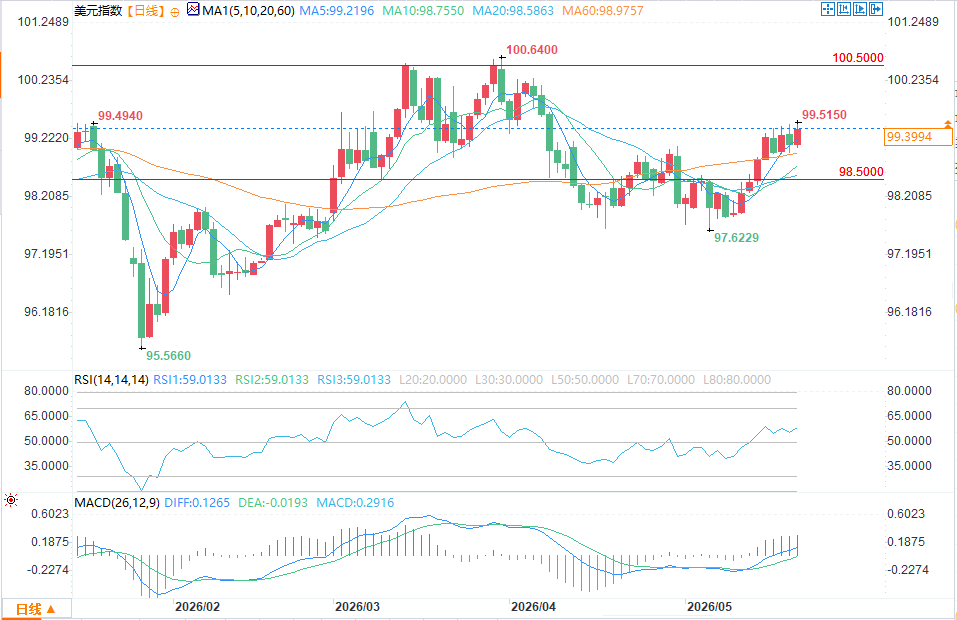
(US Dollar Index Daily Chart Source: FX678)
From a technical perspective, the US dollar index is currently trending upwards, but the RSI indicator has shown signs of retreating from overbought territory. OCBC Bank analysis points out that key short-term resistance levels are at 99.40 (23.6% Fibonacci retracement) and 100.50 to 100.60 (the 2026 high area); support levels are at 98.30 to 98.50 (convergence of the 21-day, 100-day, and 200-day moving averages), 98.10 (50% Fibonacci retracement), and 97.50 to 97.60 (61.8% Fibonacci retracement and double bottom support).
Until the resistance level is effectively broken, the US dollar index is expected to maintain a high-level consolidation pattern.
The ongoing conflict in the Middle East not only prolongs energy supply disruptions but also potentially provides the Federal Reserve with a basis for raising interest rates by pushing up core consumer prices and inflation expectations in the United States. Meanwhile, the growth prospects of other major economies are becoming increasingly bleak due to high energy costs, further highlighting the relatively strong economic resilience of the United States and providing solid fundamental support for the US dollar.
Global PMIs softened across the board, exacerbating the divergence in growth patterns.
Thursday's May Purchasing Managers' Index (PMI) data disappointed markets, further exacerbating the divergence in growth among economies. Eurozone economic activity contracted by the largest drop in over two and a half years, dragged down by factors such as war-induced high living costs, sluggish demand in the services sector, and accelerated layoffs by businesses. British businesses experienced their broadest decline in business activity in over a year. In Japan, manufacturing activity slowed slightly in May, while services growth stalled for the first time in over a year.
Noah Buffam, Head of FICC Strategy at CIBC Capital Markets, stated, "Many data points have fallen short of expectations, and looking ahead, we may see further economic slowdown. It's been almost three months since the oil shock began, and typically at this point, the global economy experiences some degree of deterioration; therefore, we are cautious about currencies affected by global growth."
Andrew Kenningham, chief European economist at Capital Economics, also pointed out that the Eurozone's PMI data was neither enough to make the European Central Bank change its plan to raise interest rates by 25 basis points in June, nor could it alleviate market concerns about the risk of an economic recession. As a result, the euro came under further pressure and fell to $1.1589, a drop of 0.34%.
The Fed meeting minutes were increasingly hawkish, but did not exceed market expectations.
The minutes of the Federal Reserve meeting showed that most Federal Open Market Committee (FOMC) members believed it was necessary to indicate a willingness to raise interest rates if inflation remained persistently above the 2% target, with the overall tone gradually shifting from neutral to hawkish. The yield on the 2-year U.S. Treasury note has risen by approximately 40 basis points from its low last month, indicating that the market has already priced in expectations of multiple rate hikes.
However, the overall tone of the meeting minutes did not significantly exceed market hawkish expectations. The latest forecasts from Fed staff indicate that, under the baseline scenario, inflation will fall to "close to 2%" next year, which currently does not constitute sufficient reason for an immediate rate hike. Lee Hardman, an analyst at MUFG, pointed out that Nvidia's strong performance boosted global market optimism regarding artificial intelligence, and the recovery in risk appetite has to some extent limited further upside potential for the dollar.
Christopher Wong, a foreign exchange strategist at OCBC Bank, added that the overnight weakness in the dollar was mainly due to falling Treasury yields and oil prices, rather than a reversal in policy signals. The meeting minutes were generally unsurprising to the market.
Resilient US employment data provides the Fed with room to focus on inflation.
On the domestic data front, initial jobless claims in the US fell last week, demonstrating strong resilience in the labor market. This result provides the Federal Reserve with valuable policy space, allowing it to focus more on addressing rising inflationary pressures while pausing interest rate cuts, further solidifying expectations of the dollar's interest rate advantage.
The yen is nearing intervention threshold; the Bank of Japan signals a June rate hike.
The yen fell 0.17% against the dollar to 159.19, nearing the 160 level. This level triggered Japan's first intervention in the foreign exchange market in nearly two years last month. Bank of Japan board member Junko Koeda stated that price pressures from the Middle East war could keep Japan's core inflation rate above the 2% target, therefore the Bank of Japan should proceed with interest rate hikes at an "appropriate pace," providing a basis for action as early as June.
Furthermore, a survey of investors by the Bank of Japan showed that some investors requested a halt to its tapering of bond purchases, indicating that there are still disagreements within the market regarding the pace of monetary policy normalization.
Technical Analysis: The US dollar index is consolidating; watch for two key resistance levels.
(US Dollar Index Daily Chart Source: FX678)
From a technical perspective, the US dollar index is currently trending upwards, but the RSI indicator has shown signs of retreating from overbought territory. OCBC Bank analysis points out that key short-term resistance levels are at 99.40 (23.6% Fibonacci retracement) and 100.50 to 100.60 (the 2026 high area); support levels are at 98.30 to 98.50 (convergence of the 21-day, 100-day, and 200-day moving averages), 98.10 (50% Fibonacci retracement), and 97.50 to 97.60 (61.8% Fibonacci retracement and double bottom support).
Until the resistance level is effectively broken, the US dollar index is expected to maintain a high-level consolidation pattern.
- Risk Warning and Disclaimer
- The market involves risk, and trading may not be suitable for all investors. This article is for reference only and does not constitute personal investment advice, nor does it take into account certain users’ specific investment objectives, financial situation, or other needs. Any investment decisions made based on this information are at your own risk.