Slowing Japanese inflation coupled with increasingly hawkish signals from the Federal Reserve sent the dollar above 159 against the yen, nearing its year-to-date high.
2026-05-22 09:50:27
Friday's Asian session will continue to focus on Japanese inflation data and the Federal Reserve's policy outlook. The USD/JPY pair extended its recent strength, rising to around 159.10, once again approaching its year-to-date high. The market believes that slowing Japanese inflation and the Federal Reserve's hawkish stance are the core reasons driving the exchange rate higher.

Data released by Japan's Ministry of Internal Affairs and Communications on Friday showed that Japan's national consumer price index (CPI) rose 1.4% year-on-year in April, lower than the previous month's 1.5%. Meanwhile, Japan's core CPI also rose 1.4% year-on-year, marking the slowest growth rate in nearly four years. The data suggests that domestic price pressures in Japan have eased somewhat in the short term, cooling market expectations for aggressive tightening policies from the Bank of Japan.
The yen weakened rapidly after the data release. The market believes that the slowdown in Japanese inflation suggests the Bank of Japan may remain cautious in its policy normalization process. Although the market widely expects the Bank of Japan to raise short-term interest rates from 0.75% to 1.0% at its June meeting, the current data has reduced the urgency for further rapid rate hikes.
However, market analysts point out that Japan's inflation still faces the risk of rebounding in the coming months. Due to continued tensions in the Middle East and persistently high international energy prices, Japan's import costs are facing upward pressure. At the same time, disruptions to global supply chains may also push companies to further raise product prices. Rising energy costs and imported inflation remain important drivers of future price increases in Japan .
In contrast, the US policy stance is significantly more hawkish. The minutes of the Federal Open Market Committee (FOMC) meeting in April showed that most officials were concerned about inflation persisting above the 2% target and believed that if inflation could not effectively fall back, the Fed might need to reconsider further interest rate hikes in the future.
The meeting minutes specifically emphasized that the escalating situation in the Middle East and the conflict with Iran, which have driven up energy prices, have become a new source of upside risk to US inflation. The market is now reassessing the Federal Reserve's interest rate cut timetable, with some institutions even postponing their expectations for a rate cut in 2026.
As a result, US Treasury yields have remained high recently, and the US dollar index has maintained a strong overall trend. The expectation of a widening US-Japan interest rate differential has become the core driver of the dollar's rise against the yen . Given Japan's long-term ultra-loose monetary policy and the potential for a prolonged period of high interest rates in the US, funds continue to flow towards dollar assets.
Furthermore, the Japanese authorities' attitude towards exchange rate trends has become a key focus of market attention. As the USD/JPY exchange rate approaches the 160 mark, the market is concerned that the Japanese Ministry of Finance may re-intervene in the exchange rate market. Previously, the Japanese government intervened when the exchange rate rapidly approached 160 to curb excessive yen depreciation.
From a market sentiment perspective, the current foreign exchange market still exhibits a clear structure of "longing the US dollar and shorting the Japanese yen." Global risk aversion and the advantage of high-yield US assets continue to attract international capital flows to US dollar assets, while the Japanese yen, as a low-yield currency, faces continued pressure.
From a technical perspective, the USD/JPY pair continues its strong upward trend on the daily chart. The exchange rate is currently trading steadily above major moving averages, indicating that the medium- to long-term bullish structure remains intact. The daily MACD indicator remains in overbought territory, and while the RSI indicator has entered overbought territory, no clear top divergence signal has yet appeared, suggesting that bullish momentum still dominates the market. Key resistance levels are concentrated at 159.50 and the psychological level of 160; a successful break above these levels could lead to a further challenge of last year's highs. Initial support is around 157.80, followed by the 156.50 area.
The 4-hour chart shows that the USD/JPY pair is also trending upwards in the short term. The exchange rate continues to move along a short-term upward channel, with the moving average system maintaining a bullish alignment. However, due to strong psychological resistance in the 159-160 area, coupled with market caution regarding potential intervention by the Japanese government, short-term volatility may increase significantly. If subsequent US economic data continues to be strong, the USD/JPY pair may have further upside potential; however, if the Bank of Japan signals a more aggressive interest rate hike, it could trigger short-term profit-taking.
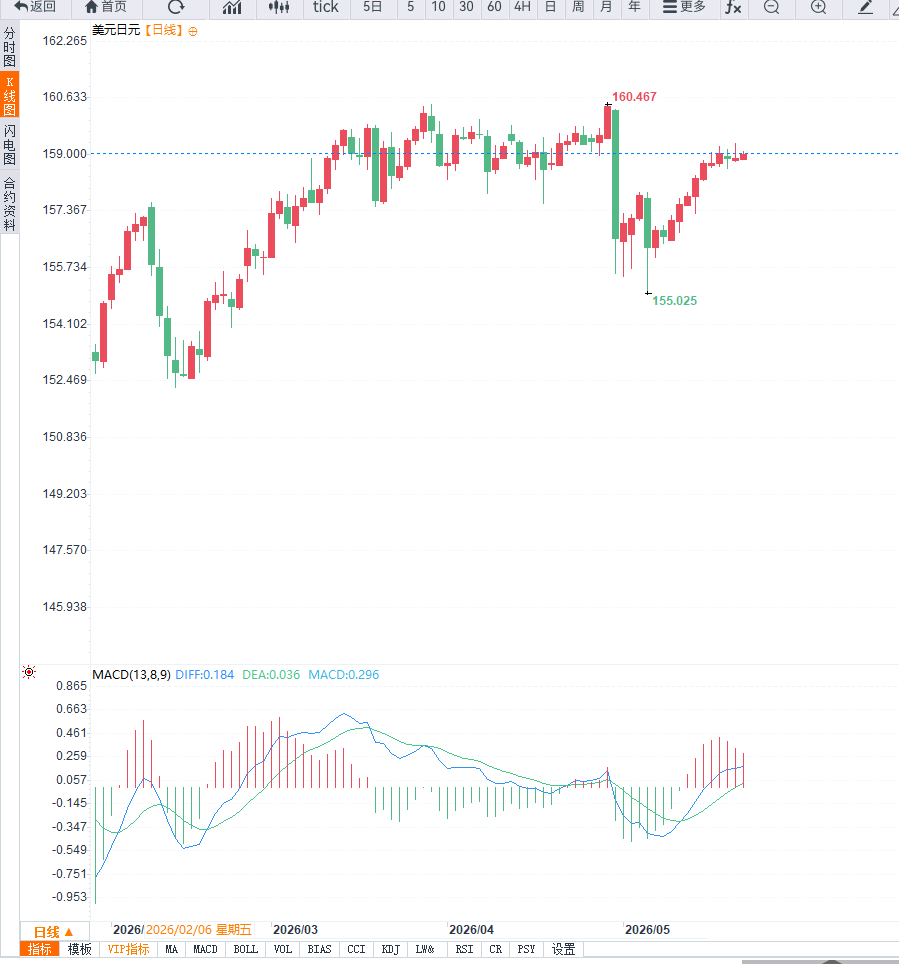
Editor's Summary : The current USD/JPY exchange rate movement remains primarily driven by the "USD/JPY interest rate differential." Slowing Japanese inflation has weakened market expectations for a rapid interest rate hike by the Bank of Japan, while the Federal Reserve maintains a hawkish stance due to rising energy prices and inflationary pressures, pushing the dollar higher. In the short term, as long as US yields remain high, the overall trend for USD/JPY remains upward. However, the 159-160 area has become a highly sensitive zone for the market, and the risk of potential intervention by the Japanese government in the foreign exchange market has significantly increased. Therefore, future exchange rate movements will depend not only on economic data and central bank policies but also on expectations of policy intervention. Investors should pay close attention to US inflation data, the Bank of Japan's June meeting, and the impact of changes in the Middle East situation on the global energy market.
Data released by Japan's Ministry of Internal Affairs and Communications on Friday showed that Japan's national consumer price index (CPI) rose 1.4% year-on-year in April, lower than the previous month's 1.5%. Meanwhile, Japan's core CPI also rose 1.4% year-on-year, marking the slowest growth rate in nearly four years. The data suggests that domestic price pressures in Japan have eased somewhat in the short term, cooling market expectations for aggressive tightening policies from the Bank of Japan.
The yen weakened rapidly after the data release. The market believes that the slowdown in Japanese inflation suggests the Bank of Japan may remain cautious in its policy normalization process. Although the market widely expects the Bank of Japan to raise short-term interest rates from 0.75% to 1.0% at its June meeting, the current data has reduced the urgency for further rapid rate hikes.
However, market analysts point out that Japan's inflation still faces the risk of rebounding in the coming months. Due to continued tensions in the Middle East and persistently high international energy prices, Japan's import costs are facing upward pressure. At the same time, disruptions to global supply chains may also push companies to further raise product prices. Rising energy costs and imported inflation remain important drivers of future price increases in Japan .
In contrast, the US policy stance is significantly more hawkish. The minutes of the Federal Open Market Committee (FOMC) meeting in April showed that most officials were concerned about inflation persisting above the 2% target and believed that if inflation could not effectively fall back, the Fed might need to reconsider further interest rate hikes in the future.
The meeting minutes specifically emphasized that the escalating situation in the Middle East and the conflict with Iran, which have driven up energy prices, have become a new source of upside risk to US inflation. The market is now reassessing the Federal Reserve's interest rate cut timetable, with some institutions even postponing their expectations for a rate cut in 2026.
As a result, US Treasury yields have remained high recently, and the US dollar index has maintained a strong overall trend. The expectation of a widening US-Japan interest rate differential has become the core driver of the dollar's rise against the yen . Given Japan's long-term ultra-loose monetary policy and the potential for a prolonged period of high interest rates in the US, funds continue to flow towards dollar assets.
Furthermore, the Japanese authorities' attitude towards exchange rate trends has become a key focus of market attention. As the USD/JPY exchange rate approaches the 160 mark, the market is concerned that the Japanese Ministry of Finance may re-intervene in the exchange rate market. Previously, the Japanese government intervened when the exchange rate rapidly approached 160 to curb excessive yen depreciation.
From a market sentiment perspective, the current foreign exchange market still exhibits a clear structure of "longing the US dollar and shorting the Japanese yen." Global risk aversion and the advantage of high-yield US assets continue to attract international capital flows to US dollar assets, while the Japanese yen, as a low-yield currency, faces continued pressure.
From a technical perspective, the USD/JPY pair continues its strong upward trend on the daily chart. The exchange rate is currently trading steadily above major moving averages, indicating that the medium- to long-term bullish structure remains intact. The daily MACD indicator remains in overbought territory, and while the RSI indicator has entered overbought territory, no clear top divergence signal has yet appeared, suggesting that bullish momentum still dominates the market. Key resistance levels are concentrated at 159.50 and the psychological level of 160; a successful break above these levels could lead to a further challenge of last year's highs. Initial support is around 157.80, followed by the 156.50 area.
The 4-hour chart shows that the USD/JPY pair is also trending upwards in the short term. The exchange rate continues to move along a short-term upward channel, with the moving average system maintaining a bullish alignment. However, due to strong psychological resistance in the 159-160 area, coupled with market caution regarding potential intervention by the Japanese government, short-term volatility may increase significantly. If subsequent US economic data continues to be strong, the USD/JPY pair may have further upside potential; however, if the Bank of Japan signals a more aggressive interest rate hike, it could trigger short-term profit-taking.
Editor's Summary : The current USD/JPY exchange rate movement remains primarily driven by the "USD/JPY interest rate differential." Slowing Japanese inflation has weakened market expectations for a rapid interest rate hike by the Bank of Japan, while the Federal Reserve maintains a hawkish stance due to rising energy prices and inflationary pressures, pushing the dollar higher. In the short term, as long as US yields remain high, the overall trend for USD/JPY remains upward. However, the 159-160 area has become a highly sensitive zone for the market, and the risk of potential intervention by the Japanese government in the foreign exchange market has significantly increased. Therefore, future exchange rate movements will depend not only on economic data and central bank policies but also on expectations of policy intervention. Investors should pay close attention to US inflation data, the Bank of Japan's June meeting, and the impact of changes in the Middle East situation on the global energy market.
- Risk Warning and Disclaimer
- The market involves risk, and trading may not be suitable for all investors. This article is for reference only and does not constitute personal investment advice, nor does it take into account certain users’ specific investment objectives, financial situation, or other needs. Any investment decisions made based on this information are at your own risk.