Japan's core inflation hit a four-year low, and the dollar broke through 159 against the yen again.
2026-05-22 10:01:11
On Friday (May 22) during Asian trading hours, the USD/JPY pair rose slightly, currently trading around 159.10, up about 0.1% on the day. This week, the USD/JPY pair has generally traded in a high-level consolidation pattern. From early to mid-May, the exchange rate experienced a continuous upward trend, achieving seven consecutive days of gains.
Data released on Friday showed that Japan's core inflation slowed more than expected in April, falling to its lowest level since March 2022, which may weaken the case for the Bank of Japan to raise interest rates sooner than anticipated. Core CPI (excluding fresh food) came in at 1.4%, while overall CPI was 1.4%, marking the fourth consecutive month below the central bank's 2% target. The Bank of Japan's closely watched "core-core" CPI (excluding food and energy) fell to 1.9% from 2.4%.
Affected by the US-Iran conflict, energy prices fell 3.9% year-on-year in April, a smaller decline than the 5.7% drop in March. Although nominal prices continued to fall, the rate of decline slowed significantly. A deeper problem lies in the structural disruption of energy supply itself—the near-shutdown of the Strait of Hormuz led to a sharp 67.2% year-on-year drop in Japan's crude oil imports from the Middle East, the lowest level since comparable data became available in 1979. This crucial shipping route, carrying about one-fifth of the world's oil traffic, has seen its traffic volume shrink continuously since the outbreak of the US-Iran conflict at the end of February, forcing Japan to urgently seek alternatives. US crude oil has become the most important alternative source, but very large crude carriers (VLCCs) carrying US oil cannot pass through the Panama Canal, forcing some cargo ships to detour around the Cape of Good Hope, a journey of approximately 55 days, more than twice that of the traditional Middle East route, resulting in a significant increase in transportation costs.
Meanwhile, Japanese Prime Minister Sanae Takaichi hinted that she was willing to compile a supplementary budget to address rising energy costs.
According to Japanese media reports, opposition lawmakers have proposed a 3 trillion yen (approximately US$18.8 billion) package that includes extending gasoline subsidies and electricity bill reductions.
Although April's inflation data showed a core CPI increase of only 1.4% year-on-year, seemingly providing a reason for the Bank of Japan to postpone interest rate hikes, the central bank made a seemingly contradictory adjustment to its forecast at its monetary policy meeting at the end of April—significantly raising its core inflation forecast for fiscal year 2026 from 1.9% to 2.8%. This adjustment of nearly one percentage point is rare in recent years. The Bank of Japan's reasoning in its quarterly outlook report was that the ongoing conflict in the Middle East is pushing up oil prices, and businesses are passing on increased costs to consumers at a faster pace than in the past. This means that although the April data was temporarily "good" due to government subsidies, the central bank believes the inflation engine has not stalled. At the same time, the voting results of the April meeting also revealed deeper internal divisions—behind the 6-3 vote, three members advocated for an immediate interest rate hike to 1.0%, marking the largest disagreement since Kazuo Ueda took office. This reflects a growing anxiety within the central bank about the potential for being passive if they wait too long.
In a report released Thursday, DBS Bank analysts noted that the Japanese economy appears to be maintaining its resilience – first-quarter GDP grew at an annualized rate of 2.1%, exceeding market expectations and marking the fastest expansion in six quarters, partly due to strong exports, particularly a 29.3% year-on-year surge in semiconductor equipment exports.
Economists at DBS Bank stated in their analysis that global AI-driven export demand and domestic fuel subsidies supporting consumption may make economic growth more resilient than expected. Even in the face of energy cost pressures from the Middle East conflict, the Japanese economy's "blood-generating capacity" has not been severed, providing the Bank of Japan with the confidence to raise interest rates based on the real economy. DBS Bank maintains its baseline forecast that the Bank of Japan will raise interest rates by 25 basis points to 1.00% at its July policy meeting, by which time Middle East-related uncertainties should have subsided, providing a clearer picture of the central bank's growth and inflation prospects.
Japan is facing a weak yen, with authorities spending approximately 10 trillion yen to intervene in the foreign exchange market from late April to early May, the largest intervention in recent years. Initially, the intervention drove the yen sharply higher, but with the resurgence of carry trades and increased demand for the US dollar as a safe haven, the yen has given back more than half of its gains, breaking through the 159 level again. The root cause of the yen's depreciation lies in structural problems: the huge interest rate differential between Japan and the US drives carry trades, coupled with Japan's declining economic competitiveness and aging population, resulting in the yen's real effective exchange rate falling to a 53-year low.
The devaluation is eroding people's purchasing power—440 commodities have seen price increases, with rice prices soaring by 67.2%, real wages declining for four consecutive years, and the cost of living for households continuing to rise. More problematic is that intervention alone cannot reverse the downward trend: Japan holds approximately $1.4 trillion in foreign exchange reserves, but 80% of that is in US Treasury bonds. Selling US Treasury bonds could push up yields, further exacerbating the yen's devaluation. Until the interest rate differential between Japan and the US narrows, intervention measures can only be a stopgap measure.
In summary, Japan's core inflation data slowed in April, reducing the urgency for a Bank of Japan (BOJ) rate hike in the short term. However, the BOJ's significant upward revision of its inflation outlook, strong exports, and better-than-expected first-quarter growth also leave room for a rate hike. Government subsidies may suppress energy prices in the short term, but import cost pressures from a weak yen continue. The market will continue to monitor the BOJ's policy signals and changes in the USD/JPY interest rate differential to determine the yen's next move.
From the daily chart, USD/JPY is currently trading around 159.10, in a high-level consolidation phase after a continuous rise. Several technical indicators show bullish signals, but the momentum has slowed down.
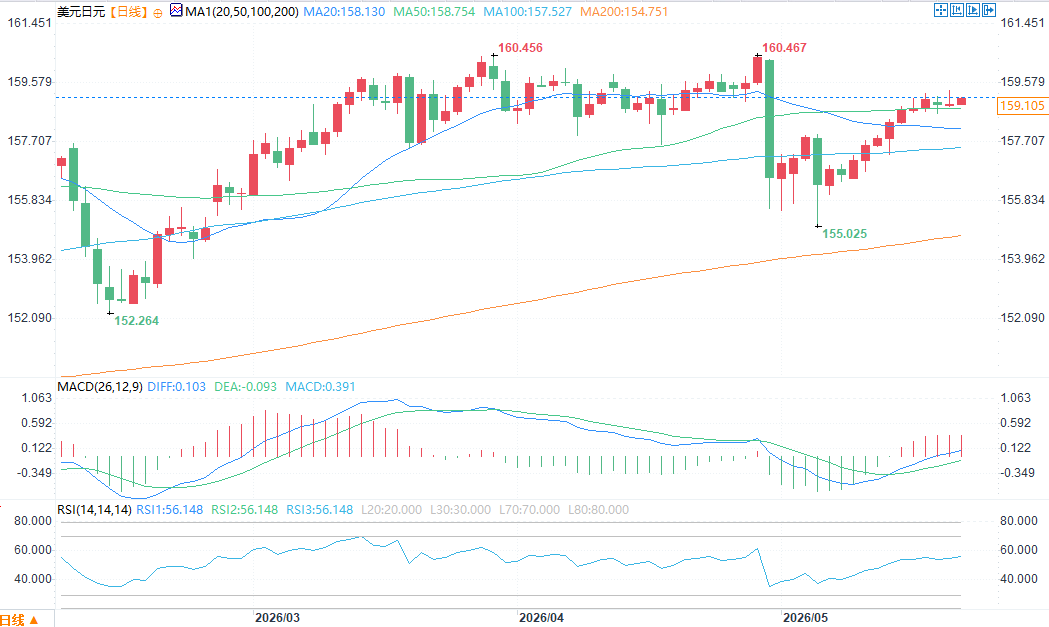
(USD/JPY daily chart, source: FX678)
Regarding the moving average system, the short-term moving averages MA20 (158.13) and MA50 (158.75) are both below the current price, forming short-term support; while MA100 (157.53) and MA200 (154.75) are significantly lower than the current price. This bullish alignment of "price above moving averages" indicates that USD/JPY remains in an upward trend. It's worth noting that the price has steadily climbed along the MA20 since early May and is currently holding above it, showing that the short-term structure remains intact. However, the price has encountered resistance multiple times in the 159.50-160.00 area, indicating that upward resistance is strengthening.
At 10:00 AM Beijing time on May 22, the USD/JPY exchange rate was 159.09/02.
Data released on Friday showed that Japan's core inflation slowed more than expected in April, falling to its lowest level since March 2022, which may weaken the case for the Bank of Japan to raise interest rates sooner than anticipated. Core CPI (excluding fresh food) came in at 1.4%, while overall CPI was 1.4%, marking the fourth consecutive month below the central bank's 2% target. The Bank of Japan's closely watched "core-core" CPI (excluding food and energy) fell to 1.9% from 2.4%.
Falling energy prices and government subsidies
Affected by the US-Iran conflict, energy prices fell 3.9% year-on-year in April, a smaller decline than the 5.7% drop in March. Although nominal prices continued to fall, the rate of decline slowed significantly. A deeper problem lies in the structural disruption of energy supply itself—the near-shutdown of the Strait of Hormuz led to a sharp 67.2% year-on-year drop in Japan's crude oil imports from the Middle East, the lowest level since comparable data became available in 1979. This crucial shipping route, carrying about one-fifth of the world's oil traffic, has seen its traffic volume shrink continuously since the outbreak of the US-Iran conflict at the end of February, forcing Japan to urgently seek alternatives. US crude oil has become the most important alternative source, but very large crude carriers (VLCCs) carrying US oil cannot pass through the Panama Canal, forcing some cargo ships to detour around the Cape of Good Hope, a journey of approximately 55 days, more than twice that of the traditional Middle East route, resulting in a significant increase in transportation costs.
Meanwhile, Japanese Prime Minister Sanae Takaichi hinted that she was willing to compile a supplementary budget to address rising energy costs.
According to Japanese media reports, opposition lawmakers have proposed a 3 trillion yen (approximately US$18.8 billion) package that includes extending gasoline subsidies and electricity bill reductions.
The Bank of Japan is sending conflicting signals: upward revisions to inflation expectations coexist with the prospect of interest rate hikes.
Although April's inflation data showed a core CPI increase of only 1.4% year-on-year, seemingly providing a reason for the Bank of Japan to postpone interest rate hikes, the central bank made a seemingly contradictory adjustment to its forecast at its monetary policy meeting at the end of April—significantly raising its core inflation forecast for fiscal year 2026 from 1.9% to 2.8%. This adjustment of nearly one percentage point is rare in recent years. The Bank of Japan's reasoning in its quarterly outlook report was that the ongoing conflict in the Middle East is pushing up oil prices, and businesses are passing on increased costs to consumers at a faster pace than in the past. This means that although the April data was temporarily "good" due to government subsidies, the central bank believes the inflation engine has not stalled. At the same time, the voting results of the April meeting also revealed deeper internal divisions—behind the 6-3 vote, three members advocated for an immediate interest rate hike to 1.0%, marking the largest disagreement since Kazuo Ueda took office. This reflects a growing anxiety within the central bank about the potential for being passive if they wait too long.
In a report released Thursday, DBS Bank analysts noted that the Japanese economy appears to be maintaining its resilience – first-quarter GDP grew at an annualized rate of 2.1%, exceeding market expectations and marking the fastest expansion in six quarters, partly due to strong exports, particularly a 29.3% year-on-year surge in semiconductor equipment exports.
Economists at DBS Bank stated in their analysis that global AI-driven export demand and domestic fuel subsidies supporting consumption may make economic growth more resilient than expected. Even in the face of energy cost pressures from the Middle East conflict, the Japanese economy's "blood-generating capacity" has not been severed, providing the Bank of Japan with the confidence to raise interest rates based on the real economy. DBS Bank maintains its baseline forecast that the Bank of Japan will raise interest rates by 25 basis points to 1.00% at its July policy meeting, by which time Middle East-related uncertainties should have subsided, providing a clearer picture of the central bank's growth and inflation prospects.
The dual impacts of a weak yen: rising import costs and the cost of intervention.
Japan is facing a weak yen, with authorities spending approximately 10 trillion yen to intervene in the foreign exchange market from late April to early May, the largest intervention in recent years. Initially, the intervention drove the yen sharply higher, but with the resurgence of carry trades and increased demand for the US dollar as a safe haven, the yen has given back more than half of its gains, breaking through the 159 level again. The root cause of the yen's depreciation lies in structural problems: the huge interest rate differential between Japan and the US drives carry trades, coupled with Japan's declining economic competitiveness and aging population, resulting in the yen's real effective exchange rate falling to a 53-year low.
The devaluation is eroding people's purchasing power—440 commodities have seen price increases, with rice prices soaring by 67.2%, real wages declining for four consecutive years, and the cost of living for households continuing to rise. More problematic is that intervention alone cannot reverse the downward trend: Japan holds approximately $1.4 trillion in foreign exchange reserves, but 80% of that is in US Treasury bonds. Selling US Treasury bonds could push up yields, further exacerbating the yen's devaluation. Until the interest rate differential between Japan and the US narrows, intervention measures can only be a stopgap measure.
The tug-of-war between cooling inflation and expectations of interest rate hikes is putting short-term pressure on the yen.
In summary, Japan's core inflation data slowed in April, reducing the urgency for a Bank of Japan (BOJ) rate hike in the short term. However, the BOJ's significant upward revision of its inflation outlook, strong exports, and better-than-expected first-quarter growth also leave room for a rate hike. Government subsidies may suppress energy prices in the short term, but import cost pressures from a weak yen continue. The market will continue to monitor the BOJ's policy signals and changes in the USD/JPY interest rate differential to determine the yen's next move.
USD/JPY Daily Technical Analysis
From the daily chart, USD/JPY is currently trading around 159.10, in a high-level consolidation phase after a continuous rise. Several technical indicators show bullish signals, but the momentum has slowed down.
(USD/JPY daily chart, source: FX678)
Regarding the moving average system, the short-term moving averages MA20 (158.13) and MA50 (158.75) are both below the current price, forming short-term support; while MA100 (157.53) and MA200 (154.75) are significantly lower than the current price. This bullish alignment of "price above moving averages" indicates that USD/JPY remains in an upward trend. It's worth noting that the price has steadily climbed along the MA20 since early May and is currently holding above it, showing that the short-term structure remains intact. However, the price has encountered resistance multiple times in the 159.50-160.00 area, indicating that upward resistance is strengthening.
At 10:00 AM Beijing time on May 22, the USD/JPY exchange rate was 159.09/02.
- Risk Warning and Disclaimer
- The market involves risk, and trading may not be suitable for all investors. This article is for reference only and does not constitute personal investment advice, nor does it take into account certain users’ specific investment objectives, financial situation, or other needs. Any investment decisions made based on this information are at your own risk.