Gold prices fluctuated and corrected due to a change in the Federal Reserve's leadership and the dollar index remaining at a high level.
2026-05-22 10:12:50
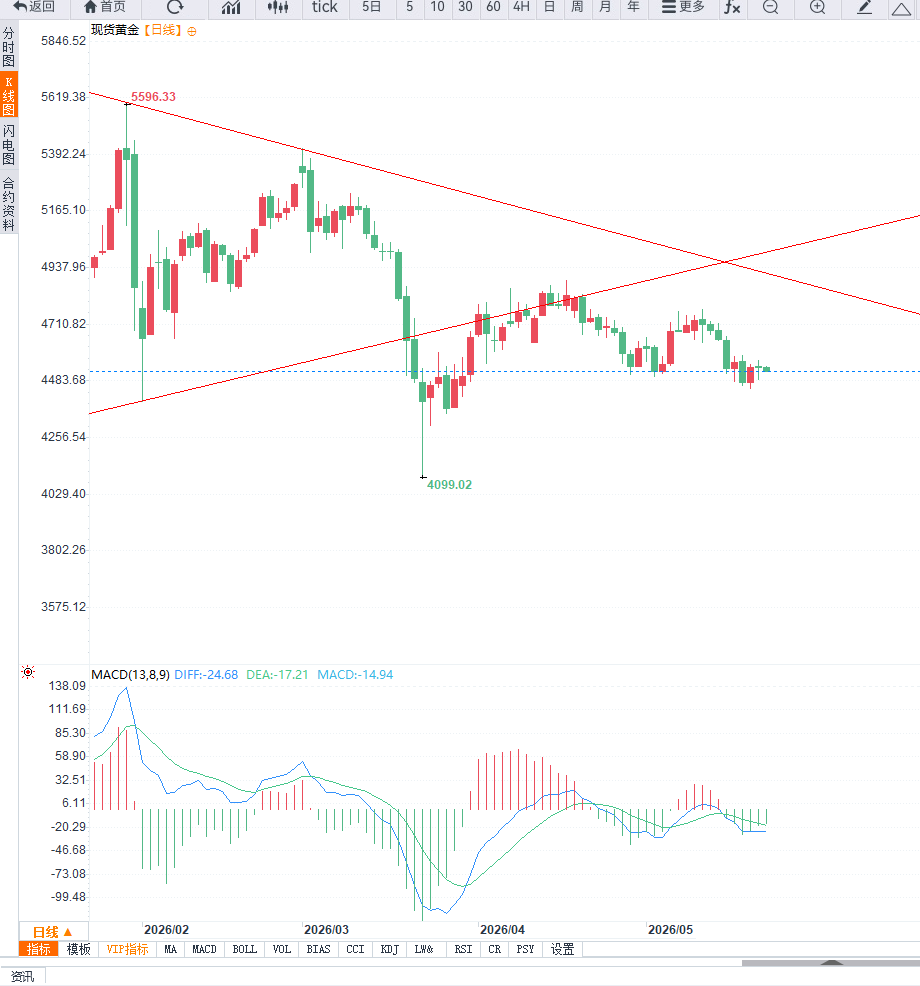
The international gold market remained cautiously volatile during Friday's Asian trading session, with spot gold (XAU/USD) trading around $4,530. The market is currently assessing the progress of ceasefire negotiations between the US and Iran, as well as potential policy changes due to a change in Federal Reserve leadership, resulting in a temporary stalemate between gold bulls and bears.

The core factor driving the recent rise in gold prices remains the global demand for safe-haven assets stemming from the escalating tensions in the Middle East. Iranian officials stated that the latest proposal from the United States has narrowed the differences between the two sides to some extent, but the situation remains complex. Iran's top leadership emphasized that Tehran will not relinquish its uranium reserves, while the issue of fees in the Strait of Hormuz continues to be a major point of contention between the two sides.
Market analysts believe this means that while there are signs of easing tensions in the Middle East, significant obstacles remain before a comprehensive agreement can be reached. US President Trump previously warned that the US might soon resume military action if Iran does not accept its demands. This tough stance has limited further improvement in market risk sentiment and continues to support safe-haven demand for gold.
The Strait of Hormuz handles approximately 20% of global seaborne crude oil transport ; therefore, any changes in control of the region and shipping security can rapidly impact risk appetite in global energy and financial markets. The biggest concern in the market currently is that a renewed deterioration in the situation could trigger another rapid rise in international energy prices, thereby exacerbating global inflationary pressures.
However, the impact of rising energy prices is not entirely positive for gold. Kieran Kaushik, global foreign exchange strategist at Lono Odier, stated that gold, as a non-yielding asset, typically performs best when US real yields are declining and the dollar is weakening. But if an energy supply shock prompts the market to reprice higher interest rate expectations, it could lead to a simultaneous strengthening of US Treasury yields and the dollar, thereby suppressing gold's performance.
The gold market is currently facing a dual struggle between "safe-haven demand" and "high interest rate pressure." On the one hand, uncertainty in the Middle East continues to attract some safe-haven funds into gold; on the other hand, rising energy prices may push up US inflation, thereby weakening market expectations for future interest rate cuts by the Federal Reserve.
In addition, the change in the leadership of the Federal Reserve has also become a key focus of market attention. US President Trump will officially appoint Kevin Warsh to succeed Jerome Powell as Chairman of the Federal Reserve on Friday. The market generally believes that Kevin Warsh's overall stance leans towards hawkishness, with a particular focus on inflation control.
Since Powell will remain in office temporarily until the formal handover is completed after his term ends, Kevin Warsh will chair the Federal Open Market Committee (FOMC) meeting for the first time at the June policy meeting. Markets are concerned that the new chairman may further strengthen the Fed's stance against inflation.
The recently released minutes of the Federal Reserve meeting have shown that most officials are concerned about the inflation risks posed by rising energy prices and believe that if core inflation continues to be above the target level, the Fed will not rule out the possibility of reconsidering interest rate hikes.
Against this backdrop, US Treasury yields remained high overall, and the US dollar index remained strong, which to some extent limited the potential for further increases in gold prices.
From a market sentiment perspective, the gold market is currently in a phase of high-level fluctuations. Previously, due to the escalation of the Middle East conflict, international gold prices surged, but as the market begins to reassess the Federal Reserve's policy path, some funds have chosen to take profits at higher levels.
From a technical perspective, gold maintains its medium-to-long-term upward trend on the daily chart, but has entered a short-term consolidation phase. Gold prices are currently trading steadily above major moving averages, indicating that the medium-to-long-term bullish structure remains intact. While the daily MACD indicator remains high, the narrowing of the red bars suggests a slowdown in upward momentum; the RSI indicator has retreated from overbought territory, indicating a short-term need for consolidation. Key support levels are currently at $4500 and $4460, while resistance is concentrated at the psychological levels of $4580 and $4600. A decisive break above $4600 could reopen upside potential for gold.
The 4-hour chart shows that gold has entered a short-term consolidation phase. The moving average system is gradually flattening, indicating a temporary weakening of market direction. If the US-Iran situation further eases, and the Federal Reserve releases stronger hawkish signals, gold may face further downward pressure; however, if the situation in the Middle East deteriorates again, safe-haven demand may drive a rapid rebound in gold prices.
Editor's Summary : The core logic of the current gold market has gradually shifted from simple safe-haven trading to a comprehensive interplay between "geopolitical risks" and "interest rate expectations." The situation in the Middle East remains complex; the Strait of Hormuz issue and the US-Iran disagreement have not been truly resolved, thus providing continued support for gold as a safe haven. However, rising energy prices may push up global inflation, and since the new Federal Reserve Chairman took office, market concerns about maintaining high interest rates in the long term have significantly increased. This limits the upside potential for gold. The market focus will now be on the progress of US-Iran negotiations, the Fed's June meeting, and changes in US inflation data. If global risk aversion intensifies again, gold may continue to reach new highs; however, if the Fed further strengthens its hawkish stance, gold prices may remain volatile at high levels in the short term or even experience a technical correction.
The core factor driving the recent rise in gold prices remains the global demand for safe-haven assets stemming from the escalating tensions in the Middle East. Iranian officials stated that the latest proposal from the United States has narrowed the differences between the two sides to some extent, but the situation remains complex. Iran's top leadership emphasized that Tehran will not relinquish its uranium reserves, while the issue of fees in the Strait of Hormuz continues to be a major point of contention between the two sides.
Market analysts believe this means that while there are signs of easing tensions in the Middle East, significant obstacles remain before a comprehensive agreement can be reached. US President Trump previously warned that the US might soon resume military action if Iran does not accept its demands. This tough stance has limited further improvement in market risk sentiment and continues to support safe-haven demand for gold.
The Strait of Hormuz handles approximately 20% of global seaborne crude oil transport ; therefore, any changes in control of the region and shipping security can rapidly impact risk appetite in global energy and financial markets. The biggest concern in the market currently is that a renewed deterioration in the situation could trigger another rapid rise in international energy prices, thereby exacerbating global inflationary pressures.
However, the impact of rising energy prices is not entirely positive for gold. Kieran Kaushik, global foreign exchange strategist at Lono Odier, stated that gold, as a non-yielding asset, typically performs best when US real yields are declining and the dollar is weakening. But if an energy supply shock prompts the market to reprice higher interest rate expectations, it could lead to a simultaneous strengthening of US Treasury yields and the dollar, thereby suppressing gold's performance.
The gold market is currently facing a dual struggle between "safe-haven demand" and "high interest rate pressure." On the one hand, uncertainty in the Middle East continues to attract some safe-haven funds into gold; on the other hand, rising energy prices may push up US inflation, thereby weakening market expectations for future interest rate cuts by the Federal Reserve.
In addition, the change in the leadership of the Federal Reserve has also become a key focus of market attention. US President Trump will officially appoint Kevin Warsh to succeed Jerome Powell as Chairman of the Federal Reserve on Friday. The market generally believes that Kevin Warsh's overall stance leans towards hawkishness, with a particular focus on inflation control.
Since Powell will remain in office temporarily until the formal handover is completed after his term ends, Kevin Warsh will chair the Federal Open Market Committee (FOMC) meeting for the first time at the June policy meeting. Markets are concerned that the new chairman may further strengthen the Fed's stance against inflation.
The recently released minutes of the Federal Reserve meeting have shown that most officials are concerned about the inflation risks posed by rising energy prices and believe that if core inflation continues to be above the target level, the Fed will not rule out the possibility of reconsidering interest rate hikes.
Against this backdrop, US Treasury yields remained high overall, and the US dollar index remained strong, which to some extent limited the potential for further increases in gold prices.
From a market sentiment perspective, the gold market is currently in a phase of high-level fluctuations. Previously, due to the escalation of the Middle East conflict, international gold prices surged, but as the market begins to reassess the Federal Reserve's policy path, some funds have chosen to take profits at higher levels.
From a technical perspective, gold maintains its medium-to-long-term upward trend on the daily chart, but has entered a short-term consolidation phase. Gold prices are currently trading steadily above major moving averages, indicating that the medium-to-long-term bullish structure remains intact. While the daily MACD indicator remains high, the narrowing of the red bars suggests a slowdown in upward momentum; the RSI indicator has retreated from overbought territory, indicating a short-term need for consolidation. Key support levels are currently at $4500 and $4460, while resistance is concentrated at the psychological levels of $4580 and $4600. A decisive break above $4600 could reopen upside potential for gold.
The 4-hour chart shows that gold has entered a short-term consolidation phase. The moving average system is gradually flattening, indicating a temporary weakening of market direction. If the US-Iran situation further eases, and the Federal Reserve releases stronger hawkish signals, gold may face further downward pressure; however, if the situation in the Middle East deteriorates again, safe-haven demand may drive a rapid rebound in gold prices.
Editor's Summary : The core logic of the current gold market has gradually shifted from simple safe-haven trading to a comprehensive interplay between "geopolitical risks" and "interest rate expectations." The situation in the Middle East remains complex; the Strait of Hormuz issue and the US-Iran disagreement have not been truly resolved, thus providing continued support for gold as a safe haven. However, rising energy prices may push up global inflation, and since the new Federal Reserve Chairman took office, market concerns about maintaining high interest rates in the long term have significantly increased. This limits the upside potential for gold. The market focus will now be on the progress of US-Iran negotiations, the Fed's June meeting, and changes in US inflation data. If global risk aversion intensifies again, gold may continue to reach new highs; however, if the Fed further strengthens its hawkish stance, gold prices may remain volatile at high levels in the short term or even experience a technical correction.
- Risk Warning and Disclaimer
- The market involves risk, and trading may not be suitable for all investors. This article is for reference only and does not constitute personal investment advice, nor does it take into account certain users’ specific investment objectives, financial situation, or other needs. Any investment decisions made based on this information are at your own risk.