The weakening yen is dominating the market, and the pound/yen pair is poised for a strong weekly gain.
2026-05-22 17:36:25
On Friday (May 22), the pound attracted bargain hunters against the yen, maintaining a modest intraday gain during the European session. Currently trading above 213.50, the pair is poised for a strong weekly gain amid a generally weakening yen.
Japan's core CPI rose 1.4% year-on-year in April from 1.8% in March, the lowest level since March 2022, and the third consecutive month below the Bank of Japan's 2% target. This weakness was largely a result of government intervention—the Japanese government implemented emergency measures in April, such as tuition subsidies and gasoline tax cuts, which directly suppressed price readings. Underlying inflationary pressures remain even after excluding the effects of these policies.
Trade statistics released on the same day as the inflation data revealed a deeper crisis. Affected by the strait blockade, Japan's crude oil imports from the Middle East in April plummeted by 67.2% year-on-year, hitting the lowest level since records began in 1979. At the same time, the import price surged to 101,400 yen per kiloliter due to soaring oil prices and a depreciating yen, a dramatic increase of 37.9% year-on-year, also a record high. Naphtha imports plummeted by 79.4%, and liquefied natural gas imports decreased by 76.1%, indicating a substantial disruption in Japan's chemical and energy supply chains.
While weak inflation has temporarily lessened the urgency for a June rate hike by the Bank of Japan, analysts generally believe that government subsidies are merely a one-off painkiller. With the summer peak demand approaching, the phasing out of subsidies, coupled with the lagged transmission of soaring import costs, could lead to a strong rebound in inflation in Japan. The yen has weakened amid apparent inflation cooling, depreciating by about 7.8% in April, brewing a deeper purchasing power crisis. The market will continue to focus on the Bank of Japan's policy signals and energy supply conditions.
On the other hand, the pound appears unaffected by disappointing UK macroeconomic data, mixed signals regarding the Bank of England's policy outlook, and political uncertainty in the UK. Data from the UK Office for National Statistics showed that retail sales fell 1.3% month-on-month in April, far worse than the revised 0.6% decline in March and the market's expected 0.6% drop. Prior to this, weaker-than-expected UK consumer inflation data and an unexpected rise in unemployment also failed to dampen market expectations for a Bank of England rate hike.
In fact, traders are still pricing in the possibility of the Bank of England raising interest rates at least once in 2026. However, Bank of England Governor Andrew Bailey said on Wednesday that the rise in market interest rates since the Iran war has given the central bank more time to assess the economic impact of the conflict.
Furthermore, the serious leadership challenges facing British Prime Minister Keir Starmer have kept pound bulls cautious. Coupled with market speculation that Japanese authorities might intervene to support the yen, these factors may limit the upside potential of the pound against the yen.
In summary, the pound/yen exchange rate is currently supported primarily by the weak yen, with weak UK economic data and political uncertainty failing to effectively pressure the pound. However, the delayed Bank of England interest rate hike expectations and the potential risk of intervention by Japanese authorities may limit further upside potential. In the short term, the pound/yen exchange rate is likely to maintain a high-level consolidation pattern, with the market continuing to focus on developments in the UK political situation, policy signals from the Bank of England, and the Japanese authorities' currency intervention moves.
From the daily chart, the GBP/JPY pair is currently trading around 213.50, in a consolidation phase after a recent rebound, with multiple technical indicators showing a neutral to slightly bullish signal.
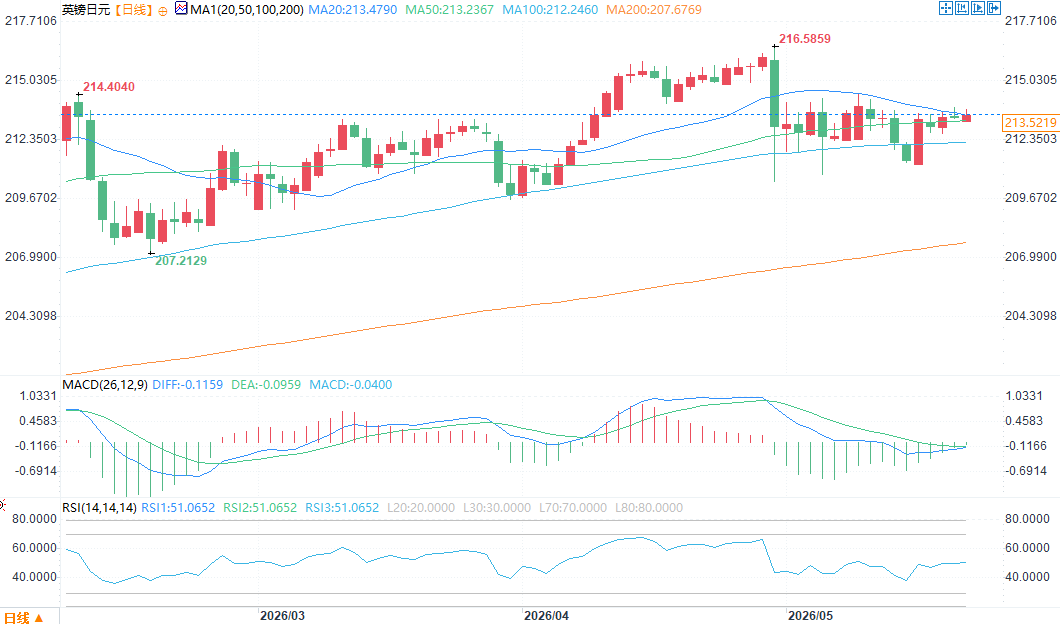
(GBP/JPY daily chart, source: FX678)
Regarding the moving average system, the short-term moving average MA20 (213.48) is basically in line with the current price, while MA50 (213.24) is slightly lower than the current price, forming short-term support; MA100 (212.25) is below the current price, and MA200 (207.68) is far below the current price. This arrangement of "price holding above MA20, MA50, and MA100" indicates that GBP/JPY is in a short-term rebound pattern, and the medium-term trend is also biased towards positive.
At 17:24 Beijing time on May 22, the British pound was trading at 213.54/55 against the Japanese yen.
Data cooling down, policy support
Japan's core CPI rose 1.4% year-on-year in April from 1.8% in March, the lowest level since March 2022, and the third consecutive month below the Bank of Japan's 2% target. This weakness was largely a result of government intervention—the Japanese government implemented emergency measures in April, such as tuition subsidies and gasoline tax cuts, which directly suppressed price readings. Underlying inflationary pressures remain even after excluding the effects of these policies.
Trade statistics released on the same day as the inflation data revealed a deeper crisis. Affected by the strait blockade, Japan's crude oil imports from the Middle East in April plummeted by 67.2% year-on-year, hitting the lowest level since records began in 1979. At the same time, the import price surged to 101,400 yen per kiloliter due to soaring oil prices and a depreciating yen, a dramatic increase of 37.9% year-on-year, also a record high. Naphtha imports plummeted by 79.4%, and liquefied natural gas imports decreased by 76.1%, indicating a substantial disruption in Japan's chemical and energy supply chains.
While weak inflation has temporarily lessened the urgency for a June rate hike by the Bank of Japan, analysts generally believe that government subsidies are merely a one-off painkiller. With the summer peak demand approaching, the phasing out of subsidies, coupled with the lagged transmission of soaring import costs, could lead to a strong rebound in inflation in Japan. The yen has weakened amid apparent inflation cooling, depreciating by about 7.8% in April, brewing a deeper purchasing power crisis. The market will continue to focus on the Bank of Japan's policy signals and energy supply conditions.
The pound demonstrates resilience: ignoring weak data and political uncertainty.
On the other hand, the pound appears unaffected by disappointing UK macroeconomic data, mixed signals regarding the Bank of England's policy outlook, and political uncertainty in the UK. Data from the UK Office for National Statistics showed that retail sales fell 1.3% month-on-month in April, far worse than the revised 0.6% decline in March and the market's expected 0.6% drop. Prior to this, weaker-than-expected UK consumer inflation data and an unexpected rise in unemployment also failed to dampen market expectations for a Bank of England rate hike.
In fact, traders are still pricing in the possibility of the Bank of England raising interest rates at least once in 2026. However, Bank of England Governor Andrew Bailey said on Wednesday that the rise in market interest rates since the Iran war has given the central bank more time to assess the economic impact of the conflict.
Furthermore, the serious leadership challenges facing British Prime Minister Keir Starmer have kept pound bulls cautious. Coupled with market speculation that Japanese authorities might intervene to support the yen, these factors may limit the upside potential of the pound against the yen.
The British pound is slightly stronger against the Japanese yen in the short term, but its upside potential may be limited.
In summary, the pound/yen exchange rate is currently supported primarily by the weak yen, with weak UK economic data and political uncertainty failing to effectively pressure the pound. However, the delayed Bank of England interest rate hike expectations and the potential risk of intervention by Japanese authorities may limit further upside potential. In the short term, the pound/yen exchange rate is likely to maintain a high-level consolidation pattern, with the market continuing to focus on developments in the UK political situation, policy signals from the Bank of England, and the Japanese authorities' currency intervention moves.
GBP/JPY Daily Technical Analysis
From the daily chart, the GBP/JPY pair is currently trading around 213.50, in a consolidation phase after a recent rebound, with multiple technical indicators showing a neutral to slightly bullish signal.
(GBP/JPY daily chart, source: FX678)
Regarding the moving average system, the short-term moving average MA20 (213.48) is basically in line with the current price, while MA50 (213.24) is slightly lower than the current price, forming short-term support; MA100 (212.25) is below the current price, and MA200 (207.68) is far below the current price. This arrangement of "price holding above MA20, MA50, and MA100" indicates that GBP/JPY is in a short-term rebound pattern, and the medium-term trend is also biased towards positive.
At 17:24 Beijing time on May 22, the British pound was trading at 213.54/55 against the Japanese yen.
- Risk Warning and Disclaimer
- The market involves risk, and trading may not be suitable for all investors. This article is for reference only and does not constitute personal investment advice, nor does it take into account certain users’ specific investment objectives, financial situation, or other needs. Any investment decisions made based on this information are at your own risk.