Gulf states pressure the US to postpone military action against Iran, causing crude oil futures to fall.
2026-05-22 20:42:13
On Friday (May 22), during the European trading session, oil prices fell from their highs as panic in the oil market subsided significantly due to news that Saudi Arabia, the UAE, and Qatar were pressuring the US to postpone military action against Iran.
The price of West Texas Intermediate (WTI) crude oil for July delivery was quoted at $96.08 per barrel, down 0.27%; the spot price of Brent crude oil fell to $103.00 per barrel, a drop of 1.79%. Oil prices fluctuated by nearly $10 this week, with the trend entirely driven by US-Iran diplomatic news. Both major crude oil benchmarks are likely to close lower for the week.
Joint pressure from the three Gulf states leads to a temporary halt in US military action.
According to sources, the leaders of the UAE, Saudi Arabia, and Qatar recently spoke with US President Trump, unanimously urging the US to postpone the resumption of military strikes against Iran and calling for "a chance for negotiations." The three countries are concerned that if hostilities resume, Iranian retaliation would directly impact energy infrastructure and shipping security in the Gulf region, triggering regional economic turmoil.
The UAE, which previously held a relatively hardline stance towards Iran, has now significantly shifted its position. As a major victim of previous Iranian attacks, the UAE now explicitly opposes a renewed conflict. Meanwhile, Saudi Arabia and Qatar have refused to provide airspace or logistical support for US military operations. Trump's announcement of a postponement of the planned military strikes to allow for diplomatic negotiations has directly alleviated market concerns about a prolonged blockade of the Strait of Hormuz.
Supply gaps persist, but market panic premiums have quickly subsided.
Although navigation in the Strait of Hormuz has not yet resumed and the daily transport of approximately 14 million barrels of crude oil remains disrupted, the premium for military conflict that the market had previously over-priced in is being rapidly cleared.
Before the conflict, approximately 20% of global energy transport passed through this route, and currently, crude oil export channels from countries such as Saudi Arabia, Iraq, and the UAE remain stalled. As a result, industry research firm BMI has raised its 2026 average Brent crude oil price forecast from $81.50 per barrel to $90 per barrel. However, in the short term, merely extending the ceasefire and diplomatic statements cannot fill the actual supply gap; the previous surge in oil prices reflected more panic than genuine changes in supply and demand.
Market sentiment fluctuated, and oil prices oscillated wildly with news.
The sharp fluctuations in oil prices this week were essentially due to the market's fluctuating expectations regarding the prospects of the negotiations. Previously, sources familiar with the matter in Iran indicated a narrowing of differences between the two sides, and the US Secretary of State released positive signals, pushing oil prices higher. However, as news of pressure from the three countries for the US to postpone military action materialized, the market realized that the probability of a short-term escalation of military conflict had significantly decreased. Traders who had previously bet on a risk premium began to liquidate their positions on a large scale, directly causing oil prices to fall.
The core contradictions in the current market remain unresolved: the issues of Iranian uranium enrichment and the Strait of Hormuz control remain unresolved, and traders generally do not expect a consensus to be reached in the short term. However, with military action temporarily suspended, oil prices are expected to shift from "conflict panic pricing" to "supply-demand gap pricing," and volatility is likely to narrow.
Technical Analysis
July WTI crude oil
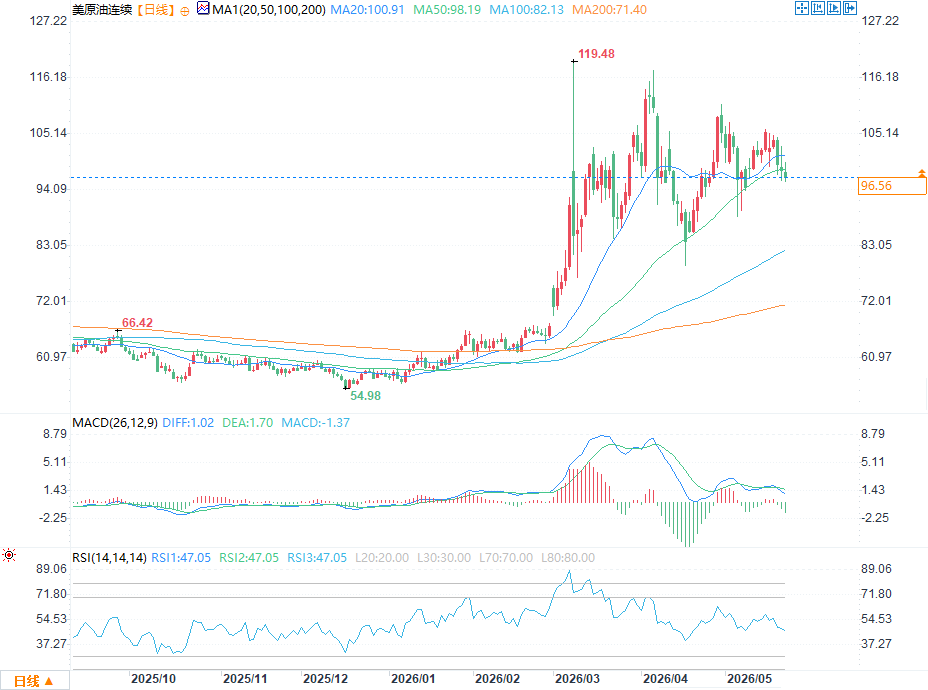
After two days of sharp declines, oil prices have rebounded slightly, attempting to recover some of the losses. The key trading range is between $98.97 and $100.17 per barrel, with the $100 mark attracting significant attention.
If prices stabilize above $100.17, oil prices could potentially challenge the recent high of $105.21.
Conversely, a drop below $98.97 would indicate a weakening market, with the first support level between $95.67 and $93.42 per barrel, and deeper support at the 50% retracement level of $91.21 and the 50-day moving average at $91.16.
July Brent crude oil
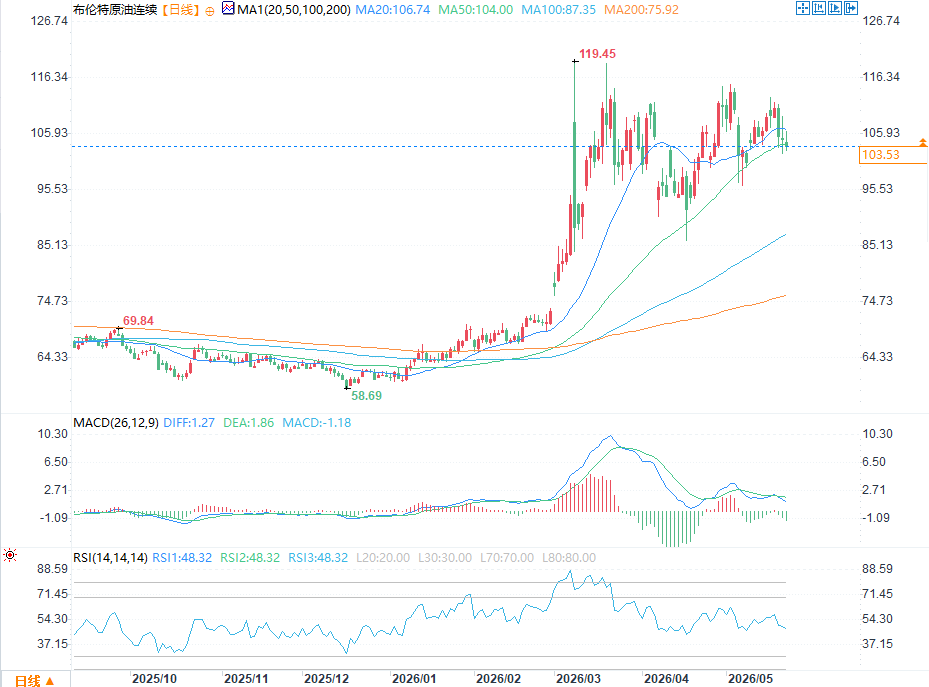
The trend has weakened further. Since reaching a record high of $119.44 per barrel on March 9th, oil prices have successively formed three decreasing peaks at $119.09, $115.24, and $112.68, with the $96.10 low becoming a crucial support level. On Friday morning, oil prices were testing the 50-day moving average resistance level at $103.36. A break above this level would target a support zone of $100.65 to $97.21 per barrel. A breach of this moving average would likely lead to a gradual move towards the $97.21 range and even the $96.10 low.
Key points to watch in the market outlook
In the short term, oil prices will continue to fluctuate around the progress of US-Iran negotiations. While the pressure from the three Gulf states to the US to postpone military action has reduced the probability of escalation, it has not resolved fundamental differences, and market sentiment may continue to oscillate between optimism and fear.
In terms of trading strategy, WTI crude oil should focus on the struggle within the $98.97 to $100.17 range, while Brent crude oil should pay attention to the $103.36 moving average level. Before the Taiwan Strait fully resumes navigation and crude oil production returns to normal, the fundamental support from the supply-demand imbalance remains, and a significant drop in oil prices may actually present a buying opportunity.
Key triggers for subsequent oil prices
Signals for the conclusion of negotiations between the two sides: whether formal face-to-face negotiations are initiated, and whether a phased consensus is announced (such as restrictions on uranium enrichment and de-escalation of regional military confrontation). If the consensus is implemented, the risk premium will continue to be absorbed, and oil prices will further return to supply and demand pricing. If the negotiations break down and the US resumes military threats, panic selling will quickly resume.
US policy statements: Whether the Trump administration will continue its decision to postpone the use of force and whether it will set a deadline for the negotiation window will exacerbate market uncertainty if no progress is made as the deadline approaches.
The price of West Texas Intermediate (WTI) crude oil for July delivery was quoted at $96.08 per barrel, down 0.27%; the spot price of Brent crude oil fell to $103.00 per barrel, a drop of 1.79%. Oil prices fluctuated by nearly $10 this week, with the trend entirely driven by US-Iran diplomatic news. Both major crude oil benchmarks are likely to close lower for the week.
Joint pressure from the three Gulf states leads to a temporary halt in US military action.
According to sources, the leaders of the UAE, Saudi Arabia, and Qatar recently spoke with US President Trump, unanimously urging the US to postpone the resumption of military strikes against Iran and calling for "a chance for negotiations." The three countries are concerned that if hostilities resume, Iranian retaliation would directly impact energy infrastructure and shipping security in the Gulf region, triggering regional economic turmoil.
The UAE, which previously held a relatively hardline stance towards Iran, has now significantly shifted its position. As a major victim of previous Iranian attacks, the UAE now explicitly opposes a renewed conflict. Meanwhile, Saudi Arabia and Qatar have refused to provide airspace or logistical support for US military operations. Trump's announcement of a postponement of the planned military strikes to allow for diplomatic negotiations has directly alleviated market concerns about a prolonged blockade of the Strait of Hormuz.
Supply gaps persist, but market panic premiums have quickly subsided.
Although navigation in the Strait of Hormuz has not yet resumed and the daily transport of approximately 14 million barrels of crude oil remains disrupted, the premium for military conflict that the market had previously over-priced in is being rapidly cleared.
Before the conflict, approximately 20% of global energy transport passed through this route, and currently, crude oil export channels from countries such as Saudi Arabia, Iraq, and the UAE remain stalled. As a result, industry research firm BMI has raised its 2026 average Brent crude oil price forecast from $81.50 per barrel to $90 per barrel. However, in the short term, merely extending the ceasefire and diplomatic statements cannot fill the actual supply gap; the previous surge in oil prices reflected more panic than genuine changes in supply and demand.
Market sentiment fluctuated, and oil prices oscillated wildly with news.
The sharp fluctuations in oil prices this week were essentially due to the market's fluctuating expectations regarding the prospects of the negotiations. Previously, sources familiar with the matter in Iran indicated a narrowing of differences between the two sides, and the US Secretary of State released positive signals, pushing oil prices higher. However, as news of pressure from the three countries for the US to postpone military action materialized, the market realized that the probability of a short-term escalation of military conflict had significantly decreased. Traders who had previously bet on a risk premium began to liquidate their positions on a large scale, directly causing oil prices to fall.
The core contradictions in the current market remain unresolved: the issues of Iranian uranium enrichment and the Strait of Hormuz control remain unresolved, and traders generally do not expect a consensus to be reached in the short term. However, with military action temporarily suspended, oil prices are expected to shift from "conflict panic pricing" to "supply-demand gap pricing," and volatility is likely to narrow.
Technical Analysis
July WTI crude oil
After two days of sharp declines, oil prices have rebounded slightly, attempting to recover some of the losses. The key trading range is between $98.97 and $100.17 per barrel, with the $100 mark attracting significant attention.
If prices stabilize above $100.17, oil prices could potentially challenge the recent high of $105.21.
Conversely, a drop below $98.97 would indicate a weakening market, with the first support level between $95.67 and $93.42 per barrel, and deeper support at the 50% retracement level of $91.21 and the 50-day moving average at $91.16.
July Brent crude oil
The trend has weakened further. Since reaching a record high of $119.44 per barrel on March 9th, oil prices have successively formed three decreasing peaks at $119.09, $115.24, and $112.68, with the $96.10 low becoming a crucial support level. On Friday morning, oil prices were testing the 50-day moving average resistance level at $103.36. A break above this level would target a support zone of $100.65 to $97.21 per barrel. A breach of this moving average would likely lead to a gradual move towards the $97.21 range and even the $96.10 low.
Key points to watch in the market outlook
In the short term, oil prices will continue to fluctuate around the progress of US-Iran negotiations. While the pressure from the three Gulf states to the US to postpone military action has reduced the probability of escalation, it has not resolved fundamental differences, and market sentiment may continue to oscillate between optimism and fear.
In terms of trading strategy, WTI crude oil should focus on the struggle within the $98.97 to $100.17 range, while Brent crude oil should pay attention to the $103.36 moving average level. Before the Taiwan Strait fully resumes navigation and crude oil production returns to normal, the fundamental support from the supply-demand imbalance remains, and a significant drop in oil prices may actually present a buying opportunity.
Key triggers for subsequent oil prices
Signals for the conclusion of negotiations between the two sides: whether formal face-to-face negotiations are initiated, and whether a phased consensus is announced (such as restrictions on uranium enrichment and de-escalation of regional military confrontation). If the consensus is implemented, the risk premium will continue to be absorbed, and oil prices will further return to supply and demand pricing. If the negotiations break down and the US resumes military threats, panic selling will quickly resume.
US policy statements: Whether the Trump administration will continue its decision to postpone the use of force and whether it will set a deadline for the negotiation window will exacerbate market uncertainty if no progress is made as the deadline approaches.
- Risk Warning and Disclaimer
- The market involves risk, and trading may not be suitable for all investors. This article is for reference only and does not constitute personal investment advice, nor does it take into account certain users’ specific investment objectives, financial situation, or other needs. Any investment decisions made based on this information are at your own risk.