Warsh makes no promises, inflation will rise on its own: This dollar storm has only just begun?
2026-05-22 20:44:42
On Friday, May 22, the US dollar index was trading around 99.3, near a six-week high. Latest market pricing indicates a significant cooling of traders' confidence in a Fed rate cut this year. The 10-year Treasury yield hovered around 4.56% to 4.58%, while April's CPI rose 3.8% year-on-year, and core CPI rose 2.8% year-on-year. Energy price fluctuations and rising long-term interest rates have jointly altered the pricing framework of the dollar index. Against this backdrop, with Warsh taking over the Fed, market focus has shifted from "when to cut rates" to "whether to re-discuss rate hikes."
The recent strengthening of the US dollar index is not merely a traditional safe-haven transaction. A more crucial variable is that the market is reassessing the lower bound of the Federal Reserve's policy rate. Previously, the dollar's downward pressure stemmed primarily from market expectations that the Fed would begin an easing cycle this year, leading to a decline in real interest rates. However, the current simultaneous rise in inflation, energy costs, fiscal financing costs, and capital expenditure has forced the interest rate cut trade to give way to a scenario of "higher interest rates remaining for a longer period" or even "re-raising interest rates."
US CPI rose 3.8% year-on-year in April, a significant increase from 3.3% in March. The energy component saw a 17.9% year-on-year increase, indicating that price pressures are not limited to single commodities but are spreading to a wider range of sectors, including transportation, aviation, services, and business cost expectations. Core CPI rose 2.8% year-on-year, lower than overall inflation, but increased 0.4% month-on-month, showing that service prices and non-energy costs remain sticky. For the US dollar, this means that short-term interest rate expectations are unlikely to decline rapidly, while long-term yields have risen again through term premiums, both supporting the dollar index.
Warsh is seen by the market as a more likely candidate to restore the credibility of the Federal Reserve's policies. During his confirmation hearing, he emphasized that he would not make any pre-commitments to the White House regarding interest rate policy, stating that interest rate decisions would be based on economic data and policy objectives themselves. The market believes that Warsh's appointment was politically motivated by expectations of interest rate cuts, but his appointment coincided with rising inflation, high energy prices, and increased selling pressure in the bond market.
This makes the short-term logic of the US dollar index more nuanced. If Warsh maintains a cautious stance to preserve his credibility as an inflation hedge, the dollar will receive support from interest rate differentials. However, if he signals overly accommodative policies, long-term US Treasury bonds may face further pressure, pushing up term yields and impacting risk asset valuations. In this case, the dollar may remain resilient due to liquidity defense needs. Therefore, the dollar is currently not simply benefiting from "hawkish rhetoric," but rather from the market's repricing of policy uncertainty.
More importantly, the Federal Reserve is not only facing a slowdown in growth. Capital expenditures related to artificial intelligence continue to support demand for equipment, data centers, electricity, and the semiconductor supply chain. This investment cycle does not naturally suppress inflation; on the contrary, it may push up demand for resources, labor, and financing in the short term. If demand does not cool significantly, the Federal Reserve will find it difficult to explain all price pressures with a one-off supply shock.
The 10-year US Treasury yield is currently hovering between 4.55% and 4.58%, having risen by approximately 0.24 to 0.25 percentage points in the past month. This change has a greater impact on the US dollar index than a single policy meeting might suggest. This is because the US dollar index essentially reflects not only short-term interest rate differentials but also a comprehensive assessment of global funds' perceptions of the duration risk, real yield, and liquidity of US dollar assets.
When rising long-term yields stem from inflation concerns, the dollar may receive short-term support, but this support is not stable. If rising yields further suppress expectations of corporate financing and fiscal sustainability, the dollar will face two forces simultaneously: on the one hand, high yields attract capital inflows; on the other hand, fiscal deficits and interest payment pressures may weaken market confidence in long-term dollar assets. Therefore, the dollar index's movement above 99 is more like a "risk premium-driven strength" than a one-sided strength driven by flawless economic fundamentals.
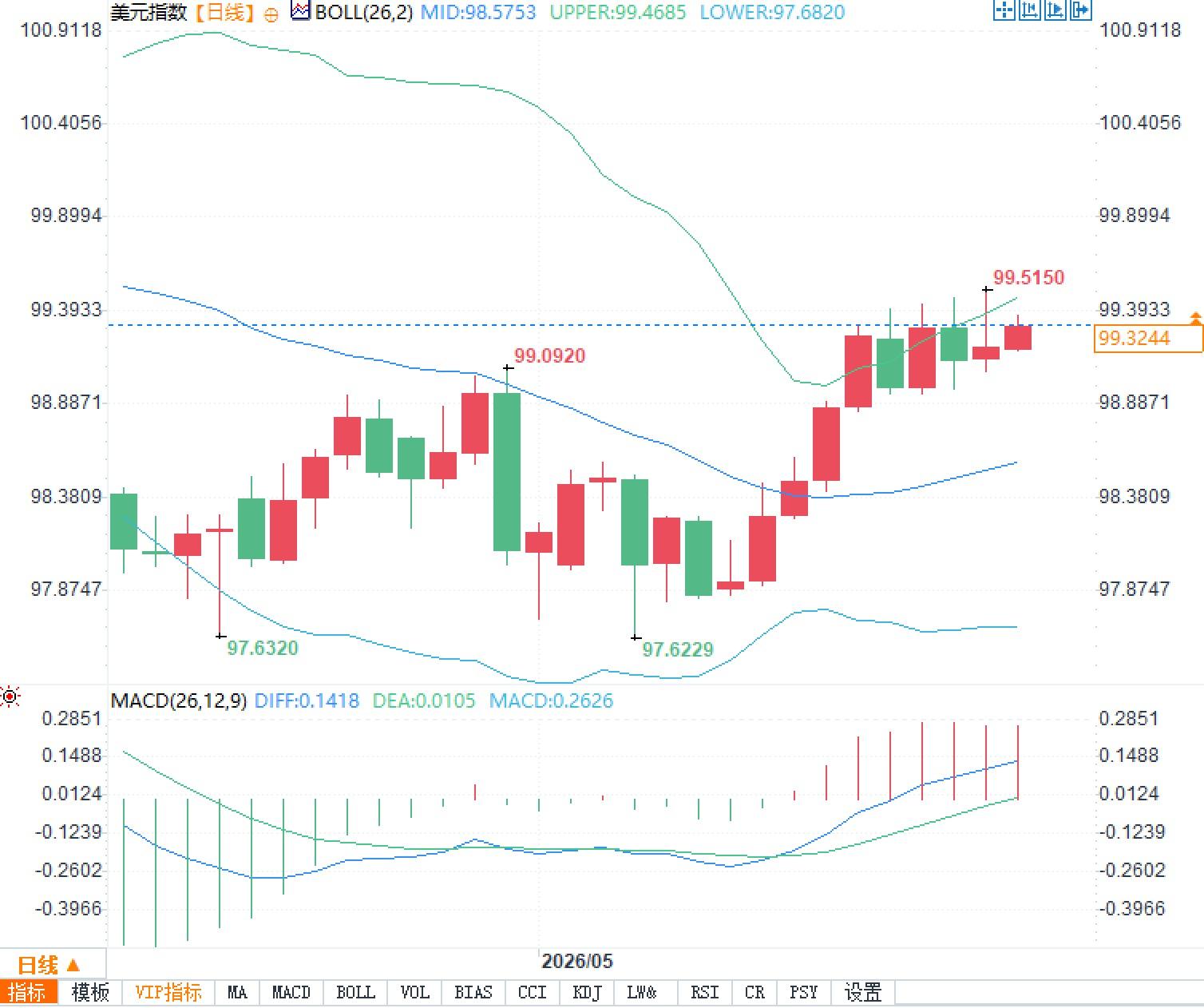
Currently, the market is not truly trading on a rate hike or cut, but rather on whether the Federal Reserve acknowledges that the central interest rate has shifted upward. If AI investment, energy disruptions, and fiscal supply pressures continue to converge, the past path of rapid rate cuts after inflation declines will be difficult to replicate. Therefore, the US dollar index is likely to exhibit high-level fluctuations rather than a smooth trend.
Crude oil remains trading around $100 a barrel, with energy prices continuing to amplify volatility in inflation expectations. For the US dollar index, the energy shock has a dual meaning: first, it pushes up short-term inflation readings, forcing the Federal Reserve to be more cautious; second, it increases global trade settlement and safe-haven liquidity demand, potentially providing temporary support for the dollar.
However, energy shocks can also compress real income and increase business costs. If consumption slows down subsequently, the driving force behind the dollar may shift from interest rate differentials to safe-haven demand. Both could be positive for the dollar, but their implications for asset structures differ. The former leans more towards interest rate trades, while the latter leans more towards risk contraction trades. Traders need to distinguish between these two sources of strength because their transmission to gold, the yen, the euro, and the US Treasury yield curve is not the same.
The core contradiction of the US dollar index is not simply about risk aversion, but rather a reassessment of the interest rate path.
The recent strengthening of the US dollar index is not merely a traditional safe-haven transaction. A more crucial variable is that the market is reassessing the lower bound of the Federal Reserve's policy rate. Previously, the dollar's downward pressure stemmed primarily from market expectations that the Fed would begin an easing cycle this year, leading to a decline in real interest rates. However, the current simultaneous rise in inflation, energy costs, fiscal financing costs, and capital expenditure has forced the interest rate cut trade to give way to a scenario of "higher interest rates remaining for a longer period" or even "re-raising interest rates."
US CPI rose 3.8% year-on-year in April, a significant increase from 3.3% in March. The energy component saw a 17.9% year-on-year increase, indicating that price pressures are not limited to single commodities but are spreading to a wider range of sectors, including transportation, aviation, services, and business cost expectations. Core CPI rose 2.8% year-on-year, lower than overall inflation, but increased 0.4% month-on-month, showing that service prices and non-energy costs remain sticky. For the US dollar, this means that short-term interest rate expectations are unlikely to decline rapidly, while long-term yields have risen again through term premiums, both supporting the dollar index.
Warsh's policy dilemma after taking office: Promises of interest rate cuts are no match for the reality of inflation.
Warsh is seen by the market as a more likely candidate to restore the credibility of the Federal Reserve's policies. During his confirmation hearing, he emphasized that he would not make any pre-commitments to the White House regarding interest rate policy, stating that interest rate decisions would be based on economic data and policy objectives themselves. The market believes that Warsh's appointment was politically motivated by expectations of interest rate cuts, but his appointment coincided with rising inflation, high energy prices, and increased selling pressure in the bond market.
This makes the short-term logic of the US dollar index more nuanced. If Warsh maintains a cautious stance to preserve his credibility as an inflation hedge, the dollar will receive support from interest rate differentials. However, if he signals overly accommodative policies, long-term US Treasury bonds may face further pressure, pushing up term yields and impacting risk asset valuations. In this case, the dollar may remain resilient due to liquidity defense needs. Therefore, the dollar is currently not simply benefiting from "hawkish rhetoric," but rather from the market's repricing of policy uncertainty.
More importantly, the Federal Reserve is not only facing a slowdown in growth. Capital expenditures related to artificial intelligence continue to support demand for equipment, data centers, electricity, and the semiconductor supply chain. This investment cycle does not naturally suppress inflation; on the contrary, it may push up demand for resources, labor, and financing in the short term. If demand does not cool significantly, the Federal Reserve will find it difficult to explain all price pressures with a one-off supply shock.
Long-term yields are the true anchor of the US dollar index.
The 10-year US Treasury yield is currently hovering between 4.55% and 4.58%, having risen by approximately 0.24 to 0.25 percentage points in the past month. This change has a greater impact on the US dollar index than a single policy meeting might suggest. This is because the US dollar index essentially reflects not only short-term interest rate differentials but also a comprehensive assessment of global funds' perceptions of the duration risk, real yield, and liquidity of US dollar assets.
When rising long-term yields stem from inflation concerns, the dollar may receive short-term support, but this support is not stable. If rising yields further suppress expectations of corporate financing and fiscal sustainability, the dollar will face two forces simultaneously: on the one hand, high yields attract capital inflows; on the other hand, fiscal deficits and interest payment pressures may weaken market confidence in long-term dollar assets. Therefore, the dollar index's movement above 99 is more like a "risk premium-driven strength" than a one-sided strength driven by flawless economic fundamentals.
Currently, the market is not truly trading on a rate hike or cut, but rather on whether the Federal Reserve acknowledges that the central interest rate has shifted upward. If AI investment, energy disruptions, and fiscal supply pressures continue to converge, the past path of rapid rate cuts after inflation declines will be difficult to replicate. Therefore, the US dollar index is likely to exhibit high-level fluctuations rather than a smooth trend.
Energy and conflict variables: exogenous drivers of inflation expectations
Crude oil remains trading around $100 a barrel, with energy prices continuing to amplify volatility in inflation expectations. For the US dollar index, the energy shock has a dual meaning: first, it pushes up short-term inflation readings, forcing the Federal Reserve to be more cautious; second, it increases global trade settlement and safe-haven liquidity demand, potentially providing temporary support for the dollar.
However, energy shocks can also compress real income and increase business costs. If consumption slows down subsequently, the driving force behind the dollar may shift from interest rate differentials to safe-haven demand. Both could be positive for the dollar, but their implications for asset structures differ. The former leans more towards interest rate trades, while the latter leans more towards risk contraction trades. Traders need to distinguish between these two sources of strength because their transmission to gold, the yen, the euro, and the US Treasury yield curve is not the same.
- Risk Warning and Disclaimer
- The market involves risk, and trading may not be suitable for all investors. This article is for reference only and does not constitute personal investment advice, nor does it take into account certain users’ specific investment objectives, financial situation, or other needs. Any investment decisions made based on this information are at your own risk.