Easing geopolitical tensions coupled with dovish signals from the Federal Reserve present another pricing window for gold.
2026-05-22 20:15:59
The current gold market is in a period of intertwined factors: the easing of geopolitical risks in the Middle East and the weakening of expectations for Federal Reserve policy. Breakthroughs in US-Iran negotiations, marginal improvements in navigation in the Strait of Hormuz, shifts in the stance of Gulf countries, and room for flexibility on the nuclear issue are all favorable for gold price development.
Meanwhile, the Federal Reserve's focus on long-term inflation and its release of cautiously dovish signals have provided support for gold prices from the perspective of real interest rates.
With Pakistan's mediation, the diplomatic game between the US and Iran has seen a substantial breakthrough, with both sides continuing to exchange negotiation texts and gradually narrowing their core differences.
Pakistani Interior Minister Naqvi met with Iranian Foreign Minister Araqchi again on May 22 and finalized the core proposals for resolving the dispute.
According to Al Arabiya satellite news agency around 2 a.m. today, the final draft of the US-Iran agreement has been completed and is expected to be released within hours.
The draft law includes five core provisions: an immediate ceasefire across the entire border, no attacks on each other's infrastructure, joint monitoring and navigation in the Strait of Hormuz, gradual lifting of sanctions, and the resumption of negotiations on outstanding issues within seven days.
The US negotiating text has narrowed the differences to some extent, and Iran is responding to the US framework. Both sides are focusing on trust-building measures and refining the details. The only difference lies in the fact that the US needs to abandon its war-loving tendencies.
If the framework is reached, the Pakistani Army Chief of Staff will visit Iraq, making the trend of the US and Iran shifting from "military confrontation" to "diplomatic reconciliation" clear.
As a global energy choke point, improved navigation in the Strait of Hormuz is a key indicator of easing tensions in the Middle East, directly weakening gold's safe-haven appeal in the energy sector.
Data from Iran's Islamic Revolutionary Guard Corps shows that 35 commercial vessels successfully transited the Strait of Hormuz in the past 24 hours under its security coordination. A Japanese oil tanker from Idemitsu Kosan has passed safely and is expected to arrive in Japan on May 25th. This is the first crude oil tanker to arrive in Japan since the US-Israel strikes against Iran at the end of February, which effectively closed the Strait of Hormuz.
The normalization of cross-strait navigation means that the risk of oil supply disruptions has subsided, and expectations for a decline in oil prices from their high levels have increased. This, in turn, alleviates global inflationary pressures, reduces the need for the Federal Reserve to maintain high interest rates, and indirectly benefits gold.
As the core of the US-Iran rivalry, both sides are currently leaving room for negotiation to avoid the situation spiraling out of control.
In response to reports that "Khamenei ordered that enriched uranium must remain within the country," senior Iranian officials explicitly denied the claims, dismissing them as "propaganda by the enemy of the agreement." They emphasized that no new orders had been issued and that Tehran's position remained consistent: Iran will dilute its enriched uranium on its own, and this issue will be central to the next phase of negotiations.
This statement sends a key signal—Iran has not “locked in its position” on the nuclear issue and is willing to adjust its nuclear activities through negotiations, preserving core flexibility for the US-Iran agreement, and significantly reducing the probability of the nuclear crisis triggering extreme risk aversion.
Market sources say the UAE has joined Saudi Arabia and Qatar in urging Trump not to restart the war against Iran.
As the only Gulf state to break ties with Iran in this US-Iran conflict, the UAE's shift in stance is a significant turning point in the easing of geopolitical tensions in the Middle East, further reducing the risk of regional conflict.
UAE Presidential Advisor Anwar Gargash clearly stated that a new round of conflict between the US and Iran would only complicate the situation, and that military confrontation must be avoided while addressing the root causes of the problem.
He emphasized that diplomatic means are the only option, and that we must not create hidden dangers for the future.
As a representative with deeply intertwined interests with the United States, the UAE's shift may signify a confirmed trend of easing tensions between the US and Iran. As discussed in previous articles, the UAE's attitude is a key point to observe. It is also worth noting that once the Strait of Hormuz is open and the Gulf countries have sufficient petrodollars, their demand for the US dollar will decrease. They may even start buying back the US Treasury bonds, gold, and other assets they recently sold, which would be beneficial for the development of gold.
In contrast to the cooling of safe-haven demand in the Middle East, the Federal Reserve's policy logic remains dovish, providing core support for gold from the perspective of real interest rates.
Federal Reserve voting member Barkin clearly stated that when inflation expectations are "anchored," short-term oil price fluctuations do not indicate long-term inflation. Consumers will not demand wage increases due to short-term price fluctuations, nor will they hoard goods to exacerbate inflation.
This stable long-term expectation makes it difficult for short-term supply shocks to turn into spiral inflation. Therefore, the Federal Reserve will not adjust interest rates due to short-term inflation fluctuations, but will prefer to set aside short-term disturbances and focus on long-term inflation stability.
Currently, Federal Reserve voting members are sending cautiously dovish signals, rejecting short-term rate hikes and even hinting at the possibility of further rate cuts. This is putting downward pressure on US Treasury yields, reducing the opportunity cost of holding gold and providing solid support for gold prices.
The bad news is that the current strong upward trend of the US dollar index is mainly due to its relative advantage highlighted by its "allies," with the continued weakness of the euro and the pound providing key support for the dollar.
The escalating political turmoil in the UK, with Prime Minister Starmer facing a challenge to his party leadership and Labour MPs resigning to make way for their rivals, has fueled growing concerns about the stability of the British political situation, triggering a triple whammy of losses in stocks, currencies, and bonds. Meanwhile, the Eurozone's economic fundamentals are clearly weak, with overall PMI data remaining in contraction territory. The aftershocks of the energy crisis have not yet dissipated, and concerns about the restructuring of the European security landscape following the recent withdrawal of US troops have led to a continued outflow of international funds from the European market, causing the euro to weaken against the US dollar.
With both the Eurozone and the UK exhibiting weak monetary conditions, the US dollar has become increasingly attractive as a traditional safe-haven currency, with the dollar index continuously hitting new highs. This shift in the currency market has exerted sustained downward pressure on gold.
The global geopolitical landscape remains turbulent, with conflicts between Russia and Ukraine, and the US and Iran. Global military spending has increased as a percentage of GDP, with Germany's spending exceeding 5%. The safe-haven appeal of gold persists. Meanwhile, marginal improvements in the Taiwan Strait situation and the Federal Reserve's dovish rhetoric have mitigated the downward pressure on gold prices caused by high interest rates increasing the cost of holding gold.
However, the strength of the US dollar index and the downward trend of gold itself have limited its upward momentum. But there are clear positive factors for gold, coupled with the continued high risk appetite globally, so there are still opportunities for allocation.
However, if gold prices fall instead of rise here, it may indicate a shift in the overall market risk appetite and other risks to be explored, which investors should pay attention to.
From a technical perspective, spot gold is trading along a downward channel, with current resistance at the middle channel line and the 5-day moving average.
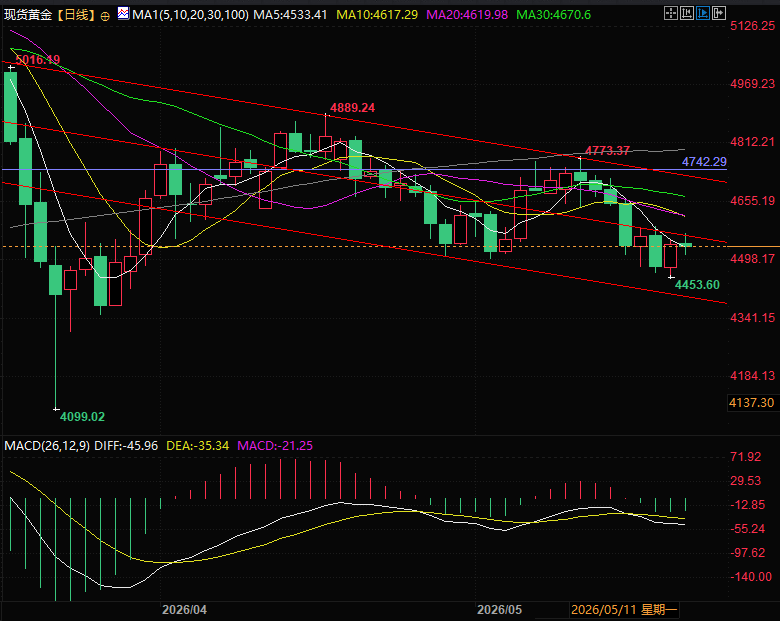
(Spot gold daily chart, source: EasyForex subsidiary)
At 20:14 Beijing time, spot gold is currently trading at $4,527 per ounce.
Meanwhile, the Federal Reserve's focus on long-term inflation and its release of cautiously dovish signals have provided support for gold prices from the perspective of real interest rates.
Key progress has been made in US-Iran negotiations, significantly reducing the risk of conflict.
With Pakistan's mediation, the diplomatic game between the US and Iran has seen a substantial breakthrough, with both sides continuing to exchange negotiation texts and gradually narrowing their core differences.
Pakistani Interior Minister Naqvi met with Iranian Foreign Minister Araqchi again on May 22 and finalized the core proposals for resolving the dispute.
According to Al Arabiya satellite news agency around 2 a.m. today, the final draft of the US-Iran agreement has been completed and is expected to be released within hours.
The draft law includes five core provisions: an immediate ceasefire across the entire border, no attacks on each other's infrastructure, joint monitoring and navigation in the Strait of Hormuz, gradual lifting of sanctions, and the resumption of negotiations on outstanding issues within seven days.
The US negotiating text has narrowed the differences to some extent, and Iran is responding to the US framework. Both sides are focusing on trust-building measures and refining the details. The only difference lies in the fact that the US needs to abandon its war-loving tendencies.
If the framework is reached, the Pakistani Army Chief of Staff will visit Iraq, making the trend of the US and Iran shifting from "military confrontation" to "diplomatic reconciliation" clear.
Navigation resumes in the Strait of Hormuz, easing energy inflation pressures.
As a global energy choke point, improved navigation in the Strait of Hormuz is a key indicator of easing tensions in the Middle East, directly weakening gold's safe-haven appeal in the energy sector.
Data from Iran's Islamic Revolutionary Guard Corps shows that 35 commercial vessels successfully transited the Strait of Hormuz in the past 24 hours under its security coordination. A Japanese oil tanker from Idemitsu Kosan has passed safely and is expected to arrive in Japan on May 25th. This is the first crude oil tanker to arrive in Japan since the US-Israel strikes against Iran at the end of February, which effectively closed the Strait of Hormuz.
The normalization of cross-strait navigation means that the risk of oil supply disruptions has subsided, and expectations for a decline in oil prices from their high levels have increased. This, in turn, alleviates global inflationary pressures, reduces the need for the Federal Reserve to maintain high interest rates, and indirectly benefits gold.
The stance on uranium enrichment remains flexible, and the risks of a nuclear crisis are not entirely solidified.
As the core of the US-Iran rivalry, both sides are currently leaving room for negotiation to avoid the situation spiraling out of control.
In response to reports that "Khamenei ordered that enriched uranium must remain within the country," senior Iranian officials explicitly denied the claims, dismissing them as "propaganda by the enemy of the agreement." They emphasized that no new orders had been issued and that Tehran's position remained consistent: Iran will dilute its enriched uranium on its own, and this issue will be central to the next phase of negotiations.
This statement sends a key signal—Iran has not “locked in its position” on the nuclear issue and is willing to adjust its nuclear activities through negotiations, preserving core flexibility for the US-Iran agreement, and significantly reducing the probability of the nuclear crisis triggering extreme risk aversion.
The UAE signals a de-escalation, prompting the Gulf alliance to reshape the geopolitical landscape.
Market sources say the UAE has joined Saudi Arabia and Qatar in urging Trump not to restart the war against Iran.
As the only Gulf state to break ties with Iran in this US-Iran conflict, the UAE's shift in stance is a significant turning point in the easing of geopolitical tensions in the Middle East, further reducing the risk of regional conflict.
UAE Presidential Advisor Anwar Gargash clearly stated that a new round of conflict between the US and Iran would only complicate the situation, and that military confrontation must be avoided while addressing the root causes of the problem.
He emphasized that diplomatic means are the only option, and that we must not create hidden dangers for the future.
As a representative with deeply intertwined interests with the United States, the UAE's shift may signify a confirmed trend of easing tensions between the US and Iran. As discussed in previous articles, the UAE's attitude is a key point to observe. It is also worth noting that once the Strait of Hormuz is open and the Gulf countries have sufficient petrodollars, their demand for the US dollar will decrease. They may even start buying back the US Treasury bonds, gold, and other assets they recently sold, which would be beneficial for the development of gold.
The Federal Reserve's cautiously dovish signals, anchoring to long-term inflation, are supporting gold prices.
In contrast to the cooling of safe-haven demand in the Middle East, the Federal Reserve's policy logic remains dovish, providing core support for gold from the perspective of real interest rates.
Federal Reserve voting member Barkin clearly stated that when inflation expectations are "anchored," short-term oil price fluctuations do not indicate long-term inflation. Consumers will not demand wage increases due to short-term price fluctuations, nor will they hoard goods to exacerbate inflation.
This stable long-term expectation makes it difficult for short-term supply shocks to turn into spiral inflation. Therefore, the Federal Reserve will not adjust interest rates due to short-term inflation fluctuations, but will prefer to set aside short-term disturbances and focus on long-term inflation stability.
Currently, Federal Reserve voting members are sending cautiously dovish signals, rejecting short-term rate hikes and even hinting at the possibility of further rate cuts. This is putting downward pressure on US Treasury yields, reducing the opportunity cost of holding gold and providing solid support for gold prices.
The US dollar index strengthened, supported by weakness in both the European and British pound.
The bad news is that the current strong upward trend of the US dollar index is mainly due to its relative advantage highlighted by its "allies," with the continued weakness of the euro and the pound providing key support for the dollar.
The escalating political turmoil in the UK, with Prime Minister Starmer facing a challenge to his party leadership and Labour MPs resigning to make way for their rivals, has fueled growing concerns about the stability of the British political situation, triggering a triple whammy of losses in stocks, currencies, and bonds. Meanwhile, the Eurozone's economic fundamentals are clearly weak, with overall PMI data remaining in contraction territory. The aftershocks of the energy crisis have not yet dissipated, and concerns about the restructuring of the European security landscape following the recent withdrawal of US troops have led to a continued outflow of international funds from the European market, causing the euro to weaken against the US dollar.
With both the Eurozone and the UK exhibiting weak monetary conditions, the US dollar has become increasingly attractive as a traditional safe-haven currency, with the dollar index continuously hitting new highs. This shift in the currency market has exerted sustained downward pressure on gold.
Summary and Technical Analysis:
The global geopolitical landscape remains turbulent, with conflicts between Russia and Ukraine, and the US and Iran. Global military spending has increased as a percentage of GDP, with Germany's spending exceeding 5%. The safe-haven appeal of gold persists. Meanwhile, marginal improvements in the Taiwan Strait situation and the Federal Reserve's dovish rhetoric have mitigated the downward pressure on gold prices caused by high interest rates increasing the cost of holding gold.
However, the strength of the US dollar index and the downward trend of gold itself have limited its upward momentum. But there are clear positive factors for gold, coupled with the continued high risk appetite globally, so there are still opportunities for allocation.
However, if gold prices fall instead of rise here, it may indicate a shift in the overall market risk appetite and other risks to be explored, which investors should pay attention to.
From a technical perspective, spot gold is trading along a downward channel, with current resistance at the middle channel line and the 5-day moving average.
(Spot gold daily chart, source: EasyForex subsidiary)
At 20:14 Beijing time, spot gold is currently trading at $4,527 per ounce.
- Risk Warning and Disclaimer
- The market involves risk, and trading may not be suitable for all investors. This article is for reference only and does not constitute personal investment advice, nor does it take into account certain users’ specific investment objectives, financial situation, or other needs. Any investment decisions made based on this information are at your own risk.