US-Iran talks dampened the dollar's gains, but a plunge in oil prices weighed on the Canadian dollar, causing the USD/CAD pair to fluctuate around 1.3800.
2026-05-25 10:18:26
The US dollar edged lower against the Canadian dollar in Asian trading on Monday, retreating slightly from its high of around 1.3825 reached last week, but remaining relatively stable around the 1.3800 level. While the US dollar index was pressured in the short term by optimism surrounding US-Iran peace talks, a sharp drop in international oil prices weakened the performance of the commodity currency Canadian dollar, thus limiting further downside for the USD/CAD pair.
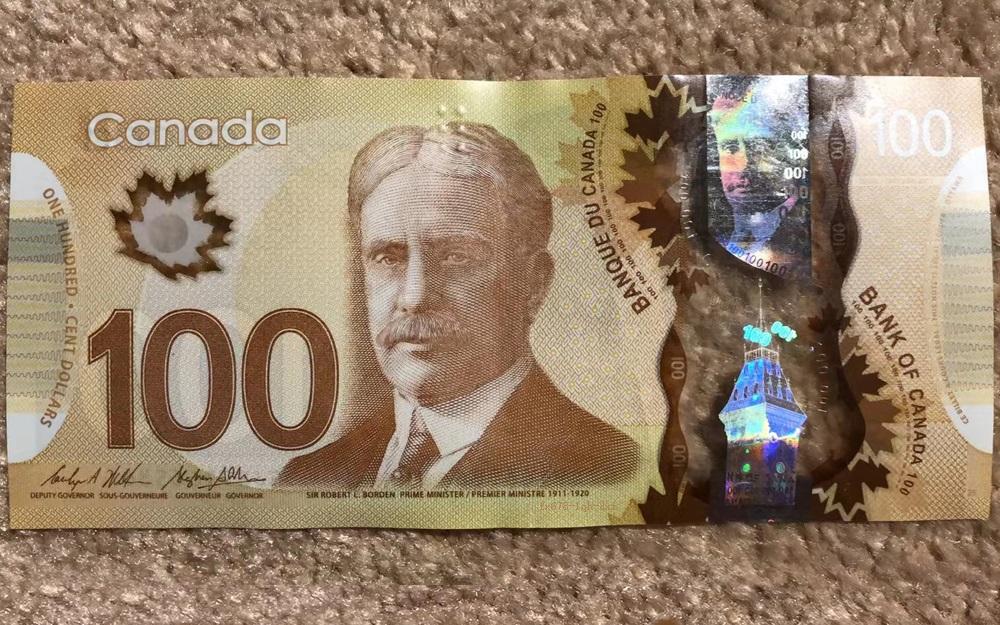
Previously, the US dollar rose to its highest level against the Canadian dollar since mid-April, mainly due to increased risk aversion in international markets, strengthened expectations of a hawkish stance from the Federal Reserve, and sharp fluctuations in the oil market. While the market currently holds some optimism regarding the easing of tensions in the Middle East, investors remain highly cautious about the global energy market and the outlook for US monetary policy.
The United States and Iran are nearing an agreement that could restore normal shipping activity in the Strait of Hormuz. The market believes that if such an agreement is reached, tensions in the global oil supply chain could ease significantly, leading to a rapid decline in international oil prices. As a result, WTI crude oil prices fell sharply on Monday, and the substantial geopolitical risk premiums previously accumulated in the market began to dissipate rapidly. As a major global oil exporter, the Canadian dollar's performance is typically highly correlated with international oil prices. With falling oil prices, the Canadian dollar came under pressure, thus providing support for the USD/CAD exchange rate.
However, several key differences remain between the US and Iran, including the issue of blocking the Strait of Hormuz and the Iranian nuclear issue. US President Trump stated on Sunday that he had told relevant representatives "there's no need to rush to reach an agreement," indicating that uncertainty remains in the short term regarding negotiations. This means that the risks in the Middle East have not been completely eliminated, and market sentiment remains highly sensitive.
Meanwhile, expectations regarding Federal Reserve policy continue to be a significant factor supporting the US dollar. Recent US inflation data has remained stubbornly robust, and several Fed officials have maintained a hawkish stance, prompting the market to further bet on a potential 25 basis point rate hike by the Fed this year. Current market expectations that the Fed will maintain a high-interest-rate environment are continuously increasing the attractiveness of dollar-denominated assets.
US Treasury yields have remained high recently, continuing to support the US dollar. Amidst ongoing uncertainty about the global economic outlook, US dollar assets remain attractive to international funds, keeping the USD/CAD pair generally strong. On the other hand, the Canadian economy is facing some growth pressure recently. With international oil prices declining, expectations for Canadian energy export revenue may be affected. Furthermore, domestic consumption and the housing market in Canada have seen slower growth momentum, leading to market caution regarding the Bank of Canada's future policy space.
Global market liquidity is currently relatively limited, with some major markets on holiday, which may lead to increased short-term volatility in the foreign exchange market. In a low-liquidity environment, the USD/CAD pair is more susceptible to sudden news and changes in market sentiment. Investors are closely watching the latest developments in the Middle East and this week's US economic data.
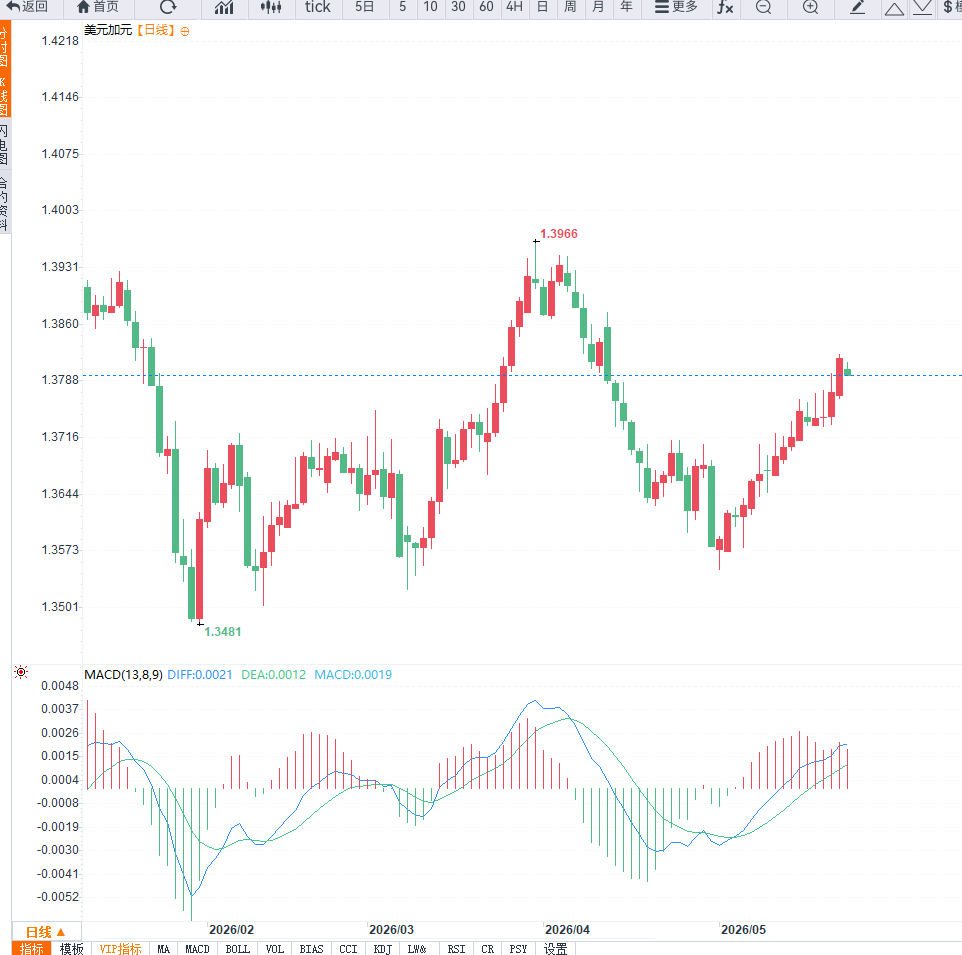
From a technical perspective, the USD/CAD daily chart maintains an overall bullish bias. After breaking through the key resistance level of 1.3750, the exchange rate rose further and is currently trading steadily above the major moving averages. Initial resistance on the daily chart is located in the 1.3825-1.3850 area; a successful break above this level could lead to a test of the 1.3900 level. On the downside, 1.3800 has become a significant short-term support area, with further support around 1.3750. If oil prices continue to decline and hawkish expectations from the Federal Reserve strengthen further, the USD/CAD pair may maintain its strength. Looking at the daily indicators, the MACD remains bullish, and although the red bars have slowed slightly, the overall upward momentum has not weakened significantly. The RSI indicator is currently in the mid-to-high range, indicating that the market still leans towards a bullish USD structure, although some technical consolidation is expected in the short term.
If further breakthroughs are achieved in negotiations between the US and Iran, and international oil prices continue to fall, the Canadian dollar may continue to be dragged down, thus supporting the USD/CAD exchange rate at a high level. However, if tensions in the Middle East escalate again and oil prices rebound, the Canadian dollar may regain support. Overall, the current USD/CAD exchange rate is still mainly driven by three factors: international oil price volatility, expectations regarding Federal Reserve policy, and changes in the Middle East situation. With the Federal Reserve maintaining a hawkish stance, the US dollar still holds a certain advantage overall, but changes in oil prices may remain a key variable affecting short-term fluctuations in the Canadian dollar.
Editor's Summary : The USD/CAD pair currently maintains a relatively strong trend. While US-Iran negotiations have alleviated some of the safe-haven demand for the US dollar, the sharp drop in international oil prices has significantly weakened the Canadian dollar's performance, causing the USD/CAD pair to remain in a high-level consolidation. Future market movements will heavily depend on developments in the Middle East and the direction of international oil prices. If normal shipping resumes in the Strait of Hormuz, oil prices may face further pressure, and the Canadian dollar may continue to weaken; however, if negotiations encounter further setbacks, risk appetite in the energy market may rekindle, supporting a rebound in the Canadian dollar. Meanwhile, the expectation that the Federal Reserve will maintain high interest rates or even further rate hikes this year will continue to support the US dollar. In the short term, the USD/CAD pair is likely to maintain a high-level consolidation with a slightly strong trend. The market needs to pay close attention to US economic data, oil price changes, and the latest developments in the Middle East.
Previously, the US dollar rose to its highest level against the Canadian dollar since mid-April, mainly due to increased risk aversion in international markets, strengthened expectations of a hawkish stance from the Federal Reserve, and sharp fluctuations in the oil market. While the market currently holds some optimism regarding the easing of tensions in the Middle East, investors remain highly cautious about the global energy market and the outlook for US monetary policy.
The United States and Iran are nearing an agreement that could restore normal shipping activity in the Strait of Hormuz. The market believes that if such an agreement is reached, tensions in the global oil supply chain could ease significantly, leading to a rapid decline in international oil prices. As a result, WTI crude oil prices fell sharply on Monday, and the substantial geopolitical risk premiums previously accumulated in the market began to dissipate rapidly. As a major global oil exporter, the Canadian dollar's performance is typically highly correlated with international oil prices. With falling oil prices, the Canadian dollar came under pressure, thus providing support for the USD/CAD exchange rate.
However, several key differences remain between the US and Iran, including the issue of blocking the Strait of Hormuz and the Iranian nuclear issue. US President Trump stated on Sunday that he had told relevant representatives "there's no need to rush to reach an agreement," indicating that uncertainty remains in the short term regarding negotiations. This means that the risks in the Middle East have not been completely eliminated, and market sentiment remains highly sensitive.
Meanwhile, expectations regarding Federal Reserve policy continue to be a significant factor supporting the US dollar. Recent US inflation data has remained stubbornly robust, and several Fed officials have maintained a hawkish stance, prompting the market to further bet on a potential 25 basis point rate hike by the Fed this year. Current market expectations that the Fed will maintain a high-interest-rate environment are continuously increasing the attractiveness of dollar-denominated assets.
US Treasury yields have remained high recently, continuing to support the US dollar. Amidst ongoing uncertainty about the global economic outlook, US dollar assets remain attractive to international funds, keeping the USD/CAD pair generally strong. On the other hand, the Canadian economy is facing some growth pressure recently. With international oil prices declining, expectations for Canadian energy export revenue may be affected. Furthermore, domestic consumption and the housing market in Canada have seen slower growth momentum, leading to market caution regarding the Bank of Canada's future policy space.
Global market liquidity is currently relatively limited, with some major markets on holiday, which may lead to increased short-term volatility in the foreign exchange market. In a low-liquidity environment, the USD/CAD pair is more susceptible to sudden news and changes in market sentiment. Investors are closely watching the latest developments in the Middle East and this week's US economic data.
From a technical perspective, the USD/CAD daily chart maintains an overall bullish bias. After breaking through the key resistance level of 1.3750, the exchange rate rose further and is currently trading steadily above the major moving averages. Initial resistance on the daily chart is located in the 1.3825-1.3850 area; a successful break above this level could lead to a test of the 1.3900 level. On the downside, 1.3800 has become a significant short-term support area, with further support around 1.3750. If oil prices continue to decline and hawkish expectations from the Federal Reserve strengthen further, the USD/CAD pair may maintain its strength. Looking at the daily indicators, the MACD remains bullish, and although the red bars have slowed slightly, the overall upward momentum has not weakened significantly. The RSI indicator is currently in the mid-to-high range, indicating that the market still leans towards a bullish USD structure, although some technical consolidation is expected in the short term.
If further breakthroughs are achieved in negotiations between the US and Iran, and international oil prices continue to fall, the Canadian dollar may continue to be dragged down, thus supporting the USD/CAD exchange rate at a high level. However, if tensions in the Middle East escalate again and oil prices rebound, the Canadian dollar may regain support. Overall, the current USD/CAD exchange rate is still mainly driven by three factors: international oil price volatility, expectations regarding Federal Reserve policy, and changes in the Middle East situation. With the Federal Reserve maintaining a hawkish stance, the US dollar still holds a certain advantage overall, but changes in oil prices may remain a key variable affecting short-term fluctuations in the Canadian dollar.
Editor's Summary : The USD/CAD pair currently maintains a relatively strong trend. While US-Iran negotiations have alleviated some of the safe-haven demand for the US dollar, the sharp drop in international oil prices has significantly weakened the Canadian dollar's performance, causing the USD/CAD pair to remain in a high-level consolidation. Future market movements will heavily depend on developments in the Middle East and the direction of international oil prices. If normal shipping resumes in the Strait of Hormuz, oil prices may face further pressure, and the Canadian dollar may continue to weaken; however, if negotiations encounter further setbacks, risk appetite in the energy market may rekindle, supporting a rebound in the Canadian dollar. Meanwhile, the expectation that the Federal Reserve will maintain high interest rates or even further rate hikes this year will continue to support the US dollar. In the short term, the USD/CAD pair is likely to maintain a high-level consolidation with a slightly strong trend. The market needs to pay close attention to US economic data, oil price changes, and the latest developments in the Middle East.
- Risk Warning and Disclaimer
- The market involves risk, and trading may not be suitable for all investors. This article is for reference only and does not constitute personal investment advice, nor does it take into account certain users’ specific investment objectives, financial situation, or other needs. Any investment decisions made based on this information are at your own risk.