The market is cautious about news of a US-Iran peace agreement; oil prices are unlikely to return to their previous levels after the Strait of Hormuz reopens.
2026-05-25 13:01:28
The US claims that a peace agreement is imminent between Iran and the Strait of Hormuz, with the Strait potentially reopening. However, after numerous failed attempts to achieve peace, the market is no longer inclined to believe such claims. Even if a ceasefire is implemented and the strait reopens, the smooth flow of crude oil transportation, inventory clearance, oil field resumption, and facility repairs will all take a long time. Coupled with uncertainties such as navigation control, insurance costs, and geopolitical differences, oil prices are unlikely to fall back to pre-conflict levels in the short term, and the medium- to long-term energy price landscape will undergo substantial changes.
US President Trump stated on Saturday that a US-Iran peace agreement is imminent and the Strait of Hormuz will soon be open to navigation. After several false ceasefire signals over the past three months, the market is no longer relying solely on verbal statements to judge the situation, but is instead awaiting a written agreement with concrete results and concrete actions.
Despite its military disadvantage, Iran has consistently used the right to pass through the Strait of Hormuz as a core bargaining chip, relying on speedboats, mines, and military drones to blockade shipping lanes and cut off one-fifth of the world's oil transport routes, thereby gaining the upper hand in negotiations. Iran's official Fars News Agency stated that even if the number of ships passing through the Strait returns to pre-war levels, the previous free passage model will not be restored, indicating that the game between the two sides is far from over.
If the Strait of Hormuz is officially reopened, the massive logistical backlog will immediately become apparent. The full return of shipping capacity will require a phased approach, with the overall process estimated to take up to three months. Currently, over one hundred oil tankers are stranded in the Persian Gulf, carrying a huge amount of crude oil. These vessels need to first sail out of the waters to make room for empty ships to enter the port for loading. Industry experts from energy analysis firms indicate that the slow speed of oil tankers means that simply clearing the congestion in the shipping lanes will take a significant amount of time.
Once shipping lanes are cleared, the market will first need to gradually deplete the previously accumulated crude oil inventory. During the conflict, production and sales were disrupted, and storage capacity in various regions remained high. Even if refineries reserved some operational space, the large inventory levels will still suppress the pace of crude oil production recovery. Most oil wells in the Middle East were shut down during the standoff, making rapid resumption of production impossible. This involves complex engineering projects such as oil and gas pressure balancing and formation protection; hasty resumption could easily damage oil reservoirs. Furthermore, cross-border and cross-enterprise coordination further prolongs the recovery period.
The war also damaged refining and oil and gas extraction infrastructure, with repairs to some key equipment and pipelines taking years. The Middle East has shut down a massive amount of crude oil and refined product production capacity, and the damaged facilities pose significant challenges to a full resumption of production.
There had been a brief window of opportunity for open navigation channels, but ships turned back after setting out due to safety alerts, leading to a strong risk-averse mentality among shipping companies. Geopolitical tensions have caused marine insurance premiums to surge, with high costs further discouraging ships from using the waterways. Coupled with Iran's continued control over the waterways and the deployment of defensive facilities, ship passage remains fraught with military risks, making a return to normal free navigation unlikely in the short term.
Meanwhile, several core differences between the US and Iran remain unresolved. Whether the US oil blockade will be lifted and whether Iran will cancel related shipping fees are key obstacles to a peaceful resolution. In the past, there have been instances where agreements were briefly reached only to be quickly broken off. This volatile situation has kept traders cautious, and oil prices have remained stable at high levels.
If the peace process progresses steadily, the market may test lower levels, but a significant pullback is highly unlikely. Analysts predict that after the shipping lanes reopen in early June, the average price of crude oil will remain high throughout the year.
According to industry strategist Michael Green, based on historical price patterns, oil prices would need to be significantly reduced to drive down refined product prices, but the market expects this scenario to be unlikely for many years to come.
Only with prolonged peace and stable conditions, and steady progress in oil field resumption of production, can oil prices have a basis for a gradual decline. However, considering the current situation, including changes in navigation rules, facility damage, and increased regional controls, the previously stable and low-priced crude oil market is no longer viable.
In summary, a verbal ceasefire declaration cannot quickly resolve the deep-seated problems in the energy supply chain. Clearing waterways, restoring production capacity, and ensuring security will all require a long time to materialize. Coupled with lingering US-Iran differences and rising shipping costs, even if the Strait of Hormuz reopens, oil prices are unlikely to return to pre-war levels, and the global energy market will remain in a state of high prices and high risks for a long time.
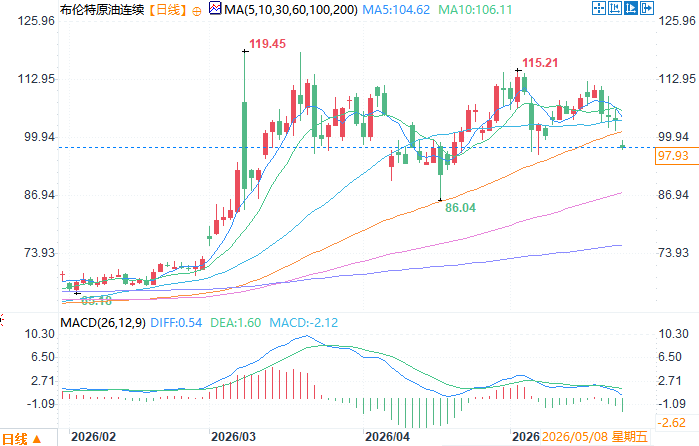
Brent crude oil daily chart source: EasyForex
At 13:02 Beijing time on May 25, Brent crude oil futures were trading at $97.81 per barrel.
The credibility of peace statements has declined, and the game situation remains complex.
US President Trump stated on Saturday that a US-Iran peace agreement is imminent and the Strait of Hormuz will soon be open to navigation. After several false ceasefire signals over the past three months, the market is no longer relying solely on verbal statements to judge the situation, but is instead awaiting a written agreement with concrete results and concrete actions.
Despite its military disadvantage, Iran has consistently used the right to pass through the Strait of Hormuz as a core bargaining chip, relying on speedboats, mines, and military drones to blockade shipping lanes and cut off one-fifth of the world's oil transport routes, thereby gaining the upper hand in negotiations. Iran's official Fars News Agency stated that even if the number of ships passing through the Strait returns to pre-war levels, the previous free passage model will not be restored, indicating that the game between the two sides is far from over.
The reopening of shipping routes faces multiple obstacles, and a full recovery period is lengthy.
If the Strait of Hormuz is officially reopened, the massive logistical backlog will immediately become apparent. The full return of shipping capacity will require a phased approach, with the overall process estimated to take up to three months. Currently, over one hundred oil tankers are stranded in the Persian Gulf, carrying a huge amount of crude oil. These vessels need to first sail out of the waters to make room for empty ships to enter the port for loading. Industry experts from energy analysis firms indicate that the slow speed of oil tankers means that simply clearing the congestion in the shipping lanes will take a significant amount of time.
Once shipping lanes are cleared, the market will first need to gradually deplete the previously accumulated crude oil inventory. During the conflict, production and sales were disrupted, and storage capacity in various regions remained high. Even if refineries reserved some operational space, the large inventory levels will still suppress the pace of crude oil production recovery. Most oil wells in the Middle East were shut down during the standoff, making rapid resumption of production impossible. This involves complex engineering projects such as oil and gas pressure balancing and formation protection; hasty resumption could easily damage oil reservoirs. Furthermore, cross-border and cross-enterprise coordination further prolongs the recovery period.
The war also damaged refining and oil and gas extraction infrastructure, with repairs to some key equipment and pipelines taking years. The Middle East has shut down a massive amount of crude oil and refined product production capacity, and the damaged facilities pose significant challenges to a full resumption of production.
Multiple risks make it difficult to completely guarantee air traffic safety.
There had been a brief window of opportunity for open navigation channels, but ships turned back after setting out due to safety alerts, leading to a strong risk-averse mentality among shipping companies. Geopolitical tensions have caused marine insurance premiums to surge, with high costs further discouraging ships from using the waterways. Coupled with Iran's continued control over the waterways and the deployment of defensive facilities, ship passage remains fraught with military risks, making a return to normal free navigation unlikely in the short term.
Meanwhile, several core differences between the US and Iran remain unresolved. Whether the US oil blockade will be lifted and whether Iran will cancel related shipping fees are key obstacles to a peaceful resolution. In the past, there have been instances where agreements were briefly reached only to be quickly broken off. This volatile situation has kept traders cautious, and oil prices have remained stable at high levels.
Oil prices have limited downside potential; the era of low prices is over.
If the peace process progresses steadily, the market may test lower levels, but a significant pullback is highly unlikely. Analysts predict that after the shipping lanes reopen in early June, the average price of crude oil will remain high throughout the year.
According to industry strategist Michael Green, based on historical price patterns, oil prices would need to be significantly reduced to drive down refined product prices, but the market expects this scenario to be unlikely for many years to come.
Only with prolonged peace and stable conditions, and steady progress in oil field resumption of production, can oil prices have a basis for a gradual decline. However, considering the current situation, including changes in navigation rules, facility damage, and increased regional controls, the previously stable and low-priced crude oil market is no longer viable.
Summarize
In summary, a verbal ceasefire declaration cannot quickly resolve the deep-seated problems in the energy supply chain. Clearing waterways, restoring production capacity, and ensuring security will all require a long time to materialize. Coupled with lingering US-Iran differences and rising shipping costs, even if the Strait of Hormuz reopens, oil prices are unlikely to return to pre-war levels, and the global energy market will remain in a state of high prices and high risks for a long time.
Brent crude oil daily chart source: EasyForex
At 13:02 Beijing time on May 25, Brent crude oil futures were trading at $97.81 per barrel.
- Risk Warning and Disclaimer
- The market involves risk, and trading may not be suitable for all investors. This article is for reference only and does not constitute personal investment advice, nor does it take into account certain users’ specific investment objectives, financial situation, or other needs. Any investment decisions made based on this information are at your own risk.