The new Federal Reserve Chair downplayed the forward guidance provided by the dot plot, and the dollar market faced policy uncertainty.
2026-05-25 16:31:37
The dollar market has recently begun to reassess the Federal Reserve's future policy communication framework. With Kevin Warsh officially taking office as the 17th Federal Reserve Chairman, market attention has rapidly increased regarding his future policy style and monetary policy path.
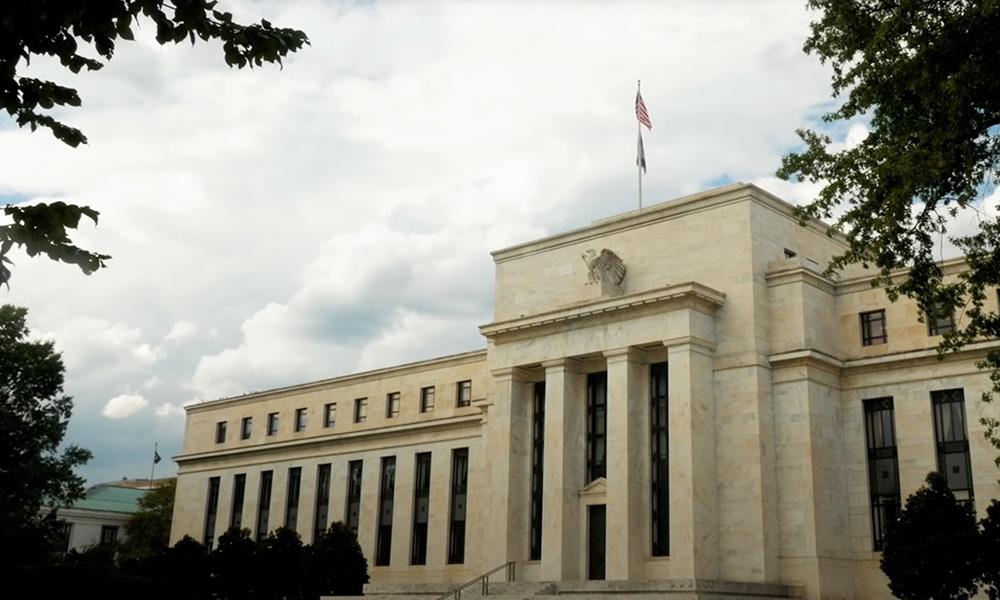
DBS analyst Philip Wee points out that the Warsh study may significantly weaken the role of the traditional dot plot in the Fed's policy communication, which means that the market's expectations for the future interest rate path may face greater uncertainty.
During his swearing-in ceremony at the White House, US President Trump stated that Warsh would "do things his own way" and emphasized the Federal Reserve's independence. However, Trump did not hide his desire for future interest rate cuts.
The market's biggest focus right now is whether Warsh will fundamentally change the Fed's policy communication model, which has relied on forward guidance for the past few years. In his inaugural address, Warsh emphasized that he would promote a "reform-oriented Fed" and criticized traditional economic models for relying too heavily on historical data and fixed frameworks. He stated that the Fed needs to achieve the dual mandate of "lower inflation and stronger economic growth" simultaneously.
At the same time, Warsh also mentioned reducing the Fed's balance sheet and decreasing reliance on the dot plot and detailed interpretations of press conferences. The market generally believes that Warsh may not provide personal interest rate forecasts in the June Summary of Economic Projections (SEP). This approach aligns with his stance of "downplaying forward guidance."
If Warsh chooses not to publish his personal interest rate path forecast, it means the market may lose an important policy anchor in the future. For the past few years, the Fed's dot plot has been a crucial tool for global financial markets to judge the future direction of interest rates. Investors typically use the dot plot to understand Fed officials' expectations for the future path of interest rates.
However, Warsh believes that over-reliance on the dot plot could "lock" the Federal Reserve into a predetermined policy path, thereby reducing policy flexibility. The market believes that Warsh's move may, on the one hand, avoid a public disagreement with Trump on high interest rates; on the other hand, it may prevent the Fed from losing market confidence in a rapidly changing economic environment. However, this change in policy communication methods may also increase market volatility.
The current US economic environment is already quite complex. On the one hand, inflationary pressures remain high, particularly with continued increases in energy prices and service sector costs; on the other hand, US consumer confidence remains weak. A recent University of Michigan survey shows that long-term inflation expectations in the US have risen to 3.9%, while consumer confidence has fallen to near historical lows. Markets are concerned that the US economy is facing a situation of "high inflation and slowing growth coexisting."
Against this backdrop, the Federal Reserve's future policy path is already highly uncertain. If Warsh further weakens policy guidance, market expectations for future interest rates could become even more confused. The upcoming US PCE price index data, to be released this week, is also a key focus for the market. PCE data is one of the Fed's most important inflation indicators.
If this week's PCE data continues to rise beyond expectations, the market may reaffirm its bets on further rate hikes by the Federal Reserve. However, the problem is that if Warsh chooses to downplay the dot plot or even refrain from releasing interest rate forecasts at this point, the market may find it difficult to accurately assess the Fed's true internal stance. If high inflation data coincides with ambiguous policy communication, volatility in the dollar market could increase significantly.
At the same time, internal divisions may emerge within the Federal Reserve. Some officials may still support maintaining a hawkish policy, while Warsh may place greater emphasis on policy flexibility and economic growth. This internal difference of opinion could also lead to greater uncertainty in the market regarding the future policy path.
Looking at the dollar's performance, the dollar index is currently maintaining a high-level consolidation pattern. High US Treasury yields and sticky US inflation continue to support the dollar. However, as the market begins to reassess the transparency of the Federal Reserve's policies, the dollar's recent volatility has increased significantly.
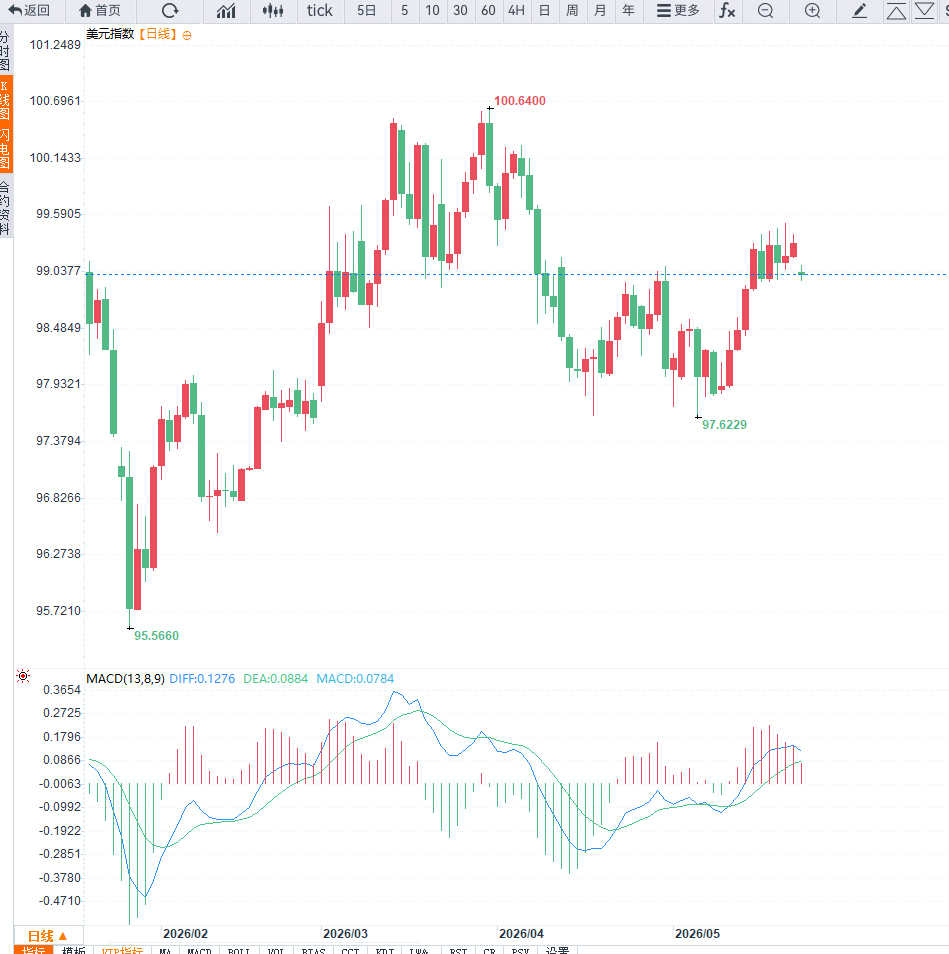
From a technical perspective, the US dollar index maintains an overall bullish trend on the daily chart. Currently trading around 99.00, the bullish trend hasn't completely reversed. Key resistance on the daily chart lies in the 99.80-100.20 area; a break above 100 could see the dollar index test the 101 area. On the downside, 98.50 has formed a key short-term support level. A break below this level could see the dollar index fall further to around 97.80. Looking at the daily indicators, the MACD remains above the zero line, but the red bars are shortening, indicating a slowdown in upward momentum. The RSI is near neutral territory, reflecting a more cautious market sentiment.
Overall, the dollar market has entered a new phase characterized by both high inflation expectations and policy communication uncertainty. Future market volatility may increase significantly, and the policy style of the new Federal Reserve Chairman, Warsh, could become a crucial variable influencing global financial markets.
Editor's Summary : With Kevin Warsh taking office, the Federal Reserve's policy communication model may undergo significant changes. While downplaying the dot plot and forward guidance may improve policy flexibility, it could also increase market uncertainty regarding the future path of interest rates. Currently, US inflation remains stubborn, and there is still considerable disagreement in the market regarding whether the Fed will continue its hawkish policy. Against this backdrop, if this week's PCE data continues to be strong, the dollar market may face greater volatility risks. Going forward, the market will need to focus on Warsh's first FOMC meeting remarks, US inflation data, changes in US Treasury yields, and the market's repricing of the Fed's policy transparency.
DBS analyst Philip Wee points out that the Warsh study may significantly weaken the role of the traditional dot plot in the Fed's policy communication, which means that the market's expectations for the future interest rate path may face greater uncertainty.
During his swearing-in ceremony at the White House, US President Trump stated that Warsh would "do things his own way" and emphasized the Federal Reserve's independence. However, Trump did not hide his desire for future interest rate cuts.
The market's biggest focus right now is whether Warsh will fundamentally change the Fed's policy communication model, which has relied on forward guidance for the past few years. In his inaugural address, Warsh emphasized that he would promote a "reform-oriented Fed" and criticized traditional economic models for relying too heavily on historical data and fixed frameworks. He stated that the Fed needs to achieve the dual mandate of "lower inflation and stronger economic growth" simultaneously.
At the same time, Warsh also mentioned reducing the Fed's balance sheet and decreasing reliance on the dot plot and detailed interpretations of press conferences. The market generally believes that Warsh may not provide personal interest rate forecasts in the June Summary of Economic Projections (SEP). This approach aligns with his stance of "downplaying forward guidance."
If Warsh chooses not to publish his personal interest rate path forecast, it means the market may lose an important policy anchor in the future. For the past few years, the Fed's dot plot has been a crucial tool for global financial markets to judge the future direction of interest rates. Investors typically use the dot plot to understand Fed officials' expectations for the future path of interest rates.
However, Warsh believes that over-reliance on the dot plot could "lock" the Federal Reserve into a predetermined policy path, thereby reducing policy flexibility. The market believes that Warsh's move may, on the one hand, avoid a public disagreement with Trump on high interest rates; on the other hand, it may prevent the Fed from losing market confidence in a rapidly changing economic environment. However, this change in policy communication methods may also increase market volatility.
The current US economic environment is already quite complex. On the one hand, inflationary pressures remain high, particularly with continued increases in energy prices and service sector costs; on the other hand, US consumer confidence remains weak. A recent University of Michigan survey shows that long-term inflation expectations in the US have risen to 3.9%, while consumer confidence has fallen to near historical lows. Markets are concerned that the US economy is facing a situation of "high inflation and slowing growth coexisting."
Against this backdrop, the Federal Reserve's future policy path is already highly uncertain. If Warsh further weakens policy guidance, market expectations for future interest rates could become even more confused. The upcoming US PCE price index data, to be released this week, is also a key focus for the market. PCE data is one of the Fed's most important inflation indicators.
If this week's PCE data continues to rise beyond expectations, the market may reaffirm its bets on further rate hikes by the Federal Reserve. However, the problem is that if Warsh chooses to downplay the dot plot or even refrain from releasing interest rate forecasts at this point, the market may find it difficult to accurately assess the Fed's true internal stance. If high inflation data coincides with ambiguous policy communication, volatility in the dollar market could increase significantly.
At the same time, internal divisions may emerge within the Federal Reserve. Some officials may still support maintaining a hawkish policy, while Warsh may place greater emphasis on policy flexibility and economic growth. This internal difference of opinion could also lead to greater uncertainty in the market regarding the future policy path.
Looking at the dollar's performance, the dollar index is currently maintaining a high-level consolidation pattern. High US Treasury yields and sticky US inflation continue to support the dollar. However, as the market begins to reassess the transparency of the Federal Reserve's policies, the dollar's recent volatility has increased significantly.
From a technical perspective, the US dollar index maintains an overall bullish trend on the daily chart. Currently trading around 99.00, the bullish trend hasn't completely reversed. Key resistance on the daily chart lies in the 99.80-100.20 area; a break above 100 could see the dollar index test the 101 area. On the downside, 98.50 has formed a key short-term support level. A break below this level could see the dollar index fall further to around 97.80. Looking at the daily indicators, the MACD remains above the zero line, but the red bars are shortening, indicating a slowdown in upward momentum. The RSI is near neutral territory, reflecting a more cautious market sentiment.
Overall, the dollar market has entered a new phase characterized by both high inflation expectations and policy communication uncertainty. Future market volatility may increase significantly, and the policy style of the new Federal Reserve Chairman, Warsh, could become a crucial variable influencing global financial markets.
Editor's Summary : With Kevin Warsh taking office, the Federal Reserve's policy communication model may undergo significant changes. While downplaying the dot plot and forward guidance may improve policy flexibility, it could also increase market uncertainty regarding the future path of interest rates. Currently, US inflation remains stubborn, and there is still considerable disagreement in the market regarding whether the Fed will continue its hawkish policy. Against this backdrop, if this week's PCE data continues to be strong, the dollar market may face greater volatility risks. Going forward, the market will need to focus on Warsh's first FOMC meeting remarks, US inflation data, changes in US Treasury yields, and the market's repricing of the Fed's policy transparency.
- Risk Warning and Disclaimer
- The market involves risk, and trading may not be suitable for all investors. This article is for reference only and does not constitute personal investment advice, nor does it take into account certain users’ specific investment objectives, financial situation, or other needs. Any investment decisions made based on this information are at your own risk.