A US-Iran deal is "close but not reached," a turning point has emerged in interest rates, and a fierce battle ensues between gold bulls and bears.
2026-05-25 18:06:14
On Monday (May 25), spot gold opened higher and continued to rise during the Asian and European sessions, before experiencing a slight pullback. The market was torn between weekend positive news and intraday negative news, resulting in a relatively restrained price reaction. Spot gold is currently trading around $4568, up 1.37%. With improved fundamentals and a recovery in global risk appetite, gold may have room for further gains.
US Secretary of State Marco Rubio recently sent a clear signal: if negotiations with Iran ultimately break down, the US will abandon diplomatic channels and instead adopt "alternative solutions."
During his visit to India, he revealed that a framework for an agreement with "high feasibility" has been reached at the negotiating table regarding the core issue of navigation in the Strait of Hormuz.
However, the Trump administration quickly cooled market expectations, with the president himself stating that the naval blockade against Iran would be "fully implemented until the agreement is formally signed and verified," emphasizing that "both sides need to proceed prudently to avoid any flaws in the agreement."
Iran, on the other hand, adopted a cautious approach. Foreign Ministry spokesman Bagay acknowledged at a press conference in Tehran that Iran and the United States had reached a consensus on most of the negotiation issues, but "there is no clear timetable for the signing of the agreement."
He specifically pointed out that the core of the current negotiations is only focused on "ending the war," and the sensitive nuclear issue has not yet been included in the scope of the consultations;
At the same time, it warned that the credibility of the US's fulfillment of its obligations was questionable, and that Tehran would not be swayed by pressure to maintain its negotiating position, creating a subtle standoff with Rubio's statement on "alternative solutions".
The conflict between the US and Israel against Iran, which began on February 28, entered a ceasefire phase on April 8, but the substantive stalemate has not been broken.
Iran continues to blockade the core shipping lanes of the Strait of Hormuz, while the United States simultaneously imposes a comprehensive blockade on Iranian ports, and the standoff between the two sides, characterized by a "blockade for blockade" exchange, continues.
As a key mediator, Pakistan is actively promoting the mediation process.
Pakistani Army Chief of Staff Munir and Prime Minister Sharif recently visited Beijing to discuss the Middle East situation with Chinese leaders.
Previously, Munir had led a delegation to Tehran to participate in mediation efforts with the Pakistani Interior Minister regarding Iraq, and multi-party diplomatic efforts are still ongoing.
As negotiations progressed, an anonymous senior official from the Trump administration disclosed the core framework of the agreement to the media: Iran had agreed in principle to two key terms: "destroying its stockpile of highly enriched uranium" and "opening the Strait of Hormuz," in exchange for the US lifting its maritime blockade.
The US has also learned that Iranian Supreme Leader Khamenei has approved the overall framework of the agreement.
However, the differences remain focused on the implementation: the US advocates a "step-by-step approach," prioritizing the resumption of navigation in the Taiwan Strait and the lifting of the blockade, while leaving technical details of the nuclear issue for further consultation.
Iran has not officially confirmed the "agreement in principle," and the two sides have a dispute over the "method and pace of highly enriched uranium destruction"—the US refuted the rumor that "Iran refused to destroy it," emphasizing that "the disagreement is not about whether to destroy it, but how to destroy it."
Charles Kupkan, a senior fellow at the Council on Foreign Relations, said the ongoing tug-of-war between the U.S. and Iran means an agreement is unlikely to be reached anytime soon.
Charles Kupkan stated, "I think this is commonplace for the Trump administration; they go this way today and that way tomorrow."
Charles Kupkan noted: “Part of the dialogue was private, and part was public diplomacy, but until we have a clear understanding that the Iranians might agree to destroy their highly enriched uranium… and open the Strait of Hormuz without restrictions, I think it’s fair to say we have a long way to go before we reach a lasting agreement.”
With Kevin Warsh taking office as the new Federal Reserve Chairman, bond investors are generally betting that the hawkish new chairman will prioritize "maintaining the Fed's credibility in fighting inflation," and may even raise interest rates again before December to meet market expectations.
This tightening expectation of "fighting inflation" is repeatedly tug-of-war with the commodity premium caused by geopolitics.
However, from a long-term macroeconomic perspective, the Fed's core indicator, which is based on real money transactions—the 5-year/5-year forward inflation expectations rate (T5YIFR)—is still holding steady in the range of 2.21%-2.26%.
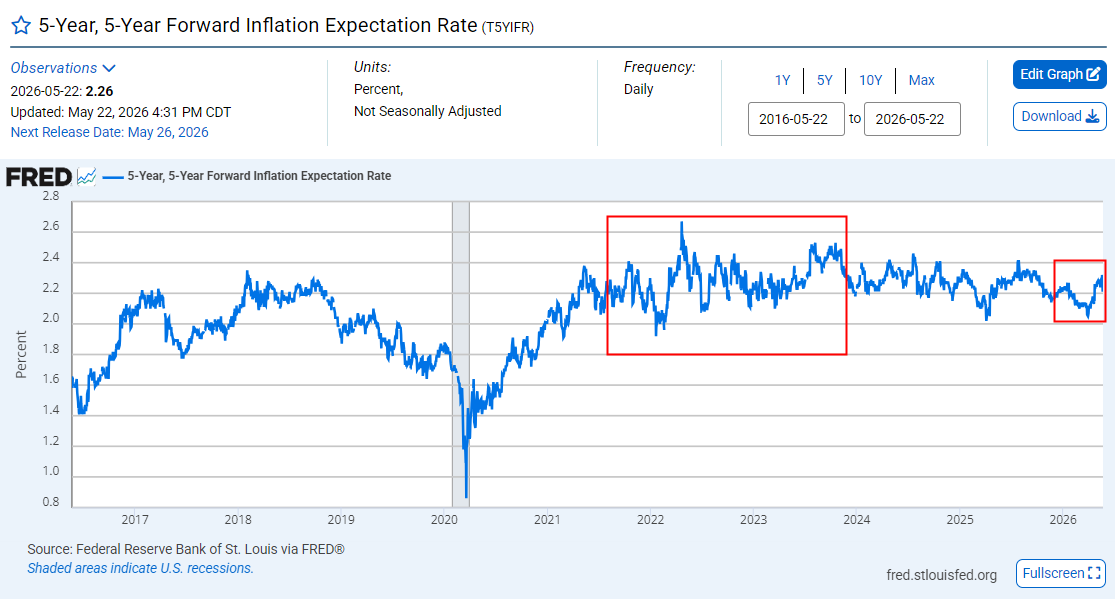
(Chart of 5-year/5-year forward inflation expectations (T5YIFR), source: Federal Reserve)
This data clearly shows that although the current situation of "blockade for blockade" in the Middle East has pushed up near-term commodity prices, global mainstream funds remain rational in the long term, betting that this round of inflation is ultimately a "phase shock," and that the long-term inflation anchor has not fundamentally derailed.
Just when the market was almost certain that an interest rate hike was inevitable, Wall Street giant BlackRock made a completely opposite "contrarian bet".
Navin Saigal, head of global fixed income for Asia Pacific at BlackRock, pointed out that under the new Federal Reserve framework led by Warsh, there are sufficient factors to support a rate cut rather than a rate hike.
Segal emphasized that, looking ahead, the labor market will face some pressure in the future, and given the ambiguous "gray area" of economic direction, the Federal Reserve is more likely to choose to hold off or cut interest rates directly.
When positive signals emerge from the negotiations, expectations for the opening of the Strait of Hormuz rise, and the decline in international oil prices cools inflation expectations, giving gold prices a chance to rebound.
The current charts show that long-term inflation expectations are indeed under control, and oil prices have already begun to correct sharply. Previous articles have repeatedly pointed out opportunities in gold, and the logic behind gold's rebound remains unchanged.
From a technical perspective, spot gold opened higher and stabilized above the 5-day moving average before directly challenging the middle line of the descending channel. Currently, the resistance is at the middle line of the descending channel and the 10-day and 20-day moving averages, while the support is near the 5-day moving average.
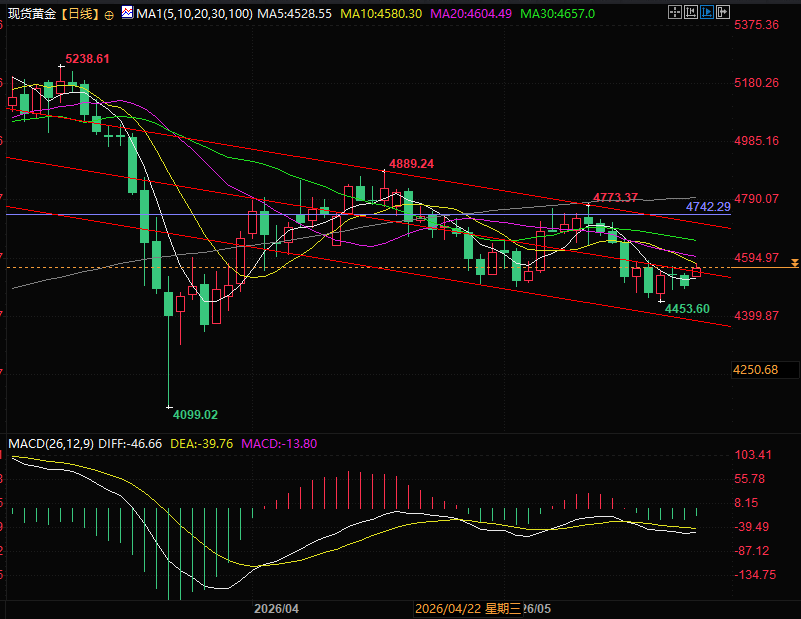
(Spot gold daily chart, source: EasyForex subsidiary)
At 18:00 Beijing time, spot gold is currently trading at $4,567 per ounce.
US Secretary of State Marco Rubio recently sent a clear signal: if negotiations with Iran ultimately break down, the US will abandon diplomatic channels and instead adopt "alternative solutions."
During his visit to India, he revealed that a framework for an agreement with "high feasibility" has been reached at the negotiating table regarding the core issue of navigation in the Strait of Hormuz.
However, the Trump administration quickly cooled market expectations, with the president himself stating that the naval blockade against Iran would be "fully implemented until the agreement is formally signed and verified," emphasizing that "both sides need to proceed prudently to avoid any flaws in the agreement."
Iran, on the other hand, adopted a cautious approach. Foreign Ministry spokesman Bagay acknowledged at a press conference in Tehran that Iran and the United States had reached a consensus on most of the negotiation issues, but "there is no clear timetable for the signing of the agreement."
He specifically pointed out that the core of the current negotiations is only focused on "ending the war," and the sensitive nuclear issue has not yet been included in the scope of the consultations;
At the same time, it warned that the credibility of the US's fulfillment of its obligations was questionable, and that Tehran would not be swayed by pressure to maintain its negotiating position, creating a subtle standoff with Rubio's statement on "alternative solutions".
Background and Stalemate of Conflict: Ceasefire Remains Unbroken, Mediation Continues
The conflict between the US and Israel against Iran, which began on February 28, entered a ceasefire phase on April 8, but the substantive stalemate has not been broken.
Iran continues to blockade the core shipping lanes of the Strait of Hormuz, while the United States simultaneously imposes a comprehensive blockade on Iranian ports, and the standoff between the two sides, characterized by a "blockade for blockade" exchange, continues.
As a key mediator, Pakistan is actively promoting the mediation process.
Pakistani Army Chief of Staff Munir and Prime Minister Sharif recently visited Beijing to discuss the Middle East situation with Chinese leaders.
Previously, Munir had led a delegation to Tehran to participate in mediation efforts with the Pakistani Interior Minister regarding Iraq, and multi-party diplomatic efforts are still ongoing.
Key points of contention: The framework of the agreement is emerging, but disagreements remain on the details of its implementation.
As negotiations progressed, an anonymous senior official from the Trump administration disclosed the core framework of the agreement to the media: Iran had agreed in principle to two key terms: "destroying its stockpile of highly enriched uranium" and "opening the Strait of Hormuz," in exchange for the US lifting its maritime blockade.
The US has also learned that Iranian Supreme Leader Khamenei has approved the overall framework of the agreement.
However, the differences remain focused on the implementation: the US advocates a "step-by-step approach," prioritizing the resumption of navigation in the Taiwan Strait and the lifting of the blockade, while leaving technical details of the nuclear issue for further consultation.
Iran has not officially confirmed the "agreement in principle," and the two sides have a dispute over the "method and pace of highly enriched uranium destruction"—the US refuted the rumor that "Iran refused to destroy it," emphasizing that "the disagreement is not about whether to destroy it, but how to destroy it."
Charles Kupkan, a senior fellow at the Council on Foreign Relations, said the ongoing tug-of-war between the U.S. and Iran means an agreement is unlikely to be reached anytime soon.
Charles Kupkan stated, "I think this is commonplace for the Trump administration; they go this way today and that way tomorrow."
Charles Kupkan noted: “Part of the dialogue was private, and part was public diplomacy, but until we have a clear understanding that the Iranians might agree to destroy their highly enriched uranium… and open the Strait of Hormuz without restrictions, I think it’s fair to say we have a long way to go before we reach a lasting agreement.”
Geopolitical factors and policy forces are working in tandem, creating a stark contrast in long-term inflation expectations.
With Kevin Warsh taking office as the new Federal Reserve Chairman, bond investors are generally betting that the hawkish new chairman will prioritize "maintaining the Fed's credibility in fighting inflation," and may even raise interest rates again before December to meet market expectations.
This tightening expectation of "fighting inflation" is repeatedly tug-of-war with the commodity premium caused by geopolitics.
However, from a long-term macroeconomic perspective, the Fed's core indicator, which is based on real money transactions—the 5-year/5-year forward inflation expectations rate (T5YIFR)—is still holding steady in the range of 2.21%-2.26%.
(Chart of 5-year/5-year forward inflation expectations (T5YIFR), source: Federal Reserve)
This data clearly shows that although the current situation of "blockade for blockade" in the Middle East has pushed up near-term commodity prices, global mainstream funds remain rational in the long term, betting that this round of inflation is ultimately a "phase shock," and that the long-term inflation anchor has not fundamentally derailed.
Just when the market was almost certain that an interest rate hike was inevitable, Wall Street giant BlackRock made a completely opposite "contrarian bet".
Navin Saigal, head of global fixed income for Asia Pacific at BlackRock, pointed out that under the new Federal Reserve framework led by Warsh, there are sufficient factors to support a rate cut rather than a rate hike.
Segal emphasized that, looking ahead, the labor market will face some pressure in the future, and given the ambiguous "gray area" of economic direction, the Federal Reserve is more likely to choose to hold off or cut interest rates directly.
Summary and Technical Analysis:
When positive signals emerge from the negotiations, expectations for the opening of the Strait of Hormuz rise, and the decline in international oil prices cools inflation expectations, giving gold prices a chance to rebound.
The current charts show that long-term inflation expectations are indeed under control, and oil prices have already begun to correct sharply. Previous articles have repeatedly pointed out opportunities in gold, and the logic behind gold's rebound remains unchanged.
From a technical perspective, spot gold opened higher and stabilized above the 5-day moving average before directly challenging the middle line of the descending channel. Currently, the resistance is at the middle line of the descending channel and the 10-day and 20-day moving averages, while the support is near the 5-day moving average.
(Spot gold daily chart, source: EasyForex subsidiary)
At 18:00 Beijing time, spot gold is currently trading at $4,567 per ounce.
- Risk Warning and Disclaimer
- The market involves risk, and trading may not be suitable for all investors. This article is for reference only and does not constitute personal investment advice, nor does it take into account certain users’ specific investment objectives, financial situation, or other needs. Any investment decisions made based on this information are at your own risk.