The USD/JPY exchange rate on the eve of 160 was entangled with interest rate differentials, oil prices, and fiscal policy.
2026-05-25 17:57:29
On Monday, May 25, the USD/JPY pair remained in a highly sensitive range. Market data showed the pair trading around 158.90, not far from the 160 level. On the same day, the Japanese government confirmed it would compile an additional budget of approximately 3 trillion yen to buffer energy bill pressures, shifting exchange rate pricing from a simple interest rate differential to a triple game involving interest rate differentials, fiscal policy, and energy input costs.

The Japanese government plans to allocate about half of its approximately 1 trillion yen reserve to electricity and gas subsidies, and rebuild its fiscal buffer through a supplementary budget of about 3 trillion yen. Prime Minister Sanae Takaichi stated that the impact of the additional issuance of deficit financing bonds is expected to be offset by factors such as increased tax revenue, and that the annual market issuance size will not deviate from the original plan. She also stated that efforts will be made to avoid market disruptions. For foreign exchange traders, the key issue is not whether 3 trillion yen is large enough, but whether fiscal expansion will change the risk compensation requirements for yen assets.
Such subsidies can lower household energy bills in the short term and may also reduce inflation figures to some extent, but they will not eliminate the cost of imported fuel, nor will they change Japan's highly sensitive structure to external energy prices. If the market believes that fiscal spending is merely transferring the energy shock from household bills to the government's balance sheet, the yen will receive limited support. In other words, subsidies may alleviate the pain on the consumer side, but may increase scrutiny of fiscal discipline on the bond market.
The Bank of Japan kept its short-term policy rate at 0.75% at its April meeting, but the vote was 6-3, with some members advocating for a rise to 1.0%. This indicates that the Bank of Japan is not without tightening pressure, but rather still needs to weigh the complex transmission between the energy shock, slowing domestic demand, and fiscal expansion. Meanwhile, the Federal Reserve maintained its target range for the federal funds rate at 3.50% to 3.75% at its April meeting, emphasizing that inflation remains high and rising energy prices increase uncertainty.
Regarding interest rate differentials, the upward stickiness of the USD/JPY exchange rate has not disappeared. Japan's core inflation fell to 1.4% in April, while the figure excluding fresh food and energy was 1.9%, which superficially reduced the urgency for immediate tightening. However, a recent report from the Bank of Japan pointed out that the year-on-year increase in import prices widened significantly in April, and the producer price index rose to about 5%. The speed at which energy costs are being passed on to downstream industries warrants assessment.
This creates a dilemma for the central bank. Raising interest rates too quickly would amplify fiscal costs and domestic financing pressures; delaying action could lead to a depreciation of the yen and increased energy import costs, potentially pushing up inflation expectations again. Therefore, the foreign exchange market will not only focus on a single month's CPI, but will pay more attention to whether the Bank of Japan is willing to incorporate "imported inflation" into its policy response function.
From a daily chart perspective, the USD/JPY pair initially touched 160.46 before quickly falling back to a low of 155.02, subsequently recovering to around 159. The current price is above the Bollinger Middle Band at 158.391, with the Upper Band at 160.658 and the Lower Band at 156.123. The MACD DIFF is 0.131 and DEA is -0.047, indicating short-term momentum recovery but not yet breaking out of the high-level consolidation pattern.
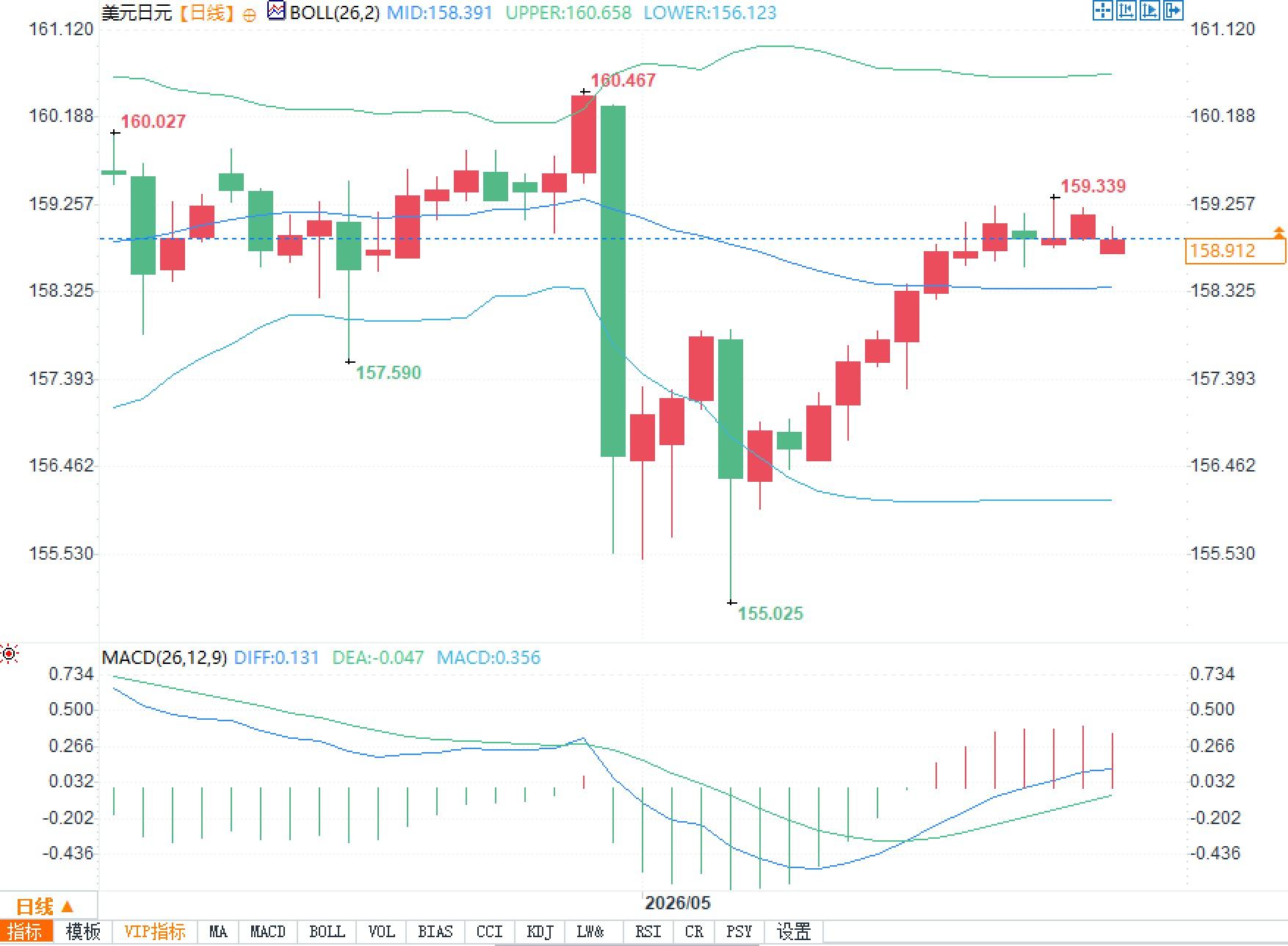
The significance of the 160 level lies in the fact that it simultaneously represents a round number, an option knock-in/knock-out range, a sensitive area for policy verbal intervention, and previous high resistance. If the exchange rate only moderately approaches 160, the market will focus more on interest rate differentials and fiscal premiums; if volatility suddenly rises, policy risk premiums will quickly be priced in. The previous sharp drop from 160 to 155 already demonstrated that yen bears are not without vulnerabilities. What truly determines market elasticity is whether bond yields, energy prices, and official statements resonate simultaneously.
On May 25, Brent crude oil futures closed at $97 per barrel, and WTI crude oil futures closed at $91 per barrel, with oil prices falling significantly from previous highs. On the surface, lower energy prices help reduce Japan's import costs, providing a marginal buffer for the yen.
However, pricing strategies cannot solely focus on oil prices. First, Brent crude remains significantly higher than its previous lows, meaning Japanese companies' electricity, gas, and logistics costs will continue to be passed on with a lag. Second, while government subsidies may lower household bills, they could delay price adjustments, making it more difficult for central banks to assess true inflationary pressures.
Therefore, the USD/JPY exchange rate is not currently exhibiting a one-way narrative, but rather is in a repricing phase after narrow fluctuations at high levels. Fiscal spending has cooled the household market, and declining energy prices have eased pressure on imports, but interest rate differentials remain, and debt sensitivity persists. What the market is truly waiting for is whether the Bank of Japan can enhance the credibility of its policies without creating disturbances in the bond market.
The core of the supplementary budget is not subsidies, but fiscal risk premium.
The Japanese government plans to allocate about half of its approximately 1 trillion yen reserve to electricity and gas subsidies, and rebuild its fiscal buffer through a supplementary budget of about 3 trillion yen. Prime Minister Sanae Takaichi stated that the impact of the additional issuance of deficit financing bonds is expected to be offset by factors such as increased tax revenue, and that the annual market issuance size will not deviate from the original plan. She also stated that efforts will be made to avoid market disruptions. For foreign exchange traders, the key issue is not whether 3 trillion yen is large enough, but whether fiscal expansion will change the risk compensation requirements for yen assets.
Such subsidies can lower household energy bills in the short term and may also reduce inflation figures to some extent, but they will not eliminate the cost of imported fuel, nor will they change Japan's highly sensitive structure to external energy prices. If the market believes that fiscal spending is merely transferring the energy shock from household bills to the government's balance sheet, the yen will receive limited support. In other words, subsidies may alleviate the pain on the consumer side, but may increase scrutiny of fiscal discipline on the bond market.
Interest rate differentials remain the main theme, with the Bank of Japan caught in the middle by energy prices.
The Bank of Japan kept its short-term policy rate at 0.75% at its April meeting, but the vote was 6-3, with some members advocating for a rise to 1.0%. This indicates that the Bank of Japan is not without tightening pressure, but rather still needs to weigh the complex transmission between the energy shock, slowing domestic demand, and fiscal expansion. Meanwhile, the Federal Reserve maintained its target range for the federal funds rate at 3.50% to 3.75% at its April meeting, emphasizing that inflation remains high and rising energy prices increase uncertainty.
Regarding interest rate differentials, the upward stickiness of the USD/JPY exchange rate has not disappeared. Japan's core inflation fell to 1.4% in April, while the figure excluding fresh food and energy was 1.9%, which superficially reduced the urgency for immediate tightening. However, a recent report from the Bank of Japan pointed out that the year-on-year increase in import prices widened significantly in April, and the producer price index rose to about 5%. The speed at which energy costs are being passed on to downstream industries warrants assessment.
This creates a dilemma for the central bank. Raising interest rates too quickly would amplify fiscal costs and domestic financing pressures; delaying action could lead to a depreciation of the yen and increased energy import costs, potentially pushing up inflation expectations again. Therefore, the foreign exchange market will not only focus on a single month's CPI, but will pay more attention to whether the Bank of Japan is willing to incorporate "imported inflation" into its policy response function.
The pricing around 160 signifies more than just a technical hurdle.
From a daily chart perspective, the USD/JPY pair initially touched 160.46 before quickly falling back to a low of 155.02, subsequently recovering to around 159. The current price is above the Bollinger Middle Band at 158.391, with the Upper Band at 160.658 and the Lower Band at 156.123. The MACD DIFF is 0.131 and DEA is -0.047, indicating short-term momentum recovery but not yet breaking out of the high-level consolidation pattern.
The significance of the 160 level lies in the fact that it simultaneously represents a round number, an option knock-in/knock-out range, a sensitive area for policy verbal intervention, and previous high resistance. If the exchange rate only moderately approaches 160, the market will focus more on interest rate differentials and fiscal premiums; if volatility suddenly rises, policy risk premiums will quickly be priced in. The previous sharp drop from 160 to 155 already demonstrated that yen bears are not without vulnerabilities. What truly determines market elasticity is whether bond yields, energy prices, and official statements resonate simultaneously.
The drop in oil prices provided a buffer, but it shouldn't be simply seen as a positive for the yen.
On May 25, Brent crude oil futures closed at $97 per barrel, and WTI crude oil futures closed at $91 per barrel, with oil prices falling significantly from previous highs. On the surface, lower energy prices help reduce Japan's import costs, providing a marginal buffer for the yen.
However, pricing strategies cannot solely focus on oil prices. First, Brent crude remains significantly higher than its previous lows, meaning Japanese companies' electricity, gas, and logistics costs will continue to be passed on with a lag. Second, while government subsidies may lower household bills, they could delay price adjustments, making it more difficult for central banks to assess true inflationary pressures.
Therefore, the USD/JPY exchange rate is not currently exhibiting a one-way narrative, but rather is in a repricing phase after narrow fluctuations at high levels. Fiscal spending has cooled the household market, and declining energy prices have eased pressure on imports, but interest rate differentials remain, and debt sensitivity persists. What the market is truly waiting for is whether the Bank of Japan can enhance the credibility of its policies without creating disturbances in the bond market.
- Risk Warning and Disclaimer
- The market involves risk, and trading may not be suitable for all investors. This article is for reference only and does not constitute personal investment advice, nor does it take into account certain users’ specific investment objectives, financial situation, or other needs. Any investment decisions made based on this information are at your own risk.