Major US-Iran breakthrough: Ship numbers may recover, oil prices fall sharply.
2026-05-25 16:35:49
On Saturday, May 23, local time, US President Trump took the lead in announcing that the framework for a US-Iran agreement aimed at ending the Middle East conflict and opening the Strait of Hormuz was nearing its "final draft," and that the agreement would soon be signed. At the same time, Iran agreed to restore the number of ships in the strait to pre-war levels.
This statement was quickly echoed by Iran – Iranian Foreign Ministry spokesman Bagae revealed that the memorandum of understanding between Iran and the United States had entered the final stage of finalization, and that a follow-up negotiation period of 30 to 60 days was considered "reasonable".
It is worth noting that in the preliminary draft agreement reached between Iran and the United States, neither side made any commitments regarding the nuclear issue or the issue of highly enriched uranium, meaning that the nuclear issue is expected to be discussed separately from the issue of passage through the Strait of Hormuz.
Multiple sources indicate that the draft agreement has received support from several countries in the Middle East. An anonymous senior U.S. official further confirmed that the two sides have reached an agreement in principle on the core terms for ending the Middle East war, and only final approval from the leaders is required, which is expected to take several days.
The optimistic outlook lasted for less than 24 hours before reversing.
Early on May 24, Beijing time, Trump suddenly changed his tune on social media, saying that the US-Iran agreement was "not yet fully agreed upon," accusing some people who were unaware of the situation of "making unwarranted criticisms," and emphasizing that the contents of the agreement had not been made public and that the outside world should not make arbitrary judgments.
White House officials added on the same day that it would still take several days before the two sides formally signed the agreement.
Iran's stance has been more cautious. Tasnim News Agency, citing sources, reported on May 25 that, as of now, Iran and the United States have not reached a final memorandum of understanding, and several key terms remain controversial.
Given the United States' history of repeatedly breaking its promises in negotiations, Iran has no optimistic expectations for the US. Even if an agreement is eventually reached, Iran will closely monitor the US's compliance. If the US violates its commitments, Iran will retain all its negotiating leverage to retaliate.
Despite the emergence of a framework consensus, the differences between the US and Iran on core issues remain unbridged, with the nuclear issue being the biggest obstacle.
The US has made it clear that the final agreement must include a commitment from Iran to suspend its nuclear program for an extended period (up to 20 years) and to transfer its stockpile of near-weapon-grade enriched uranium. The US also hopes to use this opportunity to limit Iran’s ballistic missile program and its support for regional armed groups—two demands that are crucial for Israel and the US’s Middle Eastern allies.
Iran, however, firmly opposed this, clearly stating that the nuclear issue should be postponed for discussion, refusing to link it with other issues, and demanding that the comprehensive lifting of sanctions be carried out simultaneously.
Iranian officials have explicitly denied rumors that Iran needs to transfer its enriched uranium stockpile before unfreezing its assets. They emphasized that once an agreement is finalized, some of the frozen overseas assets must be unfrozen immediately, and that Iran must be guaranteed full access to the funds. They also opposed any additional conditions imposed by the United States.
The rules of passage and control over the Strait of Hormuz are another major focus of the negotiations, and directly affect the global energy lifeline.
Trump had previously claimed that the agreement would promote the "opening of the Strait of Hormuz," but Iran's Fars News Agency refuted this claim in an article published early on the 24th, pointing out that the statement was "incomplete and inconsistent with the facts."
According to the latest text exchanged between the two sides, even if an agreement is reached, the Strait of Hormuz will still be under the full control of Iran, with route planning, ship passage times, passage methods, and licensing rights all controlled by Iran.
Iran only agreed to restore the number of ships passing through the strait to pre-war levels, but made it clear that this does not mean the strait will return to its pre-war "free passage" status.
Recent data shows that traffic volume in the strait has gradually rebounded. On May 23, the Iranian Revolutionary Guard reported that 25 vessels of various types were permitted to pass through in the past 24 hours.
It is worth noting that the UAE has begun to actively circumvent the blockade. Since withdrawing from OPEC on May 1, Abu Dhabi National Oil Company (ADNOC) has used its own fleet to circumvent the control of Iranian and US naval vessels by "dark navigation" with transponders turned off, becoming one of the most successful energy exporters in the Middle East.
Meanwhile, the UAE is accelerating the construction of a new oil pipeline that bypasses the Strait of Hormuz, which is currently 50% complete and is expected to be completed in 2027, significantly reducing its dependence on the Strait of Hormuz.
Since this round of US-Iran negotiations partially bypassed Israel, and there were previous reports that the dialogue between the US and Israel was very tense, the US was also trying to help Israel clean up the mess.
Trump called on some Muslim countries to join the Abraham Accords with Israel if the U.S. can reach a solution with Iran.
On May 23, Trump spoke separately with the leaders of Saudi Arabia, the UAE, Qatar, Pakistan, Turkey, Egypt, Jordan, and Bahrain, stating that he expects all countries that have not yet reached peace agreements with Israel or joined a treaty after the war to join and normalize relations.
Sources say the leaders of Saudi Arabia, Qatar, and Pakistan were surprised by the call, but the leaders also expressed support for the impending US-Iran deal.
Trump hopes to use the US-Iran agreement as leverage to push more Muslim countries, such as Saudi Arabia, Qatar, Turkey, Egypt, Jordan, and Pakistan, to join the Abraham Accords, further expanding the scope of normalization of relations between Israel and the Arab/Islamic world.
Every step of the US-Iran peace talks continues to impact the international crude oil market. After Trump announced on May 23 that an agreement was close to being reached, crude oil futures prices plummeted by more than 10% in the grey market.
White House chief economic advisor Hassett stated that if the US-Iran agreement is ultimately implemented, energy prices are expected to decline further, which will create room for the Federal Reserve to lower interest rates and alleviate current inflationary pressures in the United States.
Consistent with previous articles that emphasized the smooth progress of the peace talks, this weekend's events revolved around the official announcement that the US-Iran agreement was nearing completion. Subsequent news slowed the pace of the talks and lowered market expectations, but surrounding details continued to corroborate the smooth progress of the peace talks.
The number of passages through the Strait continues to improve marginally, while descriptions of uranium enrichment were largely absent before this extension of negotiations and even during the process of finalizing the framework. This indicates that the factors for a successful peace talk have increased further, and the nuclear issue negotiations and passage through the Strait have become disconnected.
Finally, since oil prices affect global inflation, which in turn influences global interest rates and valuation levels, solving oil price issues can solve many problems and is an important leverage point for recent asset volatility. However, if there is a geopolitical benefit of the framework being implemented, it may be a point where the negative factors for oil prices have been exhausted, because the substantive nuclear issue has not been resolved, but has only been downplayed in this negotiation process.
Technical Analysis: Brent crude oil gapped down and then rebounded, finding support near the 0.618 Fibonacci retracement level of the recent price increase. 97.17 is a key support level in the near term.
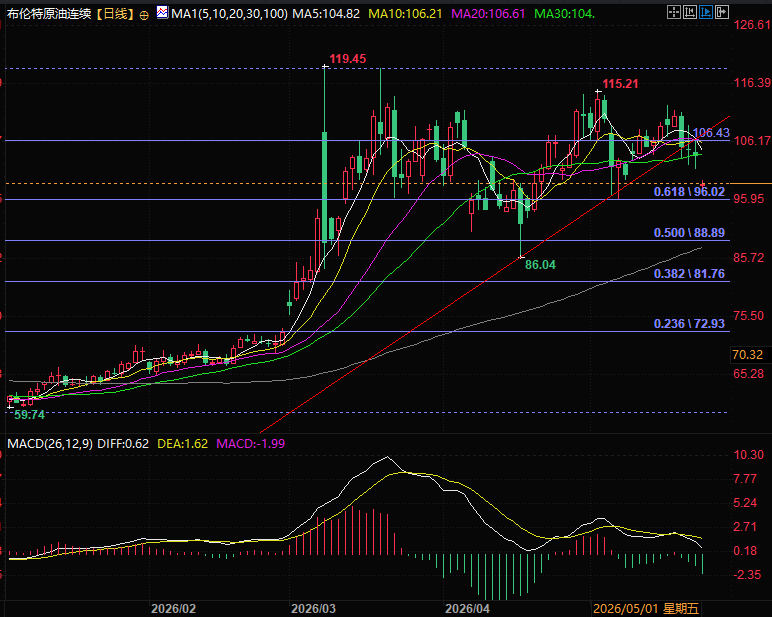
(Brent crude oil futures daily chart, source: EasyForex)
At 16:21 Beijing time, Brent crude oil futures were trading at $99.13 per barrel.
This statement was quickly echoed by Iran – Iranian Foreign Ministry spokesman Bagae revealed that the memorandum of understanding between Iran and the United States had entered the final stage of finalization, and that a follow-up negotiation period of 30 to 60 days was considered "reasonable".
It is worth noting that in the preliminary draft agreement reached between Iran and the United States, neither side made any commitments regarding the nuclear issue or the issue of highly enriched uranium, meaning that the nuclear issue is expected to be discussed separately from the issue of passage through the Strait of Hormuz.
Multiple sources indicate that the draft agreement has received support from several countries in the Middle East. An anonymous senior U.S. official further confirmed that the two sides have reached an agreement in principle on the core terms for ending the Middle East war, and only final approval from the leaders is required, which is expected to take several days.
A reversal in attitude: Trump changes his tune, saying "not fully agreed," Iran questions the US's sincerity in fulfilling its commitments.
The optimistic outlook lasted for less than 24 hours before reversing.
Early on May 24, Beijing time, Trump suddenly changed his tune on social media, saying that the US-Iran agreement was "not yet fully agreed upon," accusing some people who were unaware of the situation of "making unwarranted criticisms," and emphasizing that the contents of the agreement had not been made public and that the outside world should not make arbitrary judgments.
White House officials added on the same day that it would still take several days before the two sides formally signed the agreement.
Iran's stance has been more cautious. Tasnim News Agency, citing sources, reported on May 25 that, as of now, Iran and the United States have not reached a final memorandum of understanding, and several key terms remain controversial.
Given the United States' history of repeatedly breaking its promises in negotiations, Iran has no optimistic expectations for the US. Even if an agreement is eventually reached, Iran will closely monitor the US's compliance. If the US violates its commitments, Iran will retain all its negotiating leverage to retaliate.
Core Disagreements: The nuclear issue and the unfreezing of assets have become key sticking points, with seriously conflicting demands.
Despite the emergence of a framework consensus, the differences between the US and Iran on core issues remain unbridged, with the nuclear issue being the biggest obstacle.
The US has made it clear that the final agreement must include a commitment from Iran to suspend its nuclear program for an extended period (up to 20 years) and to transfer its stockpile of near-weapon-grade enriched uranium. The US also hopes to use this opportunity to limit Iran’s ballistic missile program and its support for regional armed groups—two demands that are crucial for Israel and the US’s Middle Eastern allies.
Iran, however, firmly opposed this, clearly stating that the nuclear issue should be postponed for discussion, refusing to link it with other issues, and demanding that the comprehensive lifting of sanctions be carried out simultaneously.
Iranian officials have explicitly denied rumors that Iran needs to transfer its enriched uranium stockpile before unfreezing its assets. They emphasized that once an agreement is finalized, some of the frozen overseas assets must be unfrozen immediately, and that Iran must be guaranteed full access to the funds. They also opposed any additional conditions imposed by the United States.
Cross-Strait Power Struggle: Dispute Over Control, "Openness" ≠ "Freedom of Movement"
The rules of passage and control over the Strait of Hormuz are another major focus of the negotiations, and directly affect the global energy lifeline.
Trump had previously claimed that the agreement would promote the "opening of the Strait of Hormuz," but Iran's Fars News Agency refuted this claim in an article published early on the 24th, pointing out that the statement was "incomplete and inconsistent with the facts."
According to the latest text exchanged between the two sides, even if an agreement is reached, the Strait of Hormuz will still be under the full control of Iran, with route planning, ship passage times, passage methods, and licensing rights all controlled by Iran.
Iran only agreed to restore the number of ships passing through the strait to pre-war levels, but made it clear that this does not mean the strait will return to its pre-war "free passage" status.
Recent data shows that traffic volume in the strait has gradually rebounded. On May 23, the Iranian Revolutionary Guard reported that 25 vessels of various types were permitted to pass through in the past 24 hours.
It is worth noting that the UAE has begun to actively circumvent the blockade. Since withdrawing from OPEC on May 1, Abu Dhabi National Oil Company (ADNOC) has used its own fleet to circumvent the control of Iranian and US naval vessels by "dark navigation" with transponders turned off, becoming one of the most successful energy exporters in the Middle East.
Meanwhile, the UAE is accelerating the construction of a new oil pipeline that bypasses the Strait of Hormuz, which is currently 50% complete and is expected to be completed in 2027, significantly reducing its dependence on the Strait of Hormuz.
The US's subtle actions are paving the way for Israel in advance.
Since this round of US-Iran negotiations partially bypassed Israel, and there were previous reports that the dialogue between the US and Israel was very tense, the US was also trying to help Israel clean up the mess.
Trump called on some Muslim countries to join the Abraham Accords with Israel if the U.S. can reach a solution with Iran.
On May 23, Trump spoke separately with the leaders of Saudi Arabia, the UAE, Qatar, Pakistan, Turkey, Egypt, Jordan, and Bahrain, stating that he expects all countries that have not yet reached peace agreements with Israel or joined a treaty after the war to join and normalize relations.
Sources say the leaders of Saudi Arabia, Qatar, and Pakistan were surprised by the call, but the leaders also expressed support for the impending US-Iran deal.
Trump hopes to use the US-Iran agreement as leverage to push more Muslim countries, such as Saudi Arabia, Qatar, Turkey, Egypt, Jordan, and Pakistan, to join the Abraham Accords, further expanding the scope of normalization of relations between Israel and the Arab/Islamic world.
Summary and Technical Analysis:
Every step of the US-Iran peace talks continues to impact the international crude oil market. After Trump announced on May 23 that an agreement was close to being reached, crude oil futures prices plummeted by more than 10% in the grey market.
White House chief economic advisor Hassett stated that if the US-Iran agreement is ultimately implemented, energy prices are expected to decline further, which will create room for the Federal Reserve to lower interest rates and alleviate current inflationary pressures in the United States.
Consistent with previous articles that emphasized the smooth progress of the peace talks, this weekend's events revolved around the official announcement that the US-Iran agreement was nearing completion. Subsequent news slowed the pace of the talks and lowered market expectations, but surrounding details continued to corroborate the smooth progress of the peace talks.
The number of passages through the Strait continues to improve marginally, while descriptions of uranium enrichment were largely absent before this extension of negotiations and even during the process of finalizing the framework. This indicates that the factors for a successful peace talk have increased further, and the nuclear issue negotiations and passage through the Strait have become disconnected.
Finally, since oil prices affect global inflation, which in turn influences global interest rates and valuation levels, solving oil price issues can solve many problems and is an important leverage point for recent asset volatility. However, if there is a geopolitical benefit of the framework being implemented, it may be a point where the negative factors for oil prices have been exhausted, because the substantive nuclear issue has not been resolved, but has only been downplayed in this negotiation process.
Technical Analysis: Brent crude oil gapped down and then rebounded, finding support near the 0.618 Fibonacci retracement level of the recent price increase. 97.17 is a key support level in the near term.
(Brent crude oil futures daily chart, source: EasyForex)
At 16:21 Beijing time, Brent crude oil futures were trading at $99.13 per barrel.
- Risk Warning and Disclaimer
- The market involves risk, and trading may not be suitable for all investors. This article is for reference only and does not constitute personal investment advice, nor does it take into account certain users’ specific investment objectives, financial situation, or other needs. Any investment decisions made based on this information are at your own risk.