Demand for the US dollar as a safe haven weakened, and gold maintained a volatile rebound, awaiting a stress test.
2026-05-26 09:45:39
International gold prices maintained their rebound during Asian trading hours on Tuesday, with spot gold (XAU/USD) rising to around $4,575 before slightly retreating and currently trading around $4,530. As ceasefire negotiations between the US and Iran entered a crucial phase, market expectations of a de-escalation in the Middle East weakened safe-haven buying of the US dollar, providing some support for gold.

US President Donald Trump said on Monday that negotiations between the US and Iran regarding extending the ceasefire agreement and reopening the Strait of Hormuz are "making good progress." At the same time, Trump also called on Saudi Arabia, Qatar, Pakistan, Turkey, Egypt, and Jordan to join the Abraham Accords and to promote diplomatic relations with Israel. Markets believe the US government is attempting to stabilize the situation in the Middle East through diplomatic means, thereby mitigating global energy supply risks.
However, despite some progress in negotiations, the market remains cautious on key issues. The US and Israel still need to determine crucial details such as whether ships will be able to freely pass through the Strait of Hormuz and the pace at which the billions of dollars in frozen Iranian funds will be unfrozen. This means that while there are signs of de-escalation in the Middle East, geopolitical risks have not been completely eliminated.
As a result, the recent rise in the US dollar index has slowed. Previously, the market had heavily bought US dollar-denominated safe-haven assets due to escalating tensions in the Middle East, but as ceasefire negotiations progressed, some funds began to flow out of the dollar and into assets with inflation-hedging properties, such as gold. A weaker dollar typically lowers the cost of holding gold, thereby increasing its attractiveness , which is one of the key factors driving the recent gold price rebound.
Tim Votel, chief market analyst at KCM Trade, said that Trump's recent positive signals regarding the Iran deal have led to market expectations that the Strait of Hormuz may reopen, putting downward pressure on international oil prices. From an inflation perspective, lower oil prices help alleviate energy cost pressures, thus providing new support for gold.
The market is also highly focused on the upcoming release of the US April Personal Consumption Expenditures Price Index (PCE). As one of the Federal Reserve's most closely watched inflation indicators, the PCE data will directly influence market expectations regarding the Fed's future monetary policy. If the data shows that US inflation remains higher than expected, the market may again bet on the Fed maintaining a hawkish stance, or even further raising interest rates. This would drive a rebound in the US dollar and put downward pressure on gold.
On the other hand, if PCE data shows signs of cooling in US inflation, market expectations for a Fed rate hike may further decline, thus benefiting gold prices. Currently, the market generally expects the Fed's future policy path to continue to depend on US inflation and employment data.
From a global capital flow perspective, safe-haven demand remains a significant supporting factor for the gold market in the near term. Although the situation in the Middle East has eased somewhat, the market remains wary of slowing global economic growth, geopolitical instability, and debt pressures on major economies. Some institutional investors continue to increase their gold allocations to hedge against future market uncertainties.
From the daily chart, gold previously formed a high near $4620 before pulling back, but the price has now rebounded above $4500 , indicating that bullish forces have not completely exited the market. On the daily chart, the 20-day moving average continues its upward trend, and the overall medium-to-long-term structure remains bullish. Although the MACD indicator has retreated from its high, the green histogram is shortening, suggesting that bearish momentum has weakened. The key resistance levels are currently at the $4600 and $4620 area; a break above this range could see gold further challenge historical highs. Key support levels are around $4520 and $4480 . A break below $4480 could trigger a deeper technical correction.
Observing the 4-hour chart, gold has gradually stabilized after its previous rapid pullback, with the RSI indicator rising back above 50, indicating a recovery in short-term buying power. Meanwhile, the Bollinger Band's middle line has begun to turn upwards, suggesting a short-term rebound structure is forming. If subsequent US PCE data is weak, gold may re-break through the $4600 level; however, if inflation exceeds expectations, the US dollar may strengthen again, and gold prices may retest the support level near $4500.
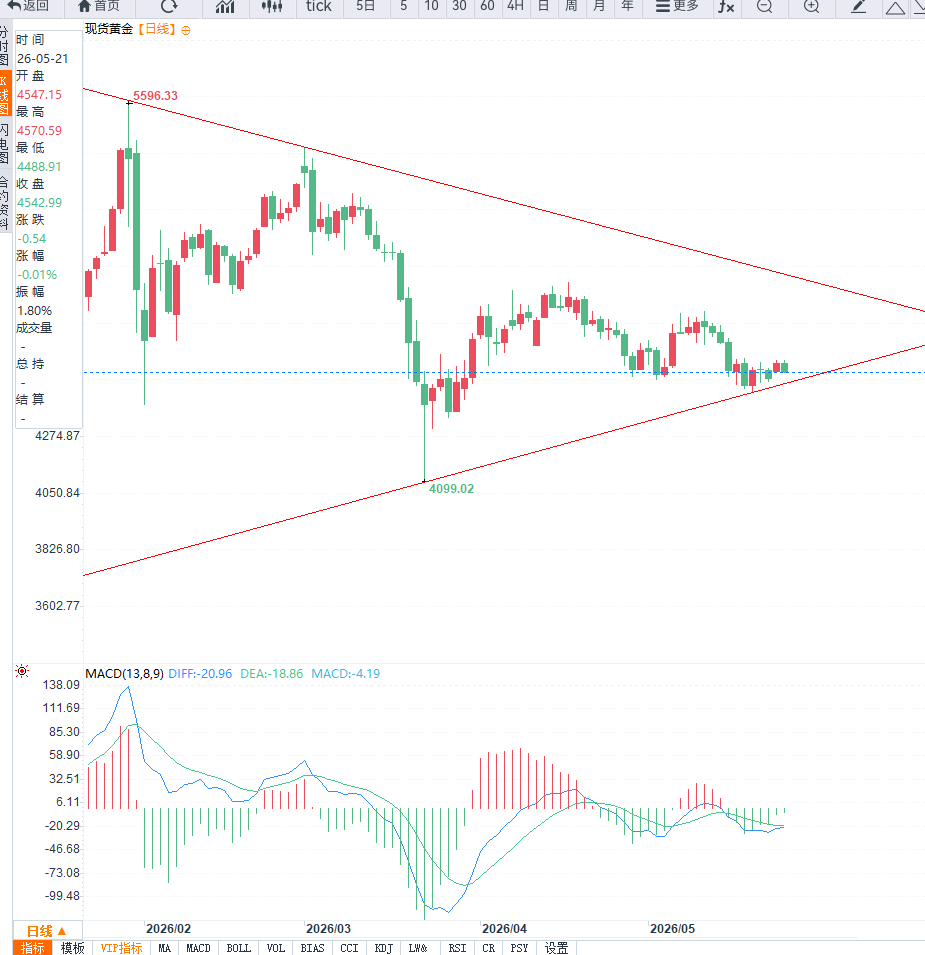
Overall, the gold market is currently in a phase influenced by three intertwined factors: the dollar's performance, expectations regarding Federal Reserve policy, and Middle East geopolitical risks. In the short term, market volatility is likely to remain high.
Editor's Summary : The current gold market trend essentially reflects the global capital market's repricing of risk, inflation, and monetary policy. While the ceasefire negotiations between the US and Iran have reduced some market demand for safe-haven assets, investors remain cautious due to the lack of finalized details of the agreement. Furthermore, the upcoming release of US PCE inflation data keeps the market highly sensitive to the future policy direction of the Federal Reserve. In the medium to long term, gold still has strong supporting factors. Global geopolitical risks have not been completely eliminated, debt problems in major economies persist, and global central bank gold purchases remain strong; these factors are likely to continue supporting gold's high levels. However, if US inflation continues to rise and prompts the Federal Reserve to further tighten policy, gold may face short-term downward pressure.
US President Donald Trump said on Monday that negotiations between the US and Iran regarding extending the ceasefire agreement and reopening the Strait of Hormuz are "making good progress." At the same time, Trump also called on Saudi Arabia, Qatar, Pakistan, Turkey, Egypt, and Jordan to join the Abraham Accords and to promote diplomatic relations with Israel. Markets believe the US government is attempting to stabilize the situation in the Middle East through diplomatic means, thereby mitigating global energy supply risks.
However, despite some progress in negotiations, the market remains cautious on key issues. The US and Israel still need to determine crucial details such as whether ships will be able to freely pass through the Strait of Hormuz and the pace at which the billions of dollars in frozen Iranian funds will be unfrozen. This means that while there are signs of de-escalation in the Middle East, geopolitical risks have not been completely eliminated.
As a result, the recent rise in the US dollar index has slowed. Previously, the market had heavily bought US dollar-denominated safe-haven assets due to escalating tensions in the Middle East, but as ceasefire negotiations progressed, some funds began to flow out of the dollar and into assets with inflation-hedging properties, such as gold. A weaker dollar typically lowers the cost of holding gold, thereby increasing its attractiveness , which is one of the key factors driving the recent gold price rebound.
Tim Votel, chief market analyst at KCM Trade, said that Trump's recent positive signals regarding the Iran deal have led to market expectations that the Strait of Hormuz may reopen, putting downward pressure on international oil prices. From an inflation perspective, lower oil prices help alleviate energy cost pressures, thus providing new support for gold.
The market is also highly focused on the upcoming release of the US April Personal Consumption Expenditures Price Index (PCE). As one of the Federal Reserve's most closely watched inflation indicators, the PCE data will directly influence market expectations regarding the Fed's future monetary policy. If the data shows that US inflation remains higher than expected, the market may again bet on the Fed maintaining a hawkish stance, or even further raising interest rates. This would drive a rebound in the US dollar and put downward pressure on gold.
On the other hand, if PCE data shows signs of cooling in US inflation, market expectations for a Fed rate hike may further decline, thus benefiting gold prices. Currently, the market generally expects the Fed's future policy path to continue to depend on US inflation and employment data.
From a global capital flow perspective, safe-haven demand remains a significant supporting factor for the gold market in the near term. Although the situation in the Middle East has eased somewhat, the market remains wary of slowing global economic growth, geopolitical instability, and debt pressures on major economies. Some institutional investors continue to increase their gold allocations to hedge against future market uncertainties.
From the daily chart, gold previously formed a high near $4620 before pulling back, but the price has now rebounded above $4500 , indicating that bullish forces have not completely exited the market. On the daily chart, the 20-day moving average continues its upward trend, and the overall medium-to-long-term structure remains bullish. Although the MACD indicator has retreated from its high, the green histogram is shortening, suggesting that bearish momentum has weakened. The key resistance levels are currently at the $4600 and $4620 area; a break above this range could see gold further challenge historical highs. Key support levels are around $4520 and $4480 . A break below $4480 could trigger a deeper technical correction.
Observing the 4-hour chart, gold has gradually stabilized after its previous rapid pullback, with the RSI indicator rising back above 50, indicating a recovery in short-term buying power. Meanwhile, the Bollinger Band's middle line has begun to turn upwards, suggesting a short-term rebound structure is forming. If subsequent US PCE data is weak, gold may re-break through the $4600 level; however, if inflation exceeds expectations, the US dollar may strengthen again, and gold prices may retest the support level near $4500.
Overall, the gold market is currently in a phase influenced by three intertwined factors: the dollar's performance, expectations regarding Federal Reserve policy, and Middle East geopolitical risks. In the short term, market volatility is likely to remain high.
Editor's Summary : The current gold market trend essentially reflects the global capital market's repricing of risk, inflation, and monetary policy. While the ceasefire negotiations between the US and Iran have reduced some market demand for safe-haven assets, investors remain cautious due to the lack of finalized details of the agreement. Furthermore, the upcoming release of US PCE inflation data keeps the market highly sensitive to the future policy direction of the Federal Reserve. In the medium to long term, gold still has strong supporting factors. Global geopolitical risks have not been completely eliminated, debt problems in major economies persist, and global central bank gold purchases remain strong; these factors are likely to continue supporting gold's high levels. However, if US inflation continues to rise and prompts the Federal Reserve to further tighten policy, gold may face short-term downward pressure.
- Risk Warning and Disclaimer
- The market involves risk, and trading may not be suitable for all investors. This article is for reference only and does not constitute personal investment advice, nor does it take into account certain users’ specific investment objectives, financial situation, or other needs. Any investment decisions made based on this information are at your own risk.