Frequent geopolitical tensions and inflation concerns pressured silver prices, causing them to rise and then fall back.
2026-05-26 10:42:08
Spot silver (XAG/USD) fluctuated lower during Tuesday's Asian trading session, hovering around $76.40 , giving back some of the previous day's gains. Markets reassessed the impact of the escalating Middle East situation on global energy prices, inflation prospects, and monetary policy, leading to significantly increased volatility in the precious metals market.
Previously, the US military launched a "self-defense strike" against southern Iran, reigniting market concerns about an escalation of tensions in the Middle East. A spokesperson for the US Central Command stated that the US military targeted missile launch facilities. Although the US military emphasized that it would exercise restraint during the ceasefire, the market remains concerned that shipping security in the Strait of Hormuz may be threatened again, with explosions reported in Bandar Abbas and surrounding areas near the Strait of Hormuz. Since the strait handles approximately 20% of global seaborne crude oil transport, the market is worried that energy supply risks may be escalating again.
As a result, international oil prices rebounded significantly after a previous sharp decline. The rise in crude oil prices has reignited concerns about global inflationary pressures, especially given the potential for renewed increases in energy costs, prompting investors to reassess the future monetary policy paths of global central banks. This environment puts considerable pressure on silver. While silver possesses the safe-haven attributes of a precious metal, it is also a typical non-yielding asset. When the market anticipates that global central banks may maintain high interest rates for a longer period, the opportunity cost of holding silver will increase significantly, thereby weakening market buying momentum.
US inflation data remains sticky overall, while Middle East energy risks could further fuel imported inflation globally. Market concerns suggest the Federal Reserve and the European Central Bank may have to maintain a hawkish policy stance, which is putting downward pressure on precious metals, including gold and silver.
However, market sentiment has not entirely turned pessimistic. Negotiations between the US and Iran regarding a ceasefire agreement and the reopening of the Strait of Hormuz are ongoing. According to a framework leaked by the market, the US may lift some of its maritime blockade measures, while Iran would reopen the Strait of Hormuz to restore order to global energy transport.
US President Trump stated that negotiations were "progressing well," but warned that the US might launch renewed military strikes if the talks broke down. Meanwhile, a Pakistani mediator told Asian countries that the two sides were close to reaching an agreement. This series of news led to significant fluctuations in market sentiment. On the one hand, investors were concerned about energy supply risks; on the other hand, they hoped a ceasefire agreement would alleviate global energy pressures. The silver market thus entered a period of high volatility and fluctuation.
From an industrial demand perspective, silver continues to receive some long-term support. Global demand for silver from the new energy industry, solar equipment, and electronics industry continues to grow, and the market believes that the medium- to long-term supply and demand structure for silver will remain tight. However, short-term macroeconomic factors and the dollar's performance remain the core variables determining the direction of silver prices.
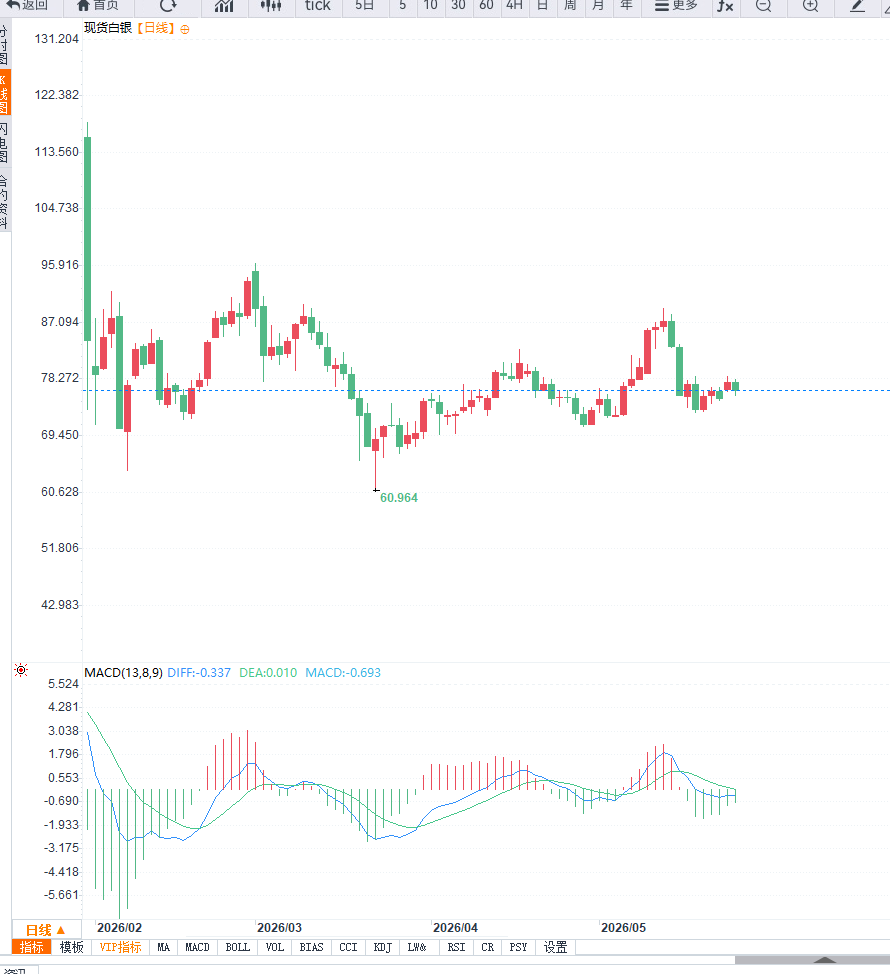
From the daily chart, silver previously formed a temporary high near $78 before undergoing a technical correction, with the price currently falling back to the $76 area. On the daily chart, the 20-day moving average continues to rise, indicating that the medium-to-long-term upward trend remains unchanged, but short-term profit-taking pressure has increased. The MACD indicator's red histogram bars are beginning to shorten, showing that bullish momentum is weakening. Currently, key resistance levels are located at $77.20 and the $78 area; a retest of these levels could lead to another challenge of historical highs. Key support levels are located around $75 and $73.80 .
Overall, the silver market is currently being affected by three factors: geopolitical risks, energy inflation expectations, and global central bank policy paths. Short-term market volatility may continue to remain high.
Editor's Summary : Silver's recent price movements reflect the market's high sensitivity to the outlook for global inflation and monetary policy. Renewed tensions in the Middle East have driven a rebound in international oil prices, raising concerns about a resurgence of energy inflation and reinforcing expectations that global central banks will maintain high interest rates, putting pressure on non-yielding assets like silver. However, as ceasefire negotiations between the US and Iran continue, the market has not fully shifted to a risk-averse mode. Furthermore, the growing demand for silver from the global renewable energy industry continues to support prices in the medium to long term. Future silver price movements will largely depend on developments in the Middle East, the Federal Reserve's policy direction, and the performance of global industrial demand.
Previously, the US military launched a "self-defense strike" against southern Iran, reigniting market concerns about an escalation of tensions in the Middle East. A spokesperson for the US Central Command stated that the US military targeted missile launch facilities. Although the US military emphasized that it would exercise restraint during the ceasefire, the market remains concerned that shipping security in the Strait of Hormuz may be threatened again, with explosions reported in Bandar Abbas and surrounding areas near the Strait of Hormuz. Since the strait handles approximately 20% of global seaborne crude oil transport, the market is worried that energy supply risks may be escalating again.
As a result, international oil prices rebounded significantly after a previous sharp decline. The rise in crude oil prices has reignited concerns about global inflationary pressures, especially given the potential for renewed increases in energy costs, prompting investors to reassess the future monetary policy paths of global central banks. This environment puts considerable pressure on silver. While silver possesses the safe-haven attributes of a precious metal, it is also a typical non-yielding asset. When the market anticipates that global central banks may maintain high interest rates for a longer period, the opportunity cost of holding silver will increase significantly, thereby weakening market buying momentum.
US inflation data remains sticky overall, while Middle East energy risks could further fuel imported inflation globally. Market concerns suggest the Federal Reserve and the European Central Bank may have to maintain a hawkish policy stance, which is putting downward pressure on precious metals, including gold and silver.
However, market sentiment has not entirely turned pessimistic. Negotiations between the US and Iran regarding a ceasefire agreement and the reopening of the Strait of Hormuz are ongoing. According to a framework leaked by the market, the US may lift some of its maritime blockade measures, while Iran would reopen the Strait of Hormuz to restore order to global energy transport.
US President Trump stated that negotiations were "progressing well," but warned that the US might launch renewed military strikes if the talks broke down. Meanwhile, a Pakistani mediator told Asian countries that the two sides were close to reaching an agreement. This series of news led to significant fluctuations in market sentiment. On the one hand, investors were concerned about energy supply risks; on the other hand, they hoped a ceasefire agreement would alleviate global energy pressures. The silver market thus entered a period of high volatility and fluctuation.
From an industrial demand perspective, silver continues to receive some long-term support. Global demand for silver from the new energy industry, solar equipment, and electronics industry continues to grow, and the market believes that the medium- to long-term supply and demand structure for silver will remain tight. However, short-term macroeconomic factors and the dollar's performance remain the core variables determining the direction of silver prices.
From the daily chart, silver previously formed a temporary high near $78 before undergoing a technical correction, with the price currently falling back to the $76 area. On the daily chart, the 20-day moving average continues to rise, indicating that the medium-to-long-term upward trend remains unchanged, but short-term profit-taking pressure has increased. The MACD indicator's red histogram bars are beginning to shorten, showing that bullish momentum is weakening. Currently, key resistance levels are located at $77.20 and the $78 area; a retest of these levels could lead to another challenge of historical highs. Key support levels are located around $75 and $73.80 .
Overall, the silver market is currently being affected by three factors: geopolitical risks, energy inflation expectations, and global central bank policy paths. Short-term market volatility may continue to remain high.
Editor's Summary : Silver's recent price movements reflect the market's high sensitivity to the outlook for global inflation and monetary policy. Renewed tensions in the Middle East have driven a rebound in international oil prices, raising concerns about a resurgence of energy inflation and reinforcing expectations that global central banks will maintain high interest rates, putting pressure on non-yielding assets like silver. However, as ceasefire negotiations between the US and Iran continue, the market has not fully shifted to a risk-averse mode. Furthermore, the growing demand for silver from the global renewable energy industry continues to support prices in the medium to long term. Future silver price movements will largely depend on developments in the Middle East, the Federal Reserve's policy direction, and the performance of global industrial demand.
- Risk Warning and Disclaimer
- The market involves risk, and trading may not be suitable for all investors. This article is for reference only and does not constitute personal investment advice, nor does it take into account certain users’ specific investment objectives, financial situation, or other needs. Any investment decisions made based on this information are at your own risk.