A life-or-death tug-of-war at the 159 level! The yen isn't just trading sideways; it's pricing in the next superstorm.
2026-05-26 15:51:00
On Tuesday, May 26, the USD/JPY pair fluctuated around the 159 level, the US dollar index was around 99.10, and Brent crude oil traded in the $99/barrel range. The current exchange rate does not simply reflect interest rate differentials, but rather a repricing of the Federal Reserve's policy rhetoric, expectations of a passage through the Strait of Hormuz, the transmission of oil price inflation, and the pace of the Bank of Japan's normalization.
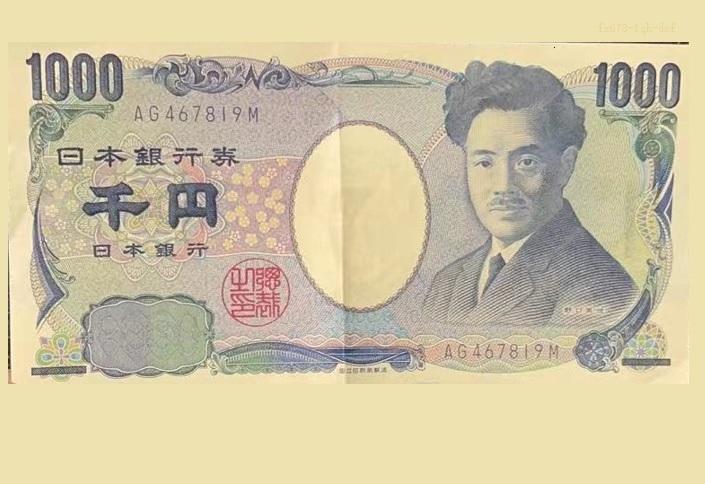
The USD/JPY pair is hovering around 159, seemingly a technical consolidation around a key level, but in reality, it reflects a tug-of-war between two macroeconomic pricing frameworks. On one hand, there's the revaluation of interest rates on the dollar side. The Federal Reserve maintained the target range for the federal funds rate at 3.5% to 3.75% at its April meeting, while the US Consumer Price Index (CPI) rose 3.8% year-on-year in April, the core CPI was 2.8% year-on-year, and energy prices rose 17.9% year-on-year. This means the Fed is unlikely to send a clear easing signal to the market in the short term.
On the other hand, policy adjustments regarding the yen remain slow. At its April meeting, the Bank of Japan maintained the unsecured overnight call rate at around 0.75% by a 6-3 vote. Although three members advocated for a rise to 1.0%, the mainstream decision-making process opted to wait for more data. Japan's consumer price index (CPI) rose 1.4% year-on-year in April, cooling in the short term due to subsidies and one-off factors. However, the Bank of Japan's own outlook still suggests that underlying inflation will gradually approach and remain near its price stability target in the second half of fiscal year 2026 and into fiscal year 2027.
The difficulty in this round of market movements lies in the fact that a drop in oil prices does not necessarily only negatively impact the US dollar, and a rise in oil prices does not necessarily only positively impact the Japanese yen. If negotiations between the US and Iran lead to a gradual resumption of cross-strait shipping, the risk premium for crude oil will decline, and the market will first suppress the tail risk of inflation. Safe-haven buying of the US dollar may cool down, and the yen may benefit from easing energy import pressures. However, if the resumption of shipping is inconsistent and oil prices remain high, rising US inflation expectations will limit the Federal Reserve's room for easing, and support for US dollar interest rates will actually strengthen.
This is precisely why the USD/JPY pair is currently reluctant to break out of its current range around 159. The dollar's traditional safe-haven, interest rate, and energy attributes are all at play simultaneously. The key is not just whether Brent crude oil is approaching $100 per barrel, but more importantly, whether the oil price increase is driven by supply shocks or demand expectations. The former is more likely to push up inflation risk premiums, while the latter may improve risk appetite; the two have different implications for the direction of the USD/JPY pair.
Federal Reserve Governor Waller stated on May 22 that recent labor market and inflation data support removing dovish language from the policy statement and that future rate cuts should not be more likely than rate hikes. The core message is not an immediate shift to rate hikes, but rather to prevent the market from linearly pricing in a rate-cutting path. For the USD/JPY pair, this means that the downside potential for the dollar is protected by policy language.
Bank of Japan Governor Kazuo Ueda emphasized after the April meeting the need to monitor companies' more proactive transmission of oil-related costs, while acknowledging that it's impossible to predict how many months will pass before determining whether conditions for the next interest rate hike are met. This statement isn't entirely favorable for the yen, as it shifts the policy response function from a single inflation data point to a comprehensive assessment of inflation expectations, wage transmission, external shocks, and economic resilience. In other words, even as the Bank of Japan moves closer to normalization, it is still controlling the pace.
Therefore, the lower limit of the US-Japan policy interest rate differential remains around 275 basis points, and the upper limit around 300 basis points. As long as the Federal Reserve does not reopen the window for interest rate cuts, and the Bank of Japan is unwilling to catch up quickly, carry trade funds will still tend to use the yen as a funding currency. However, the weakness of this logic lies in the fact that the 159 to 160 range usually amplifies official verbal warnings, demand for option protection, and short-term stop-loss fluctuations.
From the daily chart, the latest USD/JPY price is around 159.10, with the Bollinger Band middle line at 158.403, the upper line at 160.683, and the lower line at 156.122. After rebounding from the low of 155.025, the price has regained its footing above the middle line, but has not yet effectively touched the upper line, indicating that while there is still restorative momentum, a new macroeconomic catalyst is needed for a trend acceleration. In the MACD indicator, the DIF is 0.165, the DEA is -0.005, and the histogram is 0.340, showing that short-term momentum is recovering from negative territory, but it has not yet entered a strong one-sided trend.
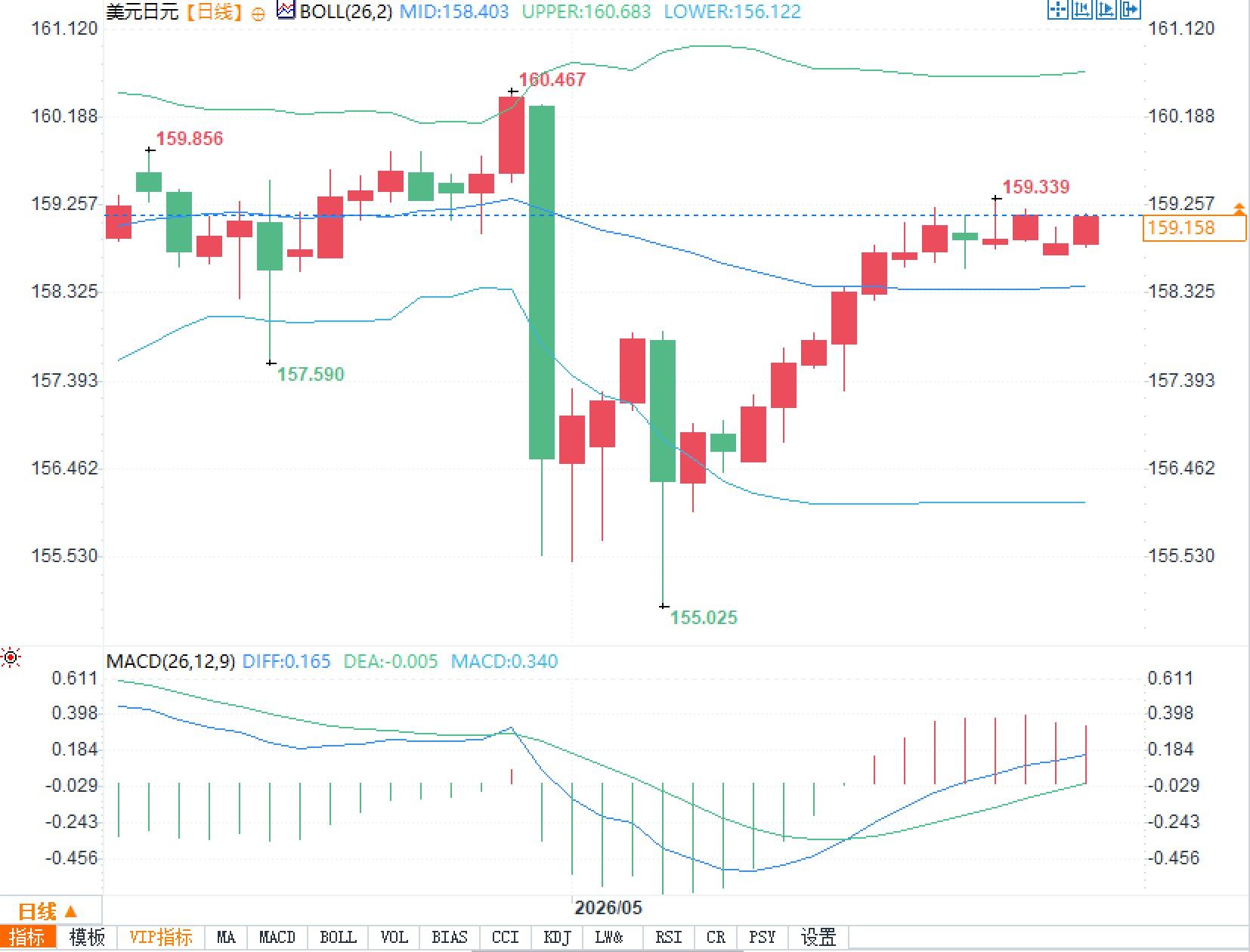
More importantly, the previous high of 160.467 and the current upper Bollinger Band at 160.683 form a relatively dense upper support zone, while the 158.30 to 158.40 area corresponds to the Bollinger Middle Band and recent platform support. If macroeconomic news reduces the risk premium for oil prices, the exchange rate may exhibit more of a pullback from its highs and a decrease in volatility. If oil prices repeatedly rise and increase the probability of the Federal Reserve maintaining a restrictive policy, USD/JPY may continue to digest the policy premium above 159. However, in a regulatory-sensitive range, the sustainability of a single day's rise in the exchange rate usually requires clearer interest rate support.
The core contradiction in USD/JPY: the area around 159 is not just ordinary sideways movement.
The USD/JPY pair is hovering around 159, seemingly a technical consolidation around a key level, but in reality, it reflects a tug-of-war between two macroeconomic pricing frameworks. On one hand, there's the revaluation of interest rates on the dollar side. The Federal Reserve maintained the target range for the federal funds rate at 3.5% to 3.75% at its April meeting, while the US Consumer Price Index (CPI) rose 3.8% year-on-year in April, the core CPI was 2.8% year-on-year, and energy prices rose 17.9% year-on-year. This means the Fed is unlikely to send a clear easing signal to the market in the short term.
On the other hand, policy adjustments regarding the yen remain slow. At its April meeting, the Bank of Japan maintained the unsecured overnight call rate at around 0.75% by a 6-3 vote. Although three members advocated for a rise to 1.0%, the mainstream decision-making process opted to wait for more data. Japan's consumer price index (CPI) rose 1.4% year-on-year in April, cooling in the short term due to subsidies and one-off factors. However, the Bank of Japan's own outlook still suggests that underlying inflation will gradually approach and remain near its price stability target in the second half of fiscal year 2026 and into fiscal year 2027.
Oil price fluctuations are altering the safe-haven status of the US dollar.
The difficulty in this round of market movements lies in the fact that a drop in oil prices does not necessarily only negatively impact the US dollar, and a rise in oil prices does not necessarily only positively impact the Japanese yen. If negotiations between the US and Iran lead to a gradual resumption of cross-strait shipping, the risk premium for crude oil will decline, and the market will first suppress the tail risk of inflation. Safe-haven buying of the US dollar may cool down, and the yen may benefit from easing energy import pressures. However, if the resumption of shipping is inconsistent and oil prices remain high, rising US inflation expectations will limit the Federal Reserve's room for easing, and support for US dollar interest rates will actually strengthen.
This is precisely why the USD/JPY pair is currently reluctant to break out of its current range around 159. The dollar's traditional safe-haven, interest rate, and energy attributes are all at play simultaneously. The key is not just whether Brent crude oil is approaching $100 per barrel, but more importantly, whether the oil price increase is driven by supply shocks or demand expectations. The former is more likely to push up inflation risk premiums, while the latter may improve risk appetite; the two have different implications for the direction of the USD/JPY pair.
Federal Reserve and Bank of Japan: Interest rate differentials remain, but marginal pricing has changed.
Federal Reserve Governor Waller stated on May 22 that recent labor market and inflation data support removing dovish language from the policy statement and that future rate cuts should not be more likely than rate hikes. The core message is not an immediate shift to rate hikes, but rather to prevent the market from linearly pricing in a rate-cutting path. For the USD/JPY pair, this means that the downside potential for the dollar is protected by policy language.
Bank of Japan Governor Kazuo Ueda emphasized after the April meeting the need to monitor companies' more proactive transmission of oil-related costs, while acknowledging that it's impossible to predict how many months will pass before determining whether conditions for the next interest rate hike are met. This statement isn't entirely favorable for the yen, as it shifts the policy response function from a single inflation data point to a comprehensive assessment of inflation expectations, wage transmission, external shocks, and economic resilience. In other words, even as the Bank of Japan moves closer to normalization, it is still controlling the pace.
Therefore, the lower limit of the US-Japan policy interest rate differential remains around 275 basis points, and the upper limit around 300 basis points. As long as the Federal Reserve does not reopen the window for interest rate cuts, and the Bank of Japan is unwilling to catch up quickly, carry trade funds will still tend to use the yen as a funding currency. However, the weakness of this logic lies in the fact that the 159 to 160 range usually amplifies official verbal warnings, demand for option protection, and short-term stop-loss fluctuations.
Technical Analysis: The consolidation above the Bollinger Band's middle line has not yet become a trend.
From the daily chart, the latest USD/JPY price is around 159.10, with the Bollinger Band middle line at 158.403, the upper line at 160.683, and the lower line at 156.122. After rebounding from the low of 155.025, the price has regained its footing above the middle line, but has not yet effectively touched the upper line, indicating that while there is still restorative momentum, a new macroeconomic catalyst is needed for a trend acceleration. In the MACD indicator, the DIF is 0.165, the DEA is -0.005, and the histogram is 0.340, showing that short-term momentum is recovering from negative territory, but it has not yet entered a strong one-sided trend.
More importantly, the previous high of 160.467 and the current upper Bollinger Band at 160.683 form a relatively dense upper support zone, while the 158.30 to 158.40 area corresponds to the Bollinger Middle Band and recent platform support. If macroeconomic news reduces the risk premium for oil prices, the exchange rate may exhibit more of a pullback from its highs and a decrease in volatility. If oil prices repeatedly rise and increase the probability of the Federal Reserve maintaining a restrictive policy, USD/JPY may continue to digest the policy premium above 159. However, in a regulatory-sensitive range, the sustainability of a single day's rise in the exchange rate usually requires clearer interest rate support.
- Risk Warning and Disclaimer
- The market involves risk, and trading may not be suitable for all investors. This article is for reference only and does not constitute personal investment advice, nor does it take into account certain users’ specific investment objectives, financial situation, or other needs. Any investment decisions made based on this information are at your own risk.