Gold prices plummeted despite falling yields? Behind the 4.50% US Treasury yield lies the most ruthless inflation killer.
2026-05-26 20:30:56
On Tuesday, May 26, spot gold traded in pre-market US trading above $4,500, lower than the previous trading day. The daily chart shows gold prices trading below the Bollinger Middle Band at $4,620.96, near the Lower Band at $4,453.26. The MACD remains in negative territory, indicating insufficient short-term rebound momentum. This pullback is not driven by a single negative factor, but rather is the result of a redistribution of energy risks, interest rate expectations, dollar strength, and safe-haven demand. Currently, Brent crude oil is fluctuating around $99, and the 10-year US Treasury yield is approximately 4.50% to 4.51%. The market's repricing of inflation and interest rate paths remains the core of gold price fluctuations.
The key variable for gold recently stems from negotiations between the US and Iran regarding the extension of the ceasefire, the reopening of the Strait of Hormuz, and arrangements for the unfreezing of assets. Reports indicate that the focus of the dispute has shifted from whether to establish a framework to the timetable for the release of funds and guarantees for implementation. Iran is reportedly demanding access to $12 billion in frozen assets in the first phase of the agreement, including approximately $6 billion in funds previously held in Qatar Bank. Market interpretation of this shift is complex. On the one hand, the negotiations entering the implementation phase suggests a realistic window for de-escalation; on the other hand, if the funding arrangements cannot be finalized, the temporary framework may still be subject to change.
On the surface, the 10-year US Treasury yield has fallen to around 4.50%, which should reduce the opportunity cost of holding non-interest-bearing assets. However, gold has weakened in tandem, because the source of the decline in nominal yields has changed. This is precisely where this round of market movement is most easily misinterpreted. The simultaneous decline in gold and US Treasury yields is not contradictory; rather, it indicates that the market is trading on a "cooling of inflation fears." If investors believe that oil prices will continue to push up inflation, gold, as an inflation hedge, should remain strong. However, if oil price risks are seen as a temporary spike, and the Federal Reserve is likely to maintain high interest rates, gold will simultaneously lose both the demand for inflation hedging and the support of low interest rates.
Brent crude oil has recently fluctuated significantly around $100, indicating that the energy market is still rapidly reassessing the risks in the Strait of Hormuz, the progress of negotiations, and any potential military events. Rising oil prices would push up inflation expectations and strengthen the Federal Reserve's case for maintaining high interest rates; conversely, falling oil prices would depress inflation premiums and weaken safe-haven buying of gold. These two paths do not always move in the same direction for gold, hence the current tug-of-war.
Market focus is now shifting to the upcoming US April personal consumption expenditures (PCE) price data. Some institutions expect the core indicator to remain around 0.3% month-on-month, meaning that the resilience of service inflation may still constrain expectations of interest rate cuts. Meanwhile, interest rate futures indicate that the market has priced in an increased probability of a Fed rate hike this year, reflecting that traders have not completely relaxed their vigilance regarding recurring inflation.
From a daily chart perspective, gold rebounded near $4773 but encountered resistance and subsequently fell below the Bollinger Middle Band, with the price approaching the $4500 psychological level and the lower Bollinger Band area. The $4453 area has become a key technical reference point for short-term fluctuations; if this area is breached, the market may further examine the support levels of previous lows and lower-volume trading zones. Conversely, the $4620-$4700 range has transformed from a previous support zone into an upper resistance zone.
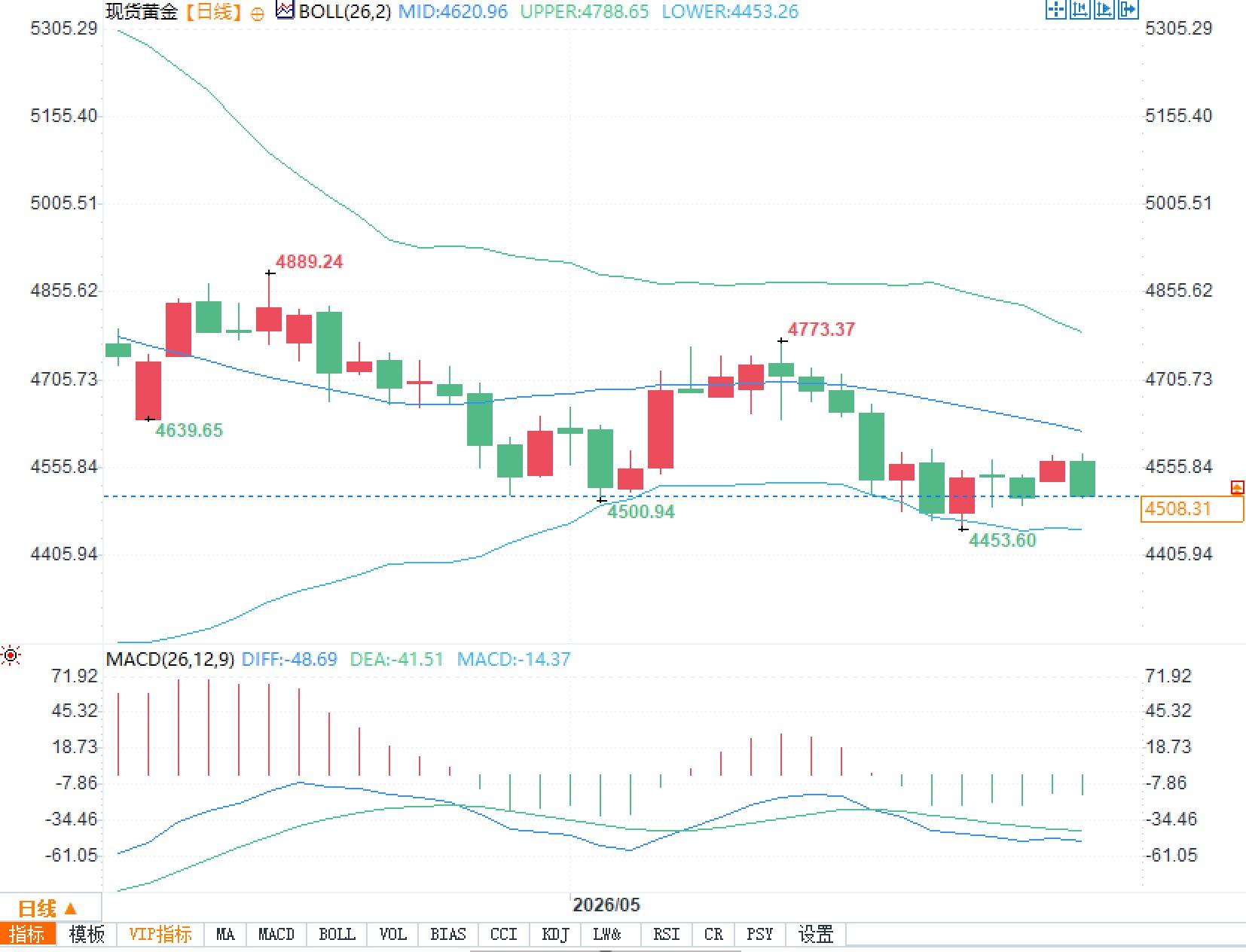
The MACD indicator is below the zero line, indicating weak trend momentum, but the contracting histogram also suggests that the downward movement is not smooth. Currently, it appears more like a repricing of risk premiums within a high-level range than a simple trend reversal. Traders are watching for a convergence of three main factors: whether negotiations continue, whether oil prices have moved away from their highs, and whether real US Treasury yields have eased.
Question 1: Why did gold prices fall despite declining yields?
A: The key is not nominal yield, but real interest rate. If yields fall due to declining inflation expectations, gold loses its demand as an inflation hedge; if real interest rates do not decline in tandem, non-interest-bearing assets still lack interest rate support.
Question 2: Is a rise in oil prices necessarily good for gold?
A: Not necessarily. Rising oil prices could increase inflation concerns and strengthen expectations that the Federal Reserve will maintain higher interest rates. The former is good for gold, while the latter is bad for it; ultimately, it depends on whether the market prioritizes safe-haven assets or interest rate constraints.
Question 3: What are the core risks to gold at present?
A: The key factors are the progress of negotiations and inflation data. If the ceasefire framework is advanced, the safe-haven premium may continue to decline; if negotiations stall or energy transportation is disrupted again, oil prices and safe-haven demand may amplify gold price volatility once more.
Gold is no longer solely supported by geopolitical risks.
The key variable for gold recently stems from negotiations between the US and Iran regarding the extension of the ceasefire, the reopening of the Strait of Hormuz, and arrangements for the unfreezing of assets. Reports indicate that the focus of the dispute has shifted from whether to establish a framework to the timetable for the release of funds and guarantees for implementation. Iran is reportedly demanding access to $12 billion in frozen assets in the first phase of the agreement, including approximately $6 billion in funds previously held in Qatar Bank. Market interpretation of this shift is complex. On the one hand, the negotiations entering the implementation phase suggests a realistic window for de-escalation; on the other hand, if the funding arrangements cannot be finalized, the temporary framework may still be subject to change.
On the surface, the 10-year US Treasury yield has fallen to around 4.50%, which should reduce the opportunity cost of holding non-interest-bearing assets. However, gold has weakened in tandem, because the source of the decline in nominal yields has changed. This is precisely where this round of market movement is most easily misinterpreted. The simultaneous decline in gold and US Treasury yields is not contradictory; rather, it indicates that the market is trading on a "cooling of inflation fears." If investors believe that oil prices will continue to push up inflation, gold, as an inflation hedge, should remain strong. However, if oil price risks are seen as a temporary spike, and the Federal Reserve is likely to maintain high interest rates, gold will simultaneously lose both the demand for inflation hedging and the support of low interest rates.
Oil prices serve as an indirect anchor for gold; the true transmission chain lies in policy expectations.
Brent crude oil has recently fluctuated significantly around $100, indicating that the energy market is still rapidly reassessing the risks in the Strait of Hormuz, the progress of negotiations, and any potential military events. Rising oil prices would push up inflation expectations and strengthen the Federal Reserve's case for maintaining high interest rates; conversely, falling oil prices would depress inflation premiums and weaken safe-haven buying of gold. These two paths do not always move in the same direction for gold, hence the current tug-of-war.
Market focus is now shifting to the upcoming US April personal consumption expenditures (PCE) price data. Some institutions expect the core indicator to remain around 0.3% month-on-month, meaning that the resilience of service inflation may still constrain expectations of interest rate cuts. Meanwhile, interest rate futures indicate that the market has priced in an increased probability of a Fed rate hike this year, reflecting that traders have not completely relaxed their vigilance regarding recurring inflation.
The technical structure is weakening, but there is no vacuum below.
From a daily chart perspective, gold rebounded near $4773 but encountered resistance and subsequently fell below the Bollinger Middle Band, with the price approaching the $4500 psychological level and the lower Bollinger Band area. The $4453 area has become a key technical reference point for short-term fluctuations; if this area is breached, the market may further examine the support levels of previous lows and lower-volume trading zones. Conversely, the $4620-$4700 range has transformed from a previous support zone into an upper resistance zone.
The MACD indicator is below the zero line, indicating weak trend momentum, but the contracting histogram also suggests that the downward movement is not smooth. Currently, it appears more like a repricing of risk premiums within a high-level range than a simple trend reversal. Traders are watching for a convergence of three main factors: whether negotiations continue, whether oil prices have moved away from their highs, and whether real US Treasury yields have eased.
Frequently Asked Questions
Question 1: Why did gold prices fall despite declining yields?
A: The key is not nominal yield, but real interest rate. If yields fall due to declining inflation expectations, gold loses its demand as an inflation hedge; if real interest rates do not decline in tandem, non-interest-bearing assets still lack interest rate support.
Question 2: Is a rise in oil prices necessarily good for gold?
A: Not necessarily. Rising oil prices could increase inflation concerns and strengthen expectations that the Federal Reserve will maintain higher interest rates. The former is good for gold, while the latter is bad for it; ultimately, it depends on whether the market prioritizes safe-haven assets or interest rate constraints.
Question 3: What are the core risks to gold at present?
A: The key factors are the progress of negotiations and inflation data. If the ceasefire framework is advanced, the safe-haven premium may continue to decline; if negotiations stall or energy transportation is disrupted again, oil prices and safe-haven demand may amplify gold price volatility once more.
- Risk Warning and Disclaimer
- The market involves risk, and trading may not be suitable for all investors. This article is for reference only and does not constitute personal investment advice, nor does it take into account certain users’ specific investment objectives, financial situation, or other needs. Any investment decisions made based on this information are at your own risk.