Crude oil analysis: Limited military action between the US and Iran is highly probable, and the geopolitical risk premium may recede further.
2026-05-27 01:45:27
On May 25-26, 2026, U.S. Central Command (CENTCOM) announced a "self-defense strike" against missile launch sites in southern Iran and Revolutionary Guard vessels attempting to lay mines near the Strait of Hormuz. The operation was limited in scale, targeting military installations and military vessels, and did not target densely populated areas, civilian infrastructure, or core energy facilities. Iran immediately condemned the military action and claimed to have shot down a U.S. drone, but did not launch a large-scale retaliatory strike such as a missile counterattack or naval blockade. Both sides maintained restraint, deliberately avoiding a full escalation of the situation.
Tactical extension of strategic pressure
Multiple professional media outlets and geopolitical analysts believe that this limited military action is a tactical extension of the Trump administration's "peace through force" strategy, a typical example of controlled strategic pressure tactics. Its core objective is to break the deadlock in the Doha indirect negotiations, rather than to provoke a full-scale military conflict. Mainstream foreign media also pointed out that the timing of this strike was highly targeted, precisely targeting the indirect talks between the US, Iran, and Qatar in Doha. The US intention is very clear: to use low-risk military leverage to pressure Iran, forcing it to make substantial concessions on three core issues: the opening of the Strait of Hormuz, the unfreezing of US-frozen Iranian assets, and the framework for negotiations on the Iranian nuclear issue.
Authoritative think tanks such as the Washington Institute for Near East Policy further analyze that this hybrid strategy of "limited military strikes + sustained diplomatic negotiations" can simultaneously address multiple US demands: accurately testing Iran's bottom line, responding to the hardline demands of domestic Republican hawks, and significantly increasing the US's bargaining leverage without deviating from the main theme of diplomatic negotiations. Industry experts interpret this as follows: Iran's domestic economic fundamentals are currently fragile, with long-term international sanctions compounded by the impact of local conflicts in the Middle East, leading to high domestic inflation and immense pressure on people's livelihoods. The Iranian authorities prefer to rely on negotiations to obtain sanctions relief and financial assistance rather than risk a full-scale confrontation with the United States. Therefore, this type of low-intensity strategic pressure is likely to push deeper negotiations toward the US and will not directly terminate the bilateral dialogue mechanism.
The statements from both sides are shrouded in mystery, and a two-pronged approach has become the norm in negotiations.
The US has struck a balance between a tough stance and negotiating flexibility, demonstrating a strong sense of proportion in its statements. US Secretary of State Marco Rubio publicly stated that indirect negotiations between the US and Iran have made "significant progress," with both sides engaging in in-depth consultations on two major issues: the full opening of the Strait of Hormuz and a time-limited framework for negotiations on the Iranian nuclear issue. He also signaled a bottom line: the Trump administration will not sign a substandard agreement that harms US interests. Trump himself also spoke out on social media, stating that the overall progress of the negotiations is positive, but simultaneously issuing a deterrent warning: if the negotiations ultimately fail to reach a consensus, the US may introduce a new round of sanctions and military measures, adhering to the core principle of "either a high-quality agreement or termination of negotiations."
Iran is also employing a "soft and hard" approach. The Iranian Revolutionary Guard and official media have clearly stated that simply opening the Strait of Hormuz in exchange for the partial unfreezing of frozen funds is a unilateral compromise that Iran cannot accept. The US must simultaneously ease sanctions across all areas and coordinate negotiations on the Iranian nuclear issue for both sides to reach an equal consensus. At the same time, Iran has not closed the negotiation channels. The Foreign Minister and his dedicated negotiating team remain in Doha to participate in the talks, and semi-official channels have also released conciliatory signals, not ruling out the possibility of resuming normal shipping through the Strait of Hormuz within 30 days.
Analysts point out that this dual approach of being tough externally and pragmatic internally is a typical characteristic of high-level geopolitical negotiations: both the US and Iran need to solidify their domestic political base and appease their radical factions through strong statements, while simultaneously preserving a buffer for compromise negotiations. Looking at the history of Middle Eastern geopolitical games, low-intensity, limited military actions often serve as a special lever to facilitate negotiations between major powers, rather than a trigger for all-out war.
Oil prices remain largely driven by negotiations, with geopolitical premiums gradually diminishing.
Even with the sudden low-intensity military friction between the US and Iran, the international crude oil market did not experience a panic-driven surge, with the core pricing logic still dominated by expectations of negotiations. The market generally anticipates that if the US and Iran reach a preliminary consensus and the Strait of Hormuz shipping lanes are fully reopened, the crude oil supplies stranded in the shipping lanes could be quickly released in the short term. Coupled with the unfreezing of frozen funds in Iran and the easing of some sanctions, Iranian crude oil exports are expected to surge in stages, negatively impacting global crude oil supply.
Recent international oil price movements have also confirmed this logic: after the Doha negotiations released positive signals, Brent crude futures fell by 5%-7% at one point during the day, and WTI crude oil prices fell back to the range of around $90 per barrel. The risk premium originally driven by the Middle East geopolitical conflict has gradually contracted as the negotiations have progressed steadily; the market has fully adapted to the push-pull fluctuations of the US-Iran "fighting while negotiating" situation, and the expectation of a recovery in actual crude oil supply has replaced military friction as the core pricing factor for oil prices at this stage.
Market Outlook: Oil prices are likely to retest the $90 mark.
Energy industry analysts believe that if the Doha talks continue to yield positive results, such as the implementation of a framework agreement for opening the Straits of Hormuz and the phased unfreezing of funds, international oil prices are expected to fall further in the short term, potentially even breaking below the key $90/barrel level. Operationally, the "sell on expectations, buy on reality" principle is recommended: the global crude oil fundamentals remain tight, with crude oil inventories in major Asian consuming countries at low levels for the year, providing bottom support for oil prices. However, the fading geopolitical risk premium will remain the dominant variable in short-term oil price movements.
Analysis of relevant potential trend scenarios:
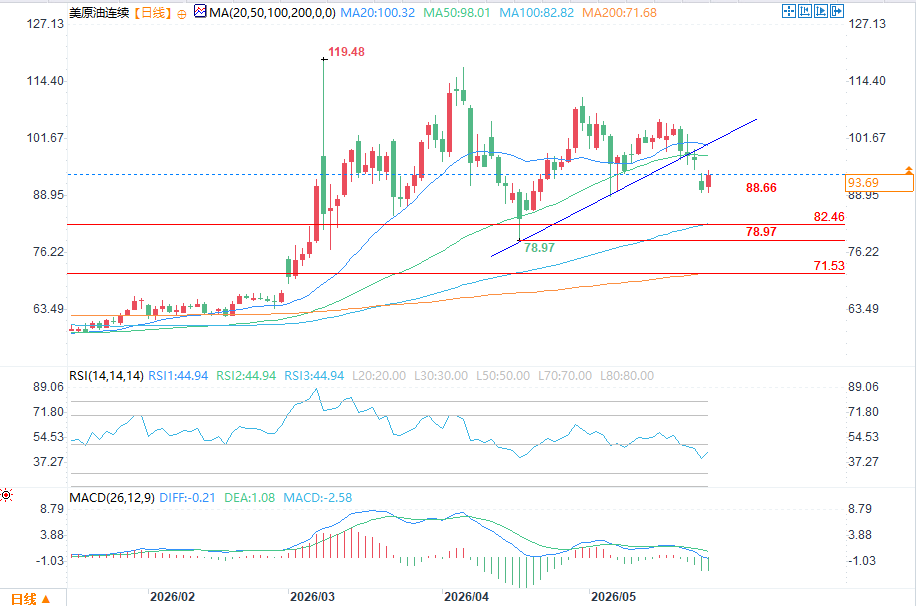
(WTI crude oil daily chart source: FX678)
Optimistic scenario: The US and Iran finalize a comprehensive agreement framework, shipping lanes are opened, sanctions are eased, and oil prices quickly fall back to $90/barrel or below.
Repeated scenario: Negotiations are locked in a tug-of-war, with alternating positive and negative news, and oil prices remain volatile at high levels, but the medium- to long-term downward trend remains unchanged.
Risk warning: Variables such as Israel's aggressive interventionist stance, internal factional divisions in Iran, and the ongoing negotiations over the details of the Iran nuclear deal could still trigger abnormal short-term fluctuations in oil prices.
Overall, this round of limited military action by the US military is essentially a psychological maneuver to complement diplomatic negotiations, and not a prelude to a full-scale escalation of the situation. Bilateral dialogue remains the core theme of the current Middle East situation and the oil market. From an investment and industry perspective, it is recommended to focus on three key signals: the progress of the Doha talks, Trump's latest public statements, and the official responses from both the US and Iran. Although there is uncertainty in the current situation, the main theme of peace negotiations has not shifted, and the pullback of oil prices to around $90 per barrel is a key market direction to watch at this stage.
Tactical extension of strategic pressure
Multiple professional media outlets and geopolitical analysts believe that this limited military action is a tactical extension of the Trump administration's "peace through force" strategy, a typical example of controlled strategic pressure tactics. Its core objective is to break the deadlock in the Doha indirect negotiations, rather than to provoke a full-scale military conflict. Mainstream foreign media also pointed out that the timing of this strike was highly targeted, precisely targeting the indirect talks between the US, Iran, and Qatar in Doha. The US intention is very clear: to use low-risk military leverage to pressure Iran, forcing it to make substantial concessions on three core issues: the opening of the Strait of Hormuz, the unfreezing of US-frozen Iranian assets, and the framework for negotiations on the Iranian nuclear issue.
Authoritative think tanks such as the Washington Institute for Near East Policy further analyze that this hybrid strategy of "limited military strikes + sustained diplomatic negotiations" can simultaneously address multiple US demands: accurately testing Iran's bottom line, responding to the hardline demands of domestic Republican hawks, and significantly increasing the US's bargaining leverage without deviating from the main theme of diplomatic negotiations. Industry experts interpret this as follows: Iran's domestic economic fundamentals are currently fragile, with long-term international sanctions compounded by the impact of local conflicts in the Middle East, leading to high domestic inflation and immense pressure on people's livelihoods. The Iranian authorities prefer to rely on negotiations to obtain sanctions relief and financial assistance rather than risk a full-scale confrontation with the United States. Therefore, this type of low-intensity strategic pressure is likely to push deeper negotiations toward the US and will not directly terminate the bilateral dialogue mechanism.
The statements from both sides are shrouded in mystery, and a two-pronged approach has become the norm in negotiations.
The US has struck a balance between a tough stance and negotiating flexibility, demonstrating a strong sense of proportion in its statements. US Secretary of State Marco Rubio publicly stated that indirect negotiations between the US and Iran have made "significant progress," with both sides engaging in in-depth consultations on two major issues: the full opening of the Strait of Hormuz and a time-limited framework for negotiations on the Iranian nuclear issue. He also signaled a bottom line: the Trump administration will not sign a substandard agreement that harms US interests. Trump himself also spoke out on social media, stating that the overall progress of the negotiations is positive, but simultaneously issuing a deterrent warning: if the negotiations ultimately fail to reach a consensus, the US may introduce a new round of sanctions and military measures, adhering to the core principle of "either a high-quality agreement or termination of negotiations."
Iran is also employing a "soft and hard" approach. The Iranian Revolutionary Guard and official media have clearly stated that simply opening the Strait of Hormuz in exchange for the partial unfreezing of frozen funds is a unilateral compromise that Iran cannot accept. The US must simultaneously ease sanctions across all areas and coordinate negotiations on the Iranian nuclear issue for both sides to reach an equal consensus. At the same time, Iran has not closed the negotiation channels. The Foreign Minister and his dedicated negotiating team remain in Doha to participate in the talks, and semi-official channels have also released conciliatory signals, not ruling out the possibility of resuming normal shipping through the Strait of Hormuz within 30 days.
Analysts point out that this dual approach of being tough externally and pragmatic internally is a typical characteristic of high-level geopolitical negotiations: both the US and Iran need to solidify their domestic political base and appease their radical factions through strong statements, while simultaneously preserving a buffer for compromise negotiations. Looking at the history of Middle Eastern geopolitical games, low-intensity, limited military actions often serve as a special lever to facilitate negotiations between major powers, rather than a trigger for all-out war.
Oil prices remain largely driven by negotiations, with geopolitical premiums gradually diminishing.
Even with the sudden low-intensity military friction between the US and Iran, the international crude oil market did not experience a panic-driven surge, with the core pricing logic still dominated by expectations of negotiations. The market generally anticipates that if the US and Iran reach a preliminary consensus and the Strait of Hormuz shipping lanes are fully reopened, the crude oil supplies stranded in the shipping lanes could be quickly released in the short term. Coupled with the unfreezing of frozen funds in Iran and the easing of some sanctions, Iranian crude oil exports are expected to surge in stages, negatively impacting global crude oil supply.
Recent international oil price movements have also confirmed this logic: after the Doha negotiations released positive signals, Brent crude futures fell by 5%-7% at one point during the day, and WTI crude oil prices fell back to the range of around $90 per barrel. The risk premium originally driven by the Middle East geopolitical conflict has gradually contracted as the negotiations have progressed steadily; the market has fully adapted to the push-pull fluctuations of the US-Iran "fighting while negotiating" situation, and the expectation of a recovery in actual crude oil supply has replaced military friction as the core pricing factor for oil prices at this stage.
Market Outlook: Oil prices are likely to retest the $90 mark.
Energy industry analysts believe that if the Doha talks continue to yield positive results, such as the implementation of a framework agreement for opening the Straits of Hormuz and the phased unfreezing of funds, international oil prices are expected to fall further in the short term, potentially even breaking below the key $90/barrel level. Operationally, the "sell on expectations, buy on reality" principle is recommended: the global crude oil fundamentals remain tight, with crude oil inventories in major Asian consuming countries at low levels for the year, providing bottom support for oil prices. However, the fading geopolitical risk premium will remain the dominant variable in short-term oil price movements.
Analysis of relevant potential trend scenarios:
(WTI crude oil daily chart source: FX678)
Optimistic scenario: The US and Iran finalize a comprehensive agreement framework, shipping lanes are opened, sanctions are eased, and oil prices quickly fall back to $90/barrel or below.
Repeated scenario: Negotiations are locked in a tug-of-war, with alternating positive and negative news, and oil prices remain volatile at high levels, but the medium- to long-term downward trend remains unchanged.
Risk warning: Variables such as Israel's aggressive interventionist stance, internal factional divisions in Iran, and the ongoing negotiations over the details of the Iran nuclear deal could still trigger abnormal short-term fluctuations in oil prices.
Overall, this round of limited military action by the US military is essentially a psychological maneuver to complement diplomatic negotiations, and not a prelude to a full-scale escalation of the situation. Bilateral dialogue remains the core theme of the current Middle East situation and the oil market. From an investment and industry perspective, it is recommended to focus on three key signals: the progress of the Doha talks, Trump's latest public statements, and the official responses from both the US and Iran. Although there is uncertainty in the current situation, the main theme of peace negotiations has not shifted, and the pullback of oil prices to around $90 per barrel is a key market direction to watch at this stage.
- Risk Warning and Disclaimer
- The market involves risk, and trading may not be suitable for all investors. This article is for reference only and does not constitute personal investment advice, nor does it take into account certain users’ specific investment objectives, financial situation, or other needs. Any investment decisions made based on this information are at your own risk.