One chart: Freight rates for large bulk carriers surge, Baltic Dry Index rises sharply.
2026-05-27 01:24:16
Latest data shows that the Baltic Dry Index (BDI) reached 3085 points on May 26, 2026, a five-day high, up 3.14% month-on-month (compared to the previous value), marking the largest increase since May 13, 2026, and the second consecutive day of increase (including zero growth). Looking at the short-term charts, the recent 11 BDI data points show: 6 positive increases, 5 negative increases, and 0 zero increases. Specifically, the Panamax Freight Index (BPI) was 2258 points, up 1.57% from the previous value; the Capesize Freight Index (BCI) was 5194 points, up 4.84%; and the Supramax Freight Index (BSI) was 1559 points, down 0.51%. For detailed 720-day and 10-year trend charts of the Baltic Dry Index and its three main sub-indices, please refer to the specially designed charts.
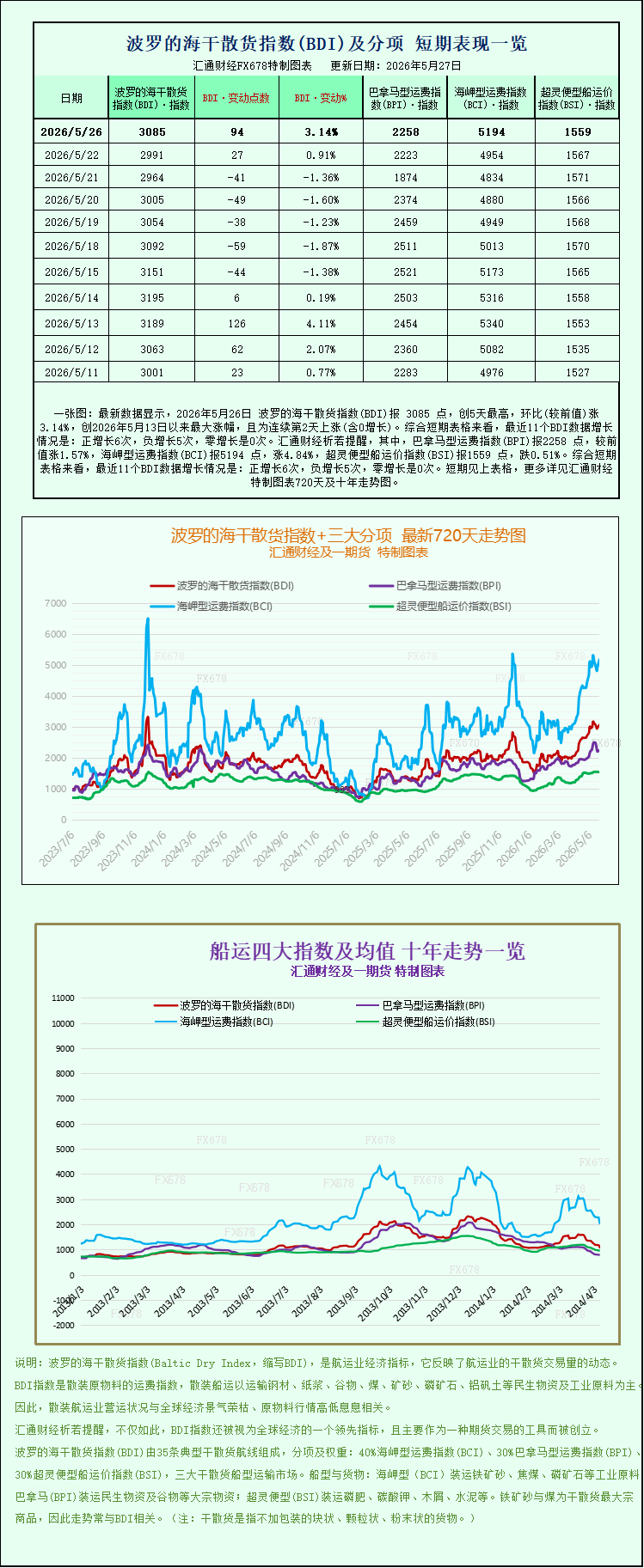
The Baltic Dry Index, a bellwether for the global shipping market, saw a significant rise on Tuesday. This increase was mainly driven by a strong rise in freight rates for large ocean-going dry bulk vessels. Demand for Capesize and Panamax vessels, along with a sharp increase in daily charter rates, recovered, offsetting the negative impact of weaker market conditions for smaller vessels. Overall, the market showed a polarized development trend.
The Baltic Dry Index (BADI) comprehensively tracks global freight rates for three major dry bulk carrier types: Capesize, Panamax, and Supramax, providing a direct reflection of the global maritime trade in commodities such as minerals, energy, and food. Data shows that the benchmark index rose 94 points, or 3.1%, to close at 3085 points, a recent high, indicating a continued recovery in the overall global dry bulk shipping market.
Large vessels were the core driver of this round of index increases, with Capesize vessels, the largest in size, showing the most significant gains. Data shows that the Capesize Exclusive Freight Index (BACI) surged 240 points in a single day, a rise of 4.9%, closing at 5194 points. These vessels typically have a deadweight tonnage of up to 150,000 tons and primarily undertake the ocean-going transportation of bulk industrial raw materials such as iron ore, thermal coal, coking coal, and coke, serving as the core carriers of the global heavy industry supply chain.
Market analysts attribute the surge in Capesize vessel charter rates primarily to unusual price fluctuations in China's upstream raw material market. The supply-demand balance in the domestic coking coal and coke market has tightened recently, with spot prices continuing to rise to their highest level since the end of 2024. Downstream steel companies are experiencing a surge in restocking demand, increasing their purchases of imported coal and iron ore, leading to a concentrated release of ocean shipping orders and directly driving up the chartering costs of large coal and ore transport vessels. Corresponding data shows that Capesize vessels have seen an average daily increase of $2,174 in earnings, with the latest average daily revenue reaching $43,602, further expanding shipowners' profit margins.
Besides Capesize vessels, Panamax vessels, the main medium-sized vessels, also saw steady growth. The Panamax Freight Index (BPNI) rose 35 points, or 1.6%, to close at 2258 points. These vessels, with a deadweight range of 60,000 to 70,000 tons, are highly adaptable and widely used for cross-regional transportation of bulk commodities such as thermal coal, grains, and fertilizers, covering multiple core shipping routes in Asia-Europe and the transatlantic. Boosted by the peak season for global grain trade and demand for coal diversion, the average daily revenue of Panamax vessels increased by $314, with the current average daily charter rate at $20,318. Simultaneously, the ocean freight procurement costs for small and medium-sized steel mills and grain traders saw a slight increase.
In contrast, the market trend for small dry bulk vessels differs sharply from that of medium and large vessels. Demand for the even smaller Supramax vessels is somewhat weak, with its Best-Indonesia Index (BSIS) falling slightly by 8 points, a 0.5% drop, to 1559 points. Industry analysts suggest that small vessels primarily serve short-haul regional trade. Currently, short-haul bulk shipping orders are relatively scarce, while the market supply of vessels is relatively abundant. This supply-demand imbalance has led to a slight decline in charter rates, temporarily dragging down the overall upward movement of the index.
In summary, the current dry bulk shipping market exhibits significant differentiation, with growth primarily driven by long-haul bulk shipping business fueled by restocking demand for industrial raw materials in China. Going forward, market participants will continue to monitor domestic ferrous metal raw material price trends, steel industry operating rates, and global grain export policies. These factors will likely directly determine the future direction of freight rates for medium and large bulk carriers and the Baltic Dry Index.
The Baltic Dry Index, a bellwether for the global shipping market, saw a significant rise on Tuesday. This increase was mainly driven by a strong rise in freight rates for large ocean-going dry bulk vessels. Demand for Capesize and Panamax vessels, along with a sharp increase in daily charter rates, recovered, offsetting the negative impact of weaker market conditions for smaller vessels. Overall, the market showed a polarized development trend.
The Baltic Dry Index (BADI) comprehensively tracks global freight rates for three major dry bulk carrier types: Capesize, Panamax, and Supramax, providing a direct reflection of the global maritime trade in commodities such as minerals, energy, and food. Data shows that the benchmark index rose 94 points, or 3.1%, to close at 3085 points, a recent high, indicating a continued recovery in the overall global dry bulk shipping market.
Large vessels were the core driver of this round of index increases, with Capesize vessels, the largest in size, showing the most significant gains. Data shows that the Capesize Exclusive Freight Index (BACI) surged 240 points in a single day, a rise of 4.9%, closing at 5194 points. These vessels typically have a deadweight tonnage of up to 150,000 tons and primarily undertake the ocean-going transportation of bulk industrial raw materials such as iron ore, thermal coal, coking coal, and coke, serving as the core carriers of the global heavy industry supply chain.
Market analysts attribute the surge in Capesize vessel charter rates primarily to unusual price fluctuations in China's upstream raw material market. The supply-demand balance in the domestic coking coal and coke market has tightened recently, with spot prices continuing to rise to their highest level since the end of 2024. Downstream steel companies are experiencing a surge in restocking demand, increasing their purchases of imported coal and iron ore, leading to a concentrated release of ocean shipping orders and directly driving up the chartering costs of large coal and ore transport vessels. Corresponding data shows that Capesize vessels have seen an average daily increase of $2,174 in earnings, with the latest average daily revenue reaching $43,602, further expanding shipowners' profit margins.
Besides Capesize vessels, Panamax vessels, the main medium-sized vessels, also saw steady growth. The Panamax Freight Index (BPNI) rose 35 points, or 1.6%, to close at 2258 points. These vessels, with a deadweight range of 60,000 to 70,000 tons, are highly adaptable and widely used for cross-regional transportation of bulk commodities such as thermal coal, grains, and fertilizers, covering multiple core shipping routes in Asia-Europe and the transatlantic. Boosted by the peak season for global grain trade and demand for coal diversion, the average daily revenue of Panamax vessels increased by $314, with the current average daily charter rate at $20,318. Simultaneously, the ocean freight procurement costs for small and medium-sized steel mills and grain traders saw a slight increase.
In contrast, the market trend for small dry bulk vessels differs sharply from that of medium and large vessels. Demand for the even smaller Supramax vessels is somewhat weak, with its Best-Indonesia Index (BSIS) falling slightly by 8 points, a 0.5% drop, to 1559 points. Industry analysts suggest that small vessels primarily serve short-haul regional trade. Currently, short-haul bulk shipping orders are relatively scarce, while the market supply of vessels is relatively abundant. This supply-demand imbalance has led to a slight decline in charter rates, temporarily dragging down the overall upward movement of the index.
In summary, the current dry bulk shipping market exhibits significant differentiation, with growth primarily driven by long-haul bulk shipping business fueled by restocking demand for industrial raw materials in China. Going forward, market participants will continue to monitor domestic ferrous metal raw material price trends, steel industry operating rates, and global grain export policies. These factors will likely directly determine the future direction of freight rates for medium and large bulk carriers and the Baltic Dry Index.
- Risk Warning and Disclaimer
- The market involves risk, and trading may not be suitable for all investors. This article is for reference only and does not constitute personal investment advice, nor does it take into account certain users’ specific investment objectives, financial situation, or other needs. Any investment decisions made based on this information are at your own risk.