May 27th Financial Breakfast: US and Iran accuse each other of violating ceasefire; gold prices dip to $4500; challenges remain in US-Iran relations; oil prices rise nearly 4%.
2026-05-27 07:28:13
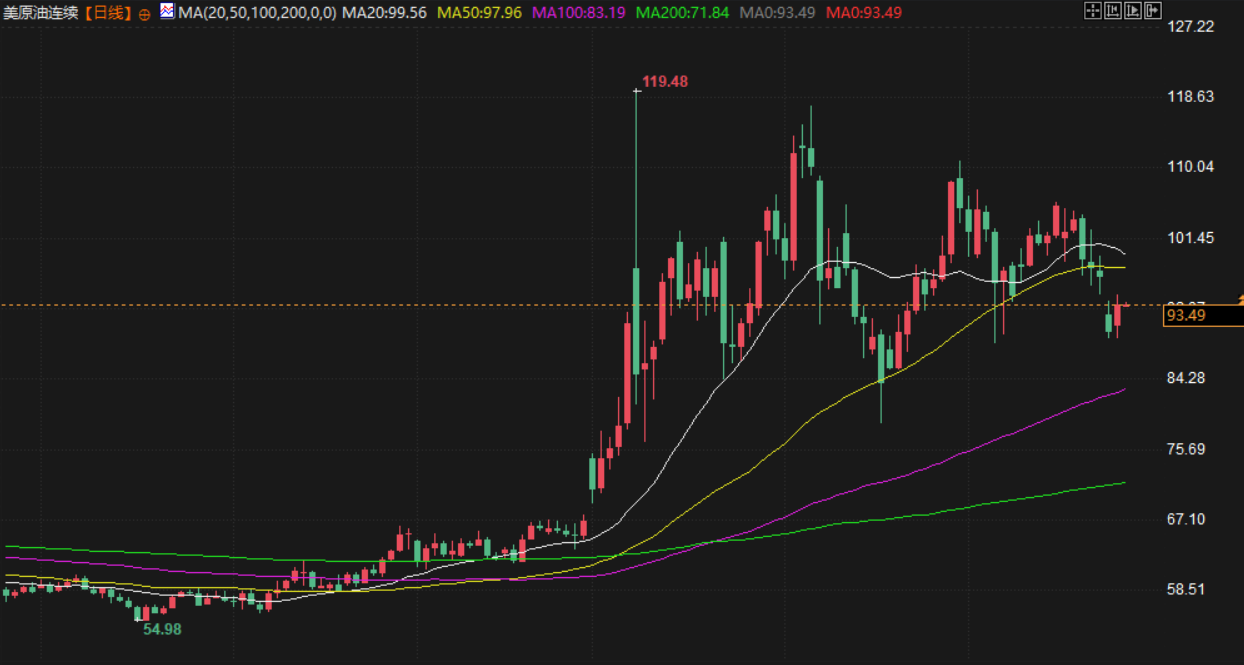
On Wednesday (May 27, Beijing time) in early Asian trading, spot gold was trading around $4,504 per ounce, having briefly dipped to the $4,500 per ounce level at the open. Tensions in the Middle East escalated again as the US and Iran accused each other of violating the ceasefire, with the US claiming its strikes were in self-defense and Iran accusing it of a "serious breach." The probability of a Fed rate hike this year dropped to 50.5%. Benefiting from the Middle East situation, oil prices rose nearly 3% on Tuesday, with US crude oil currently trading around $93.40 per barrel.

Fueled by optimism surrounding artificial intelligence, the S&P 500 and Nasdaq indices closed at record highs on Tuesday. Micron Technology surged 19% after UBS tripled its price target to $1,625, pushing its market capitalization past the trillion-dollar mark for the first time.
Despite the recent US airstrikes on Iran causing Brent crude futures to rise by about 4%, the market was reassured by US Secretary of State Rubio's statement that an agreement to end the conflict with Tehran "could be reached in just a few days." Meanwhile, strong corporate earnings and renewed confidence in AI deals propelled tech stocks to lead the gains—the Philadelphia S&P Semiconductor Index surged 5.5% to a record high, Qualcomm rose nearly 4.5% after reaching a chip supply agreement with ByteDance, and Marvell Technology closed 6% higher.
The Dow Jones Industrial Average fell 0.23% to 50,461.68, the S&P 500 rose 0.61% to 7,519.12, and the Nasdaq Composite rose 1.19% to 26,656.18. During the session, the S&P 500, Nasdaq, and Russell 2000 all hit record highs. With the earnings season nearing its end, the market expects first-quarter earnings to grow by 29% year-over-year, far exceeding the 16.1% forecast a month ago.
Gold prices fell more than 1% on Tuesday as markets bet on a U.S. interest rate hike this year, after a renewed U.S. military strike on Iran dampened hopes for a peace deal and pushed up oil prices, reigniting inflation concerns.
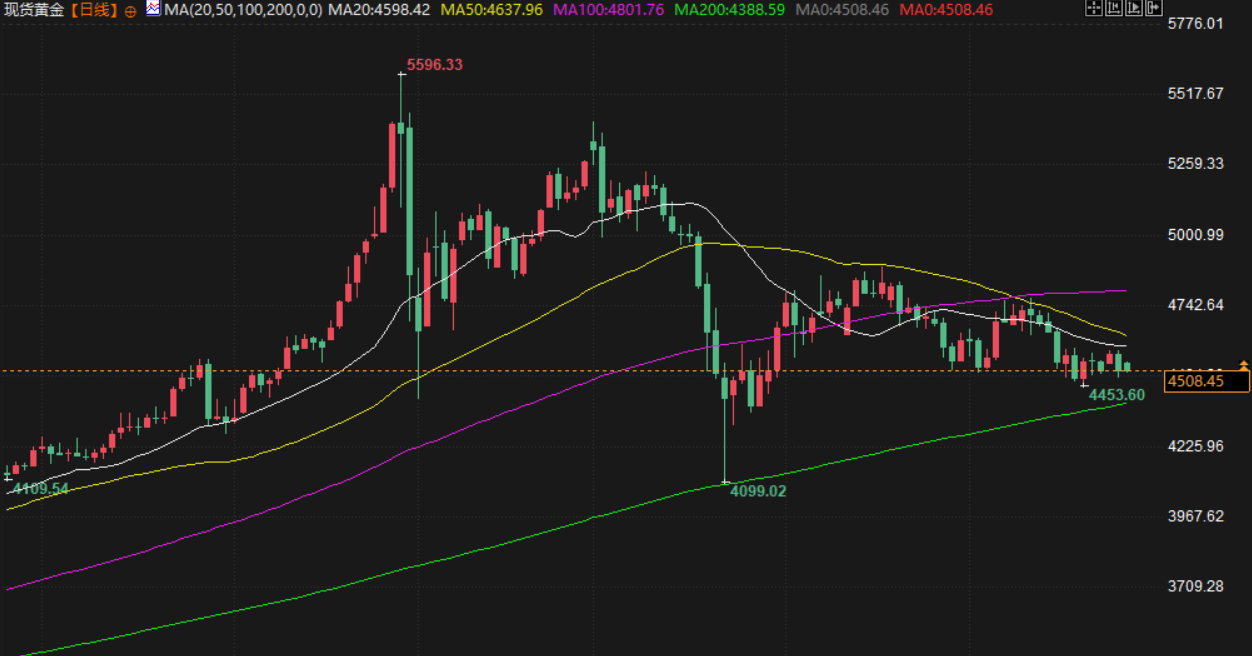
Spot gold fell 1.38% to $4,507.38 an ounce. Jim Wikoff, a market analyst at the U.S. Gold Exchange in New York, said the bond market's expectation that the Federal Reserve's next interest rate move would be a rate hike is negative for the gold market.
Warsh took office as Federal Reserve Chairman last Friday, amid rising market expectations that the Fed would tighten monetary policy, with a 25 basis point rate hike currently anticipated in December.
Although gold is seen as a hedge against inflation, this non-yielding asset typically underperforms in a high-interest-rate environment. The market will be closely watching Thursday's release of the U.S. Personal Consumption Expenditures (PCE) price index to assess inflationary pressures and the Federal Reserve's future policy path.
Meanwhile, UBS lowered its year-end gold price target by $400 to $5,500, citing persistent risks of rising yields and a stronger dollar. Spot silver fell 2.3% to $76.27 per ounce, platinum fell 1.3% to $1,942.56, and palladium fell 1.3% to $1,379.54.
Oil prices rose more than 3.6% on Tuesday, with Brent crude surging 3.67% to settle at $99.72 a barrel, while WTI crude rose 3.62% to settle at $93.57 a barrel, buoyed by the US airstrikes on Iran. This followed market disappointment following hopes that a US-Iran agreement would end the conflict and reopen the Strait of Hormuz.
U.S. gasoline and diesel futures fell 7% and 4% respectively, both hitting five-week lows. Iran accused the U.S. of violating the ceasefire agreement by launching a "defensive strike," while U.S. Secretary of State Rubio said that reaching an agreement could "take a few more days." Since the conflict began in late February, Iran has almost completely halted the passage of non-Iranian vessels through the Strait of Hormuz, severely disrupting about one-fifth of global oil and liquefied natural gas (LNG) transport. Although three LNG carriers recently passed through the strait, overall transport remains restricted.
Tensions in the Middle East have escalated again following a new round of US airstrikes against Iran, boosting the dollar slightly on Tuesday as safe-haven demand rose, with the dollar index climbing 0.17% to 99.14.
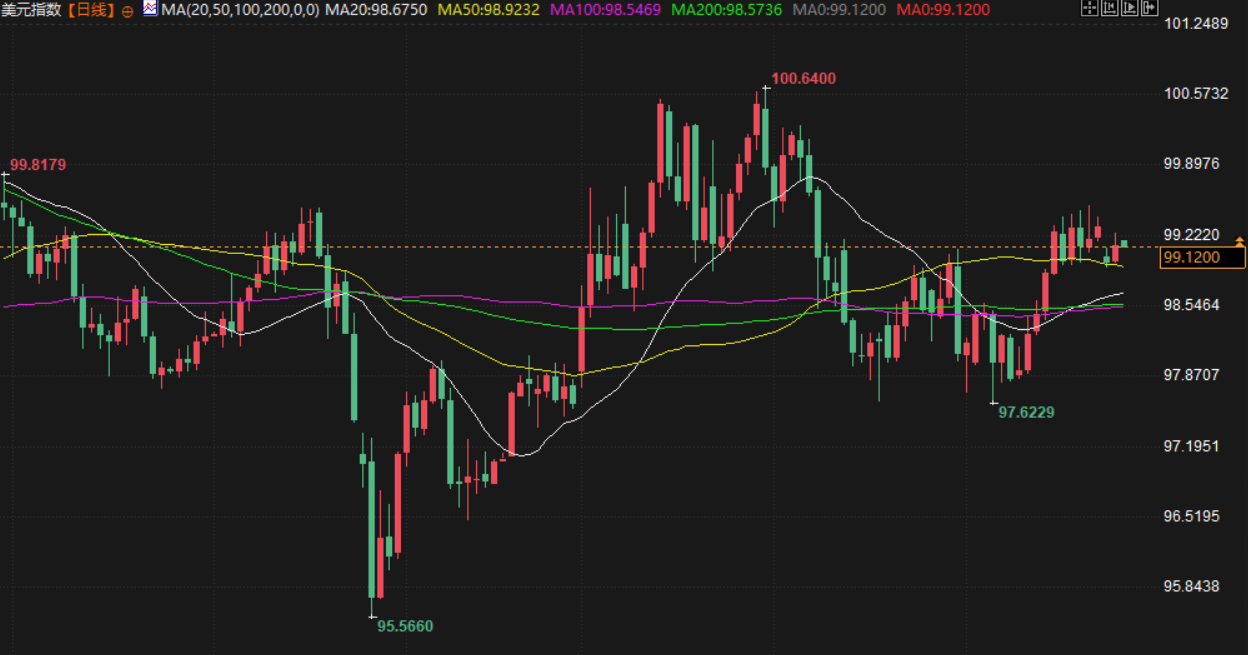
The euro fell 0.12% against the dollar to 1.1629, while the dollar rose 0.4% against the Swiss franc to 0.786. Meanwhile, the yen weakened, with the dollar rising 0.2% against the yen to 159.31, nearing the 160 level, a potential trigger for intervention.
Market hopes for a swift end to the conflict have waned, and U.S. consumer confidence declined in May due to inflation concerns. Goldman Sachs analysts noted that the foreign exchange market remains highly focused on the Middle East conflict, risk appetite, and energy price volatility, with unusually high correlations between currency pairs.
The yield on the 10-year U.S. Treasury note fell 7.6 basis points to 4.497%. In other currencies, the pound fell 0.45% to US$1.3445, and the Australian dollar fell 0.1% to US$0.7167.
The US and Iran accused each other of violating the ceasefire: the US claimed its strikes were in self-defense, while Iran accused the other of a "serious breach."
Iran on Tuesday accused the United States of a “serious violation” of the fragile ceasefire agreement that had lasted for nearly seven weeks after its strikes against targets near the Strait of Hormuz. The Iranian Foreign Ministry stated that the US military action against Hormozgan province in the south was a blatant breach of the ceasefire and reserved the right to retaliate. The US argued that its targets included missile launch sites and ships attempting to lay mines, and that the action was entirely defensive in nature. Meanwhile, US Secretary of State Marco Rubio stated that reaching an agreement to end the conflict could still take “a few more days.” Previously, both sides had indicated progress on a memorandum of understanding, which aimed to halt hostilities, restore shipping through the blocked strait, and give negotiators 60 days to resolve complex issues such as Iran's nuclear program. Iranian media reported that Iran had strongly advocated for the inclusion of the unfreezing of frozen assets in the memorandum during the Doha talks. Following the US strikes, Rubio stated firmly that the Strait of Hormuz must be opened “no matter what.” Affected by the escalating tensions, Brent crude futures rose more than 3.5% on Tuesday, returning to around $100 per barrel. Iran's Islamic Revolutionary Guard Corps claimed to have shot down a U.S. drone and fired on two other aircraft, accusing them of violating Iranian airspace. Iran's Supreme Leader Ayatollah Khamenei stated on social media that "the clock cannot be turned back" and reiterated the slogan "Down with America, down with Israel." According to Iranian media reports, the preliminary memorandum of understanding aims to cover ending the war on all fronts, establishing a 30-day framework for the resumption of shipping, and some economic relief. The unfreezing of $24 billion in frozen funds is considered the final major obstacle to finalizing the memorandum. Furthermore, Iran has demanded an end to the conflict in Lebanon, while Israeli Prime Minister Benjamin Netanyahu has declared that he is "increasing military operations in Lebanon."
The European Council extends sanctions against relevant Russian individuals and entities.
On May 26, local time, the European Council decided to extend restrictive measures against relevant Russian individuals and entities for another year, until May 28, 2027. It is understood that the EU's restrictive measures currently apply to 72 individuals and one entity in Russia under sanctions. The assets of individuals and entities on the EU sanctions list are frozen within the EU. EU citizens and companies are prohibited from providing funds to the restricted individuals. Furthermore, these sanctioned individuals are also subject to EU travel bans, prohibiting them from entering or transiting through EU countries. (CCTV News)
Iranian parliamentary leader: Challenges remain in Iran-US relations even if an agreement is reached.
On May 25 local time, Ibrahim Aziz, chairman of the National Security and Foreign Policy Committee of the Iranian Islamic Parliament, reiterated in an interview that "the Americans are unlikely to act in good faith; they are too accustomed to tearing up agreements." Aziz stated that even if Iran and the United States reach an agreement through negotiations, it does not mean the end of the conflict, nor does it mean that relations between Iran and the United States will no longer face challenges—the very actions of the United States demonstrate that "it is far from over." Aziz also emphasized that post-February 28 war Iran is "completely different" from pre-war Iran. Iran must prepare for this life-or-death struggle. (CCTV News)
Israeli forces launched a surprise attack across the border into southern Lebanon, escalating tensions ahead of a US-Iran agreement.
Israeli media reported on the 26th that, in response to Hezbollah's continued drone attacks against Israel, the Israeli military has begun ground operations beyond the "yellow line" defined by the April 17 ceasefire agreement, penetrating deeper into Lebanese territory. The Jerusalem Post reported that the extent of this operation is currently unclear. The report quoted Israeli military officials as saying that controlling specific locations outside the "yellow line" could help weaken Hezbollah's drone threat. The report stated that the purpose of this operation is unclear, but it may aim to gradually expand control over Lebanese territory, pressure Hezbollah to reduce drone attacks or even accept partial disarmament, and demonstrate to the Israeli public that the government and military are responding to security threats with a tough stance. The report noted that this escalation of the Israeli-Lebanese conflict comes at a time when there is widespread expectation that the United States and Iran will reach an agreement. A US-Iran agreement may further require a more comprehensive ceasefire between Israel and Hezbollah. (Xinhua)
FAO: Shipping issues in the Strait of Hormuz could trigger a global food security crisis
On May 26 local time, Qu Dongyu, Director-General of the Food and Agriculture Organization of the United Nations (FAO), warned at an event in Rome that the shipping problems in the Strait of Hormuz are having a systemic impact on the global agricultural and food system. He stated that if timely action is not taken, the world may face a serious food security crisis in the coming years. In a statement that day, the FAO said that the severe disruption to shipping in the Strait of Hormuz has affected the transport of oil, liquefied natural gas, and fertilizers, driving up the cost of agricultural inputs. At the same time, seed prices are also facing upward pressure because seed production relies on fertilizers. Rising energy prices have led to a comprehensive increase in the operating costs of agricultural and food systems in all regions of the world. The FAO has responded swiftly by mobilizing technical support, strengthening its monitoring and early warning system, and expanding its coordination network to actively address the current challenges. (CCTV News)
The probability of the Federal Reserve raising interest rates this year is 50.5%.
According to CME's "FedWatch": The probability of the Federal Reserve keeping interest rates unchanged by June is 99.2%, and the probability of a cumulative rate cut of 25 basis points is 0.8%. The probability of the Federal Reserve keeping interest rates unchanged by July is 88.6%, the probability of a cumulative rate hike of 25 basis points is 11.3%, and the probability of a cumulative rate cut of 25 basis points is 0%. The probability of the Federal Reserve keeping interest rates unchanged by December is 49.5%, and the probability of at least a rate hike of 25 basis points is 50.5%.
Rubio: Iran deal negotiations need more time
U.S. Secretary of State Marco Rubio stated that negotiations between the U.S. and Iran to extend the ceasefire and reopen the Strait of Hormuz are still ongoing due to disagreements over the wording of the draft agreement and will take several more days to complete. He said the U.S. insists that the waterway remain fully open and free of charge, and warned President Trump that he would not accept a "bad deal."
Industry insiders: Huawei's strategic investment presents a significant opportunity, ushering in new opportunities for the chip industry chain.
Yesterday, at the Shanghai International Circuits and Systems Symposium, He Tingbo, Director of Huawei and President of its Semiconductor Business Unit, released "Tao's Law," attracting significant attention from the industry and market. Analysts from securities research institutes explained that with the development of the chip industry in recent years, traditional wafer manufacturing has increasingly approached its limits in pursuing higher precision advanced processes at the two-dimensional level, making technological breakthroughs more difficult and leading to the emergence of various advanced packaging technologies. Huawei's "Tao's Law" provides new paths for the industry from multiple perspectives. Industry analysts believe that the biggest breakthrough of "Tao's Law" at this stage is mainly reflected in circuit layer design. If the corresponding chips are successfully mass-produced in the second half of this year, the wafer foundry segment is expected to benefit. In the future, EDA design tools at the software level, as well as upstream equipment and materials, will need to keep pace. US media even predicts that if "Tao's Law" can be widely applied, it will have a profound impact on the global chip ecosystem. (CCTV Finance)
Inbound tourism is booming, with inbound traffic turning into increased consumption.
Arriving empty-handed and leaving fully loaded has become the norm for inbound tourists visiting China. Since the national tax refund policy for departing tourists was introduced last year, Shanghai has released a three-year action plan, proposing a number of measures, including expanding service outlets, increasing product categories, promoting convenience, and optimizing the environment, to create a benchmark city for tax refunds for departing tourists. Over the past year, the popularity of Shanghai's inbound consumption market has continued to rise. Data shows that from May last year to April this year, the number of applications for "instant tax refund" for departing tourists issued in Shanghai increased by 14.7 times year-on-year, and the sales volume of "instant tax refund" increased by 9.7 times year-on-year, with more than 1,200 new tax refund stores added. With the implementation of convenient policies such as "instant tax refund," more and more overseas tourists have started a "buy, buy, buy" spree in Shenzhen. At a drone sales store in Huaqiangbei, Shenzhen, even on weekdays, the store is still crowded with people, including many overseas tourists. The reporter saw that after overseas tourists placed an order, the sales staff provided "one-stop" service to help them quickly complete the tax refund procedures. The store's sales staff said that in the first four months of this year, the store's sales increased by 40% compared to the same period last year. Data shows that from January to April this year, sales of goods eligible for tax refunds for departing tourists in Shenzhen surged by 145% year-on-year, while sales and tax refunds for goods eligible for "instant refund upon purchase" increased by 1.11 times year-on-year. (CCTV Finance)
Key Focus Today
stock market
Fueled by optimism surrounding artificial intelligence, the S&P 500 and Nasdaq indices closed at record highs on Tuesday. Micron Technology surged 19% after UBS tripled its price target to $1,625, pushing its market capitalization past the trillion-dollar mark for the first time.
Despite the recent US airstrikes on Iran causing Brent crude futures to rise by about 4%, the market was reassured by US Secretary of State Rubio's statement that an agreement to end the conflict with Tehran "could be reached in just a few days." Meanwhile, strong corporate earnings and renewed confidence in AI deals propelled tech stocks to lead the gains—the Philadelphia S&P Semiconductor Index surged 5.5% to a record high, Qualcomm rose nearly 4.5% after reaching a chip supply agreement with ByteDance, and Marvell Technology closed 6% higher.
The Dow Jones Industrial Average fell 0.23% to 50,461.68, the S&P 500 rose 0.61% to 7,519.12, and the Nasdaq Composite rose 1.19% to 26,656.18. During the session, the S&P 500, Nasdaq, and Russell 2000 all hit record highs. With the earnings season nearing its end, the market expects first-quarter earnings to grow by 29% year-over-year, far exceeding the 16.1% forecast a month ago.
Gold Market
Gold prices fell more than 1% on Tuesday as markets bet on a U.S. interest rate hike this year, after a renewed U.S. military strike on Iran dampened hopes for a peace deal and pushed up oil prices, reigniting inflation concerns.
Spot gold fell 1.38% to $4,507.38 an ounce. Jim Wikoff, a market analyst at the U.S. Gold Exchange in New York, said the bond market's expectation that the Federal Reserve's next interest rate move would be a rate hike is negative for the gold market.
Warsh took office as Federal Reserve Chairman last Friday, amid rising market expectations that the Fed would tighten monetary policy, with a 25 basis point rate hike currently anticipated in December.
Although gold is seen as a hedge against inflation, this non-yielding asset typically underperforms in a high-interest-rate environment. The market will be closely watching Thursday's release of the U.S. Personal Consumption Expenditures (PCE) price index to assess inflationary pressures and the Federal Reserve's future policy path.
Meanwhile, UBS lowered its year-end gold price target by $400 to $5,500, citing persistent risks of rising yields and a stronger dollar. Spot silver fell 2.3% to $76.27 per ounce, platinum fell 1.3% to $1,942.56, and palladium fell 1.3% to $1,379.54.
oil market
Oil prices rose more than 3.6% on Tuesday, with Brent crude surging 3.67% to settle at $99.72 a barrel, while WTI crude rose 3.62% to settle at $93.57 a barrel, buoyed by the US airstrikes on Iran. This followed market disappointment following hopes that a US-Iran agreement would end the conflict and reopen the Strait of Hormuz.
U.S. gasoline and diesel futures fell 7% and 4% respectively, both hitting five-week lows. Iran accused the U.S. of violating the ceasefire agreement by launching a "defensive strike," while U.S. Secretary of State Rubio said that reaching an agreement could "take a few more days." Since the conflict began in late February, Iran has almost completely halted the passage of non-Iranian vessels through the Strait of Hormuz, severely disrupting about one-fifth of global oil and liquefied natural gas (LNG) transport. Although three LNG carriers recently passed through the strait, overall transport remains restricted.
Foreign exchange market
Tensions in the Middle East have escalated again following a new round of US airstrikes against Iran, boosting the dollar slightly on Tuesday as safe-haven demand rose, with the dollar index climbing 0.17% to 99.14.
The euro fell 0.12% against the dollar to 1.1629, while the dollar rose 0.4% against the Swiss franc to 0.786. Meanwhile, the yen weakened, with the dollar rising 0.2% against the yen to 159.31, nearing the 160 level, a potential trigger for intervention.
Market hopes for a swift end to the conflict have waned, and U.S. consumer confidence declined in May due to inflation concerns. Goldman Sachs analysts noted that the foreign exchange market remains highly focused on the Middle East conflict, risk appetite, and energy price volatility, with unusually high correlations between currency pairs.
The yield on the 10-year U.S. Treasury note fell 7.6 basis points to 4.497%. In other currencies, the pound fell 0.45% to US$1.3445, and the Australian dollar fell 0.1% to US$0.7167.
International News
The US and Iran accused each other of violating the ceasefire: the US claimed its strikes were in self-defense, while Iran accused the other of a "serious breach."
Iran on Tuesday accused the United States of a “serious violation” of the fragile ceasefire agreement that had lasted for nearly seven weeks after its strikes against targets near the Strait of Hormuz. The Iranian Foreign Ministry stated that the US military action against Hormozgan province in the south was a blatant breach of the ceasefire and reserved the right to retaliate. The US argued that its targets included missile launch sites and ships attempting to lay mines, and that the action was entirely defensive in nature. Meanwhile, US Secretary of State Marco Rubio stated that reaching an agreement to end the conflict could still take “a few more days.” Previously, both sides had indicated progress on a memorandum of understanding, which aimed to halt hostilities, restore shipping through the blocked strait, and give negotiators 60 days to resolve complex issues such as Iran's nuclear program. Iranian media reported that Iran had strongly advocated for the inclusion of the unfreezing of frozen assets in the memorandum during the Doha talks. Following the US strikes, Rubio stated firmly that the Strait of Hormuz must be opened “no matter what.” Affected by the escalating tensions, Brent crude futures rose more than 3.5% on Tuesday, returning to around $100 per barrel. Iran's Islamic Revolutionary Guard Corps claimed to have shot down a U.S. drone and fired on two other aircraft, accusing them of violating Iranian airspace. Iran's Supreme Leader Ayatollah Khamenei stated on social media that "the clock cannot be turned back" and reiterated the slogan "Down with America, down with Israel." According to Iranian media reports, the preliminary memorandum of understanding aims to cover ending the war on all fronts, establishing a 30-day framework for the resumption of shipping, and some economic relief. The unfreezing of $24 billion in frozen funds is considered the final major obstacle to finalizing the memorandum. Furthermore, Iran has demanded an end to the conflict in Lebanon, while Israeli Prime Minister Benjamin Netanyahu has declared that he is "increasing military operations in Lebanon."
The European Council extends sanctions against relevant Russian individuals and entities.
On May 26, local time, the European Council decided to extend restrictive measures against relevant Russian individuals and entities for another year, until May 28, 2027. It is understood that the EU's restrictive measures currently apply to 72 individuals and one entity in Russia under sanctions. The assets of individuals and entities on the EU sanctions list are frozen within the EU. EU citizens and companies are prohibited from providing funds to the restricted individuals. Furthermore, these sanctioned individuals are also subject to EU travel bans, prohibiting them from entering or transiting through EU countries. (CCTV News)
Iranian parliamentary leader: Challenges remain in Iran-US relations even if an agreement is reached.
On May 25 local time, Ibrahim Aziz, chairman of the National Security and Foreign Policy Committee of the Iranian Islamic Parliament, reiterated in an interview that "the Americans are unlikely to act in good faith; they are too accustomed to tearing up agreements." Aziz stated that even if Iran and the United States reach an agreement through negotiations, it does not mean the end of the conflict, nor does it mean that relations between Iran and the United States will no longer face challenges—the very actions of the United States demonstrate that "it is far from over." Aziz also emphasized that post-February 28 war Iran is "completely different" from pre-war Iran. Iran must prepare for this life-or-death struggle. (CCTV News)
Israeli forces launched a surprise attack across the border into southern Lebanon, escalating tensions ahead of a US-Iran agreement.
Israeli media reported on the 26th that, in response to Hezbollah's continued drone attacks against Israel, the Israeli military has begun ground operations beyond the "yellow line" defined by the April 17 ceasefire agreement, penetrating deeper into Lebanese territory. The Jerusalem Post reported that the extent of this operation is currently unclear. The report quoted Israeli military officials as saying that controlling specific locations outside the "yellow line" could help weaken Hezbollah's drone threat. The report stated that the purpose of this operation is unclear, but it may aim to gradually expand control over Lebanese territory, pressure Hezbollah to reduce drone attacks or even accept partial disarmament, and demonstrate to the Israeli public that the government and military are responding to security threats with a tough stance. The report noted that this escalation of the Israeli-Lebanese conflict comes at a time when there is widespread expectation that the United States and Iran will reach an agreement. A US-Iran agreement may further require a more comprehensive ceasefire between Israel and Hezbollah. (Xinhua)
FAO: Shipping issues in the Strait of Hormuz could trigger a global food security crisis
On May 26 local time, Qu Dongyu, Director-General of the Food and Agriculture Organization of the United Nations (FAO), warned at an event in Rome that the shipping problems in the Strait of Hormuz are having a systemic impact on the global agricultural and food system. He stated that if timely action is not taken, the world may face a serious food security crisis in the coming years. In a statement that day, the FAO said that the severe disruption to shipping in the Strait of Hormuz has affected the transport of oil, liquefied natural gas, and fertilizers, driving up the cost of agricultural inputs. At the same time, seed prices are also facing upward pressure because seed production relies on fertilizers. Rising energy prices have led to a comprehensive increase in the operating costs of agricultural and food systems in all regions of the world. The FAO has responded swiftly by mobilizing technical support, strengthening its monitoring and early warning system, and expanding its coordination network to actively address the current challenges. (CCTV News)
The probability of the Federal Reserve raising interest rates this year is 50.5%.
According to CME's "FedWatch": The probability of the Federal Reserve keeping interest rates unchanged by June is 99.2%, and the probability of a cumulative rate cut of 25 basis points is 0.8%. The probability of the Federal Reserve keeping interest rates unchanged by July is 88.6%, the probability of a cumulative rate hike of 25 basis points is 11.3%, and the probability of a cumulative rate cut of 25 basis points is 0%. The probability of the Federal Reserve keeping interest rates unchanged by December is 49.5%, and the probability of at least a rate hike of 25 basis points is 50.5%.
Rubio: Iran deal negotiations need more time
U.S. Secretary of State Marco Rubio stated that negotiations between the U.S. and Iran to extend the ceasefire and reopen the Strait of Hormuz are still ongoing due to disagreements over the wording of the draft agreement and will take several more days to complete. He said the U.S. insists that the waterway remain fully open and free of charge, and warned President Trump that he would not accept a "bad deal."
Domestic News
Industry insiders: Huawei's strategic investment presents a significant opportunity, ushering in new opportunities for the chip industry chain.
Yesterday, at the Shanghai International Circuits and Systems Symposium, He Tingbo, Director of Huawei and President of its Semiconductor Business Unit, released "Tao's Law," attracting significant attention from the industry and market. Analysts from securities research institutes explained that with the development of the chip industry in recent years, traditional wafer manufacturing has increasingly approached its limits in pursuing higher precision advanced processes at the two-dimensional level, making technological breakthroughs more difficult and leading to the emergence of various advanced packaging technologies. Huawei's "Tao's Law" provides new paths for the industry from multiple perspectives. Industry analysts believe that the biggest breakthrough of "Tao's Law" at this stage is mainly reflected in circuit layer design. If the corresponding chips are successfully mass-produced in the second half of this year, the wafer foundry segment is expected to benefit. In the future, EDA design tools at the software level, as well as upstream equipment and materials, will need to keep pace. US media even predicts that if "Tao's Law" can be widely applied, it will have a profound impact on the global chip ecosystem. (CCTV Finance)
Inbound tourism is booming, with inbound traffic turning into increased consumption.
Arriving empty-handed and leaving fully loaded has become the norm for inbound tourists visiting China. Since the national tax refund policy for departing tourists was introduced last year, Shanghai has released a three-year action plan, proposing a number of measures, including expanding service outlets, increasing product categories, promoting convenience, and optimizing the environment, to create a benchmark city for tax refunds for departing tourists. Over the past year, the popularity of Shanghai's inbound consumption market has continued to rise. Data shows that from May last year to April this year, the number of applications for "instant tax refund" for departing tourists issued in Shanghai increased by 14.7 times year-on-year, and the sales volume of "instant tax refund" increased by 9.7 times year-on-year, with more than 1,200 new tax refund stores added. With the implementation of convenient policies such as "instant tax refund," more and more overseas tourists have started a "buy, buy, buy" spree in Shenzhen. At a drone sales store in Huaqiangbei, Shenzhen, even on weekdays, the store is still crowded with people, including many overseas tourists. The reporter saw that after overseas tourists placed an order, the sales staff provided "one-stop" service to help them quickly complete the tax refund procedures. The store's sales staff said that in the first four months of this year, the store's sales increased by 40% compared to the same period last year. Data shows that from January to April this year, sales of goods eligible for tax refunds for departing tourists in Shenzhen surged by 145% year-on-year, while sales and tax refunds for goods eligible for "instant refund upon purchase" increased by 1.11 times year-on-year. (CCTV Finance)
- Risk Warning and Disclaimer
- The market involves risk, and trading may not be suitable for all investors. This article is for reference only and does not constitute personal investment advice, nor does it take into account certain users’ specific investment objectives, financial situation, or other needs. Any investment decisions made based on this information are at your own risk.