4.3% Inflation Looms! Reserve Bank of New Zealand Holds Rates Steady but Makes it Clear: Significant Rate Hikes Likely in the Second Half of the Year
2026-05-27 10:17:10
New Zealand's Monetary Policy Committee voted on Wednesday (May 27) to keep the Official Cash Rate (OCR) at 2.25%.
The Reserve Bank of New Zealand (RBNZ) reported that the annual consumer price inflation rate was 3.1% in the March quarter. The Middle East conflict is pushing up short-term inflation and weakening economic activity. Inflation is projected to peak at 4.3% in the September quarter and return to the 2% target midpoint by mid-2027. Currently, core inflation, wage growth, and medium- to long-term inflation expectations remain consistent with the medium-term inflation return to the 2% target midpoint.
The Reserve Bank of New Zealand stated that uncertainty remains in the global economic landscape. Supply chain disruptions, rising petrochemical prices, and a more fragmented global trade environment are impacting the outlook. Economic growth will vary across countries, depending on energy intensity, fiscal support, and exposure to artificial intelligence investments. Overall, New Zealand's trading partners are expected to experience weaker growth and higher inflation.
The Reserve Bank of New Zealand also noted that domestically, business contacts and surveys indicated weakening confidence and spending. For some businesses, rising costs are squeezing profit margins and dampening investment and hiring intentions. Consumer confidence has declined sharply, and the housing market remains weak. Economic conditions continue to vary across regions and sectors, with high commodity prices supporting regional incomes in New Zealand.
The Reserve Bank of New Zealand's policy statement indicates that the outlook for medium-term inflationary pressures remains uncertain. These pressures are likely to remain high if households and businesses anticipate higher future costs and incorporate these expectations into their current pricing and wage-setting decisions. However, weak demand and high unemployment will likely dampen medium-term inflationary pressures.
The Reserve Bank of New Zealand stated that the Committee remains focused on ensuring that increased costs do not lead to persistently high inflation in the medium term, while avoiding unnecessary economic volatility. Overall, the OCR is likely to need to rise sooner and more significantly than anticipated in the February Monetary Policy Statement . The pace of the OCR increase will depend on the relative impact of persistent wage and pricing behavior on medium-term inflationary pressures relative to weak economic activity.
Analysts pointed out that although the Reserve Bank of New Zealand ultimately decided to keep the Open Rate of Return (OCR) unchanged at 2.25%, the overall policy signal leaned towards a hawkish stance. The statement explicitly stated that "the OCR is likely to need to be raised sooner and more significantly than expected in February," indicating that the committee's vigilance regarding inflation risks has clearly increased.
As a result, the New Zealand dollar rose more than 30 points against the US dollar in the short term, reaching a two-day high of 0.5876 as of 10:09, with a daily increase of about 0.7%.
The following is a summary of the minutes from the Reserve Bank of New Zealand's meeting.

The ongoing conflict in the Middle East is weakening economic activity and increasing short-term inflation. The Committee remains focused on ensuring that higher costs do not lead to persistently high inflation over the medium term, while avoiding unnecessary economic volatility. A prolonged period of weak economic growth and high unemployment is expected to dampen the inflationary effects over the medium term. The Committee judges that the balance of risks is tilted to the upside with respect to inflation and to the downside with respect to growth.
The Middle East conflict is disrupting global supply chains
The Middle East conflict has severely disrupted the supply of oil, natural gas, and other petroleum products transported through the Strait of Hormuz. So far, the decline in oil supply has been somewhat mitigated through inventory depletion, diversions, increased production in other regions, and demand adjustments in some countries. This helped to control oil price increases during April and May, despite the ongoing conflict. However, since the start of the conflict, petroleum product prices have risen sharply, leading to increased prices for fuels and petrochemical-intensive inputs such as plastics and fertilizers.
The committee noted that the energy price outlook depends on how the conflict evolves, the extent of damage to Middle Eastern energy infrastructure, and the speed of global supply chain adjustments. Members believe these events will prompt companies to permanently reconfigure their supply chains to reduce exposure to the region. Coupled with increased global demand for renewable energy, this could exert further upward pressure on global energy prices in the near term.
The pricing in the oil futures market aligns with expectations that the conflict will be resolved in the coming months and that shipping will resume through the Strait of Hormuz. However, given the damage to energy infrastructure and the need to rebuild inventories, oil prices are expected to remain high in the medium term.
Inflation is rising in trading partners
The committee noted that rising energy prices have pushed up headline inflation in many of New Zealand's trading partners in recent months. Inflation in these partners is expected to rise further as the direct and indirect effects of higher costs materialize. Members pointed out that the extent to which higher costs are transmitted to short-term inflation will vary across economies, depending on factors such as energy intensity, price controls, changes in subsidies or taxes. Current differences in economic conditions, including the degree of capacity pressure, will influence the level of medium-term inflationary pressures in trading partners.
The Middle East conflict poses a downside risk to global economic activity. High-frequency indicators show that higher petrochemical prices are dampening confidence and real income in many economies. Economies more reliant on imported energy and energy-intensive manufacturing, including many of New Zealand's Asian trading partners, are most affected. In some cases, these headwinds may be partially offset by continued strong demand for artificial intelligence exports and fiscal support.
New Zealand's economy was recovering before the Middle East conflict.
The committee noted that New Zealand was in the early stages of economic recovery prior to the conflict. GDP growth for the December 2025 quarter was 0.2%, below expectations, but timely indicators suggested continued economic expansion in the March 2026 quarter. For example, retail spending strengthened across sectors, and businesses reported increased capacity constraints, consistent with the strengthening recovery momentum.
New Zealand's economy has long suffered from significant spare capacity. This is reflected in several indicators, with the output gap for the March 2026 quarter estimated at -1.3% of potential output, largely consistent with the February estimate.
The labor market is stabilizing, with moderate employment growth and annual wage inflation remaining at 2% in the March 2026 quarter. Net migration has increased significantly since the end of 2025. The unemployment rate remains high, indicating slack in the labor market.
The annualized inflation rate remained at 3.1% in the March quarter, higher than expected in the February statement, primarily due to higher fuel prices in March. Underlying inflation continued to moderate gradually, with core inflation measures averaging 2.3%.
Short-term inflation is expected to rise, and economic growth will weaken.
The first round of direct and indirect effects from higher petrochemical product prices will push up inflation this year. The direct effects of rising corporate fuel prices are expected to outpace the indirect effects of rising petrochemical-intensive input prices. Intelligence from business contacts indicates that some companies have already implemented temporary fuel surcharges, although the extent varies by industry. Some companies are absorbing increased costs into profit margins amid weak demand, while others are incorporating higher costs into price adjustments.
The committee noted that its short-term inflation forecasts are subject to significant uncertainty. These forecasts incorporate current oil futures pricing and assume that Dubai crude oil prices will fall to $96 by the end of this year. Annual headline inflation is projected to peak at 4.3% in the September 2026 quarter and return to the midpoint of the target by mid-2027. While short-term inflation expectations have risen somewhat, medium- to long-term expectations remain close to 2%.
Due to the conflict in the Middle East, short-term economic activity is likely to be weaker than assumed in the February statement. Higher fuel prices are increasing costs, reducing profit margins for many businesses, and decreasing real income and household purchasing power. High-frequency data, including electronic card transactions and indicators of business and consumer confidence, all point to weak short-term demand. With consumption and investment weakening, annual GDP growth in 2026 is now projected to be 0.9 percentage points lower than assumed in the February statement. These projections suggest a slower short-term economic recovery, with the pace of economic growth accelerating by the end of the year.
Financial conditions have tightened
Domestic and international market expectations for central bank policy rates have risen. The Committee discussed differences in economic starting points, fiscal and structural policy responses to higher fuel prices, and how dependence on imported energy will affect the monetary policy responses needed to curb inflation in the medium term.
The committee noted that financial conditions in New Zealand have tightened through rising wholesale rates, which have been transmitted to higher fixed-term mortgage rates (and to a lesser extent, time deposit rates). The average interest rate on outstanding mortgages fell to 4.9% in March, but is expected to rise to 5.3% over the next 12 months.
Global financial market volatility increased sharply in March due to the Middle East conflict, but subsided after a ceasefire in early April. Global risk appetite subsequently improved, partly due to a significant upward revision of earnings growth forecasts for US technology companies, which boosted global stock markets. The New Zealand dollar's trade-weighted exchange rate experienced some fluctuations but has remained largely unchanged since the beginning of the year.
The committee also heard a briefing on the stability of the financial system and unanimously agreed that this would not pose a significant trade-off to achieving the inflation target.
The committee discussed the risks to the inflation outlook.
The members noted the uncertainty surrounding the scale and duration of the global economic consequences of the Middle East conflict, and how this shock will spread through the New Zealand economy and affect medium-term inflationary pressures.
The Committee discussed the risk of short-term inflation rising and then transmitting to medium-term inflation. Members noted that business pricing behavior is likely to be more persistent due to persistently high overall inflation since the pandemic and the cost-push nature of the current shock. This would lead to a stronger second-round inflation effect than currently assumed. This risk is exacerbated by lower profit margins for some businesses due to weak activity and rising costs, limiting their ability to absorb further cost increases. Labor shortages in certain sectors and regions could also trigger wage pressures. However, if the recent trend of increasing net migration continues, it will help offset this risk.
Members noted that domestic spare capacity and weak global demand may limit firms' ability to pass on higher costs to a greater extent than the center's forecasts assume. Reduced household spending due to slower real income growth, persistently high unemployment, a weak housing market, and diminished resilience due to repeated shocks collectively pose downside risks to domestic economic activity. However, if a resolution to the Middle East conflict leads to lower domestic fuel prices, economic activity could recover faster than assumed.
The Committee discussed risks to the global growth outlook. On the downside, members noted that high and rising global government debt ratios, coupled with escalating geopolitical fragmentation, could push up long-term bond yields, tighten financial conditions, and drag down global growth. The Committee also noted that earnings expectations and valuations in the U.S. stock market remain high, and if revenue from artificial intelligence products fails to meet expectations, it could trigger a shock, posing a downside risk to global growth.
On the upside, members agreed that New Zealand's export demand could be stronger than expected if its Asian trading partners continue to benefit from robust manufacturing investment. Further investment from large technology companies, as well as stronger investment in economic and military security sectors, could also continue to boost the global economy through stronger economic activity in Asia, Europe, and the United States.
The Committee noted the three alternative scenarios in its May statement. These scenarios provide a trade-off for the Committee’s discussions and decisions. These scenarios represent only three of many possible paths for the domestic economy and inflation. In reality, monetary policy decisions depend on a wide range of factors, including current economic conditions, the outlook for inflationary pressures over the medium term, and the Committee’s secondary objectives of avoiding unnecessary economic instability and taking into account the stability of the financial system.
The committee voted to maintain the OCR at 2.25%.
The Committee emphasized its continued focus on ensuring that core inflation, wage growth, and medium- to long-term inflation expectations are aligned with the medium-term inflation target of 2%. It discussed the monetary conditions required to achieve the medium-term inflation target. Members noted that financial conditions have tightened significantly this year, helping to mitigate the risk of a second round of price effects.
All committee members agreed that the central forecast for OCR was appropriate and well reflected the current trade-offs. However, members disagreed on the preferred timing for the first upward adjustment of OCR.
The three members (Anna Breman, Karen Silk, and Paul Conway) deemed it appropriate to maintain the OCR at 2.25% at this meeting. They emphasized that core inflation and wage growth remain under control, with medium- to long-term inflation expectations hovering around 2%. Economic activity indicators have deteriorated, in some cases faster than expected. Tightening financial conditions and economic uncertainty are already dampening household and business confidence, thereby reducing consumption and investment. Spare capacity in the economy is likely to suppress a second round of inflationary pressures.
With inflationary pressures rising in the coming months, these members agreed that the Open Rate of Return (OCR) needs to be raised to ensure inflation returns to its target over the medium term. They noted the broad range of neutral rate estimates, making it difficult to assess the degree of easing in current monetary conditions. They emphasized that the timing of the OCR increase should depend on evolving data, the outlook, and the balance of risks. Close monitoring of global developments, supply chain normalization, core inflation, wage dynamics, and inflation expectations is necessary. These data, along with high-frequency indicators, will clarify whether a stronger second round of inflationary effects is emerging.
The three members (Carl Hansen, Hayley Gourley, and Prasanna Gai) favored raising the OCR by 25 basis points to 2.5% at this meeting. They emphasized that given the conflict's impact on numerous key inputs, the first round of indirect price increases could become more widespread, increasing the risk of a second round of price increases. They noted that 2-year inflation expectations have risen in multiple surveys. Businesses may reset prices based on a shared belief in the persistence of the shock, with prices remaining high even after the shock subsides. Furthermore, a faster recovery in confidence could lead to stronger demand if domestic fuel prices fall faster than expected. The members pointed out that monetary conditions remain accommodative. In addition, inflation in New Zealand's trading partners may rise faster than expected due to supply constraints caused by the Middle East conflict and demand boosted by AI-related spending.
These members believed that removing stimulus now, while observing domestic economic developments, would help reduce medium-term inflation risks. Given the upward pressure on the neutral interest rate, which could limit the overall magnitude of the OCR increase and its negative impact on output, they considered an earlier increase preferable. One member (Carl Hansen) emphasized that raising the OCR at this meeting would also create room for further monetary policy tightening in July.
All Committee members agreed that it would likely be necessary to raise the OCR at the upcoming meeting to ensure that a rise in short-term inflation does not transmit to higher medium-term inflation. The Committee considers this a proportionate response to bringing inflation back to the target within a reasonable timeframe without causing unnecessary fluctuations in output. The pace of the OCR increase will depend on the relative impact of persistent wage and pricing behavior on medium-term inflationary pressures relative to weak economic activity.
On Wednesday, May 27, three committee members (Anna Breman, Karen Silk, and Paul Conway) voted to keep the OCR unchanged, while three members (Carl Hansen, Hayley Gourley, and Prasanna Gai) voted to raise it by 25 basis points. In this case, the chair has the deciding vote, and therefore the OCR remains unchanged at 2.25%. The committee remains focused on bringing inflation back to its target over the medium term and anticipates that an upward revision of the OCR will be necessary this year.
This meeting revealed a clear division. The chairman's decisive vote kept interest rates unchanged, indicating a dovish stance in the short term; however, the overall tone and future guidance leaned hawkish, which the market could interpret as "holding back, but the arrow is already on the bowstring."
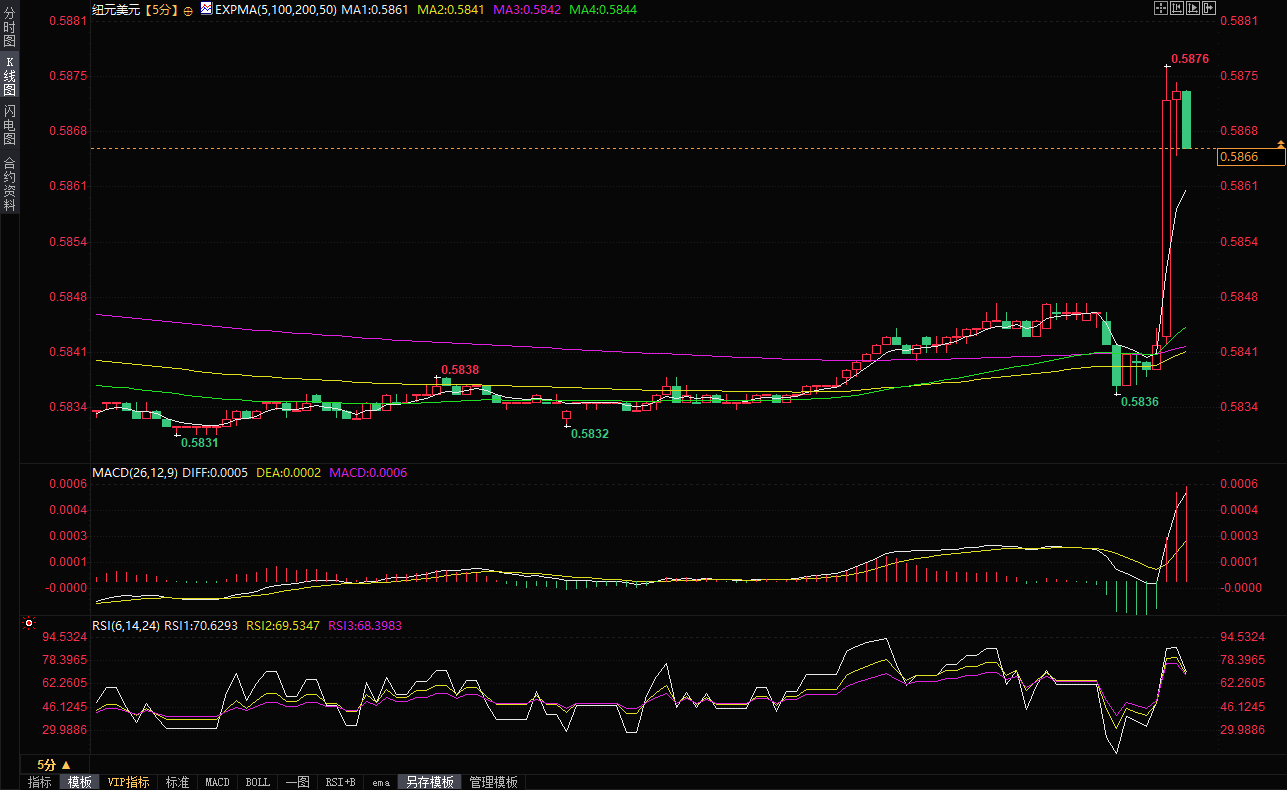
(NZD/USD 5-minute chart, source: EasyForex)
At 10:13 Beijing time, the New Zealand dollar is trading at 0.5867/68 against the US dollar.
The Reserve Bank of New Zealand (RBNZ) reported that the annual consumer price inflation rate was 3.1% in the March quarter. The Middle East conflict is pushing up short-term inflation and weakening economic activity. Inflation is projected to peak at 4.3% in the September quarter and return to the 2% target midpoint by mid-2027. Currently, core inflation, wage growth, and medium- to long-term inflation expectations remain consistent with the medium-term inflation return to the 2% target midpoint.
The Reserve Bank of New Zealand stated that uncertainty remains in the global economic landscape. Supply chain disruptions, rising petrochemical prices, and a more fragmented global trade environment are impacting the outlook. Economic growth will vary across countries, depending on energy intensity, fiscal support, and exposure to artificial intelligence investments. Overall, New Zealand's trading partners are expected to experience weaker growth and higher inflation.
The Reserve Bank of New Zealand also noted that domestically, business contacts and surveys indicated weakening confidence and spending. For some businesses, rising costs are squeezing profit margins and dampening investment and hiring intentions. Consumer confidence has declined sharply, and the housing market remains weak. Economic conditions continue to vary across regions and sectors, with high commodity prices supporting regional incomes in New Zealand.
The Reserve Bank of New Zealand's policy statement indicates that the outlook for medium-term inflationary pressures remains uncertain. These pressures are likely to remain high if households and businesses anticipate higher future costs and incorporate these expectations into their current pricing and wage-setting decisions. However, weak demand and high unemployment will likely dampen medium-term inflationary pressures.
The Reserve Bank of New Zealand stated that the Committee remains focused on ensuring that increased costs do not lead to persistently high inflation in the medium term, while avoiding unnecessary economic volatility. Overall, the OCR is likely to need to rise sooner and more significantly than anticipated in the February Monetary Policy Statement . The pace of the OCR increase will depend on the relative impact of persistent wage and pricing behavior on medium-term inflationary pressures relative to weak economic activity.
Analysts pointed out that although the Reserve Bank of New Zealand ultimately decided to keep the Open Rate of Return (OCR) unchanged at 2.25%, the overall policy signal leaned towards a hawkish stance. The statement explicitly stated that "the OCR is likely to need to be raised sooner and more significantly than expected in February," indicating that the committee's vigilance regarding inflation risks has clearly increased.
As a result, the New Zealand dollar rose more than 30 points against the US dollar in the short term, reaching a two-day high of 0.5876 as of 10:09, with a daily increase of about 0.7%.
The following is a summary of the minutes from the Reserve Bank of New Zealand's meeting.
Meeting Minutes Summary – May 2026
The ongoing conflict in the Middle East is weakening economic activity and increasing short-term inflation. The Committee remains focused on ensuring that higher costs do not lead to persistently high inflation over the medium term, while avoiding unnecessary economic volatility. A prolonged period of weak economic growth and high unemployment is expected to dampen the inflationary effects over the medium term. The Committee judges that the balance of risks is tilted to the upside with respect to inflation and to the downside with respect to growth.
The Middle East conflict is disrupting global supply chains
The Middle East conflict has severely disrupted the supply of oil, natural gas, and other petroleum products transported through the Strait of Hormuz. So far, the decline in oil supply has been somewhat mitigated through inventory depletion, diversions, increased production in other regions, and demand adjustments in some countries. This helped to control oil price increases during April and May, despite the ongoing conflict. However, since the start of the conflict, petroleum product prices have risen sharply, leading to increased prices for fuels and petrochemical-intensive inputs such as plastics and fertilizers.
The committee noted that the energy price outlook depends on how the conflict evolves, the extent of damage to Middle Eastern energy infrastructure, and the speed of global supply chain adjustments. Members believe these events will prompt companies to permanently reconfigure their supply chains to reduce exposure to the region. Coupled with increased global demand for renewable energy, this could exert further upward pressure on global energy prices in the near term.
The pricing in the oil futures market aligns with expectations that the conflict will be resolved in the coming months and that shipping will resume through the Strait of Hormuz. However, given the damage to energy infrastructure and the need to rebuild inventories, oil prices are expected to remain high in the medium term.
Inflation is rising in trading partners
The committee noted that rising energy prices have pushed up headline inflation in many of New Zealand's trading partners in recent months. Inflation in these partners is expected to rise further as the direct and indirect effects of higher costs materialize. Members pointed out that the extent to which higher costs are transmitted to short-term inflation will vary across economies, depending on factors such as energy intensity, price controls, changes in subsidies or taxes. Current differences in economic conditions, including the degree of capacity pressure, will influence the level of medium-term inflationary pressures in trading partners.
The Middle East conflict poses a downside risk to global economic activity. High-frequency indicators show that higher petrochemical prices are dampening confidence and real income in many economies. Economies more reliant on imported energy and energy-intensive manufacturing, including many of New Zealand's Asian trading partners, are most affected. In some cases, these headwinds may be partially offset by continued strong demand for artificial intelligence exports and fiscal support.
New Zealand's economy was recovering before the Middle East conflict.
The committee noted that New Zealand was in the early stages of economic recovery prior to the conflict. GDP growth for the December 2025 quarter was 0.2%, below expectations, but timely indicators suggested continued economic expansion in the March 2026 quarter. For example, retail spending strengthened across sectors, and businesses reported increased capacity constraints, consistent with the strengthening recovery momentum.
New Zealand's economy has long suffered from significant spare capacity. This is reflected in several indicators, with the output gap for the March 2026 quarter estimated at -1.3% of potential output, largely consistent with the February estimate.
The labor market is stabilizing, with moderate employment growth and annual wage inflation remaining at 2% in the March 2026 quarter. Net migration has increased significantly since the end of 2025. The unemployment rate remains high, indicating slack in the labor market.
The annualized inflation rate remained at 3.1% in the March quarter, higher than expected in the February statement, primarily due to higher fuel prices in March. Underlying inflation continued to moderate gradually, with core inflation measures averaging 2.3%.
Short-term inflation is expected to rise, and economic growth will weaken.
The first round of direct and indirect effects from higher petrochemical product prices will push up inflation this year. The direct effects of rising corporate fuel prices are expected to outpace the indirect effects of rising petrochemical-intensive input prices. Intelligence from business contacts indicates that some companies have already implemented temporary fuel surcharges, although the extent varies by industry. Some companies are absorbing increased costs into profit margins amid weak demand, while others are incorporating higher costs into price adjustments.
The committee noted that its short-term inflation forecasts are subject to significant uncertainty. These forecasts incorporate current oil futures pricing and assume that Dubai crude oil prices will fall to $96 by the end of this year. Annual headline inflation is projected to peak at 4.3% in the September 2026 quarter and return to the midpoint of the target by mid-2027. While short-term inflation expectations have risen somewhat, medium- to long-term expectations remain close to 2%.
Due to the conflict in the Middle East, short-term economic activity is likely to be weaker than assumed in the February statement. Higher fuel prices are increasing costs, reducing profit margins for many businesses, and decreasing real income and household purchasing power. High-frequency data, including electronic card transactions and indicators of business and consumer confidence, all point to weak short-term demand. With consumption and investment weakening, annual GDP growth in 2026 is now projected to be 0.9 percentage points lower than assumed in the February statement. These projections suggest a slower short-term economic recovery, with the pace of economic growth accelerating by the end of the year.
Financial conditions have tightened
Domestic and international market expectations for central bank policy rates have risen. The Committee discussed differences in economic starting points, fiscal and structural policy responses to higher fuel prices, and how dependence on imported energy will affect the monetary policy responses needed to curb inflation in the medium term.
The committee noted that financial conditions in New Zealand have tightened through rising wholesale rates, which have been transmitted to higher fixed-term mortgage rates (and to a lesser extent, time deposit rates). The average interest rate on outstanding mortgages fell to 4.9% in March, but is expected to rise to 5.3% over the next 12 months.
Global financial market volatility increased sharply in March due to the Middle East conflict, but subsided after a ceasefire in early April. Global risk appetite subsequently improved, partly due to a significant upward revision of earnings growth forecasts for US technology companies, which boosted global stock markets. The New Zealand dollar's trade-weighted exchange rate experienced some fluctuations but has remained largely unchanged since the beginning of the year.
The committee also heard a briefing on the stability of the financial system and unanimously agreed that this would not pose a significant trade-off to achieving the inflation target.
The committee discussed the risks to the inflation outlook.
The members noted the uncertainty surrounding the scale and duration of the global economic consequences of the Middle East conflict, and how this shock will spread through the New Zealand economy and affect medium-term inflationary pressures.
The Committee discussed the risk of short-term inflation rising and then transmitting to medium-term inflation. Members noted that business pricing behavior is likely to be more persistent due to persistently high overall inflation since the pandemic and the cost-push nature of the current shock. This would lead to a stronger second-round inflation effect than currently assumed. This risk is exacerbated by lower profit margins for some businesses due to weak activity and rising costs, limiting their ability to absorb further cost increases. Labor shortages in certain sectors and regions could also trigger wage pressures. However, if the recent trend of increasing net migration continues, it will help offset this risk.
Members noted that domestic spare capacity and weak global demand may limit firms' ability to pass on higher costs to a greater extent than the center's forecasts assume. Reduced household spending due to slower real income growth, persistently high unemployment, a weak housing market, and diminished resilience due to repeated shocks collectively pose downside risks to domestic economic activity. However, if a resolution to the Middle East conflict leads to lower domestic fuel prices, economic activity could recover faster than assumed.
The Committee discussed risks to the global growth outlook. On the downside, members noted that high and rising global government debt ratios, coupled with escalating geopolitical fragmentation, could push up long-term bond yields, tighten financial conditions, and drag down global growth. The Committee also noted that earnings expectations and valuations in the U.S. stock market remain high, and if revenue from artificial intelligence products fails to meet expectations, it could trigger a shock, posing a downside risk to global growth.
On the upside, members agreed that New Zealand's export demand could be stronger than expected if its Asian trading partners continue to benefit from robust manufacturing investment. Further investment from large technology companies, as well as stronger investment in economic and military security sectors, could also continue to boost the global economy through stronger economic activity in Asia, Europe, and the United States.
The Committee noted the three alternative scenarios in its May statement. These scenarios provide a trade-off for the Committee’s discussions and decisions. These scenarios represent only three of many possible paths for the domestic economy and inflation. In reality, monetary policy decisions depend on a wide range of factors, including current economic conditions, the outlook for inflationary pressures over the medium term, and the Committee’s secondary objectives of avoiding unnecessary economic instability and taking into account the stability of the financial system.
The committee voted to maintain the OCR at 2.25%.
The Committee emphasized its continued focus on ensuring that core inflation, wage growth, and medium- to long-term inflation expectations are aligned with the medium-term inflation target of 2%. It discussed the monetary conditions required to achieve the medium-term inflation target. Members noted that financial conditions have tightened significantly this year, helping to mitigate the risk of a second round of price effects.
All committee members agreed that the central forecast for OCR was appropriate and well reflected the current trade-offs. However, members disagreed on the preferred timing for the first upward adjustment of OCR.
The three members (Anna Breman, Karen Silk, and Paul Conway) deemed it appropriate to maintain the OCR at 2.25% at this meeting. They emphasized that core inflation and wage growth remain under control, with medium- to long-term inflation expectations hovering around 2%. Economic activity indicators have deteriorated, in some cases faster than expected. Tightening financial conditions and economic uncertainty are already dampening household and business confidence, thereby reducing consumption and investment. Spare capacity in the economy is likely to suppress a second round of inflationary pressures.
With inflationary pressures rising in the coming months, these members agreed that the Open Rate of Return (OCR) needs to be raised to ensure inflation returns to its target over the medium term. They noted the broad range of neutral rate estimates, making it difficult to assess the degree of easing in current monetary conditions. They emphasized that the timing of the OCR increase should depend on evolving data, the outlook, and the balance of risks. Close monitoring of global developments, supply chain normalization, core inflation, wage dynamics, and inflation expectations is necessary. These data, along with high-frequency indicators, will clarify whether a stronger second round of inflationary effects is emerging.
The three members (Carl Hansen, Hayley Gourley, and Prasanna Gai) favored raising the OCR by 25 basis points to 2.5% at this meeting. They emphasized that given the conflict's impact on numerous key inputs, the first round of indirect price increases could become more widespread, increasing the risk of a second round of price increases. They noted that 2-year inflation expectations have risen in multiple surveys. Businesses may reset prices based on a shared belief in the persistence of the shock, with prices remaining high even after the shock subsides. Furthermore, a faster recovery in confidence could lead to stronger demand if domestic fuel prices fall faster than expected. The members pointed out that monetary conditions remain accommodative. In addition, inflation in New Zealand's trading partners may rise faster than expected due to supply constraints caused by the Middle East conflict and demand boosted by AI-related spending.
These members believed that removing stimulus now, while observing domestic economic developments, would help reduce medium-term inflation risks. Given the upward pressure on the neutral interest rate, which could limit the overall magnitude of the OCR increase and its negative impact on output, they considered an earlier increase preferable. One member (Carl Hansen) emphasized that raising the OCR at this meeting would also create room for further monetary policy tightening in July.
All Committee members agreed that it would likely be necessary to raise the OCR at the upcoming meeting to ensure that a rise in short-term inflation does not transmit to higher medium-term inflation. The Committee considers this a proportionate response to bringing inflation back to the target within a reasonable timeframe without causing unnecessary fluctuations in output. The pace of the OCR increase will depend on the relative impact of persistent wage and pricing behavior on medium-term inflationary pressures relative to weak economic activity.
On Wednesday, May 27, three committee members (Anna Breman, Karen Silk, and Paul Conway) voted to keep the OCR unchanged, while three members (Carl Hansen, Hayley Gourley, and Prasanna Gai) voted to raise it by 25 basis points. In this case, the chair has the deciding vote, and therefore the OCR remains unchanged at 2.25%. The committee remains focused on bringing inflation back to its target over the medium term and anticipates that an upward revision of the OCR will be necessary this year.
Summarize
This meeting revealed a clear division. The chairman's decisive vote kept interest rates unchanged, indicating a dovish stance in the short term; however, the overall tone and future guidance leaned hawkish, which the market could interpret as "holding back, but the arrow is already on the bowstring."
(NZD/USD 5-minute chart, source: EasyForex)
At 10:13 Beijing time, the New Zealand dollar is trading at 0.5867/68 against the US dollar.
- Risk Warning and Disclaimer
- The market involves risk, and trading may not be suitable for all investors. This article is for reference only and does not constitute personal investment advice, nor does it take into account certain users’ specific investment objectives, financial situation, or other needs. Any investment decisions made based on this information are at your own risk.