The 160 mark is just around the corner! Will the Japanese authorities intervene again?
2026-05-27 10:21:31
On Wednesday (May 27) during the Asian morning session, the US dollar fluctuated narrowly against the Japanese yen, currently trading around 159.30.
The market is awaiting two key variables: whether Japanese authorities will intervene again, and whether US inflation data can provide clearer guidance for the Federal Reserve's policy path.
In addition, the U.S. April Personal Consumption Expenditures Price Index report will be released later on Thursday, becoming the focus of the market.
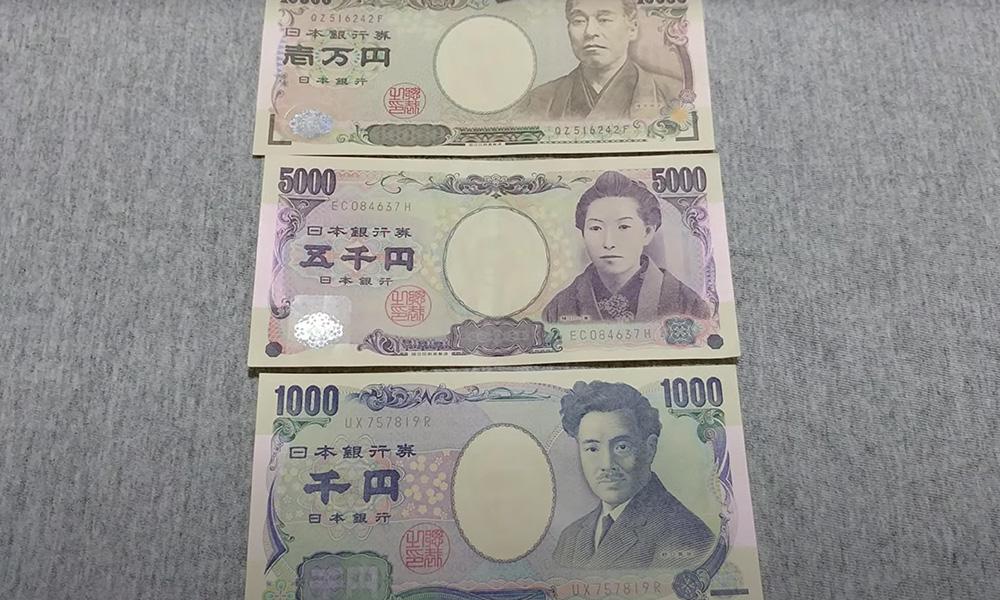
Traders remain highly vigilant against further currency intervention, with Japan's top foreign exchange diplomat, Jun Mimura, warning that he will continue to closely monitor speculative short positions.
Mimura had previously issued a rare "final warning" after the yen broke through the 160 mark at the end of April, after which Japanese authorities were reported to have intervened for the first time in nearly two years, injecting approximately 10 trillion yen. This round of intervention had pushed the dollar/yen exchange rate down from above 160 to around 155, but the effect has gradually faded, and the yen has given back more than half of its gains since the intervention.
Although Mimura's current rhetoric has softened somewhat compared to the end of April, his statement of "continuing to closely monitor" is still interpreted by the market as: the authorities will not tolerate the 160 mark being easily breached again.
Finance Minister Katsunobu Kato stated that Japan is prepared to act on excessive foreign exchange volatility while ensuring that any intervention avoids pushing up U.S. Treasury yields. This "handcuffed intervention" statement reveals the core dilemma facing the Japanese authorities—Japan holds approximately $1.4 trillion in foreign exchange reserves, the majority of which are held in the form of U.S. Treasury bonds. Selling U.S. bonds to raise funds for intervention could push up U.S. Treasury yields, thereby strengthening the dollar and weakening the effectiveness of the intervention.
During his previous visit to Japan, US Treasury Secretary Bessenter clearly stated that the US preferred Japan to support the yen through interest rate hikes rather than selling US Treasury bonds. Kato's statement was intended to reassure the US and signal that "Japan will not disrupt the US Treasury market to save the yen." However, the first two rounds of intervention have already consumed approximately 10 trillion yen (about US$63.3 billion), only resulting in a brief rebound. "Targeted intervention" alone cannot reverse the interest rate-driven depreciation trend.
Traders generally believe that any verbal intervention will only have a temporary deterrent effect until the Bank of Japan actually shifts to raising interest rates at its June meeting.
Bank of Japan Governor Kazuo Ueda said on Wednesday that the current Middle East conflict is Japan's fifth major oil shock, and warned that initial conditions such as wages, inflation expectations, and exchange rates will determine whether the shock is temporary or persistent.
Ueda points out that rising oil prices will first worsen terms of trade and damage the real economy, putting downward pressure on potential inflation; however, if high oil prices persist long enough, they may also raise inflation expectations, thus pushing up core inflation. Japan is currently at a delicate balance: on the one hand, the Spring Equinox achieved a wage increase of about 5%, laying the foundation for reversing deflationary sentiment; on the other hand, the yen has depreciated to a near 40-year low, significantly increasing import costs. If the conflict continues for a long time, supply chain disruptions could further damage fragile production activities.
Against this backdrop, the Bank of Japan faces a dilemma between "fighting inflation" and "stabilizing growth": raising interest rates too quickly could inadvertently harm the production side, while remaining inactive would allow the yen's depreciation to further erode purchasing power. Ueda's statement suggests that the central bank will not rush to raise interest rates simply because of a short-term surge in oil prices, but will closely observe whether a wage-inflation spiral has truly formed, remaining cautious until it confirms that the economy's endogenous growth momentum is strong enough.
On Tuesday, the United States launched defensive strikes against ships and missile launch sites in Iran, raising concerns about a renewed escalation of tensions in the Middle East.
U.S. Central Command spokesman Captain Tim Hawkins said the strikes targeted missile launch sites and Iranian vessels attempting to lay mines in the Strait of Hormuz, and were aimed at “protecting U.S. forces from the threat posed by Iranian forces.”
Hawkins stated that the US military would continue to "exercise restraint" during the ongoing ceasefire. According to Phoenix TV, two Iranian Islamic Revolutionary Guard Corps vessels were discovered laying mines in the Strait of Hormuz, which the US military subsequently destroyed. The US also struck an air-to-air missile site in Bandar Abbas that was targeting US warplanes. Iran's official student news agency reported that at least three people were killed in the attack.
The Iranian Islamic Revolutionary Guard Corps subsequently issued a strong statement, warning that Iran has the "legitimate and inevitable" right to retaliate against any violation of the ceasefire by the United States and will respond in kind.
In summary, the interplay surrounding these two major variables is the core reason for the current narrow consolidation of the USD/JPY pair. On one hand, intervention warnings from Katsunobu Kato and Jun Mimura have heightened market vigilance regarding potential government action at the 160 level, providing support for the yen. On the other hand, the market remains cautious ahead of Thursday's US PCE data release, as any unexpectedly high inflation reading could push up US Treasury yields, thus diminishing the yen's upside potential. Furthermore, while US-Iran tensions have provided additional safe-haven buying for the yen, Kazuo Ueda's warnings about an energy shock also remind the market that the yen's medium-term trajectory ultimately depends on oil price developments and inflation expectations.
From the daily chart, USD/JPY is currently trading around 159.30, in a high-level consolidation phase after a continuous rise. Several technical indicators show bullish signals, but the momentum has slowed down.
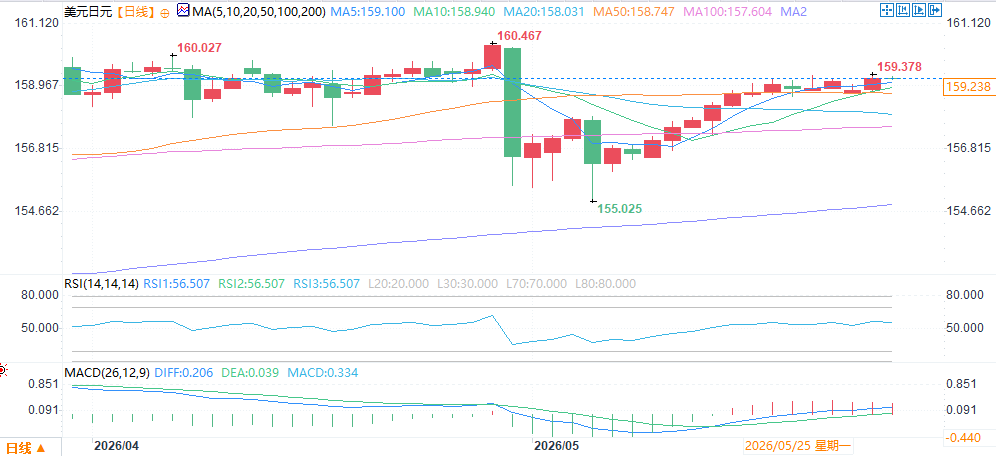
(USD/JPY daily chart, source: FX678)
Regarding the moving average system, the short-term moving averages MA5 (159.10), MA10 (158.94), MA20 (158.03), and MA50 (158.75) are all below the current price, forming short-term support; while MA100 (157.60) is well below the current price, showing a bullish alignment. This alignment of "price above all major moving averages" indicates that USD/JPY remains in a clear upward trend.
At 10:21 Beijing time on May 27, the USD/JPY exchange rate was 159.27/28.
The market is awaiting two key variables: whether Japanese authorities will intervene again, and whether US inflation data can provide clearer guidance for the Federal Reserve's policy path.
In addition, the U.S. April Personal Consumption Expenditures Price Index report will be released later on Thursday, becoming the focus of the market.
Intervention Risk: Officials warn of close monitoring of speculative short sellers and readiness to act.
Traders remain highly vigilant against further currency intervention, with Japan's top foreign exchange diplomat, Jun Mimura, warning that he will continue to closely monitor speculative short positions.
Mimura had previously issued a rare "final warning" after the yen broke through the 160 mark at the end of April, after which Japanese authorities were reported to have intervened for the first time in nearly two years, injecting approximately 10 trillion yen. This round of intervention had pushed the dollar/yen exchange rate down from above 160 to around 155, but the effect has gradually faded, and the yen has given back more than half of its gains since the intervention.
Although Mimura's current rhetoric has softened somewhat compared to the end of April, his statement of "continuing to closely monitor" is still interpreted by the market as: the authorities will not tolerate the 160 mark being easily breached again.
Finance Minister Katsunobu Kato stated that Japan is prepared to act on excessive foreign exchange volatility while ensuring that any intervention avoids pushing up U.S. Treasury yields. This "handcuffed intervention" statement reveals the core dilemma facing the Japanese authorities—Japan holds approximately $1.4 trillion in foreign exchange reserves, the majority of which are held in the form of U.S. Treasury bonds. Selling U.S. bonds to raise funds for intervention could push up U.S. Treasury yields, thereby strengthening the dollar and weakening the effectiveness of the intervention.
During his previous visit to Japan, US Treasury Secretary Bessenter clearly stated that the US preferred Japan to support the yen through interest rate hikes rather than selling US Treasury bonds. Kato's statement was intended to reassure the US and signal that "Japan will not disrupt the US Treasury market to save the yen." However, the first two rounds of intervention have already consumed approximately 10 trillion yen (about US$63.3 billion), only resulting in a brief rebound. "Targeted intervention" alone cannot reverse the interest rate-driven depreciation trend.
Traders generally believe that any verbal intervention will only have a temporary deterrent effect until the Bank of Japan actually shifts to raising interest rates at its June meeting.
Kazuo Ueda warns: The Middle East conflict is Japan's fifth major oil shock.
Bank of Japan Governor Kazuo Ueda said on Wednesday that the current Middle East conflict is Japan's fifth major oil shock, and warned that initial conditions such as wages, inflation expectations, and exchange rates will determine whether the shock is temporary or persistent.
Ueda points out that rising oil prices will first worsen terms of trade and damage the real economy, putting downward pressure on potential inflation; however, if high oil prices persist long enough, they may also raise inflation expectations, thus pushing up core inflation. Japan is currently at a delicate balance: on the one hand, the Spring Equinox achieved a wage increase of about 5%, laying the foundation for reversing deflationary sentiment; on the other hand, the yen has depreciated to a near 40-year low, significantly increasing import costs. If the conflict continues for a long time, supply chain disruptions could further damage fragile production activities.
Against this backdrop, the Bank of Japan faces a dilemma between "fighting inflation" and "stabilizing growth": raising interest rates too quickly could inadvertently harm the production side, while remaining inactive would allow the yen's depreciation to further erode purchasing power. Ueda's statement suggests that the central bank will not rush to raise interest rates simply because of a short-term surge in oil prices, but will closely observe whether a wage-inflation spiral has truly formed, remaining cautious until it confirms that the economy's endogenous growth momentum is strong enough.
US-Iran Tensions: US Launches Attacks on Iran, Iran Reserves Right to Retaliate
On Tuesday, the United States launched defensive strikes against ships and missile launch sites in Iran, raising concerns about a renewed escalation of tensions in the Middle East.
U.S. Central Command spokesman Captain Tim Hawkins said the strikes targeted missile launch sites and Iranian vessels attempting to lay mines in the Strait of Hormuz, and were aimed at “protecting U.S. forces from the threat posed by Iranian forces.”
Hawkins stated that the US military would continue to "exercise restraint" during the ongoing ceasefire. According to Phoenix TV, two Iranian Islamic Revolutionary Guard Corps vessels were discovered laying mines in the Strait of Hormuz, which the US military subsequently destroyed. The US also struck an air-to-air missile site in Bandar Abbas that was targeting US warplanes. Iran's official student news agency reported that at least three people were killed in the attack.
The Iranian Islamic Revolutionary Guard Corps subsequently issued a strong statement, warning that Iran has the "legitimate and inevitable" right to retaliate against any violation of the ceasefire by the United States and will respond in kind.
With two major variables remaining unclear, the USD/JPY exchange rate is caught in a dilemma.
In summary, the interplay surrounding these two major variables is the core reason for the current narrow consolidation of the USD/JPY pair. On one hand, intervention warnings from Katsunobu Kato and Jun Mimura have heightened market vigilance regarding potential government action at the 160 level, providing support for the yen. On the other hand, the market remains cautious ahead of Thursday's US PCE data release, as any unexpectedly high inflation reading could push up US Treasury yields, thus diminishing the yen's upside potential. Furthermore, while US-Iran tensions have provided additional safe-haven buying for the yen, Kazuo Ueda's warnings about an energy shock also remind the market that the yen's medium-term trajectory ultimately depends on oil price developments and inflation expectations.
USD/JPY Daily Technical Analysis
From the daily chart, USD/JPY is currently trading around 159.30, in a high-level consolidation phase after a continuous rise. Several technical indicators show bullish signals, but the momentum has slowed down.
(USD/JPY daily chart, source: FX678)
Regarding the moving average system, the short-term moving averages MA5 (159.10), MA10 (158.94), MA20 (158.03), and MA50 (158.75) are all below the current price, forming short-term support; while MA100 (157.60) is well below the current price, showing a bullish alignment. This alignment of "price above all major moving averages" indicates that USD/JPY remains in a clear upward trend.
At 10:21 Beijing time on May 27, the USD/JPY exchange rate was 159.27/28.
- Risk Warning and Disclaimer
- The market involves risk, and trading may not be suitable for all investors. This article is for reference only and does not constitute personal investment advice, nor does it take into account certain users’ specific investment objectives, financial situation, or other needs. Any investment decisions made based on this information are at your own risk.