The market is focused on the Reserve Bank of New Zealand's forward guidance, with the New Zealand dollar awaiting a directional breakout.
2026-05-27 09:09:26
On Wednesday (May 27), the New Zealand dollar rose slightly against the US dollar, currently trading at 0.5845.
The market is holding its breath awaiting the Reserve Bank of New Zealand's interest rate decision – although the market has already fully priced in the unchanged rate, the central bank's forward guidance on the future path of interest rate hikes is the real "main event".
The Reserve Bank of New Zealand is expected to keep the official cash rate (OCR) unchanged at 2.25% for the third consecutive time on Wednesday, as the impact of the war with Iran continues to weigh on economic growth and exacerbate inflationary pressures.
The interest rate decision will be announced at 10:00 Beijing time, along with the monetary policy assessment, monetary policy statement, and meeting minutes.
A press conference following the meeting will be held by Reserve Bank of New Zealand Governor Dr. Anna Brehman. The New Zealand dollar has been trading in a wide range against the US dollar since mid-April, and it may react strongly to the risks associated with this meeting.

An ING FX strategist said, "Our current forecast is a 50 basis point tightening in 2026, but this is highly dependent on energy market dynamics. Swap market pricing indicates a 21 basis point tightening in July and a 75 basis point tightening by the end of the year."
However, with inflation expectations returning to the Reserve Bank of New Zealand's (RBNZ) target range of 2%-3% and the economic output gap remaining negative, it remains to be seen whether the RBNZ will dampen recent expectations of interest rate hikes or raise rates unexpectedly as a precautionary measure to address the prospect of high inflation.
The discussions at the April meeting of the Monetary Policy Committee were far more intense than the public statements suggested.
According to the minutes of the Reserve Bank of New Zealand's meeting released on April 8, the committee had engaged in in-depth debate on whether to take preemptive measures to prevent runaway inflation expectations. Some members favored early action to prevent the energy shock triggered by the Middle East conflict from escalating into broader inflationary pressures; others emphasized that, given the already sluggish economic growth and the unemployment rate climbing to 5.4%, more data was needed to determine whether weak demand could effectively offset the risk of a second round of inflation.
At the press conference following the meeting, Brehman acknowledged that "we discussed raising interest rates at today's meeting," a statement that itself exceeded market expectations. However, she also emphasized that the committee "has not yet seen price increases entrenched in inflation expectations," and therefore chose to "temporarily tolerate" the impending energy shock.
However, she left the door open to interest rate hikes, stating explicitly that "tightening may occur at every or every other meeting, depending on the circumstances." This wording was interpreted by the market as meaning that the question was not "whether" to raise rates, but "when."
If the central bank does not raise interest rates unexpectedly this time, the OCR forecast will be a key focus. In its February monetary policy statement, the Reserve Bank of New Zealand projected an OCR of 2.26% in June 2026 and 2.4% by the end of the year. However, since then, the situation in the Middle East has completely altered the inflation path.
The Reserve Bank of New Zealand's April forecast indicated that inflation could surge to 4.2% in the second quarter, well above the 1%-3% target range. The committee explicitly stated that it would "decisively and promptly" raise the Open Rate of Return (OCR) if medium-term inflation expectations ease or there are clear signs of a second round of effects.
A recent Westpac survey shows that as many as 83% of institutional clients expect 2-3 interest rate hikes before the end of the year, with OCR's target range pointing to 2.75%-3.00%. This means that even if interest rates remain unchanged this time, the significant upward revision of OCR's forecast could be seen as a sign of "hawkish inaction," thus providing support for the New Zealand dollar.
From the daily chart, the New Zealand dollar is currently trading around 0.5840 against the US dollar, in a consolidation phase at recent lows, with multiple technical indicators showing neutral to weak signals.
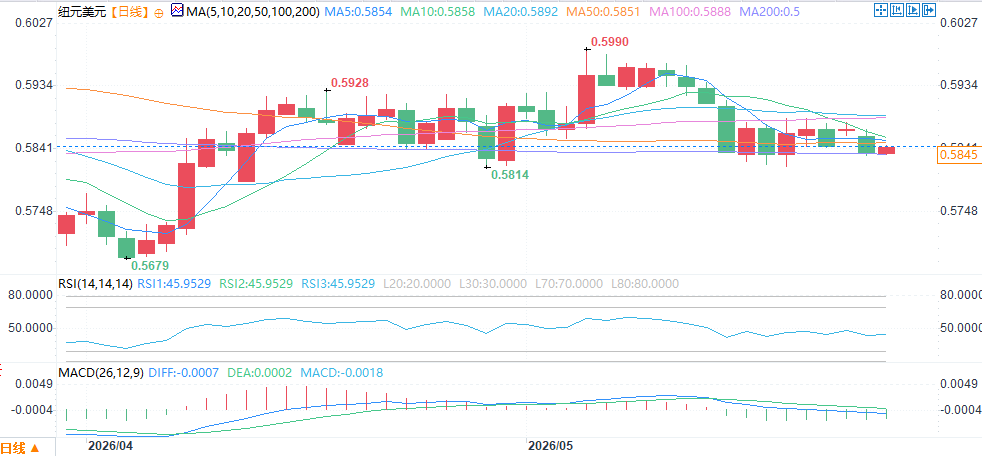
(NZD/USD daily chart, source: FX678)
Regarding the moving average system, the short-term moving averages MA5 (0.5853) and MA10 (0.5858) are above the current price, forming short-term resistance; MA20 (0.5892) and MA100 (0.5888) are also above the current price, indicating significant medium-term resistance; MA50 (0.5851) is also above the current price. This arrangement of "price below most major moving averages" suggests that the New Zealand dollar is under significant short-term pressure against the US dollar and is in a weak consolidation pattern.
Regarding the RSI indicator, the RSI is slightly below the 50 neutral threshold, indicating that bearish forces have a slight advantage, but it is not significant. This reading is in the neutral zone, suggesting that the market still has room for further two-way fluctuations and has not yet entered an oversold state.
In conclusion, the Reserve Bank of New Zealand (RBNZ) is highly likely to keep interest rates unchanged at this meeting, but the market's focus will be on the revision of the OCR forecast and the governor's wording. If the central bank lowers the OCR forecast or avoids tightening guidance, the New Zealand dollar may come under downward pressure; if there is an unexpected rate hike or an upward revision of the OCR forecast, the New Zealand dollar is expected to be boosted.
At 09:09 Beijing time on May 27, the New Zealand dollar was trading at 0.5844/45 against the US dollar.
The market is holding its breath awaiting the Reserve Bank of New Zealand's interest rate decision – although the market has already fully priced in the unchanged rate, the central bank's forward guidance on the future path of interest rate hikes is the real "main event".
The Reserve Bank of New Zealand is expected to keep the official cash rate (OCR) unchanged at 2.25% for the third consecutive time on Wednesday, as the impact of the war with Iran continues to weigh on economic growth and exacerbate inflationary pressures.
The interest rate decision will be announced at 10:00 Beijing time, along with the monetary policy assessment, monetary policy statement, and meeting minutes.
A press conference following the meeting will be held by Reserve Bank of New Zealand Governor Dr. Anna Brehman. The New Zealand dollar has been trading in a wide range against the US dollar since mid-April, and it may react strongly to the risks associated with this meeting.
Market expectations: at least two interest rate hikes this year, highly dependent on energy market dynamics.
An ING FX strategist said, "Our current forecast is a 50 basis point tightening in 2026, but this is highly dependent on energy market dynamics. Swap market pricing indicates a 21 basis point tightening in July and a 75 basis point tightening by the end of the year."
However, with inflation expectations returning to the Reserve Bank of New Zealand's (RBNZ) target range of 2%-3% and the economic output gap remaining negative, it remains to be seen whether the RBNZ will dampen recent expectations of interest rate hikes or raise rates unexpectedly as a precautionary measure to address the prospect of high inflation.
Chairman Brehman stated that the door to interest rate hikes is open, but he has not yet seen inflation expectations solidify.
The discussions at the April meeting of the Monetary Policy Committee were far more intense than the public statements suggested.
According to the minutes of the Reserve Bank of New Zealand's meeting released on April 8, the committee had engaged in in-depth debate on whether to take preemptive measures to prevent runaway inflation expectations. Some members favored early action to prevent the energy shock triggered by the Middle East conflict from escalating into broader inflationary pressures; others emphasized that, given the already sluggish economic growth and the unemployment rate climbing to 5.4%, more data was needed to determine whether weak demand could effectively offset the risk of a second round of inflation.
At the press conference following the meeting, Brehman acknowledged that "we discussed raising interest rates at today's meeting," a statement that itself exceeded market expectations. However, she also emphasized that the committee "has not yet seen price increases entrenched in inflation expectations," and therefore chose to "temporarily tolerate" the impending energy shock.
However, she left the door open to interest rate hikes, stating explicitly that "tightening may occur at every or every other meeting, depending on the circumstances." This wording was interpreted by the market as meaning that the question was not "whether" to raise rates, but "when."
If the central bank does not raise interest rates unexpectedly this time, the OCR forecast will be a key focus. In its February monetary policy statement, the Reserve Bank of New Zealand projected an OCR of 2.26% in June 2026 and 2.4% by the end of the year. However, since then, the situation in the Middle East has completely altered the inflation path.
The Reserve Bank of New Zealand's April forecast indicated that inflation could surge to 4.2% in the second quarter, well above the 1%-3% target range. The committee explicitly stated that it would "decisively and promptly" raise the Open Rate of Return (OCR) if medium-term inflation expectations ease or there are clear signs of a second round of effects.
A recent Westpac survey shows that as many as 83% of institutional clients expect 2-3 interest rate hikes before the end of the year, with OCR's target range pointing to 2.75%-3.00%. This means that even if interest rates remain unchanged this time, the significant upward revision of OCR's forecast could be seen as a sign of "hawkish inaction," thus providing support for the New Zealand dollar.
New Zealand Dollar/US Dollar Daily Technical Analysis
From the daily chart, the New Zealand dollar is currently trading around 0.5840 against the US dollar, in a consolidation phase at recent lows, with multiple technical indicators showing neutral to weak signals.
(NZD/USD daily chart, source: FX678)
Regarding the moving average system, the short-term moving averages MA5 (0.5853) and MA10 (0.5858) are above the current price, forming short-term resistance; MA20 (0.5892) and MA100 (0.5888) are also above the current price, indicating significant medium-term resistance; MA50 (0.5851) is also above the current price. This arrangement of "price below most major moving averages" suggests that the New Zealand dollar is under significant short-term pressure against the US dollar and is in a weak consolidation pattern.
Regarding the RSI indicator, the RSI is slightly below the 50 neutral threshold, indicating that bearish forces have a slight advantage, but it is not significant. This reading is in the neutral zone, suggesting that the market still has room for further two-way fluctuations and has not yet entered an oversold state.
The Reserve Bank of New Zealand is expected to hold rates steady, but forward guidance will determine the direction of the New Zealand dollar.
In conclusion, the Reserve Bank of New Zealand (RBNZ) is highly likely to keep interest rates unchanged at this meeting, but the market's focus will be on the revision of the OCR forecast and the governor's wording. If the central bank lowers the OCR forecast or avoids tightening guidance, the New Zealand dollar may come under downward pressure; if there is an unexpected rate hike or an upward revision of the OCR forecast, the New Zealand dollar is expected to be boosted.
At 09:09 Beijing time on May 27, the New Zealand dollar was trading at 0.5844/45 against the US dollar.
- Risk Warning and Disclaimer
- The market involves risk, and trading may not be suitable for all investors. This article is for reference only and does not constitute personal investment advice, nor does it take into account certain users’ specific investment objectives, financial situation, or other needs. Any investment decisions made based on this information are at your own risk.