Escalating tensions in the Middle East are increasing demand for the US dollar as a safe haven, while hawkish expectations from the Federal Reserve are keeping gold prices hovering around the $4,500 mark.
2026-05-27 13:43:55
Spot gold remained weak and volatile during Asian trading hours on Wednesday, fluctuating around the $4,500 mark. Continued tensions in the Middle East fueled demand for the safe-haven dollar, while rising international oil prices intensified global inflation concerns. Market expectations that major central banks may maintain high interest rates for an extended period limited the upside potential for gold. Investors are awaiting US PCE inflation data and the latest statements from Federal Reserve officials.

Meanwhile, Iran's Revolutionary Guard stated that it reserves the right to carry out "legitimate and explicit" retaliation against the United States for violating the ceasefire. Iran's Supreme Leader Mojtaba Khamenei further stated that regional countries will no longer be "protected areas" for US military bases. These statements have clearly exacerbated market concerns about a further deterioration of the situation in the Middle East and fueled continued demand for the US dollar as a safe haven.
The Strait of Hormuz handles approximately 20% of global seaborne crude oil transport. Uncertainty surrounding shipping security in the region has fueled market concerns about potential disruptions to global energy supplies, keeping international oil prices high. Furthermore, the US blockade of Iranian ports has further reinforced market expectations of tight crude oil supplies. Rising international oil prices have reignited concerns about a possible resurgence of "energy-driven inflation."
The current market logic is shifting. While geopolitical risks have historically favored gold, the market is now more focused on the possibility that high oil prices could lead to major central banks maintaining high interest rates. The market anticipates a near 50% probability of a Federal Reserve rate hike before December. Meanwhile, the Reserve Bank of Australia raised rates in May, and the European Central Bank, the Bank of Japan, and the Reserve Bank of New Zealand are also expected to further tighten policies this year.
Since gold itself does not generate interest income, a high-interest-rate environment typically diminishes its appeal. Meanwhile, the continued high yields on US Treasury bonds and the US dollar index further limit the upside potential for gold. The market is currently awaiting further speeches from Federal Reserve officials to determine future policy direction. Given the lack of significant US economic data releases on Wednesday, the dollar's short-term performance will be more influenced by statements from Federal Reserve officials and developments in the Middle East.
However, the market's real focus remains on the US Personal Consumption Expenditures (PCE) price index and the revised US GDP data to be released on Thursday. The PCE data is one of the core inflation indicators most closely watched by the Federal Reserve. If the data shows that US inflation remains stubbornly high, market expectations for the Fed to maintain high interest rates may further intensify, thus continuing to put downward pressure on gold. Conversely, if the inflation data shows a significant cooling, it may alleviate upward pressure on the dollar and help gold stabilize in the short term.
From a technical perspective, the 4-hour chart for gold maintains an overall weak structure. After encountering resistance near $4580, short-term downward pressure has increased significantly. Currently, the $4580 area coincides with the 100-period exponential moving average and has become a key technical resistance level. The MACD indicator continues to run below the zero line, indicating that bearish momentum still dominates. Meanwhile, the RSI indicator remains around 41, below the neutral zone, suggesting that short-term market sentiment remains bearish.
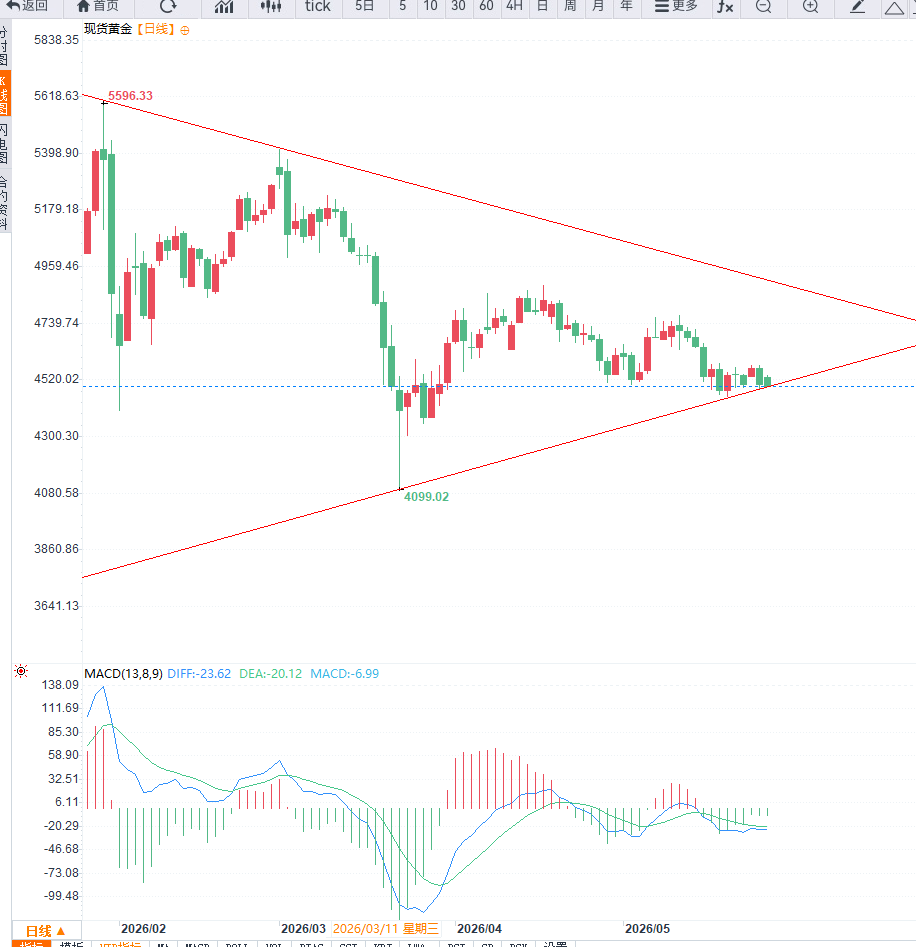
If gold prices break below the monthly low support level of $4,450, it could open up further downside potential. This means that gold still faces the risk of further correction. Looking at the daily chart, while the medium-to-long-term trend for gold remains high, the short-term trend has clearly entered a correction phase. The MACD red histogram continues to narrow, and the RSI indicator has also clearly retreated from the overbought zone, reflecting increasing profit-taking pressure in the market. Key resistance levels to watch are the $4,580 and $4,620 areas; important support levels are around $4,450 and $4,380.
The 4-hour chart shows that the short-term downtrend in gold remains largely unchanged. Prices continue to trade below short-term moving averages, and the MACD remains in negative territory, indicating a continued bearish bias in the short term. If the US dollar continues to be driven by safe-haven demand and high interest rate expectations, gold may further test the $4450 support level; however, if US PCE data cools down or there are signs of easing tensions in the Middle East, gold prices may experience a technical rebound.
The market is currently focused on US PCE data, speeches by Federal Reserve officials, and developments in the Middle East. The market is also closely monitoring international oil price trends, as changes in energy prices will directly impact future global inflation expectations and the policy paths of major central banks.
Editor's Summary : The current gold market is in a complex tug-of-war between "safe-haven demand" and "high interest rate pressure." While the escalating situation in the Middle East continues to provide some safe-haven support for gold, inflation concerns stemming from rising international oil prices are reinforcing market expectations that major central banks worldwide will maintain high interest rate policies. From an overall market perspective, the safe-haven demand for the US dollar and rising US Treasury yields have become the core factors currently suppressing gold. Meanwhile, technical indicators suggest that the short-term correction in gold is not yet over, and market sentiment remains cautious. Future gold price movements will largely depend on US inflation data, the Federal Reserve's policy direction, and developments in the Middle East. In the short term, gold may continue to maintain a highly volatile and volatile pattern, with the support level around $4450 becoming a key area to watch.
Meanwhile, Iran's Revolutionary Guard stated that it reserves the right to carry out "legitimate and explicit" retaliation against the United States for violating the ceasefire. Iran's Supreme Leader Mojtaba Khamenei further stated that regional countries will no longer be "protected areas" for US military bases. These statements have clearly exacerbated market concerns about a further deterioration of the situation in the Middle East and fueled continued demand for the US dollar as a safe haven.
The Strait of Hormuz handles approximately 20% of global seaborne crude oil transport. Uncertainty surrounding shipping security in the region has fueled market concerns about potential disruptions to global energy supplies, keeping international oil prices high. Furthermore, the US blockade of Iranian ports has further reinforced market expectations of tight crude oil supplies. Rising international oil prices have reignited concerns about a possible resurgence of "energy-driven inflation."
The current market logic is shifting. While geopolitical risks have historically favored gold, the market is now more focused on the possibility that high oil prices could lead to major central banks maintaining high interest rates. The market anticipates a near 50% probability of a Federal Reserve rate hike before December. Meanwhile, the Reserve Bank of Australia raised rates in May, and the European Central Bank, the Bank of Japan, and the Reserve Bank of New Zealand are also expected to further tighten policies this year.
Since gold itself does not generate interest income, a high-interest-rate environment typically diminishes its appeal. Meanwhile, the continued high yields on US Treasury bonds and the US dollar index further limit the upside potential for gold. The market is currently awaiting further speeches from Federal Reserve officials to determine future policy direction. Given the lack of significant US economic data releases on Wednesday, the dollar's short-term performance will be more influenced by statements from Federal Reserve officials and developments in the Middle East.
However, the market's real focus remains on the US Personal Consumption Expenditures (PCE) price index and the revised US GDP data to be released on Thursday. The PCE data is one of the core inflation indicators most closely watched by the Federal Reserve. If the data shows that US inflation remains stubbornly high, market expectations for the Fed to maintain high interest rates may further intensify, thus continuing to put downward pressure on gold. Conversely, if the inflation data shows a significant cooling, it may alleviate upward pressure on the dollar and help gold stabilize in the short term.
From a technical perspective, the 4-hour chart for gold maintains an overall weak structure. After encountering resistance near $4580, short-term downward pressure has increased significantly. Currently, the $4580 area coincides with the 100-period exponential moving average and has become a key technical resistance level. The MACD indicator continues to run below the zero line, indicating that bearish momentum still dominates. Meanwhile, the RSI indicator remains around 41, below the neutral zone, suggesting that short-term market sentiment remains bearish.
If gold prices break below the monthly low support level of $4,450, it could open up further downside potential. This means that gold still faces the risk of further correction. Looking at the daily chart, while the medium-to-long-term trend for gold remains high, the short-term trend has clearly entered a correction phase. The MACD red histogram continues to narrow, and the RSI indicator has also clearly retreated from the overbought zone, reflecting increasing profit-taking pressure in the market. Key resistance levels to watch are the $4,580 and $4,620 areas; important support levels are around $4,450 and $4,380.
The 4-hour chart shows that the short-term downtrend in gold remains largely unchanged. Prices continue to trade below short-term moving averages, and the MACD remains in negative territory, indicating a continued bearish bias in the short term. If the US dollar continues to be driven by safe-haven demand and high interest rate expectations, gold may further test the $4450 support level; however, if US PCE data cools down or there are signs of easing tensions in the Middle East, gold prices may experience a technical rebound.
The market is currently focused on US PCE data, speeches by Federal Reserve officials, and developments in the Middle East. The market is also closely monitoring international oil price trends, as changes in energy prices will directly impact future global inflation expectations and the policy paths of major central banks.
Editor's Summary : The current gold market is in a complex tug-of-war between "safe-haven demand" and "high interest rate pressure." While the escalating situation in the Middle East continues to provide some safe-haven support for gold, inflation concerns stemming from rising international oil prices are reinforcing market expectations that major central banks worldwide will maintain high interest rate policies. From an overall market perspective, the safe-haven demand for the US dollar and rising US Treasury yields have become the core factors currently suppressing gold. Meanwhile, technical indicators suggest that the short-term correction in gold is not yet over, and market sentiment remains cautious. Future gold price movements will largely depend on US inflation data, the Federal Reserve's policy direction, and developments in the Middle East. In the short term, gold may continue to maintain a highly volatile and volatile pattern, with the support level around $4450 becoming a key area to watch.
- Risk Warning and Disclaimer
- The market involves risk, and trading may not be suitable for all investors. This article is for reference only and does not constitute personal investment advice, nor does it take into account certain users’ specific investment objectives, financial situation, or other needs. Any investment decisions made based on this information are at your own risk.