Indian gold demand is expected to drop by 10%! Will this further worsen global gold prices?
2026-05-27 14:34:36
Following the Indian government's increase in import tariffs on gold, domestic gold prices rose somewhat, but the increase was less than expected. Given weak demand and ample supply, domestic gold prices have not yet fully reflected the impact of the tariff hike.
Indian gold demand is expected to be hit this year by increased import tariffs. The Indian gold market has seen an unusual disconnect following the government's move to raise import tariffs on precious metals. While the tariff increase did push up prices, the increase was less than expected – because the substantial tariff increase takes time to be transmitted and coincided with already weakening demand.
In a recent report, Kavita Chakow, head of India research at the World Gold Council, wrote that since the measure was implemented, gold prices in India have risen by 4%-6%, significantly lower than the 9% increase in import taxes. “Physical market prices do not fully or immediately reflect tariff increases—they tend to lag behind, especially with such a large change as 9%,” she stated.
Data shows that this lag means that the price of gold in India is currently trading at a discount of nearly $150 per ounce relative to the official landed price, far higher than the average of about $14 per ounce before the tariff increase. Tariff increases in 2019 and 2022 also led to discounts in the domestic market, but this phenomenon is more pronounced due to the larger magnitude of the current tariff increase.
Furthermore, this tariff increase coincides with the seasonal off-season for gold purchases in India – the peak wedding season has passed, and mid-May to mid-June is traditionally a low season for gold demand.
“Market feedback indicates that there is an ample supply of gold jewelry for trade-ins, and there may be pre-loading of imports, which further limits price increases,” Chaco said.
Historically, higher import tariffs in India have often distorted local gold pricing dynamics and fueled smuggling. A World Gold Council report notes that tariff increases between 2013 and 2026 have largely been accompanied by increases in unofficial or smuggled gold. “Higher import tariffs widen the price gap between domestic and international markets, increasing the incentive for smuggling, while lower tariffs reduce its attractiveness,” the report states.
The World Gold Council predicts that Indian gold demand will decline in 2026 due to increased import tariffs. Combined demand for jewelry, gold bars, and coins may decrease by 50 to 60 tons this year, a drop of about 10% from 2025 levels, as rising import costs dampen investment demand and purchasing intentions. Given that India (alongside China) is the world's largest gold consumer, a 10% decline in demand could put downward pressure on gold prices.
This negative signal from the fundamental demand side echoes the current weak technical pattern—both pointing to the current short-term pressure on gold.
From the daily chart, spot gold is currently trading below $4,500, in a weak consolidation phase after a recent pullback from highs, with multiple technical indicators showing bearish signals.
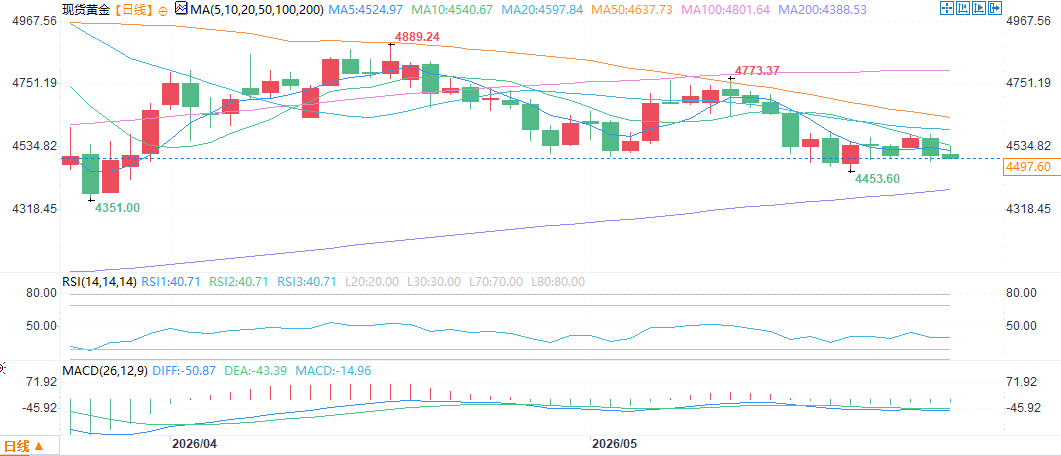
(Spot gold daily chart, source: FX678)
Regarding the MACD indicator, the DIFF line is at -50.87, and the DEA line is at -43.39. The DIFF has crossed below the DEA, forming a death cross, and the gap between the two lines is widening. The MACD histogram value is -14.96, which is negative and expanding, indicating that the bearish momentum is accelerating.
Regarding the RSI indicator, it is currently in the 40-45 range, below the 50 neutral dividing line, indicating that the bears have the upper hand. It is still some distance from the oversold area of 30, which means that the price still has room to fall further.
Key support and resistance: Initial support is seen in the $4480-$4450 area; a break below this level would test the 200-day moving average around $4388-$4400. Resistance is located at the 5-day moving average (MA5) ($4524.82) and the 10-day moving average (MA10) ($4540.59); a break above these levels would target the 20-day moving average (MA20) ($4597.80).
In summary, the Indian gold market is experiencing a rare discount – the increase in domestic gold prices after the tariff hike was far less than expected, due to weak demand, ample supply, and the lag in the tariff's impact. Seasonal off-season demand, increased supply from trade-ins, and potential smuggling activities further suppressed price increases. The World Gold Council predicts that Indian gold demand will decline by approximately 10% in 2026, which, as one of the world's largest gold consumers, could put downward pressure on global gold prices.
At 14:33 Beijing time on May 27, spot gold was trading at $4484.22 per ounce.
Indian gold demand is expected to be hit this year by increased import tariffs. The Indian gold market has seen an unusual disconnect following the government's move to raise import tariffs on precious metals. While the tariff increase did push up prices, the increase was less than expected – because the substantial tariff increase takes time to be transmitted and coincided with already weakening demand.
Prices and Demand: Domestic gold prices in India rose by only 4%-6%, far below the 9% tariff increase.
In a recent report, Kavita Chakow, head of India research at the World Gold Council, wrote that since the measure was implemented, gold prices in India have risen by 4%-6%, significantly lower than the 9% increase in import taxes. “Physical market prices do not fully or immediately reflect tariff increases—they tend to lag behind, especially with such a large change as 9%,” she stated.
Data shows that this lag means that the price of gold in India is currently trading at a discount of nearly $150 per ounce relative to the official landed price, far higher than the average of about $14 per ounce before the tariff increase. Tariff increases in 2019 and 2022 also led to discounts in the domestic market, but this phenomenon is more pronounced due to the larger magnitude of the current tariff increase.
Seasonal factors: It coincides with the off-season for demand, and trade-in programs and early imports increase supply.
Furthermore, this tariff increase coincides with the seasonal off-season for gold purchases in India – the peak wedding season has passed, and mid-May to mid-June is traditionally a low season for gold demand.
“Market feedback indicates that there is an ample supply of gold jewelry for trade-ins, and there may be pre-loading of imports, which further limits price increases,” Chaco said.
Historical Impact and Future Outlook: High tariffs stimulate smuggling; demand is expected to decline by 10% this year.
Historically, higher import tariffs in India have often distorted local gold pricing dynamics and fueled smuggling. A World Gold Council report notes that tariff increases between 2013 and 2026 have largely been accompanied by increases in unofficial or smuggled gold. “Higher import tariffs widen the price gap between domestic and international markets, increasing the incentive for smuggling, while lower tariffs reduce its attractiveness,” the report states.
The World Gold Council predicts that Indian gold demand will decline in 2026 due to increased import tariffs. Combined demand for jewelry, gold bars, and coins may decrease by 50 to 60 tons this year, a drop of about 10% from 2025 levels, as rising import costs dampen investment demand and purchasing intentions. Given that India (alongside China) is the world's largest gold consumer, a 10% decline in demand could put downward pressure on gold prices.
Spot Gold Daily Technical Analysis
This negative signal from the fundamental demand side echoes the current weak technical pattern—both pointing to the current short-term pressure on gold.
From the daily chart, spot gold is currently trading below $4,500, in a weak consolidation phase after a recent pullback from highs, with multiple technical indicators showing bearish signals.
(Spot gold daily chart, source: FX678)
Regarding the MACD indicator, the DIFF line is at -50.87, and the DEA line is at -43.39. The DIFF has crossed below the DEA, forming a death cross, and the gap between the two lines is widening. The MACD histogram value is -14.96, which is negative and expanding, indicating that the bearish momentum is accelerating.
Regarding the RSI indicator, it is currently in the 40-45 range, below the 50 neutral dividing line, indicating that the bears have the upper hand. It is still some distance from the oversold area of 30, which means that the price still has room to fall further.
Key support and resistance: Initial support is seen in the $4480-$4450 area; a break below this level would test the 200-day moving average around $4388-$4400. Resistance is located at the 5-day moving average (MA5) ($4524.82) and the 10-day moving average (MA10) ($4540.59); a break above these levels would target the 20-day moving average (MA20) ($4597.80).
The discount on gold in India highlights weak demand, posing potential headwinds for global gold prices.
In summary, the Indian gold market is experiencing a rare discount – the increase in domestic gold prices after the tariff hike was far less than expected, due to weak demand, ample supply, and the lag in the tariff's impact. Seasonal off-season demand, increased supply from trade-ins, and potential smuggling activities further suppressed price increases. The World Gold Council predicts that Indian gold demand will decline by approximately 10% in 2026, which, as one of the world's largest gold consumers, could put downward pressure on global gold prices.
At 14:33 Beijing time on May 27, spot gold was trading at $4484.22 per ounce.
- Risk Warning and Disclaimer
- The market involves risk, and trading may not be suitable for all investors. This article is for reference only and does not constitute personal investment advice, nor does it take into account certain users’ specific investment objectives, financial situation, or other needs. Any investment decisions made based on this information are at your own risk.