The euro has rebounded against the pound as expectations of a hawkish rate hike from the European Central Bank have risen, coupled with renewed bets on a rate cut in the UK.
2026-05-27 14:59:45
The euro rose slightly against the pound (EUR/GBP) in early European trading on Wednesday, reaching around 0.8650. Current market movements are primarily driven by both rising expectations of a hawkish stance from the European Central Bank (ECB) and weakening UK economic data. The ECB's recent hawkish signals have further strengthened market expectations for future interest rate hikes. ECB official François Villeroy de Gallo stated on Tuesday that the ECB "will take all necessary measures" to ensure inflation returns to its target level.

Meanwhile, European Central Bank (ECB) Executive Board member Isabel Schnabel explicitly supported a further interest rate hike by the ECB in June. She pointed out that even if the US and Iran ultimately reach an agreement, the Middle East situation has already lasted far longer than previously expected, and high energy prices are gradually spreading to a wider economic sector. The market has already fully priced in two more ECB rate hikes. Furthermore, the market even expects a near 50% probability of further ECB rate hikes within the next year.
Current market concerns suggest that high international energy prices could reignite inflationary pressures in the Eurozone. Particularly against the backdrop of ongoing tensions in the Strait of Hormuz, European energy costs face significant uncertainty. The Strait of Hormuz handles approximately 20% of global seaborne crude oil transport. Therefore, developments in the Middle East have a substantial impact on the European energy market and inflation expectations.
Some European Central Bank officials believe that if energy prices continue to rise, the Eurozone may face a more pronounced "second wave of inflation," forcing the ECB to maintain high interest rates for an extended period. In contrast, recent economic data from the UK has been relatively weak, putting pressure on the pound.
UK inflation data unexpectedly fell in April, while the unemployment rate rose to 5.0%, indicating that the UK's economic growth momentum is beginning to slow. As a result, the market lowered its expectations for further interest rate hikes by the Bank of England. Traders have now reduced their bets on the number of Bank of England rate hikes in 2026, and UK government bond yields have also fallen significantly.
Analysts believe the decline in UK government bond yields was mainly due to three factors: falling international oil prices, improved expectations of political stability in the UK, and reduced uncertainty surrounding UK fiscal policy. Cooling expectations for UK interest rates have diminished the pound's appeal. Meanwhile, the European Central Bank's continued hawkish stance has further boosted the euro against the pound.
However, the market remains cautious about the European economic outlook. Given the still weak overall economic growth in the Eurozone, the high-interest-rate environment may continue to put pressure on corporate financing and consumer demand. Investors are also currently watching the progress of negotiations between the US and Iran. If the situation in the Middle East eases significantly, international oil prices may fall, thereby alleviating inflationary pressures in Europe and potentially reducing the need for the European Central Bank to continue raising interest rates.
From the daily chart, the EUR/GBP pair maintains a generally bullish structure with some volatility. The exchange rate has recently held above both the 20-day and 50-day moving averages, indicating a gradually strengthening medium-term bullish trend. The MACD indicator has formed a golden cross again, with the red momentum bars continuing to expand, suggesting a recovery in bullish momentum. The RSI indicator remains around 58, indicating bullish market sentiment, but it has not yet entered overbought territory, meaning the exchange rate still has room for further upward movement. From a trend structure perspective, the area around 0.8670 has become the first key resistance zone on the daily chart, and this level is also close to the previous high. If it can be effectively broken, the exchange rate may further test the 0.8720 area. On the downside, 0.8610 has formed a support zone and is close to the 20-day moving average; a break below this level could lead to a retest of the important support around 0.8570.
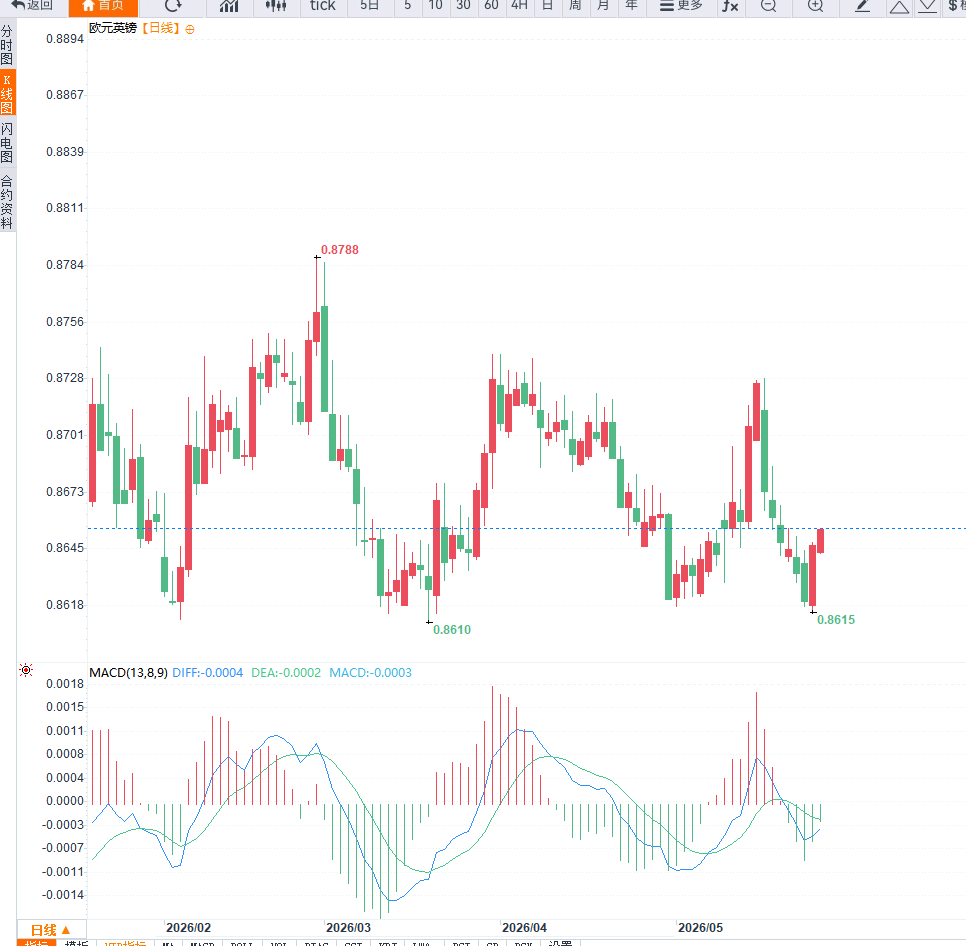
Overall, the daily trend for EUR/GBP remains bullish, but the 4-hour chart suggests a potential short-term consolidation phase at higher levels. If the ECB continues its hawkish stance while UK economic data remains weak, EUR/GBP could rise further; however, a significant drop in international oil prices and easing of European inflationary pressures could limit further upside for the euro.
Investors are currently focused on speeches by European Central Bank officials, UK economic data, and developments in the Middle East. The market is also closely monitoring changes in international energy prices, as these will directly influence the future policy paths of the European Central Bank and the Bank of England.
Editor's Summary : The current EUR/GBP market is primarily driven by both hawkish expectations from the European Central Bank (ECB) and weak UK economic data. Rising calls for an ECB rate hike strengthen the euro's interest rate advantage, while slowing UK inflation and employment data weaken market expectations for further tightening by the Bank of England. Technically, the EUR/GBP pair maintains a generally bullish trend on the daily chart, but it is approaching a short-term resistance level, potentially entering a consolidation phase at higher levels. Future market movements will largely depend on ECB policy changes, UK economic performance, and international energy price trends. In the short term, the 0.8670 resistance level and the 0.8610 support level will be key areas to watch.
Meanwhile, European Central Bank (ECB) Executive Board member Isabel Schnabel explicitly supported a further interest rate hike by the ECB in June. She pointed out that even if the US and Iran ultimately reach an agreement, the Middle East situation has already lasted far longer than previously expected, and high energy prices are gradually spreading to a wider economic sector. The market has already fully priced in two more ECB rate hikes. Furthermore, the market even expects a near 50% probability of further ECB rate hikes within the next year.
Current market concerns suggest that high international energy prices could reignite inflationary pressures in the Eurozone. Particularly against the backdrop of ongoing tensions in the Strait of Hormuz, European energy costs face significant uncertainty. The Strait of Hormuz handles approximately 20% of global seaborne crude oil transport. Therefore, developments in the Middle East have a substantial impact on the European energy market and inflation expectations.
Some European Central Bank officials believe that if energy prices continue to rise, the Eurozone may face a more pronounced "second wave of inflation," forcing the ECB to maintain high interest rates for an extended period. In contrast, recent economic data from the UK has been relatively weak, putting pressure on the pound.
UK inflation data unexpectedly fell in April, while the unemployment rate rose to 5.0%, indicating that the UK's economic growth momentum is beginning to slow. As a result, the market lowered its expectations for further interest rate hikes by the Bank of England. Traders have now reduced their bets on the number of Bank of England rate hikes in 2026, and UK government bond yields have also fallen significantly.
Analysts believe the decline in UK government bond yields was mainly due to three factors: falling international oil prices, improved expectations of political stability in the UK, and reduced uncertainty surrounding UK fiscal policy. Cooling expectations for UK interest rates have diminished the pound's appeal. Meanwhile, the European Central Bank's continued hawkish stance has further boosted the euro against the pound.
However, the market remains cautious about the European economic outlook. Given the still weak overall economic growth in the Eurozone, the high-interest-rate environment may continue to put pressure on corporate financing and consumer demand. Investors are also currently watching the progress of negotiations between the US and Iran. If the situation in the Middle East eases significantly, international oil prices may fall, thereby alleviating inflationary pressures in Europe and potentially reducing the need for the European Central Bank to continue raising interest rates.
From the daily chart, the EUR/GBP pair maintains a generally bullish structure with some volatility. The exchange rate has recently held above both the 20-day and 50-day moving averages, indicating a gradually strengthening medium-term bullish trend. The MACD indicator has formed a golden cross again, with the red momentum bars continuing to expand, suggesting a recovery in bullish momentum. The RSI indicator remains around 58, indicating bullish market sentiment, but it has not yet entered overbought territory, meaning the exchange rate still has room for further upward movement. From a trend structure perspective, the area around 0.8670 has become the first key resistance zone on the daily chart, and this level is also close to the previous high. If it can be effectively broken, the exchange rate may further test the 0.8720 area. On the downside, 0.8610 has formed a support zone and is close to the 20-day moving average; a break below this level could lead to a retest of the important support around 0.8570.
Overall, the daily trend for EUR/GBP remains bullish, but the 4-hour chart suggests a potential short-term consolidation phase at higher levels. If the ECB continues its hawkish stance while UK economic data remains weak, EUR/GBP could rise further; however, a significant drop in international oil prices and easing of European inflationary pressures could limit further upside for the euro.
Investors are currently focused on speeches by European Central Bank officials, UK economic data, and developments in the Middle East. The market is also closely monitoring changes in international energy prices, as these will directly influence the future policy paths of the European Central Bank and the Bank of England.
Editor's Summary : The current EUR/GBP market is primarily driven by both hawkish expectations from the European Central Bank (ECB) and weak UK economic data. Rising calls for an ECB rate hike strengthen the euro's interest rate advantage, while slowing UK inflation and employment data weaken market expectations for further tightening by the Bank of England. Technically, the EUR/GBP pair maintains a generally bullish trend on the daily chart, but it is approaching a short-term resistance level, potentially entering a consolidation phase at higher levels. Future market movements will largely depend on ECB policy changes, UK economic performance, and international energy price trends. In the short term, the 0.8670 resistance level and the 0.8610 support level will be key areas to watch.
- Risk Warning and Disclaimer
- The market involves risk, and trading may not be suitable for all investors. This article is for reference only and does not constitute personal investment advice, nor does it take into account certain users’ specific investment objectives, financial situation, or other needs. Any investment decisions made based on this information are at your own risk.