The escalating situation in the Middle East, coupled with rising expectations of a Federal Reserve interest rate hike, has caused the US dollar index to fluctuate around the 99 level.
2026-05-27 13:49:20
The US dollar index (DXY) remained high in early European trading on Wednesday, trading around 99.10. Despite a slight short-term pullback, the dollar was generally supported by safe-haven demand and expectations of higher interest rates from the Federal Reserve. Recent tensions in the Middle East have continued to fluctuate, and market concerns about an escalation of the conflict between the US and Iran have not eased significantly. Iranian officials stated that recent US attacks on targets near the Strait of Hormuz have violated the current ceasefire agreement, potentially further complicating already fragile diplomatic negotiations. The Strait of Hormuz handles approximately 20% of global seaborne oil transport. Therefore, the market is concerned that a deterioration in the region could affect global energy supply security and drive international oil prices higher.
The market is currently closely watching the progress of diplomatic negotiations between the United States and Iran. US President Donald Trump stated on Tuesday that the US and Iran are moving forward with negotiations to extend the ceasefire agreement and reopen shipping through the Strait of Hormuz. However, due to significant differences in wording regarding Iran's nuclear program and sanctions, the market remains cautious about whether a final agreement can be reached.
Amidst global risk aversion, demand for the US dollar as a safe haven continues to receive some financial support. Meanwhile, rising international oil prices have reignited market concerns about global inflation. The market now estimates a nearly 39% probability of a 25 basis point rate hike by the Federal Reserve this year. Rising international oil prices could push US inflation higher again, forcing the Fed to maintain high interest rates for an extended period.
The market has begun to reassess the Federal Reserve's future policy path. Investors are concerned that if energy prices continue to rise, US inflation may deviate from its target level again, which would limit the Fed's room for future interest rate cuts.
Meanwhile, the recent high yields on U.S. Treasury bonds continue to support the dollar's performance. Due to the higher returns on dollar assets, global funds continue to flow into the dollar market.
The market's focus has now shifted to the US April Personal Consumption Expenditures (PCE) price index data, due on Thursday. As the PCE is a core inflation indicator closely watched by the Federal Reserve, the data result could directly impact the dollar's next move. If the US PCE data is higher than market expectations, the dollar index may strengthen further. Conversely, if inflation shows a significant cooling, it could alleviate market concerns about further tightening by the Fed and put pressure on the dollar.
From a broader market perspective, the US dollar is currently supported by both safe-haven demand and high interest rate expectations. On the one hand, escalating tensions in the Middle East strengthen the dollar's safe-haven appeal; on the other hand, rising inflation concerns are also increasing market expectations that the Federal Reserve will maintain a hawkish policy. However, the market is also paying attention to the potential negative impact of continued rising international oil prices on US economic growth. If excessively high energy costs lead to an economic slowdown, the Fed's future policy space may be limited.
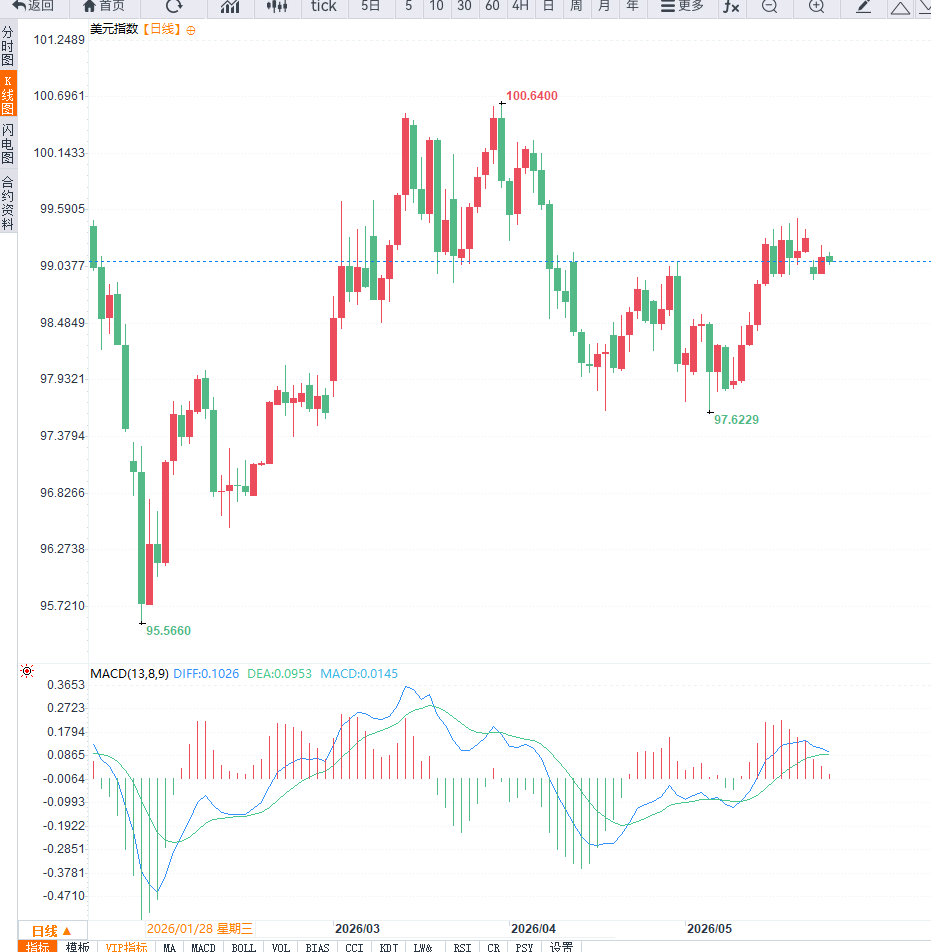
From a technical perspective, the US dollar index daily chart maintains an overall medium-term bullish structure, with prices continuing to trade above major moving averages. The MACD indicator remains in positive territory, but the red histogram bars have narrowed, indicating a slight slowdown in upward momentum. The RSI indicator remains around 58, suggesting that the market is still generally bullish, but there is a short-term need for consolidation at higher levels. Key resistance levels to watch are the 99.60 and 100.20 areas; a successful break above these levels could lead the dollar index to test its recent highs. Important support levels are located around 98.70 and 98.10.
The 4-hour chart shows the US dollar index maintaining a slightly bullish, oscillating pattern in the short term. Prices are hovering around short-term moving averages, and the MACD indicator is gradually approaching the zero line, indicating that the short-term market direction is currently unclear. Meanwhile, the RSI indicator remains above 50, reflecting that the dollar still has some buying support. If US PCE data continues to be strong, the dollar index may retest the 100 level; however, if the situation in the Middle East eases and inflation data cools, the dollar may experience a temporary pullback.
Investors are currently focused on US PCE data, speeches by Federal Reserve officials, and developments in the US-Iran situation. The market is also closely monitoring international oil price fluctuations, as energy price trends directly impact future US inflation expectations and the Federal Reserve's policy direction.
Editor's Summary : The current US dollar index market is driven by both "safe-haven demand from the Middle East" and "expectations of high interest rates from the Federal Reserve." Continued tensions in the Middle East strengthen the dollar's safe-haven appeal, while rising international oil prices further fuel market concerns about recurring US inflation. From an overall perspective, the dollar still has strong short-term support, especially given the unstable global risk sentiment and persistently high US Treasury yields. However, market concerns about a slowdown in US economic growth are gradually intensifying, which may limit the dollar's upside potential. Future market direction will largely depend on US PCE data, the Federal Reserve's policy path, and the evolution of the Middle East situation. In the short term, the dollar index is likely to continue fluctuating at high levels within the 99-100 range.
The market is currently closely watching the progress of diplomatic negotiations between the United States and Iran. US President Donald Trump stated on Tuesday that the US and Iran are moving forward with negotiations to extend the ceasefire agreement and reopen shipping through the Strait of Hormuz. However, due to significant differences in wording regarding Iran's nuclear program and sanctions, the market remains cautious about whether a final agreement can be reached.
Amidst global risk aversion, demand for the US dollar as a safe haven continues to receive some financial support. Meanwhile, rising international oil prices have reignited market concerns about global inflation. The market now estimates a nearly 39% probability of a 25 basis point rate hike by the Federal Reserve this year. Rising international oil prices could push US inflation higher again, forcing the Fed to maintain high interest rates for an extended period.
The market has begun to reassess the Federal Reserve's future policy path. Investors are concerned that if energy prices continue to rise, US inflation may deviate from its target level again, which would limit the Fed's room for future interest rate cuts.
Meanwhile, the recent high yields on U.S. Treasury bonds continue to support the dollar's performance. Due to the higher returns on dollar assets, global funds continue to flow into the dollar market.
The market's focus has now shifted to the US April Personal Consumption Expenditures (PCE) price index data, due on Thursday. As the PCE is a core inflation indicator closely watched by the Federal Reserve, the data result could directly impact the dollar's next move. If the US PCE data is higher than market expectations, the dollar index may strengthen further. Conversely, if inflation shows a significant cooling, it could alleviate market concerns about further tightening by the Fed and put pressure on the dollar.
From a broader market perspective, the US dollar is currently supported by both safe-haven demand and high interest rate expectations. On the one hand, escalating tensions in the Middle East strengthen the dollar's safe-haven appeal; on the other hand, rising inflation concerns are also increasing market expectations that the Federal Reserve will maintain a hawkish policy. However, the market is also paying attention to the potential negative impact of continued rising international oil prices on US economic growth. If excessively high energy costs lead to an economic slowdown, the Fed's future policy space may be limited.
From a technical perspective, the US dollar index daily chart maintains an overall medium-term bullish structure, with prices continuing to trade above major moving averages. The MACD indicator remains in positive territory, but the red histogram bars have narrowed, indicating a slight slowdown in upward momentum. The RSI indicator remains around 58, suggesting that the market is still generally bullish, but there is a short-term need for consolidation at higher levels. Key resistance levels to watch are the 99.60 and 100.20 areas; a successful break above these levels could lead the dollar index to test its recent highs. Important support levels are located around 98.70 and 98.10.
The 4-hour chart shows the US dollar index maintaining a slightly bullish, oscillating pattern in the short term. Prices are hovering around short-term moving averages, and the MACD indicator is gradually approaching the zero line, indicating that the short-term market direction is currently unclear. Meanwhile, the RSI indicator remains above 50, reflecting that the dollar still has some buying support. If US PCE data continues to be strong, the dollar index may retest the 100 level; however, if the situation in the Middle East eases and inflation data cools, the dollar may experience a temporary pullback.
Investors are currently focused on US PCE data, speeches by Federal Reserve officials, and developments in the US-Iran situation. The market is also closely monitoring international oil price fluctuations, as energy price trends directly impact future US inflation expectations and the Federal Reserve's policy direction.
Editor's Summary : The current US dollar index market is driven by both "safe-haven demand from the Middle East" and "expectations of high interest rates from the Federal Reserve." Continued tensions in the Middle East strengthen the dollar's safe-haven appeal, while rising international oil prices further fuel market concerns about recurring US inflation. From an overall perspective, the dollar still has strong short-term support, especially given the unstable global risk sentiment and persistently high US Treasury yields. However, market concerns about a slowdown in US economic growth are gradually intensifying, which may limit the dollar's upside potential. Future market direction will largely depend on US PCE data, the Federal Reserve's policy path, and the evolution of the Middle East situation. In the short term, the dollar index is likely to continue fluctuating at high levels within the 99-100 range.
- Risk Warning and Disclaimer
- The market involves risk, and trading may not be suitable for all investors. This article is for reference only and does not constitute personal investment advice, nor does it take into account certain users’ specific investment objectives, financial situation, or other needs. Any investment decisions made based on this information are at your own risk.